
What we'll cover
Share with your community!


Get Free Consultation
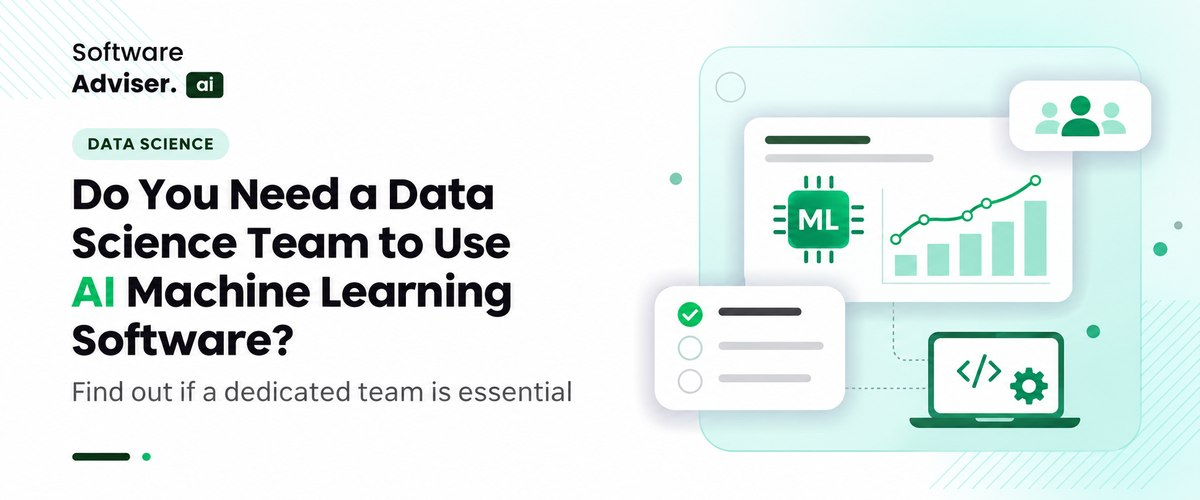
Do You Need a Data Science Team to Use AI Machine Learning Software?
 Dokas mile
A vendor demo ends, the pricing slide comes up, and someone asks the question that quietly decides the budget: who is going to run this? If the honest answer is "we do not have a data scientist," it is easy to assume the purchase is off the table. Sometimes that assumption is right. Often it is not.
 Looking for AI Machine Learning Software? Check out Softwareadviser.ai List of the Best AI Machine Learning Software in USA for Your Business.
The short answer is no. Most businesses don't need a data science team to use ready-made AI machine learning software, provided the use case is common. You do need real expertise once you start building custom models, automating high-stakes decisions, or running models inside production systems.
What Is the Difference Between Data Science and Using Machine Learning Software?
Data science is the practice of collecting, cleaning, and analyzing data to answer a question or predict an outcome. Machine learning is one set of methods inside data science, where a model learns patterns from past data instead of following rules someone wrote by hand. AI machine learning packages part of that work into a product you can log into.
That packaging is the whole point. A data scientist picks the data, builds the inputs, trains and tests the model, and decides whether it is good enough to trust. Software can take over some of that list. A lead score in a CRM, an attrition forecast in an AI HR tool, and a demand prediction in an inventory system all run on machine learning, yet the person using them never touches the model.
So the real question is not whether data science is involved. It is whether someone at your company has to do the data science work, or whether the vendor already did it.
Which Machine Learning Tasks Can You Run Without a Data Scientist?
It helps to think in three tiers, from least to most effort.
- Ready-made features: Many business tools ship with machine learning built in. Scoring leads inside AI CRM software, forecasting headcount with AI HR analytics software, or identifying items in photos through AI image recognition software all fall here. You switch the feature on, review what it produces, and judge it with your own business knowledge. Nobody needs to understand the model, though someone should ask what it was trained on.
- Pre-trained models: Some models are trained on large public datasets and can be used directly for jobs such as sentiment analysis or sorting text and images into categories. They can also be adapted to your own data through transfer learning, which needs far less data than training from scratch. A retailer sorting product photos with an off-the-shelf model inside AI image recognition software is a typical case.
- No-code and AutoML platforms: These use visual, drag-and-drop screens to prepare data, choose a model, train it, and produce predictions, so an analyst can forecast things like customer churn or delivery times without writing code. AWS offers one example in Amazon SageMaker Canvas.
- All three tiers share a condition: the problem must be common enough that a general model fits it. A sales team working inside AI CRM software gets good value from a standard scoring model because most sales pipelines behave in similar ways. Once you need something specific to your operation, the picture changes.
How Much Does a Data Science Team Cost in the US?
Hiring is where this decision usually becomes real. That figure covers one person, before benefits, recruiting fees, cloud bills, or tooling.
A working team often needs more than one role. Someone has to move and clean the data, someone has to deploy the models, and someone has to keep them running. One engineering-focused article on Towards Data Science makes the point that few data scientists are equally strong at modeling and software development, which is why a single hire tends to turn into several.
For a small or mid-sized company, a full team is a heavy commitment for a project that may only need one prediction feature. That is why many firms begin with software and bring in outside help only for the pieces that truly need it.
Do You Know?
The Bureau of Labor Statistics projects employment of data scientists to grow by about 35 percent between 2025 and 2035, much faster than the average for all occupations. Strong demand is one reason many smaller companies start with ready-made software before building a team. Is the data correct
When Do You Actually Need a Data Scientist?
Software does not remove the need for expertise in every case. These are the situations where skipping a specialist tends to cause trouble.
- You are building a custom model: If your prediction depends on data nobody else has, such as your own sensor readings, claims history, or production logs, a general product rarely fits well. Someone has to design the model and test it.
- The decision carries real consequences: Credit decisions, hiring screens, pricing, and anything touching health or safety call for a person who can check for bias, explain a result, and defend it to a customer or regulator. Even AI HR analytics software that flags flight risks or ranks applicants needs a human reviewer who understands what the numbers can and cannot say.
- You have very little data: Small datasets invite overfitting, where a model matches its training data closely but fails on new cases. Simple models and careful validation matter more here, and that judgment comes from experience.
- The model will run in production: Moving a model into a live system takes software engineering, infrastructure, and monitoring. Accuracy also drifts as customer behavior changes, so someone has to notice when results go stale.
If data science is critical to how your company wins, build that capability in-house. If it is not, outsourcing makes more sense. And if you are not prepared to act on what the data tells you, hiring data scientists will not fix that.
Can Non-Technical Teams Use AutoML and No-Code Machine Learning?
Yes, within limits. No-code and AutoML tools are built for analysts, marketers, and operations staff, and they take care of repetitive steps such as data preparation, model selection, and training. The trade-off is control. People who want to adjust every modeling choice often find these platforms restrictive compared with code-first environments.
These tools work best when the person using them understands the business question and can read results with a skeptical eye. A marketing analyst who knows what a realistic churn rate looks like will catch a strange prediction faster than any score will. The software automates the modeling steps. It cannot supply the judgment about whether the answer makes sense.
Is Your Data Ready? Data Fabric, Data Quality and Data Recovery
Many machine learning projects stall on data long before they reach a model. If customer records sit in a CRM, invoices in accounting software and support tickets in a help desk, the first job is getting them to line up.
A data fabric is one way to do that. It is an architecture that connects data across systems through catalogs, integration, governance, and self-service access, and SAP notes that it can provide access without physically moving everything into one place. It is not something you buy in a box. Qlik points out that no single tool fully establishes a data fabric, so most companies combine several. A smaller team may not need that much. Picking one system of record, agreeing on a definition, and cleaning it up can go a long way. Larger companies with data spread across clouds can look at data fabric software to see what is available.
Protection matters as much as access. Your training data, labeled examples, and trained models represent real work. Keep versioned backups, test that you can restore them, and decide who owns the process. If a dataset is corrupted or deleted, sound data recovery habits can save weeks of rework, and AI data recovery software can help when something goes wrong.
The same applies to the systems underneath, so check how your AI database management software handles backups and access control. Clean, well-organized tables in your AI database management software will do more for model accuracy than any amount of tuning later.
Where Do AI Agent Platforms Fit In?
AI agent platforms often come up in the same conversation, so it is worth separating them from machine learning software. A machine learning platform is mostly about building and running predictive models. An AI agent platform deploys software agents that take actions, such as answering customer questions, qualifying leads, or routing tickets.
Salesforce describes the parts of an agent platform as an agent builder, a reasoning engine, actions, and governance controls, and many are set up through low-code or plain-language screens. That makes them reachable for non-technical teams. The catch is that you are configuring behavior and permissions rather than training a model on your own data, so the skills involved are different: process knowledge, careful testing, and clear rules about when a human steps in.
If your goal is to take repetitive work off people's plates rather than predict outcomes, an AI agent platform or AI workflow automation software may be a closer match than a machine learning tool. Routing invoices for approval is a good example: it follows rules and needs reliable steps, not a trained model, so AI workflow automation software handles it without any data science involved.
Pro-tip
Before you buy, ask the vendor three questions: what data was the model trained on, how is accuracy measured for customers like you, and what happens when results drift. A vendor that answers plainly is doing the data science work on your behalf. A vendor that dodges is handing that work back to you.
A Practical Way to Decide Before You Buy
Four questions will get you most of the way. Is your problem common, or specific to your operation? How costly is a wrong prediction? How much clean data do you actually have? Who will watch performance after launch?
|
Where you are |
Who you realistically need |
|
Using machine learning features built into tools you already pay for |
A business user who can judge whether results make sense. No data scientist. |
|
Building predictions with no-code or AutoML platforms |
A data-literate analyst, with an occasional review from an expert or consultant. |
|
Custom models, high-stakes decisions or models running in production |
A data scientist plus engineering support, in-house or contracted. |
Here is a hypothetical case. A regional retailer wants to forecast weekly demand. Its sales history lives in one system, a wrong forecast costs a few overstocked shelves, and the operations manager already reviews inventory every Monday. That company can try a no-code forecasting tool and check its numbers against the manager's instincts. Now picture a lender that wants to approve loans automatically. A wrong prediction harms customers, regulators will ask questions, and the data is messy. That lender needs a data scientist from day one.
If your answers lean toward common, low cost, enough data, and a named owner, software on its own is likely fine. If they lean toward specific, costly, and thin on data, expert help is worth paying for, even if it is only a part-time consultant who reviews the work. Plenty of companies start in the first row and move down as their data science needs grow.
One mistake shows up again and again: buying the software and assuming it will look after itself. Someone has to own the data, review the output, and decide what happens when the model is wrong. Without a named owner, even a simple tool slowly stops being trusted and quietly falls out of use.
Conclusion
Most businesses can start with AI machine learning software and no data science team, and many should. Begin with features inside tools you already use, test one no-code use case with a data-literate analyst, and treat expert help as something you add when the stakes or the complexity rise. What you cannot skip is judgment: clean data, a clear question, and a person who checks the results. When you are ready to compare options, the related categories below are a good place to start, including the listings for AI data science tools. Pick the platform that matches the skills your team has today.
Related Reads :
- AI CRM Software: Turn More Leads Into Clients
- AI Talent Marketplace: How Internal Mobility Matching Works
- AI-as-a-Service (AIaaS): How SMBs Buy AI Without Building Models
- AI Sales Assistant vs SDR: Which Prospecting Tasks AI Handles Today
- AI App Builders vs No-Code Platforms: What Prompt-Built Apps Still Can't Do
FAQ's
Yes, if it relies on built-in features or no-code tools for common tasks like lead scoring or forecasting, and someone on staff can judge whether the results make sense.
It automates steps such as data preparation, model selection, training, and deployment, so analysts can build predictions without writing code.
It depends on the task, but small datasets raise the risk of overfitting, so start with simple models and test them on data the model has not seen.
No, but it helps when your data sits in many systems and needs consistent access and governance.
Not for custom model building, since agent platforms mainly deploy agents that act on tasks rather than train predictive models on your data.
Here's an miserable number: the average agent takes over 15 hours to respond to a new lead. By then, that buyer has already talked to three other agen [...]

David N. Wilks

Recount the last time your major undertaking fell apart. The wreckage suggests that the incident didn't happen because your team suddenly stopped work [...]
David N. Wilks

Managing corporate trips has turned into an expensive, chaotic puzzle for modern finance teams. Between fluctuating flight prices, unoptimized hotel b [...]