
What we'll cover
Share with your community!


Get Free Consultation
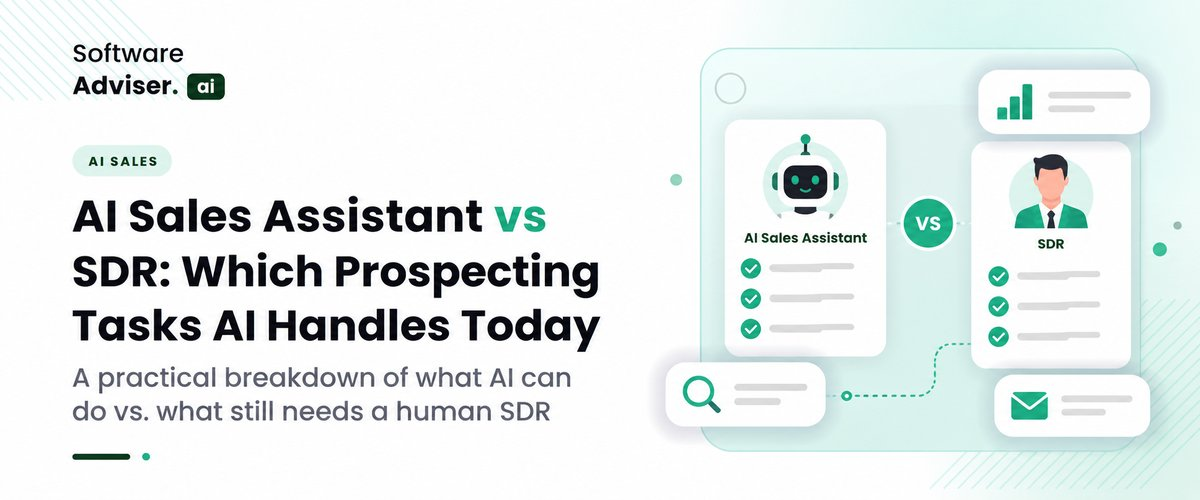
AI Sales Assistant vs SDR: Which Prospecting Tasks AI Handles Today
 Dokas mile
Your pipeline is thin, your reps are tired of cold outreach, and someone in leadership has asked whether software can simply take over prospecting. It is a fair question. The AI sales assistant vs SDR debate has moved out of conference panels and into real budget meetings, and many teams are making the call with only half the picture.
Here is the short version. An AI sales assistant handles the repetitive parts of prospecting well. A sales development representative, or SDR, handles the parts that need judgment, timing, and a little nerve. Neither one covers everything.
What Is the Real Difference in AI Sales Assistant vs SDR?
Start with plain definitions. A sales development representative, usually shortened to SDR, is a person. Their job sits at the top of the funnel: find accounts that look like a fit, reach out, learn whether there is real interest, and pass warm leads to an account executive.
A sales assistant powered by AI is software. It sits next to a rep, or sometimes in place of one, and takes over defined chores such as account research, message drafting, meeting scheduling, and data entry. Some vendors sell fully autonomous agents that run outreach with no human in the loop. Others sell assistants that suggest while a person approves. The label on the product matters less than how much freedom the tool actually gets.
That is why the AI sales assistant vs SDR question is really about task ownership. Who is accountable for each step of prospecting, and what happens when a prospect replies with something the script never planned for? Once you frame it that way, the choice stops being all or nothing.
Which Prospecting Tasks Can an AI Sales Assistant Handle Well Today?
Think of prospecting as a chain of small jobs. In the AI sales assistant vs SDR comparison, AI is not equally good at every link. Here is how the chain looks right now, based on how most current tools behave.
How Reliable Is AI at Finding and Researching Prospects?
This is where software earns its keep first. Modern lead generation software can scan company databases, filter by size, industry, and tech stack, and build a target list in minutes. A human doing the same work by hand might need several mornings. AI lead generation software goes a step further by watching for buying signals such as a hiring push, a funding announcement, or a new executive joining, then moving those accounts up the list.
Accuracy is the catch. Contact data decays, job titles change, and AI can sound very sure of itself while pulling an outdated email address. Treat every list as a draft until a person or a verification step checks it, and ask any vendor of AI lead generation software how often its contact data is refreshed. If finding contact details is your main bottleneck, a dedicated set of AI email finder tools is worth a look alongside your main stack.
Can AI Write Outreach That Actually Gets Replies?
It can write a decent first draft. Give a tool a prospect's role, some company news, and your offer, and it will produce a short, relevant opening message faster than any person. It can also run the follow-up schedule, spacing touches across email and LinkedIn without anyone setting reminders. That is the core of sales engagement, and AI sales engagement tools now cover most of the mechanical side.
The weak spot is sameness. When hundreds of companies point similar tools at similar lists, inboxes fill with messages that feel lightly personalized and oddly alike. Buyers notice. AI sales engagement works best when a rep supplies a clear angle and edits the draft, and worst when the tool is left to improvise tone on its own.
Does AI Handle Follow-Ups, Scheduling, and Data Entry?
Yes, and this is probably the safest place to start. Logging calls, updating fields, creating tasks, and sending a calendar link are all rule-based jobs. Reps under quota pressure tend to skip them, which leaves crm software half empty and forecasts shaky. A sales assistant that writes call summaries straight into your sales CRM removes that excuse.
It also feeds cleaner data into sales tracking, because activity gets recorded whether or not a rep felt like typing it up.
AI Sales Assistant vs SDR: Who Handles Which Prospecting Task
|
Task |
AI sales assistant |
Human SDR |
Who should own it |
|
Building prospect lists |
Fast. Filters by company size, industry, and tech stack, though contact data needs a check |
Slower, but spots odd fits a filter would miss |
AI first, human spot check |
|
Account research |
Pulls news, hiring, and funding signals in minutes |
Reads context and notices what the data leaves out |
Shared |
|
First-touch emails |
Solid drafts at volume, but messages can start to sound alike |
Sends fewer messages with a sharper angle |
AI drafts, rep edits |
|
Follow-up sequences |
Reliable timing across email and LinkedIn |
Easy to forget when quota pressure hits |
AI |
|
Meeting scheduling |
Handles open slots, calendar sync, and reminders |
Better when a prospect has unusual constraints |
AI |
|
CRM updates and call notes |
Logs activity the same way every time |
Often skipped on busy days |
AI |
|
Live conversations and objections |
Weak on tone, hesitation, and unspoken concerns |
Strong at reading the room and adjusting |
Human |
|
Judging whether an account fits |
Follows the rules it was given |
Can spot a merger, a departed champion, or bad timing |
Human |
|
Building trust on high-value deals |
Limited |
Phone calls, referrals, and personal follow-through |
Human |
Which Tasks Still Belong to a Human Sales Development Representative?
Live conversation comes first. When a prospect says they looked at a similar product last year and it went badly, a good SDR hears what sits underneath that sentence. They ask a gentle follow-up, adjust the approach, and sometimes turn a brush-off into a real discovery call. Current AI can respond to the words on the screen. It is much less dependable at catching hesitation, sarcasm, or the unspoken reason a deal stalled.
Judgment on fit comes second. Not every company that matches your filters deserves your time. A human sales development representative can notice that a prospect is mid-merger, or that your champion just left, and decide to wait three months. AI tends to follow the rules it was given.
Trust is third. In larger deals, buyers want to know a real person stands behind the pitch. Phone calls, event conversations, and referrals that begin with a friend suggesting you reach out are still won by people. Accounts with several stakeholders also need someone who can read the room and change the plan halfway through.

Pro-tip
Before you buy anything, track one SDR's week. Note how many minutes go to research, writing, data entry, and real conversations with buyers. That split shows you which tasks to hand to an AI sales assistant first and which ones are worth protecting.
How Do AI Tools Fit Into Your CRM Software and Lead Management Setup?
Whichever way you lean in the AI sales assistant vs. SDR debate, the tools have to connect to something. That something is usually your CRM. Plain crm software stores contacts and deals. AI crm software adds scoring, suggested next steps, and automatic summaries on top of that record. An AI sales CRM goes a bit further, aiming to coordinate outreach, meetings, and pipeline stages in one place.
Lead management is where the payoff tends to show. A good setup routes new leads to the right owner, scores them, and flags the ones going cold. AI lead management tools can do that scoring and routing around the clock, which helps when a lead arrives at 2 a.m., and nobody is online. Still, scoring models learn from your history. If your past data is messy or leans toward one customer type, the AI will repeat that pattern with full confidence. A person should still review the very top and very bottom of the AI lead management scores now and then, since that is where odd results tend to hide.
One practical warning. Teams often end up with prospecting data in one tool, sequences in another, and the CRM in a third. When those do not talk to each other, an assistant cannot see the full picture, and its suggestions turn shallow. Before adding anything new, check how it connects to the sales CRM you already use. Ask any AI sales CRM vendor the same question before you sign.
What Changes for Sales Management and Sales Tracking When AI Joins the Team?
Sales management gets harder in one way and easier in another. Easier, because dashboards fill themselves and managers stop chasing reps for updates. Harder, because the old metrics start to mislead. Emails sent and calls dialed look impressive when software does the sending. They say very little about quality.
Shift your attention to outcomes. Track meetings that were actually held, not only booked. Look at how many of those meetings became real opportunities and how long that took. AI sales tracking features can break this down by source, so you can see whether AI-sourced leads convert as well as those from a human rep. If you are comparing platforms, the AI sales management is a sensible place to see what each product reports on, and sales tracking tools show how activity data gets captured.
AI sales management tools can also help with coaching. Calls get summarized, objections get tagged, and managers can review the handful of conversations that matter instead of listening to everything. Used well, that frees a manager to coach people rather than audit spreadsheets.
Should You Replace an SDR With an AI Sales Assistant or Keep Both?
Winning sales organizations do not treat this technology as a replacement for human representatives. Instead, they build a hybrid strategy where automated software powers the SDR's day-to-day workflow.
When Does an AI Sales Assistant Make Sense on Its Own?
You should lean toward AI if you are an early-stage team with no dedicated sales hire, if your outbound volume is high and the offer is simple, or if your main problem is that nobody has time to follow up. A founder prospecting at night can get real relief from an assistant that handles research and sequencing.
When Should You Still Hire a Sales Development Representative?
You should not hand everything to software if deal values are high, buying committees are large, or your brand depends on a personal touch. Complex enterprise sales, regulated industries, and products that need careful explaining all reward human conversation. A sales development representative also brings market feedback no dashboard can give you: which objections keep coming up, which competitor suddenly got cheaper, which message falls flat.
Is a Hybrid Setup Usually the Better Answer?
For most teams, yes. The common pattern puts AI on research, drafting, scheduling, and CRM updates, while people handle conversations and qualification. In that arrangement, your SDR stops being a data clerk and spends the day talking to buyers. The AI sales assistant vs SDR choice turns into AI plus SDR, with each doing what it does best.
How Can You Start Without Putting Your Pipeline at Risk?
Whichever side of the AI sales assistant vs SDR argument you land on, begin small. Pick one task, such as account research or CRM logging, and run the assistant on it for a month while a person reviews the output. Read a sample of messages before they go out. Set clear limits on volume and on which accounts the tool may contact, because your most valuable prospects probably deserve a human touch.
Keep US email rules such as CAN-SPAM in mind, including honest sender details and a working opt-out. At the end of the trial, compare meetings held and opportunities created against your previous baseline, not just activity counts. Set up AI sales tracking reports before the pilot begins so that baseline exists. If the numbers hold, add another task. If they do not, you have learned something cheap.
Do You Know?
Studies of sales teams often suggest that reps spend only a minority of their week actually selling, with the rest going to research, admin, and CRM updates. Exact figures vary from one study to the next, but the pattern keeps showing up.
Conclusion
Today, AI handles research, first drafts, follow-up timing, and record-keeping well. People still win on live conversation, judgment, and trust. The practical answer for most US teams is to give AI the repetitive prospecting work, keep a human SDR on the conversations that matter, and measure results by meetings held rather than messages sent. Run a small pilot, check your CRM data, and let the results decide how far to take it. The AI sales assistant vs SDR question does not need a permanent answer. It needs a good first experiment.
FAQ's
An SDR is a person who owns prospecting, while an AI sales assistant is software that takes over specific repetitive tasks.
Not for most teams today, since live conversations and judgment calls still need a person.
Prospect research, list building, first drafts, follow-up scheduling, and CRM data entry.
It works best with one, because clean CRM data improves its suggestions and keeps activity records accurate.
Track meetings actually held and opportunities created, not just emails sent.
Talent shortages and compressed margins have pushed US accounting firms into a corner that manual workflows can't solve. The answer most practices are [...]

David N. Wilks

Almost every AI tool now has a free version, which is both a gift and a trap. The gift is obvious: you can test powerful software without spending a c [...]
David N. Wilks

In the US, hospital management software using AI is revolutionising the healthcare sphere, removing administrative friction for patients and medical s [...]