
What we'll cover
Share with your community!


Get Free Consultation
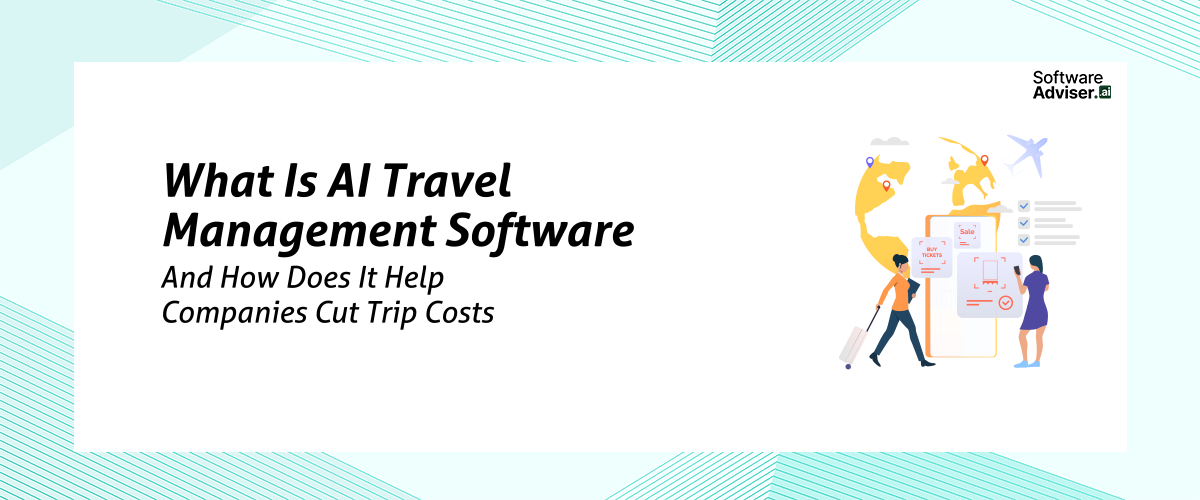
What Is AI Travel Management Software and How Does It Help Companies Cut Trip Costs
 Dokas mile
Managing corporate trips has turned into an expensive, chaotic puzzle for modern finance teams. Between fluctuating flight prices, unoptimized hotel bookings, and messy receipt tracking, companies lose massive amounts of revenue to operational leakages every day. To stop these financial leaks, forward-thinking organizations are replacing outdated manual booking methods with automated Travel Management systems. By using predictive algorithms and real-time data engines, these advanced platforms automate itineraries, enforce company budgets at the point of purchase, and unlock deep volume discounts. This guide breaks down exactly how deploying intelligent software into your corporate workflow optimizes booking paths, protects your global workforce, and slashes business trip costs permanently.
Defining Corporate Travel Management in the Modern Era
Let's look closely at the actual operational reality of tracking corporate mobility today. The business landscape has moved far past the point where manual booking paths can handle a growing mobile workforce efficiently. Traditional corporate travel management frameworks usually mean relying on an external administrative agent or forcing your internal HR staff to handle endless booking requests over email. This creates massive visibility gaps because you only see the final bill weeks after the journey ends.
A standard reservation approach treats every single booking as an isolated purchase. This completely disconnects it from your central financial projections. Shifting your focus toward business travel management using active automation changes this passive storage folder structure into an active data machine. The application continuously scans historical spending loops, identifies patterns in employee preferences, and flags expensive booking habits. This gives leadership teams total control over their dynamic operational data.
What Is AI Travel Management Software?
Explaining this technology layer simply means looking at the shift from human entry to algorithmic prediction. At its core, a smart company ride platform is an integrated software setup that uses deep learning models and natural language processing to arrange, optimize, and manage enterprise journeys. Instead of logging into five exceptional airline websites, a worker talks to a single dashboard that holds their exact corporate spending limits, non-public room tastes, and authorized transit lanes.
The software functions as an automated digital companion for your corporate finance department. It reads real-time market data across global travel networks, anticipating fare spikes and room availability before they disrupt your corporate budget. It moves your corporate administration away from a manual setup where employees buy whatever looks cheap on their screen to a structured engine that ensures every booking aligns with corporate policy instantly.
The Core Architecture of AI-Driven Travel Systems for Enterprises
Deploying smart workflows requires a solid understanding of the background software engines that process your daily corporate logistics. Implementing advanced AI-pushed travel management structures for organisations involves connecting numerous specialized digital components right into a unified command dashboard:
- Predictive Price Forecasting Engines: Advanced algorithms track historical pricing fluctuations to inform your staff exactly when to buy tickets or hold off for a drop.
- Autonomous Policy Enforcement Modules: Software rules that check user choices against your corporate travel handbook before a transaction runs, blocking non-compliant luxury suites automatically.
- Automated Expense Itemization Scanners: Optical text readers that scan paper receipts from an employee's phone camera, extract tax details, and match them with corporate card charges.
- Centralized Logistics Dashboards: A single software dashboard where your operations managers see every active flight itinerary, ticket change, and travel invoice across your entire enterprise footprint.
To protect your company records while processing high volumes of transaction data, companies connect these platforms directly with advanced AI Expense Management Software. This architecture makes sure every single cup of coffee, hotel tax fee, and taxi charge links up cleanly with your master database, completely removing manual tracking mistakes.
How Smart Automation Slashes Corporate Trip Costs
The primary reason financial leaders upgrade their legacy systems is to achieve immediate, compounding cost reduction. Intelligent software cuts down on corporate trip expenses across four major operational pathways:
-
Real-Time Price Optimization
Flight and hotel room rates shift constantly throughout the day. Instead of forcing your staff to search endlessly for a deal, the platform tracks pricing patterns and automates re-booking sequences if a flight price drops after the initial reservation.
-
Direct Wholesale Marketplace Access
Using an automated system connects your business directly to wholesale hospitality suppliers.This bypasses customer markups and top class booking service prices completely, giving small groups the exact identical negotiating leverage as a worldwide corporation.
-
Eliminating Out-of-Policy Leakage
Employees often buy premium seating or choice hotel options because traditional platforms do not block those selections at check-out.A cognitive booking engine filters out non-compliant listings instantly, stopping unauthorized spending before it takes place.
-
Streamlining Administrative Payroll Costs
When your group spends hours organizing receipts, filing cost paperwork, and filing manual reports, you lose valuable working hours. Automating these records pipelines lets your personnel awareness absolutely on excessive-level enterprise dreams.
Managing these automated processes requires linking your booking dashboard directly with your broader AI Workflow Automation Software channels. This technical connection ensures your data flows smoothly between your internal corporate calendars, HR rosters, and project budgets without requiring manual input.
Prioritizing Employee Travel Risk Management
While slicing trip prices is a first-rate corporate aim, protective your team of workers even as they're on the road is even greater essential. Modern company governance calls for sturdy employee journey hazard control guardrails to handle surprising delays, clinical issues, or extreme weather situations.
Intelligent trip platforms give your HR teams absolute visibility over your field workforce. The software provides real-time location mapping, automatic flight disruption updates, and instant emergency messaging systems. If an international flight gets canceled due to a sudden storm, the platform identifies the problem instantly. It books an alternative route, reserves a nearby hotel, and updates the traveler's phone dashboard before they even reach the airport customer desk.
This deep integration of worldwide travel risk management principles ensures your business meets its legal duty of care obligations perfectly, protecting your human capital wherever they travel for business.
Real-World Use Cases of AI in Business Travel
Deploying smart logistics structures looks very different depending on your corporate setup and industry model:
-
High-Volume Sales Operations
A nationwide sales consulting brand deploys an automated framework to manage monthly client service trips. The platform tracks sales team schedules, coordinates multi-city flights, and auto-populates client billings without a single human error.
-
Field Engineering and On-Site Support
Technical service firms send specialized crews to remote industrial locations on short notice. The software scans local housing databases, finds safe corporate apartments near the job site, and sets up flexible billing profiles instantly.
-
Executive Event Logistics
Corporate event managers use intelligent dashboards to organize large corporate conferences. The system reads hundreds of incoming employee flight times, matches them with local ground transit options, and handles group room blocks seamlessly.
To process these complicated financial pipelines cleanly, companies link their software environments with enterprise-grade AI Accounting Software platforms. This digital setup maps every single travel expense to its correct corporate tax category automatically, simplifying your year-end auditing tasks.
Choosing Between an AI Platform and a Traditional Travel Management Company
Deciding whether or not to control your agency's company trips thru a legacy travel management corporation or install an impartial automatic software tool relies upon in your inner technical sources and scaling approach. Legacy corporations depend closely on human smartphone sellers, which results in excessive reserving fees, gradual re-routing instances throughout emergencies, and fragmented information dashboards.
Investing in a modern automated system gives your internal operations team total data ownership and immediate flexibility. Look for platforms that offer comprehensive data encryption, flexible API connections, and clean user interfaces. Ensuring your new logistics platform links smoothly with your existing AI Expense Management Software prevents operational data silos, keeping your financial statements clear and organized.
Overcoming Common Implementation Obstacles
Shifting your enterprise corporate trip pipeline to a fully automated model introduces specific operational challenges that require careful planning. The most common pitfall is fragmented historical data records. If your past expense logs are full of duplicate files or missing receipt descriptions, your new intelligent system will struggle to calculate accurate budget baselines.
Before launching a new platform, run a thorough audit of your internal corporate data directories. Clean up formatting mistakes and organize your past vendor contracts properly. Furthermore, focus on keeping your internal finance managers involved. Automated booking engines are built to handle repetitive tracking tasks, but your executive team must still review high-level corporate travel budgets to ensure absolute financial safety.
The Strategic Horizon of Corporate Mobility
The global corporate mobility landscape is accelerating quickly. Over the coming quarters, we will see a major industry transition toward fully predictive, automated travel networks that manage corporate trips inside a single, integrated environment.
To protect your market position, look into specialized Corporate Travel Optimization Platforms to monitor your internal logistical tracking. Upgrading your corporate travel software framework early helps your brand handle massive field expansions smoothly, prevent budget waste, and scale your business volume without breaking your current software frameworks.
Conclusion :
Embracing intelligent corporate trip tracking is no longer just an optional tech experiment for fast-growing companies. It is the definitive operational foundation needed to handle business journeys efficiently in a volatile global market. Moving away from slow, manual reservation tracking and launching integrated data pipelines lets your business handle corporate logistics with absolute precision.
Whether your primary operational goal this quarter is to organize your trip infrastructure using modern AI Expense Management Software, optimize your daily data pipelines via smart AI Workflow Automation Software, or track your budget metrics using AI Accounting Software, the ultimate target remains identical. You want an operational framework that runs smoother, faster, and smarter. Taking that first easy step nowadays guarantees your business stays competitive, lean, and completely ready to lead the market.
FAQ's
AI travel management software automates business travel planning, booking, and expense tracking.
AI optimizes bookings, enforces travel policies, and automates expense management.
Corporate travel management is the process of planning, booking, and managing business trips efficiently.
AI provides real-time alerts, itinerary updates, and emergency support for traveling employees.
Look for automated booking, expense tracking, travel policy enforcement, and analytics.
A legal professional is an increasing number of people turning to AI to reduce the time spent on repetitive responsibilities together with prison stud [...]

David N. Wilks
Two founders go to choose some automation software and get two completely different results, both correct. That's the honest starting point for n8n vs [...]
David N. Wilks
With the pace of the American dining experience, an overwhelming number of customers during a typical Friday-night rush can produce miscommunication o [...]