
What we'll cover
Share with your community!


Get Free Consultation
AI Talent Marketplace: How Internal Mobility Matching Works
 Dokas mile
A senior analyst in finance spends three years building data modeling skills, yet an open role in product operations never reaches her. Nobody ignored her. The posting lived in one system, her skills lived in another, and no one connected the two. An AI talent marketplace is built to close that gap. It reads skills, experience, and career interests, then matches employees to open roles, projects, and mentors inside the same company. This guide explains how internal mobility matching works, which data it depends on to produce matches, how it relates to other AI HR software, and what US employers should verify before buying. It also covers the legal and fairness questions that deserve attention before launch rather than after.
Key Takeaways
- Internal mobility matching compares employee skills, interests, and experience against roles, projects, and mentorships, then ranks the closest fits.
- Match quality depends more on the quality of skills data than on the sophistication of the algorithm.
- The platform performs best when it connects to the systems that already hold employee records, performance history, and learning data.
- US employers should treat transparency, bias testing, and human review as purchase criteria, not afterthoughts.
What an AI Talent Marketplace Does
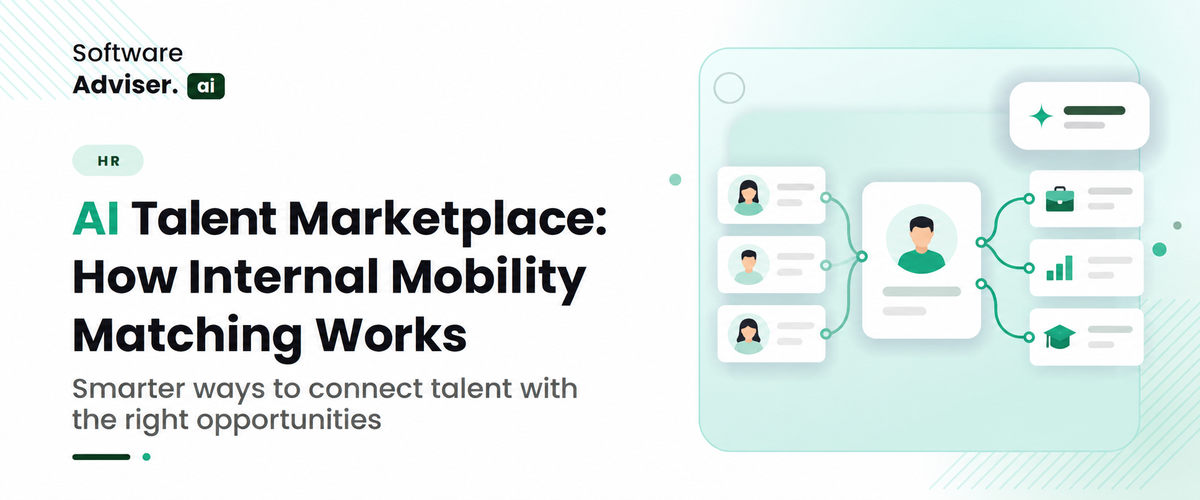
An AI talent marketplace is a platform that matches current employees to internal opportunities. Those opportunities include full-time roles, short-term projects, stretch assignments, and mentorships. The system compares what people can do with what the organization needs, rather than waiting for someone to remember the right name.
Many companies hire externally for roles that a current employee could fill with modest training. External hiring costs more in agency fees and onboarding time, and it sends a quiet message to existing staff that advancement happens elsewhere. Marketplaces try to reverse that message by making internal options visible and searchable.
A job board lists openings and waits for applicants. A marketplace works in both directions: employees see recommended opportunities, and managers see recommended candidates, including people they have never worked with.
How Internal Mobility Matching Works
Most platforms follow the same three-stage pattern.
Stage One: Building a Skills Profile
The system first needs to know what each employee can do. It gathers this from résumés, job histories, internal profiles, project records, certifications, and course completions. Natural language processing then maps those inputs to a skills taxonomy, which is a structured vocabulary of skills and the relationships between them. The taxonomy might recognize, for example, that experience with Structured Query Language points toward data analysis, even if the employee never used those exact words.
Many platforms also infer adjacent skills. If an engineer has led two system migrations, the model may suggest project coordination as a likely capability. Employees can then confirm, edit, or remove the suggestion. That confirmation step matters, because unverified inference is where most inaccurate profiles begin.
Stage Two: Scoring the Match
Each open role or project is broken into required and preferred skills using the same taxonomy. The platform then calculates how closely a profile fits. Simple systems count overlapping skills. More advanced ones weigh recency, proficiency level, and how near a related skill sits to the one required.
Good tools also show the gap. An employee may match most of a role and see exactly which missing skills could be learned. That gap view turns a recommendation into a development path rather than a polite rejection.
Stage Three: Surfacing and Learning
Recommendations reach employees through a portal, email, or HR app, and reach managers as suggested candidates. The platform then learns from outcomes: who applied, who was interviewed, who was hired, and who succeeded afterward. Over time those signals refine the rankings. Human review stays in the loop. The software ranks and suggests, and people decide.
Where the Matching Data Comes From
Accuracy rests on data the marketplace usually does not own. Most of it comes from systems the company already runs.
Core employee records sit in AI HRIS software: job titles, hire dates, reporting lines, and locations. Goals, reviews, and feedback come from an AI performance management system. Course completions and certifications come from AI training management systems. Details on how past roles were filled often live in AI recruiting software.
When these sources are disconnected or inconsistent, the marketplace inherits the mess. Job titles that mean different things across departments are a common example. A "coordinator" in one team may do work another team calls "specialist." Cleaning that up before launch usually improves results more than any model tuning.
Do You Know?
Employees often build capabilities through side projects, volunteer work, and self-directed courses that never appear in a formal job history, which is why skills-based matching can surface candidates that title searches miss.
How It Fits Within the Wider HR Technology Stack
Buyers often ask whether a marketplace replaces existing tools. In most cases it does not. It sits between them. The broader category of AI HR software includes several adjacent products, and understanding the boundaries prevents duplicate spending.
AI employee management software handles daily administration such as time, attendance, documentation, and workflows. AI employee experience management software tracks engagement, surveys, and sentiment, and can show where people feel stuck. A marketplace benefits from those signals indirectly, since employees who feel stalled often gain the most from visible options.
AI workforce planning software forecasts future headcount and skill needs. The pairing is useful: planning tools show where gaps will appear, and the marketplace shows who inside the company could fill them. AI resource management software assigns people to projects based on availability and capacity, which overlaps with the marketplace's project matching.
Finally, AI HR analytics software reports on mobility outcomes such as internal fill rates, time to fill, and retention after a move.
A Realistic Example
Consider a US company with roughly 2,000 employees spread across customer support, operations, and finance. The operations group plans to launch a business intelligence team and expects to hire from outside. Before posting externally, HR runs the role through the marketplace.
The platform surfaces six internal candidates. Three come from customer support, where analysts have been building reports in spreadsheets and basic dashboard tools. One of them had never applied for analytics roles because that job family appeared nowhere near her career path. The hiring manager interviews four candidates and fills two openings internally, with a short plan, assigned through AI training management systems, covering the remaining skill gaps. The external search shrinks to a single role.
This scenario is illustrative, not a measured result, but the value clearly came from visibility, not a clever algorithm.
Limitations and When It May Not Fit
A marketplace is not the right investment for every employer. Very small companies, say under a few hundred people, usually know their staff well enough that a manager conversation does the same job. Organizations with thin or outdated skills records, including sparse review notes in an AI performance management system, will see weak matches until the data improves.
Culture limits results too. If managers hold on to high performers and discourage moves, the best recommendations go nowhere. Some employees also hesitate to browse openings out of concern that a manager will notice. Platforms differ in how they protect browsing privacy, and engagement results from AI employee experience management software can reveal whether that hesitation exists.
Skill inference is probabilistic. It can overstate or understate ability, particularly for employees with short tenures, career breaks, or nontraditional backgrounds.
Compliance and Fairness for US Employers
Because the platform influences who gets considered for promotions and transfers, it falls within an area US regulators watch closely. Federal anti-discrimination law, including Title VII of the Civil Rights Act, applies to employment decisions whether software or a person shapes them. New York City's Local Law 144 requires bias audits and candidate notices for automated employment decision tools used in hiring and promotion decisions. Other states and cities have introduced or passed their own rules, and requirements keep shifting, so employers should confirm current obligations with legal counsel before deployment.
Practical safeguards are fairly consistent. Ask the vendor for bias testing results. Require an explanation of why each match was recommended. Keep people responsible for final decisions. Document how the recommendations are used; reports from AI HR analytics software can help review that trail later.

Pro-tip
Before shopping for software, export a sample of 50 employee profiles and check how many list current, specific skills. If most are blank or outdated, plan a profile refresh campaign first. It will improve any platform you choose.
How to Evaluate a Platform
Polished demo data says little about real-world performance. These questions expose the differences:
- Which systems does it connect to, including AI HRIS software, an AI performance management system, AI training management systems, and AI recruiting software, and does data sync continuously or on a schedule?
- How is the skills taxonomy built, and can it be customized to the company's own job architecture?
- Can employees see and correct their own profiles?
- What explanation accompanies each recommendation?
- What bias testing has been done, and will the vendor share the results?
- What does pricing look like per employee, and what does implementation include?
The strongest test is a pilot with a real role and real data. Pick a position that has recently been filled, run it through the platform, and compare the candidates it surfaces with the people who were actually considered.
Common Implementation Mistakes
The most frequent error is launching before cleaning the data. Duplicate titles, outdated profiles, and missing skills produce confident-looking recommendations that are simply wrong. A close second is treating the marketplace as a recruiting add-on. Its value depends on managers releasing talent and employees trusting that exploring a move carries no penalty, which is a communication task as much as a technology task.
Measurement is another weak point. Teams often track logins and profile completion, then declare success. Better indicators include internal fill rates, movement between departments, and retention of people who changed roles. Feeding those results into AI workforce planning software and AI HR analytics software gives leadership a clearer view of where skills are growing and where they are running short.
Role changes should also flow back into AI employee management software so reporting lines stay accurate, and project-based moves should be reconciled with AI resource management software to avoid double-booking people.
Finally, avoid overpromising. If employees are told the platform will find them a new role, and few moves happen, trust erodes quickly. Describing it as a way to see options sets a more accurate expectation.
Conclusion
An AI talent marketplace works when three things line up: reliable skills data, clear rules for how matches are used, and managers who support internal moves. The technology can surface candidates nobody would have thought to check, but it cannot fix a culture that discourages mobility. Employers weighing a purchase should map the platform against their existing AI HR software, review how it will draw on AI employee management software and AI employee experience management software, and decide how AI resource management software fits where project staffing is involved. Pair its output with AI workforce planning software to anticipate shortages, start with a small pilot, and measure outcomes that matter, not just activity.
FAQ's
AI recruiting software focuses on attracting and screening external candidates. A marketplace focuses on current employees, matching them to roles, projects, and mentors within the organization.
No. It relies on the HRIS for core employee data and adds a matching layer on top. Most deployments connect to existing AI HRIS software rather than replacing it.
Accuracy varies by vendor and by data quality. Inferred skills should be treated as suggestions that employees and managers can verify, not as final records.
Federal anti-discrimination law applies, and some jurisdictions, such as New York City, have specific audit and notice rules. Requirements are changing, so legal review before launch is wise.
Possibly, but the return is usually greater in larger organizations where employees and managers cannot easily see across departments. Smaller teams may do well with simpler tools within their current HR platform.

Remote work solved geography and created a new problem nobody named for years: coordination overhead. Slack threads stretching across eight time zones [...]

David N. Wilks

Every founder hits the same wall eventually. A handful of tools connect collectively, a to-do list with the intention to not prevent development, and [...]
David N. Wilks

Small business owners in America often have only one way to manage their cash flow - by sending invoices out the door. As their businesses grow, howev [...]