
Best Marketing Automation Software in
Are you looking for Marketing Automation Software for your Business in ? SaaS Adviser brings you the best Marketing Automation Software to ease your worries. In order to make your work smooth and swift, SaaS Adviser has compiled a list of the best software available. Compare the Best software features, pricing, free demo, and trial to select the best Marketing Automation Software for your organization.
 Researched and Written by Akash Patel
Top 3 Featured Softwares


List of Top Marketing Automation Software
Get Free Consultation


Enalito

By Enalito
Welcome to Enalito! Enalito is a cloud-based platform that features robust AI technology to provide new insights and efficiencies that can elevate businesses and customer experi...
View Profile
Karooya
By Karooya
The most common way of losing money is to pay for the traffic that (a) user don't want, (b) doesn't convert at all, and (c) converts very poorly. This is wasted ad spend. They h...
View Profile

Bigly Sales
By Bigly Sales
Introducing Bigly Sales, the CRM that provides key features small businesses need to optimize their sales. With Bigly Sales, professionals can easily manage customer and prospect...
View Profile

Rewardoo
By Rewardoo
Rewardoo is a marketing automation platform that connects your audience to all of your promotional campaign content through a single link. No matter where users are online or whe...
View Profile
TheConvertWay
By TheConvertWay
Use automated SMS and WhatsApp marketing campaigns to drive repeat purchases. Get higher engagement and direct sales by sending marketing messages with less expenditure. Automate...
View Profile

LiveReport.io
By LiveReport.io
LiveReport.io is a reporting software that enables ad budget monitoring and minimizes data overload. It makes it possible for marketers to monitor and track all of their marketin...
View Profile

Selligent
By Selligent
Selligent is a marketing automation platform that enables B2C marketers to keep their customers engaged and drive greater ROI from email and digital marketing campaigns. The omni...
View Profile
Klaviyo is a marketing automation software that helps businesses of every size from entrepreneurs to iconic brands in building sales for their online businesses. It allows customer...
View Profile

SharpSpring is a market automation tool that automates the process of lead generation and sales optimization for businesses of all sizes. It helps you engage leads, score them, t...
View Profile

Ontraport is a business software that helps service businesses systemize and scale their operations. It manages and automates the buying cycle, resulting in faster growth while f...
View Profile

WebEngage is a customer data platform and marketing automation suite that makes user engagement and retention simplified and highly effective for consumer tech enterprises and SM...
View Profile

Engagebay is a software that helps businesses to streamline their marketing, sales, and services processes under one roof. It offers powerful email marketing capabilities which let...
View Profile

OutboundEngine is a marketing automation software that is designed to help businesses with their marketing outreach and growth. It is simple and easy to use, and it helps keep up...
View Profile

Listrak
By Listrak
Listrak is the industry’s leading cross-channel marketing platform that delivers results for 1,000+ retailers. It provides best-in-class SMS, behavioural marketing, email, cros...
View Profile

Drip is an email marketing automation tool that helps users connect and engage with their customers on a personal level. With a flexible API and simple migration, Drip is able to...
View Profile

What is Iterable? Iterable software is a powerful cross-channel marketing automation platform built to help businesses create personalized customer journeys at scale. If you’v...
View Profile

Vbout is an advanced multi-channel marketing automation solution that is ideally suited for all types of enterprises. It provides users with tools for social media management, em...
View Profile

Delivra is a cloud-based marketing tool that helps businesses automate their email marketing campaigns. It's appropriate for small to midsize businesses in a range of industries,...
View Profile
Lead Liaison provides lead scoring, lead nurturing, lead distribution, and lead tracking as well as marketing automation and lead management solutions. It allows you to customize...
View Profile
RD Station
By RD Station
RD Station is a complete marketing automation software that helps companies to make their digital marketing operations more efficient. The software can be used to generate better...
View Profile

Table of Content
What is Marketing Automation Software?
As a cloud-based software that automates, digitizes, and evaluates marketing efforts, Enhanced Marketing Solutions helps organizations optimize productivity, increase engagement, and tailor customer relationships on a larger scale. With marketing automation, brands can get rid of menial marketing tasks such as email and social media posting as well as lead scoring. This enables marketing departments to prioritize strategy and innovation.
1. Latest Market Trends in Marketing Automation Program
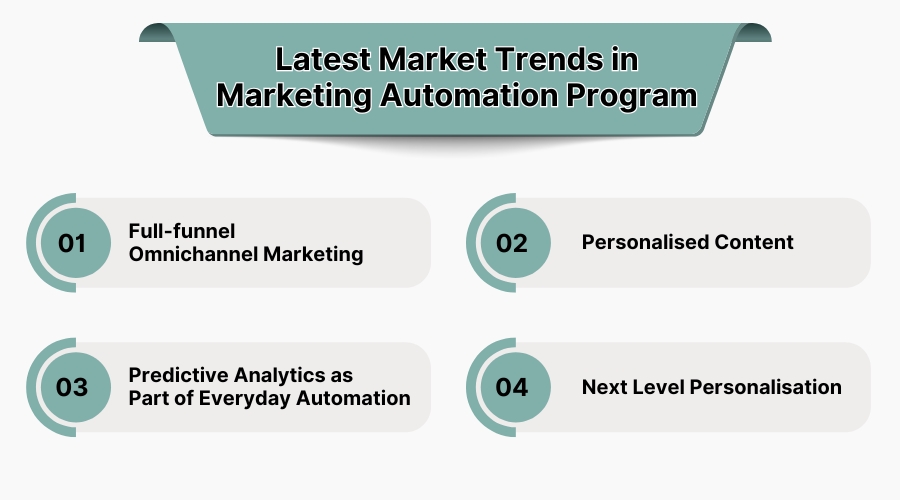
Currently, about 56% of businesses use marketing automation software to create personalized campaigns across multiple channels! For 2025, marketing automation expands with the following significant trends:
1. Full-Funnel Omnichannel Marketing
Businesses are implementing methods focusing on providing a splendid experience for customers on every channel and every stage of the buyer's journey. It not only improves customer satisfaction but also builds customer loyalty.
2. Personalized Content
Business strategies that aim to optimize customer tailored experiences are contributing more and more to the use of automation and personalized content. Through proper analysis of customer data, businesses can craft targeted messages that appeal to individual preferences.
3. Predictive analytics as part of everyday automation
Automating the integration of predictive analytics into marketing allows companies to forecast customer behavior and trends. This enables better campaign planning, effective marketing resource allocation, and overall better marketing results.
4. Next level personalisation
Advanced personalisation goes beyond basic customization to incorporate AI and machine learning. This results in more personalized interaction. This could include real-time changes to dynamic content or product recommendations based on user behavior.
You can visit our detailed guide on marketing automation trends if you want to know more about the upcoming trends.
2. Challenges in Attendance Management Software
Attendance tracking software has the potential to improve productivity in an organization. Although its use is beneficial, the adoption and application of such software poses certain challenges. These include the following:
1. Implementation Difficulties
There is always a standing challenge of associating new attendance management systems to other systems in the organization. Problems in the interface can lead to attendance processing errors that reduce productivity and inflate payroll costs. In order to achieve these objectives, the software will need to be actively managed and tested for functionality.
2. Training and Processes
Automated systems are usually problematic for manual workers. Poor training can lead to poor data capture and failure to use the system as intended. Employers need to implement good procedural and training policies to guide the processes.
3. Concerns about Privacy and Monitoring
The use of attendance management software which also tracks tools of work can be viewed as an invasion of privacy. Some might view it as an intrusion and a breach of trust that diminishes motivation. Clear explanations on the intended use of the software and sufficient data security could go a long way in changing such perceptions.
4. Software Compatibility and Updates
Consideration of whether the installed program will work with previously existing systems is very important. Data loss can happen if compatibility problems arise. In addition, periodic updates are essential for solving issues, adding new functionalities, and improving overall protection. Consistent maintenance of the application allows it to work properly and avoids problems in the future.
3. Features of Marketing Automation Services in the USA
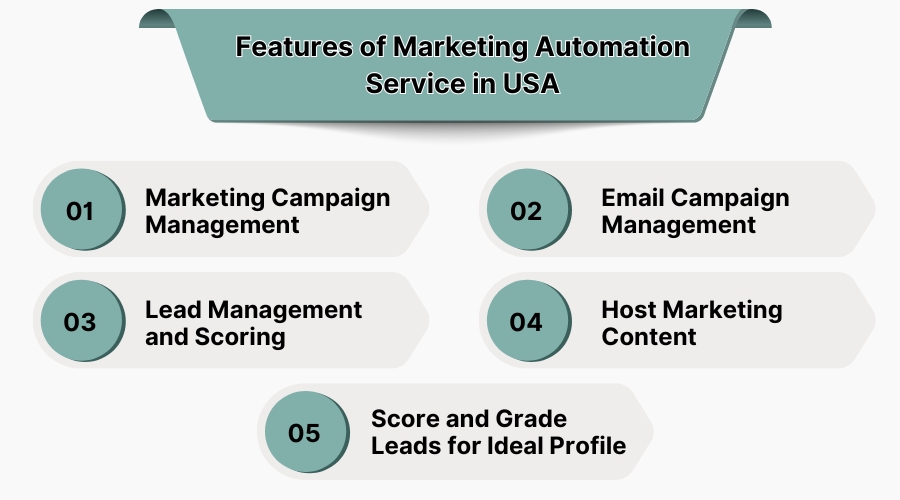
With automation, marketers can set and forget a wide variety of activities that a brand would usually spend a lot of time doing. The most important features are:
1. Marketing Campaign Management
These systems offer a central interface for advertising on different mediums, including social media, blogs, websites, and email. Some of the included features are audience segmentation, A/B testing, retargeting, and checking the performance of the marketing channels. These allow for review and refinement of the marketing campaign.
2. Email Campaign Management
Automation tools offer the ability to create email campaigns and schedule the sending out of these emails, while also analyzing the results. Top-end systems will allow the use of personalization and dynamic content while applying automated workflows to drastically improve customer and lead engagement and conversions.
3. Lead Management and Scoring
Proper management of leads will include capture, nurturing, and scoring of leads based on the activities that a person undertakes. Automation software gives a balance of prospects that marketing and sales provide during the process of nurturing, qualifying, and selling.
4. Host Marketing Content
Businesses can place different marketing content within the system such as landing pages and downloadable assets which businesses might need. The hosting of assets allows for the tracking of content marketing performance which aids in understanding marketing effectiveness and developing marketing content strategies.
5. Score and Grade Leads for Ideal Profile
Analyzing the behavior of leads, their engagement, and the company's ideal customer profile will give the business insight into how leads can be graded and scored, all made possible by marketing automation software. This guarantees that sales teams are working with good quality leads. This increases the chances of closing deals as well as customer acquisition efficiency. If your sales team lack talented candidates, we suggest you use recruitment automation software.
4. Who Uses Marketing Automation Software?
All types and sizes of companies from small businesses to large corporations in different industries utilize these soft wares. Digital marketers, salespeople, and customer relationship managers use these software for automating processes like customer lead acquisition, email marketing, and follow-up questions. Automation is used by e-businesses to tailor customer journeys, while B2B companies use it for lead scoring and nurturing to shorten sales cycles. Agencies and consultants also use marketing automation systems for the efficient handling of numerous client campaign projects simultaneously.
5. Five Best Marketing Automation Tools in USA
1. Brevo
Brevo, which recently changed its name from Sendinblue, is an all-embracing marketing automation solution that caters to businesses of every scale. It allows for email and SMS marketing as well as offering CRM features which makes it perfect for customer interaction. Using automation workflows, marketing activities can be made more efficient, which enables organizations to enhance their lead nurturing processes.
Features:
-
Email Marketing: Create and send personalized email campaigns with ease.
-
SMS Marketing: Reach customers directly on their mobile devices.
-
Chat: Engage with website visitors in real-time.
-
CRM: Manage customer relationships and track interactions.
-
Marketing Automation: Automate workflows to nurture leads and engage customers.
Pros:
-
User-Friendly Interface: Straightforward design that is easy to interpret for people with a range of technical expertise.
-
Comprehensive Feature Set: Consolidation of multifarious marketing tools under a single application.
-
Competitive Pricing: Economical pricing, appropriate for small and average businesses.
Cons:
-
Advanced Features Limitations: Some advanced features may require higher-tier plans.
-
Learning Curve: New users might need time to explore all functionalities fully.
Pricing:
-
Free Plan: Includes core features with limitations.
-
Paid Plans: Start at $25 per month, offering additional features and higher sending limits.
2. Mailchimp
Mailchimp is among the most well-known automated marketing services. It features a simple interface and integration with email marketing. Also, it provides AI-based analytics, audience segmentation, tailored templates and several other recommended tools. These help businesses create targeted advertising campaigns that will improve engagement, conversions and customer relationships in the process.
Features:
-
Email Marketing: Create and send sophisticated looking emails using the provided design editor.
-
Audience Segmentation: Divides audience into sub-groups within the business for simpler and direct campaign targeting.
-
Marketing Automation: Allows the automation of customer journeys and workflows.
-
Analytics and Reporting: Reports from the descriptions provide in-depth insights of how the branded campaigns are performing.
-
Integrations: Provides the option to integrate with different third-party applications and services.
Pros:
-
Ease of Use: Intuitive interface suitable for beginners.
-
Comprehensive Templates: Offers a variety of customizable email templates.
-
Free Plan Available: Allows users to start with basic features at no cost.
Cons:
-
Pricing Increases with List Size: As the number of shareable subscribers increase, expenses will increase almost exponentially.
-
Limited Automation in Lower-tier Plans: Advanced automation of relevant features only with higher tier subscriptions.
Pricing:
-
Free Plan: Includes basic features with limitations on the number of subscribers and emails sent.
-
Paid Plans: Begins at $20 per month and increases depending on the number of claimable subscribers and added features.
3. Moosend
Moosend is an advanced software that automates marketing processes seamlessly. This tool helps in lead generation and audience analysis. Their advanced features include automated workflows, behavioral automation based on business metrics, and comprehensive reporting.
Features:
-
Email Campaigns: A drag and drop email builder to design responsive emails.
-
Automation Workflows: Automates repetitive functions and creates complex workflows.
-
Landing Pages: Publish and design landing pages without coding skills.
-
Subscription Forms: Create forms that can be modified to help collect emails.
Pros:
-
Affordable Pricing: Great value pricing especially for new businesses and economical firms.
-
User-Friendly Interface: Eases the hurdles of forming and managing campaign strategies.
-
Detailed automation capabilities: Allows full automation capabilities without requiring a higher tier plan.
Cons:
-
Limited Integrations: Fewer native integrations compared to some competitors.
-
Template Variety: Doesn't offer a wide selection for emails
Pricing:
-
Pro Plan: Starting $9 a month for under 500 subscribers with unlimited emailing and feature access.
-
Enterprise Plan: Larger businesses have custom pricing options.
4. Constant Contact
Constant Contact is another marketing automation service that specializes in email marketing and social media marketing. It provides automation tools to follow-up with customers, perform A/B testing, and analyze results. It’s a fantastic tool for small businesses and even nonprofits seeking to stretch their reach.
Features:
-
Email Marketing: Professional emails can be sent using templates of one’s choice.
-
Event Marketing: Promotion and intake management of events can be done.
-
Social Media Integration: Campaigns can be shared and connected to social media.
-
List Management: Correspondences can be organized and segmented for specified communication.
-
Reporting: Real-time analytics can be used to monitor email statistics.
Pros:
-
Easy to Use: Considered easy to use by people who are not very technical.
-
Integrated Customer Support: Integrate several customer support services.
-
Event Management Features: Specialized features for the arrangement and advertising of events.
Cons:
-
Cost: Relative to similar platforms, could be more costly.
-
Automation Limitations: Lacks sophisticated automation capabilities compared to other systems.
Pricing:
-
Lite: $12/month, for 1 user, and offers 1 GB storage.
-
Standard: $35/month, for 3 users, and offers 10 GB storage.
-
Premium: $80/month for unlimited users, and offers 25 GB storage
5. ActiveCampaign
ActiveCampaign is a sophisticated marketing automation platform which integrates email marketing and CRM with automation to deliver personalized customer services. Also, its multi-channel engagement and AI-driven insights make it a popular tool.
Features:
-
Email Marketing: Set automated personalized email campaigns.
-
CRM & Sales Automation: Monitor leads, control pipelines, and automate activities such as follow up.
-
Machine Learning Predictions: Improve customer engagement with AI-derived data.
-
Omnichannel Marketing: Use SMS, social media, or site messages in workflows.
Pros:
-
Highly Customizable Automation: Unrestricted advanced workflows and conditional triggers enable corporate and personalized marketing.
-
Strong CRM Capabilities: ActiveCampaign assists businesses in lead management and subsequently effective nurturing.
-
AI-Driven Insights: Predictive customer optimization behavior and strategizing makes engagement effortless.
Cons:
-
Steeper Learning Curve: Complex automation workflows are not intuitive and take time to learn.
-
Pricing for Small Businesses: Entry level users face higher costs than some competitors.
Pricing:
-
Lite Plan: Starts at $29 per month for up to 1,000 contacts.
-
Plus & Professional Plans: More expensive plans with advanced additional CRM, AI, and automation functions.
6. Benefits of Marketing Automation Systems
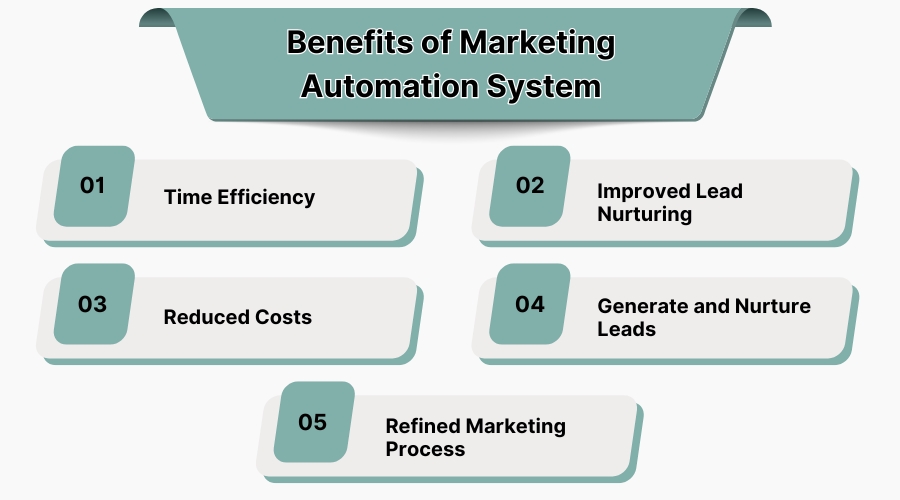
Using marketing automation software has its array of advantages which improves a business's marketing campaigns and profits. Some of the core enhancements include:
1. Time Efficiency
Automation increases efficiency by helping marketers execute repetitive actions like email sequences, social media updates, and follow-up calls. Now, instead of performing these basic tasks, marketing departments can devote their resources towards strategic and creative approaches, which increases efficiency.
2. Improved Lead Nurturing
Automation allows businesses to send timely, relevant messages to leads and prospects. Because of personalized relevance, businesses can stimulate interest and engagement on critical steps of the sales funnel and improve conversion rate.
3. Reduced Costs
Using automation reduces the need for great manual work which saves business expenses. The use of automation tools also increases efficiency while decreasing mistakes which more than compensates for previously incurred expenses.
4. Enhanced Lead Generation
Automation tools help capture leads across different channels. By scoring the managed leads, the business can focus on good prospects thus increasing leads and sales. If you have trouble with lead data management, the mobile forms automation software can come handy.
5. Refined Marketing Processes
Automation systems structured the marketing processes which guarantees improvement, consistency and efficiency. It ensures that there is better reporting on customer interaction and campaign activity for best decision making.
7. Choosing An Ideal Marketing Automation Platform
Several companies have different objectives with marketing automation, which assists in the enhancement of productivity.Following is a summary of defining factors that one should prioritize:
1. User Interface Design And Usability
Marketing professionals need tools that simplify their work. For modern marketing experts, the ability to create campaigns and analyze results offered from automation technologies should come without the need of spending too much time learning complex systems. Designers and programmers need to maintain a balance between graphical user interface (GUI) and functionalities. If the interface is too complicated or too simple it could result in unnecessary resources wasted.
2. Integration With Other Platforms
Any modern marketing automation tool should support a wide range of connections with other pre-existent tools, including Customer Relationship Management (CRM), Email Marketing Software, Analytics tools, and even online shopping platforms. The ability to work with other platforms simplifies and enhances their use from a customer perspective.
3. Personalization And Task Automation Options
A marketing automation tool has several basic tasks that should facilitate sending emails campaigns, scoring leads, and identifying target clients. Furthermore, personalization allows businesses to engage clients through AI-driven strategies and targeted messaging
4. Bolt-on Scalability and Flexibility
The software solutions of a business should grow with the business. Whether working with a couple of hundred leads or a few thousand contacts, a platform should be able to accommodate growing campaigns, data, and even sophisticated marketing approaches.
5. Analytics and Reporting
Digital marketing campaigns have to be analyzed in detail for rational decisions to be made. This leads to the need for having a well-integrated reporting and analytic system which measures campaign activity, sales conversions, customer interactions, and ROI. You can also use an accounts payable automation software to manage the funds efficiently.
6. Lead Management and Scoring
Efficient lead management features facilitate capturing, nurturing, and converting leads. The platform must enable sales teams to focus on the leads that matter by scoring leads depending on their activities, engagement, and other demographic information.
7. Omnichannel Marketing Skills
Marketing is no longer just about sending emails. A sophisticated platform should allow for SMS, social media, webinars, website marketing, and any other forms of communication which together form a seamless integrated marketing approach.
8. Customer Support and Training Resources
Support from IT experts is important when it comes to setting up a system. Opt for one who guarantees service around the clock and who provides documents, educational videos, and lessons for better use of the program.
9. Pricing & Cost Efficiency
The prices of marketing automation software differ by model. There are subscription-based, feature-based, and enterprise pricing models. It is advisable for firms to analyze their budget allocation and conduct a comparison of the features provided in order to obtain a reasonable and value-based solution.
8. Conclusion
SaaS Adviser guarantees marketing automation services that best fit your company’s requirements. From lead scoring to funnel automations and email marketing, SaaS Adviser makes sure that you receive the best tools in marketing automation service. Moreover, SaaS Adviser allows businesses to evaluate tools by giving them detailed reviews, comparisons and professional advice.
