
Best E-commerce Platforms in
Are you looking for E-commerce Platforms for your Business in ? SaaS Adviser brings you the best E-commerce Platforms to ease your worries. In order to make your work smooth and swift, SaaS Adviser has compiled a list of the best software available. Compare the Best software features, pricing, free demo, and trial to select the best E-commerce Platforms for your organization.
 Researched and Written by Nikita Rao
Top 3 Featured Softwares


List of Top E-commerce Platforms
Get Free Consultation


Drupal Commerce
Solving your complex ecommerce needs using design & technology.The Drupal Association is a non-income enterprise. It helps the Drupal task and network with investment, infrastructure, and occasions. Funded by personal and business enterprise i...
View Profile

Wallester

White-Label Card Issuing
Wallester is a financial technology company based in Estonia, specializing in digital payment solutions, including white-label Visa card issuance, expense management, and API-drive...
View Profile

Omnisend is a comprehensive marketing automation platform specifically designed for e-commerce businesses to enhance their customer engagement and drive sales through person...
View Profile

Zoho Forms is a versatile online form builder that allows businesses to create forms for various purposes, from simple contact forms to complex enterprise-level workflows. It enabl...
View Profile

Wortal CRM
best crm softwareWortal is a customer relationship management (CRM) software designed to help businesses manage their customer interactions, streamline sales processes, and enhance overall customer...
View Profile

CBO ERP (Centralized Business Operations ERP) is an advanced enterprise resource planning solution designed to help businesses streamline their operations, improve efficiency, ...
View Profile

Agile CRM
The best Email marketing softwareAgile CRM Automate your sales, marketing, and service in one platform. Avoid data leaks and enable consistent messaging, Make the most of Agile's modern features ...
View Profile
.png "ZipERP")
ZipERP
Web based, fully integrated softwareZipERP is a smart Web based ERP solution primarily designed for Micro and Small enterprises looking for a cost effective solution which can enable them to quickly move away from cu...
View Profile

MailerLite
The best Email marketing softwareMailerLite have websites which are keep growing your email list, email compaigns which are build and manage emails with ease, automation which are target and segment subscrib...
View Profile

Sender.net is email marketing software designed to save users time and boost response rates. It offers an easy-to-use interface with features like a WYSIWYG email editor, drip ca...
View Profile

Magento Commerce
Have all the selling opportunities with Magento CommerceMagento Commerce is a platform best balancing the functionality offering and the cost of ownership. 200,000+ retailers successfully build their businesses around Magento Commerce.
View Profile

Bolt
Shockingly simple checkoutBolt can be implemented quickly and is quite versatile. Get in touch with e-commerce systems like BigCommerce, Magento, and PrestaShop without trouble. Install it quickly and allow...
View Profile

Dubb is a video hosting platform designed to create relationships and close business sales offers. It's a sales-driven video platform that lets you share videos from a screen or ...
View Profile

FinoForce
Scalability is our IdentityFinoForce is a main IT organization mastery in all sorts of online arrangements with a built-up mark in India. They are specialists in MLM Solution and Website development custom m...
View Profile

TFAT ERP
Best ERP for SME-Best Manufacturing ERPWhat is TFAT ERP?TFAT ERP is a comprehensive enterprise resource planning solution designed to unify and streamline business operations. It supports key functions like finance,...
View Profile

Kibo eCommerce
By Kibo eCommerce
Kibo eCommerce is a modern, multi-tenant SaaS solution that is built with top-rated commerce functionality and great extensibility to support the most unique customizations. Kibo...
View Profile

Shiprocket is an e-commerce shipping solution that aims to reduce shipping costs, improve shipping quality, automate shipping activities, and provide customers with a better expe...
View Profile

Simplio3D
3D product configurator ecommerceOnline 3d product configurator platform to create interactive and engaging 3D visualizations to pump-up lead generation, sales and increase conversion rates.
View Profile

Smart H2R
Smart AI based HRMS & Payroll softwareSmartH2R modules shape an intersection in between Human Resource Management (HRM) and Information Technology. It merges HRM as a discipline and in particular it’s basic HR activi...
View Profile

Personalization Engine
AI Powered Personalization EngineVue.ai's Personalization engine helps retailers grow revenue multi-fold with the power of A.I. that constantly learns and re-learns customer behavior as it relates to their busines...
View Profile

Table of Content
The best eCommerce tools helps companies in streamlining online operation, increasing sales and providing smooth customer experiences. These solutions ease every step of your online journey, whether it involves product management and secure payments, or marketing automation and analytics. Explore the Top eCommerce tools in USA designed for scalability and efficiency, and choose the best eCommerce management software to grow your store, improve customer satisfaction, and stay ahead in the competitive online marketplace.
1. Conclusion
The choice of the best eCommerce tools allows the business to grow, achieve business efficiency, and be scalable. Be it a startup or an established business, sales and customer experience can always be enhanced by a good strategic platform investment. SaaS Adviser offers unparalleled support to businesses looking for perfect eCommerce management tools tailored specifically to their requirements.
2. What are the Key Features of E-Commerce Tools?
 (1).jpg)
1. Marketing Tools
The professional eCommerce tools are loaded with functions such as email marketing, social media, and SEO tools. These characteristics multiply traffic and sales to the business because they contribute to customer acquisition and enhance the conversion rates.
2. Central Database
The powerful features of a centralized eCommerce management tools stores product details, customer information, and order history in one place. This assures effortless inventory management, expedite data access, enhanced decision making.
3. Website Builder
A user-friendly Custom Drag-and-Drop Interface enables businesses to develop appealing ecommerce sites that are responsive on mobile devices. Brand consistency and the user experience is enhanced with custom templates alongside easy navigation.
4. Automated Checkout Process
Automated streamlined checkout assists in lowering the loss of sales due to abandoned shopping baskets. Customer satisfaction and sales assist with features such as multiple and secure payment methods, one-click checkout, and SSL secured payment gateways.
5. Data Analytics
E-commerce tools has the capability to monitor in real-time customer analytics, sales and marketing stats, and other activities. This allows businesses to make changes to the stock, campaign, set prices, and alter plans for greater profit.
3. Top 5 Best E-Commerce Tools in USA (Features, Pros, Cons, Pricing)
1. Shopify
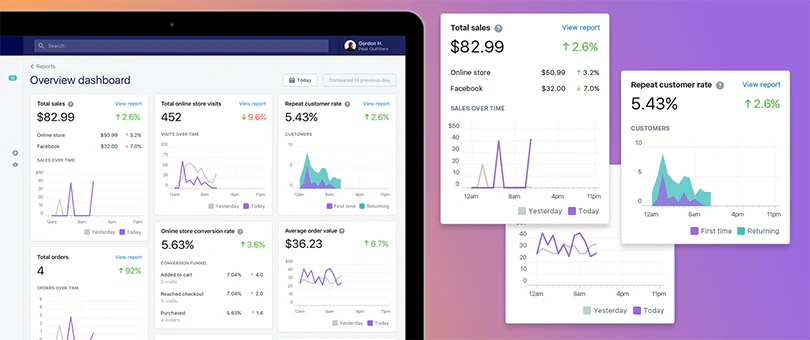
Shopify is perhaps the most widespread eCommerce tools solution in the US, with their easy user interface. Its comprehensive nature enables users to develop, build, and run an online store by offering services that are fundamental like marketing, hosting, inventory control, taking payments, and many more. The powerful functions of Shopify can be used by both start-up and enterprise brands. You don't need to have another inventory management software if you have Shopify.
Features:
-
Drag-and-drop website builder with fully customizable templates
-
Multiple currencies and payment options are accepted through a secure payment gateway
-
Advanced inventory and order management tools ensure smooth operations
-
Customer experience boosts with mobile-responsive store design
Pros:
-
No coding or technical skills needed which makes the system simple to use
-
Hundreds of add-ons and functionalities offered through an extensive app marketplace
-
Equally suitable for small and large businesses as they are highly scalable
Cons:
-
Use of other payment processors incur higher transaction fees
-
Customization flexibility is limited compared to open-source competitors like WooCommerce
Pricing:
-
Basic: $39/month
-
Shopify: $105/month
-
Advanced: $399/month
2. Wix
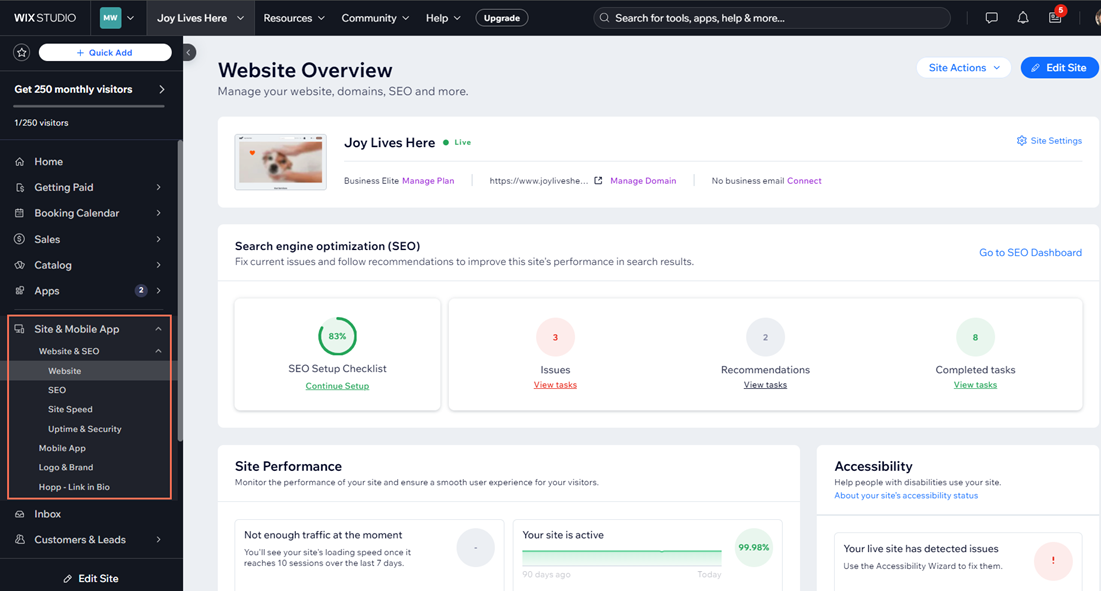
Best described as eCommerce tool for beginners, Wix allows businesses to create professional online stores within a matter of minutes. It features an AI-driven drag-and-drop website builder, which makes it suitable for small businesses and startups wanting a sophisticated store without any coding knowledge.
Features:
-
With the use of artificial intelligence, a custom website can be created using one of the hundreds of available templates.
-
Various modes of payment can be accepted through the website as payment integration is included.
-
An inventory and shipping management system helps improve the control of logistics.
-
The mobile version of the store is adjusted to be user-friendly.
Pros:
-
It is effortless for someone with no computer or programming skills to create an online store.
-
Pricing plans are reasonable, making it ideal for cost-conscious companies.
-
An abundant selection of design templates and customization options is offered.
-
There is advanced blogging and integrated marketing tools available to help attract visitors and increase sales.
Cons:
-
Less advanced features compared to other eCommerce tools mandates like Shopify.
-
Additional transaction costs are incurred when using third-party payment service providers instead of Wix Payments.
Pricing:
-
Business Basic: $27 a month
-
Business Unlimited: $32 a month
-
Business VIP: $59 a month
3. BigCommerce
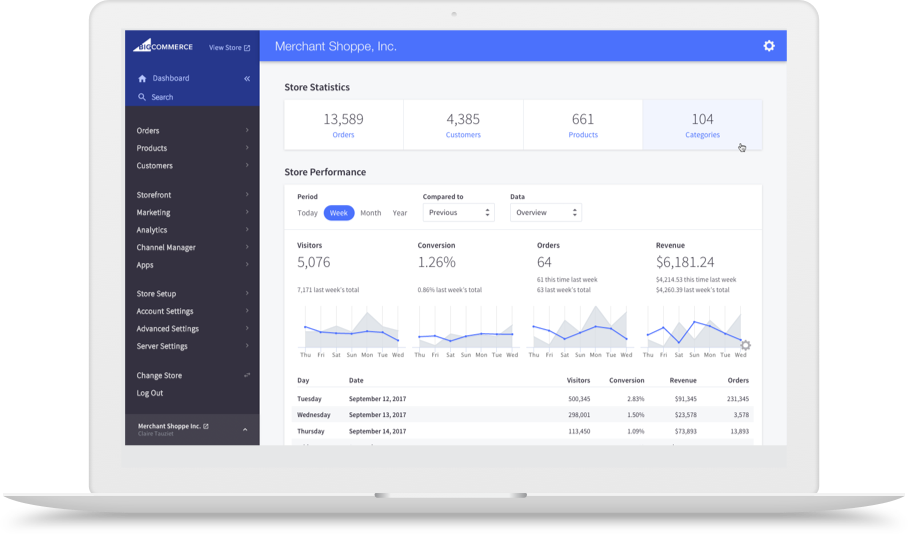
BigCommerce is tools designed to manage eCommerce for both established enterprises and businesses looking to grow. Businesses that are looking to scale tend to favor it because it has powerful customization options, multi-channel selling capabilities, and enterprise-grade features without incurring extra costs per transaction.
Features:
-
Storefronts are fully customizable and include responsive and mobile friendly templates.
-
Sales can be done on multiple channels such as Amazon, eBay, and Instagram
-
For every plan selected, there are no transaction fees which increases profitability for businesses.
-
Advanced analytics are available along with full SEO options, marketing automation, and other built in tools.
Pros:
-
All-in-one features are available which lessen the need for third-party applications.
-
All major credit cards are accepted with no additional transaction fees per payment, per order.
-
Companies that are medium or large would greatly benefit because it is highly scalable.
Cons:
-
Compared to some competitors, premium features are available at a higher price.
-
Compared to Shopify and Wix, there are free theme options that are much more limited.
Pricing:
-
Standard: $39 a month
-
Plus: $105 a month
-
Pro: $399 a month
4. WooCommerce
WooCommerce is amongst the most sophisticated eCommerce systems designed uniquely for users of WordPress. As a flexible solution, it enables full access to store layout, product catalog, and customer relations, which makes it an outstanding choice for any business. It is tailored for businesses seeking a hosted eCommerce solution that is easily modifiable and has no limitations on scaling.
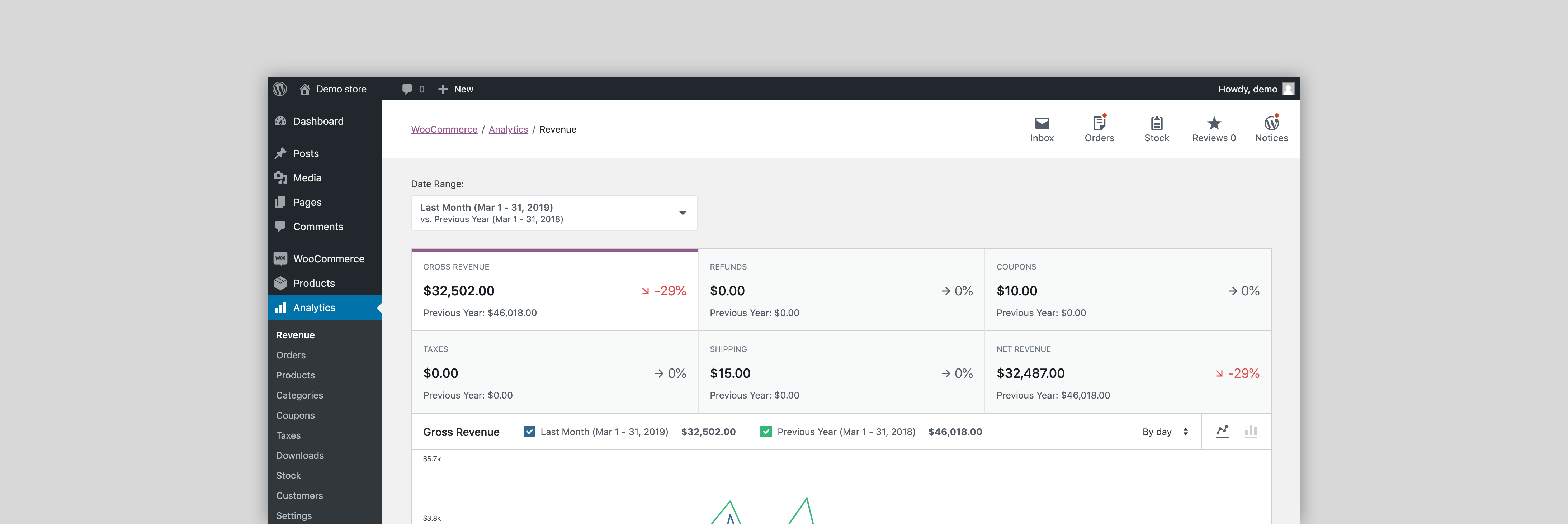
Features:
-
Allows full customization and advanced design flexibility as an open-source platform.
-
It has effortless integration with WordPress which supports thousands of themes and plugins.
-
Includes PayPal, Stripe, and direct bank transfers of multiple payment gateways.
-
Has an extensive plugin library with additional features for marketing, analytics, and automation.
-
Users have access to basic eCommerce SEO tools which help in improving search visibility.
Pros:
-
Installation is free and there are many low-cost extensions available.
-
Complete control over the design, functions, and features of a website is granted.
-
Web based stores of any size from starting startups to large enterprise level are all supported.
Cons:
-
Management and setup of the tools requires prior knowledge of WordPress.
-
The costs of hosting, domain registration, and premium extensions may become expensive.
-
Responsibility for security, backups, and maintenance of the website lies on the owner.
Pricing:
-
Installation of the core tool is free of charge.
-
Premium plugins are available from free up to $299+ and themes start at the same price.
5. GoDaddy
The eCommerce tools from GoDaddy serves users with an all-in-one option which is perfect for those looking for a complete online store solution. For small business owners and beginners, GoDaddy's advanced AI website builder alongside built-in marketing tools and secure payment processors make it an ideal choice.
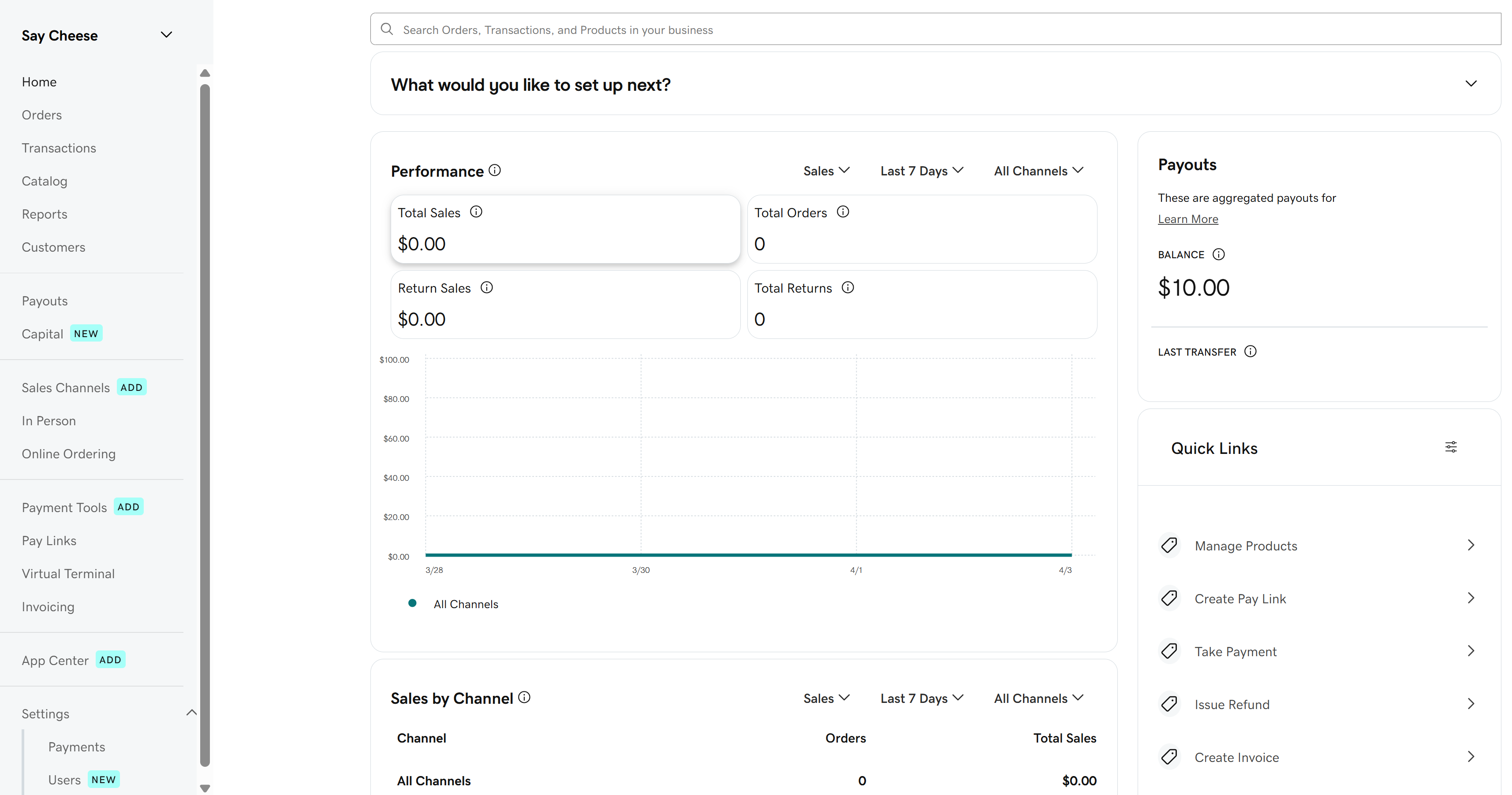
Features:
-
Highly intuitive website creation tool using AI technology that allows drag and drop features
-
Payment processing made easy with integrations from PayPal, Stripe, and Square
-
Enhanced outbound marketing capabilities through integrated social media, email marketing, and built-in SEO tools
-
Quick Mobile Optimized page designs to provide an effortless shopping journey
-
Effective order tracking and fulfillment through inventory and shipping management tools
Pros:
-
An extremely easy setup is guaranteed making this ideal for those who are not technologically inclined
-
All business owners can take advantage since no coding skills are needed
-
Flexible pricing options suitable for small businesses/startups at low-cost
-
Convenience is also improved since it includes hosting, domain registration, and SSL security
Cons:
-
Customizability is limited in comparison to WooCommerce and Shopify
-
Lacks more advanced tools for businesses looking to scale
-
Some third party payment gateways may incur transaction costs
Pricing:
-
Basic: $9.99/month
-
Standard: $14.99/month
-
Premium: $19.99/month
-
ECommerce: $29.99/month
4. What Are The Benefits Of E-Commerce Tools?
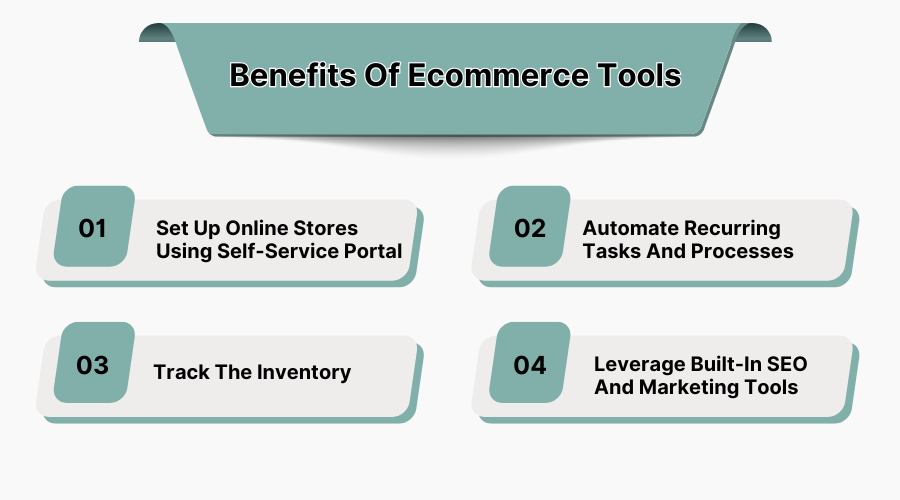
1. Set Up Online Stores Using Self-Service Portal
Online stores can be created without any prior knowledge of web design courtesy of the drag and drop user interface electronic commerce tools provides alongside set templates and dashboards. This is the ideal low to no code knowledge endsolution.
2. Automate Recurring Tasks And Processes
Recurring work such as notifying customers, order processing and payment is handled through ecommerce management tools. Manual work is reduced through automation which helps boost efficiency and most importantly the customer experience.
3. Track The Inventory
The integrated ecommerce tools help businesses to be in-touch with stock levels after they have been sold, thus doing away with chances of overstocking associated with time-consuming manual restocking. This feature will guarantee that the business operations are not affected and the purchase orders are not overlooked.
4. Leverage Built-In Seo And Marketing Tools
Specialized eCommerce tools services provide support in SEO related tasks, assists in advertising via emails, and allows the linking of social media accounts. These features give businesses tools to boost their online presence, improve website or page traffic, and increase the number of sales picked.
5. What Are The Different Types Of E-Commerce Tools?
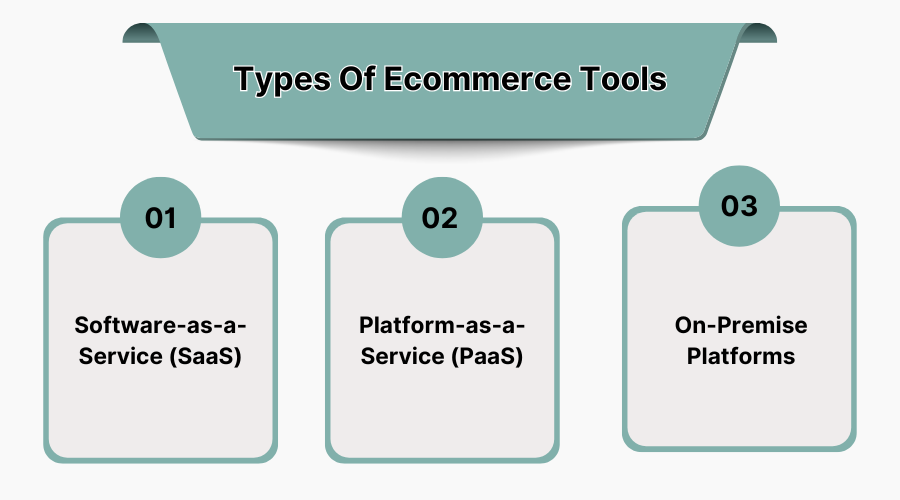
1. Software-as-a-Service (SaaS)
SaaS e-commerce solutions allow businesses to design and operate online stores assuming they have no technical knowledge through e-commerce hosted tools. They offer inclusive hosting, automatic security and updates which is very appealing to a SME business.
2. Platform-as-a-Service (PaaS)
PaaS e-commerce solutions offer a more flexible approach through customizable frameworks which help businesses build and scale their online stores. Unlike SaaS solutions, they offer the ability to use other applications and customize working parts to suit the business needs.
3. On-Premise Platforms
On-Premise Platforms are installed in the company servers where a business can have complete control in customization, security and performance. It fits best with large businesses and enterprises that require greater security, scalability and tailored business processes.
6. What are ECommerce Tools?
An eCommerce tool is a platform that allows companies to electronically sell their goods and services. It contains a website builder, stock management, payment processing, and a customer relationship management system. With the right e-commerce tools, selling goods and services online can be made efficient as all processes are streamlined.
Most ecommerce companies have a self-hosted solution or offer it in the cloud for ease of access. Marketing, analytics, and logistic functionalities combine with electronic commerce tool to improve sales strategies. From small businesses to large enterprises, ecommerce management tools enables automation, scalability, and efficient transaction management for online stores.
The E-Commerce Platform Market was valued at USD 8.47 billion in 2025 and is expected to attain USD 26.50 billion by 2034.
