
Best Small Business HR Software in
Are you looking for Small Business HR Software for your Business in ? SaaS Adviser brings you the best Small Business HR Software to ease your worries. In order to make your work smooth and swift, SaaS Adviser has compiled a list of the best software available. Compare the Best software features, pricing, free demo, and trial to select the best Small Business HR Software for your organization.
 Researched and Written by Akash Patel
Top 3 Featured Softwares


List of Top Small Business HR Software
Get Free Consultation

Humaans

By Humaans
Humaans is a modern, user-friendly HR software designed to help organizations efficiently manage their people operations. Built for speed and flexibility, Humaans streamlines c...
View Profile

Atlas-Workforce Management
Workforce Management Solution to Hire and Pay Staff Globally – Atlas HXM
Atlas enables innovative companies to compete in a global economy, believing that businesses should employ whomever they want, wherever the talent exists. As the largest Dir...
View Profile

Zoho Payroll is a cloud-based payroll platform designed to simplify payroll management and streamline business operations. It ensures compliance with labor and statutory regula...
View Profile

What is Lever?Lever is a present day, cloud-primarily based expertise acquisition suite that mixes applicant tracking, candidate relationship control, and recruitment a...
View Profile

Emgage
HR Simplified!Emgage is a cloud-based Human Resource Management System (HRMS) designed to simplify HR operations for small and medium-sized businesses (SMBs) and enterprises. It offers a com...
View Profile

KENJO
Digital HR and Shift Planning for your deskless workforce
Kenjo is an all-in-one Human Resource Management System (HRMS) tailored for small and mid-sized businesses, particularly those with frontline and deskless workforces. It c...
View Profile
Nitso HRMS
Following ExcellencyWhat is Nitso HRMS? Nitso HRMS is an all-in-one Human Resource Management System designed to simplify and automate day-to-day HR tasks. It provides a centralized platform to manag...
View Profile
PayrollMexico
PEO in Mexico. Employer of Record (EOR). Hiring in Mexico.
PayrollMexico, also known as Human Resources Mexico (HRM), is a professional Employer of Record (EOR) and Professional Employer Organization (PEO) service dedicated exclusively...
View Profile
ADP (Automatic Data Processing) is a global provider of cloud-based human capital management (HCM) solutions. It offers software and services to handle payroll, HR, talent manageme...
View Profile
.jpg "People Hum")
People Hum
A people management platform built for peoplepeople Hum is the Human Capital Platform built for the next decade. The winner of the 2019 Global Codie award, used by organizations around the world.
View Profile
Connect HR
All-in-One HR SoftwareWhat is Connect HR?Connect HR is an advanced cloud-based Human Resource Management System (HRMS) that helps businesses of all sizes streamline and automate their HR and payroll...
View Profile
.png "HRMWage")
HRMWage
Simplify Your HR TasksHRMWage is an HR Management Software that manages and optimizes the day-to-day HR professional's tasks.
View Profile
Velocity Global
Transparent EOR pricing that helps you grow
What is Velocity Global?Velocity Global is a comprehensive global workforce management platform that enables companies to hire, manage, and support employees in over 185 countr...
View Profile

Medlin Payroll is a fully featured Payroll Software designed to serve Startups, Agencies. Medlin Payroll provides end-to-end solutions designed for Windows. This online Payroll...
View Profile
_mid.jpg "HRMantra : HR & Payroll software")
HRMantra streamlines Time and Attendance Management prudently on multiple platforms like Mobile, Desktop, and Biometric. It streamlines the HR and payroll process and other all...
View Profile
DigiSME
HR Software for Small & Medium BusinessesWe offer a robust & comprehensible HRMS Software with modules that proves beneficial for your HR Management. Modules that can help with staff training, onboarding, payrolls and...
View Profile
SutiHR is a cloud-based human resource management software designed to streamline and automate HR processes for businesses of all sizes. From employee onboarding and performanc...
View Profile
iSpring Learn is a powerful cloud-based Learning Management System (LMS) designed to deliver and manage online training programs efficiently. It enables organizations to train ...
View Profile
airSlate Academy
Transform your document experience with automationWhat is airSlate Academy?AirSlate Academy is an online educational platform designed to teach individuals and businesses how to automate workflows using AirSlate’s no-code automa...
View Profile
Bambee
By BambeeBambee is a cloud-based HR management solution designed specifically for small businesses, offering an affordable and efficient way to handle human resources. Unlike traditional HR...
View Profile

Table of Content
What is Small Business HR Software?
Small Business HR Software assists small business owners in automating routine tasks and saving time. With it, you do not have to maintain multiple systems for payroll, hiring and onboarding, attendance tracking, benefits administration, and compliance.The software’s user-friendly nature reduces the chances of errors and saves time for small businesses where HR tasks are typically performed by a manager or one employee.Small Business HR Software platforms also offer employee self-service, so that they can do tasks like ask for time off, change their information, or see their pay data without having to go through HR. It also helps you focus on growth, employee engagement, and long-term success by making regular tasks easier, offering you immediate reports, and helping you comply with labour obligations.
1. Latest Market Trends in Best Small Business HR Software
HR technology is evolving quickly, driven by shifts in workplace culture, remote work adoption, and advancements in automation. A report from Business.com says that in recent times, about 3.2 million small and medium businesses use cloud-based HR software to handle their human resources tasks. We have listed some of the latest trends in Small Business HR software.
1. Cloud-Based Solutions
Cloud deployment is now the norm for modern HR tools. It allows businesses to access employee information, payroll details, and compliance records wherever there is a web connection. You can operate from home or in a hybrid way without needing to deal with on-site servers or complicated IT setups. It also helps small firms maintain their software up to date and grow without needing to acquire new infrastructure.
2. AI-Powered Features
HR specialists can use AI to assist with reviewing job applications, tracking employees who might leave, and personalizing employee training and development. AI can speed up the process for small organizations in identifying the best people, so they can put their time and effort into other important matters. AI chatbots can provide an employee with HR responses instantly and address pressing requests from employees, which helps organizations alleviate the burden on small HR teams.
3. Integrated Workflows
Modern small business HR software works well with other essential tools like accounting programs, customer relationship management, and project management systems. This connection helps avoid entering the same information multiple times and keeps data consistent across teams. For small businesses with limited staff, having everything connected makes it easier to make decisions and see how the business is running as a whole. Using the best HR software for startups ensures that even early-stage companies can benefit from these integrations and streamline their operations efficiently.
4. Focus on Employee Experience
Companies are realizing that HR software is not just for administrative efficiency—it’s also a key driver of employee satisfaction and retention. Platforms now include features like pulse surveys, recognition programs, and career growth tracking to create a more engaging workplace. This focus on employee experience helps small businesses attract top talent and maintain morale in competitive labor markets.
5. Data Analytics and Reporting
Advanced reporting capabilities allow businesses to track workforce metrics such as turnover rates, productivity trends, and hiring timelines in real time. These insights support data-driven decision-making, helping small business owners identify problem areas before they escalate. The ability to generate visual dashboards also makes it easier for managers to communicate workforce performance to stakeholders
2. How to Choose an HR System for Your Small Business
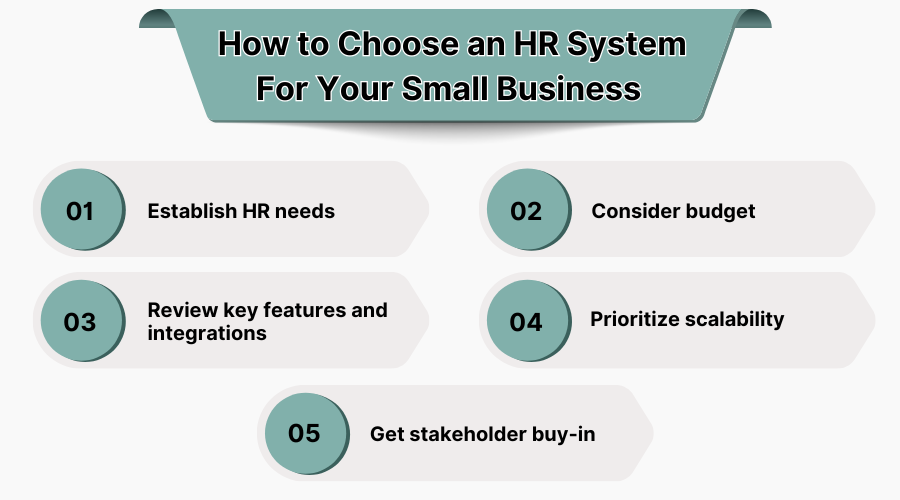
HR technology is evolving quickly, driven by shifts in workplace culture, remote work adoption, and advancements in automation. A report from Business.com says that in recent times, about 3.2 million small and medium businesses use cloud-based HR software to handle their human resources tasks. We have listed some of the latest trends in Small Business HR software.
1. Cloud-Based Solutions
Cloud deployment is now the norm for modern HR tools. It allows businesses to access employee information, payroll details, and compliance records wherever there is a web connection. You can operate from home or in a hybrid way without needing to deal with on-site servers or complicated IT setups. It also helps small firms maintain their software up to date and grow without needing to acquire new infrastructure.
2. AI-Powered Features
HR specialists can use AI to assist with reviewing job applications, tracking employees who might leave, and personalizing employee training and development. AI can speed up the process for small organizations in identifying the best people, so they can put their time and effort into other important matters. AI chatbots can provide an employee with HR responses instantly and address pressing requests from employees, which helps organizations alleviate the burden on small HR teams.
3. Integrated Workflows
Modern small business HR software works well with other essential tools like accounting programs, customer relationship management, and project management systems. This connection helps avoid entering the same information multiple times and keeps data consistent across teams. For small businesses with limited staff, having everything connected makes it easier to make decisions and see how the business is running as a whole. HR data analytics software can further enhance this by providing actionable insights into workforce trends, performance metrics, and overall HR effectiveness.
4. Focus on Employee Experience
Companies are realizing that HR software is not just for administrative efficiency—it’s also a key driver of employee satisfaction and retention. Platforms now include features like pulse surveys, recognition programs, and career growth tracking to create a more engaging workplace. This focus on employee experience helps small businesses attract top talent and maintain morale in competitive labor markets.
5. Data Analytics and Reporting
Advanced reporting capabilities allow businesses to track workforce metrics such as turnover rates, productivity trends, and hiring timelines in real time. These insights support data-driven decision-making, helping small business owners identify problem areas before they escalate. The ability to generate visual dashboards also makes it easier for managers to communicate workforce performance to stakeholders
3. Conclusion
Selecting HR software is not merely a matter of checking boxes on a list of features; it is about identifying a product that aligns with the way your company operates. A platform that is right for you can save you time, reduce paperwork, and make your team more productive. From recruitment to performance management, payroll, and insights into your data, it is all made easier when it is stored in one location. It is important to take time to compare options, test demos, and select a solution that seems intuitive to your organization. The right choice now will make people management simpler for the company in the long run.
4. Benefits of Small Business HR Software
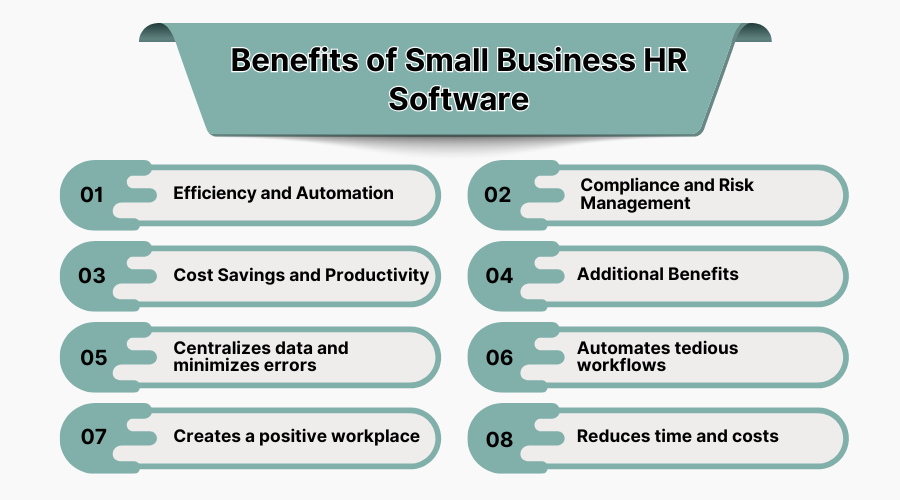
Small Business HR Software should be selected carefully, and make sure that it connects well with the company’s existing system. The best software for your company can save you a lot of time by handling small tasks and giving you clear information, which will help you make better decisions
1. Efficiency and Automation
Instead of using spreadsheets to approve vacation, payroll, and benefits, modern HR systems use automated processes. Most small business HR software reviews center on how effective it is. Task automation also reduces the amount of time wasted due to needless delays. This means a manager can focus on business growth rather than mundane administrative tasks. This is especially helpful when the team is small.
2. Compliance and Risk Management
It is not an easy job to stay current with labor law and taxation regulations. HR software helps to produce compliance-ready reports and safely store applicable documents. Integrated time tracking guarantees accurate salaries, lowering the risks of penalties or litigation. This is a key driver behind growing small business HR software USA adoption.
3. Cost Savings and Productivity
The mechanization of payroll, benefits, and reporting functions allows businesses to save hours of repetitive and expensive mistakes. Today, what previously took a half day can now be done in minutes. In the end, businesses report higher productivity, and this gives them a greater ROI.
4. Additional Benefits
It keeps all of the employee information in one location, improving accuracy and making information easy to find. Onboarding software, digital forms, and training modules are included in most platforms to simplify hiring. Analytics also allow you to view engagement and retention trends. These tools save you time and enable you to construct a stronger, more engaged workplace culture.
5. Centralizes Data and Minimizes Errors
Having all staff data—ranging from contracts to training records—in one location reduces the likelihood of duplicates or mistakes. When combined with payroll software, having data in one location ensures accurate salary computation and tax refunds every time. It also becomes easier for managers to get quick insights without needing to dig through a lot of dispersed files.
6. Automates Tedious Workflows
Processes such as leave tracking, shift scheduling, and expense reimbursements are fully automated. This is highly important for firms that use applicant tracking software. It can automate recruitment and employee onboarding processes to ensure that no task or candidate is forgotten.
7. Creates a Positive Workplace
Self-service portals allow employees to request time off, view their paychecks, or make changes to their information without having to wait for HR. Tools like employee engagement software in US assist with gathering feedback and celebrating successes, which helps in maintaining employee satisfaction and thus makes them more likely to work for the company for a long time.
8. Reduces Time and Costs
Moreover, the use of employee attendance helps companies save on lost work hours by automating tasks. It also empowers HR to access real-time workforce data, which makes it easier to make better decisions.
5. Features of Small Business HR Software
A good HR system must be more than an electronic filing cabinet—it must actively serve your hiring, onboarding, SaaS performance management, and payroll requirements.
1. Time and Attendance Tracking and Absence Management
With employee attendance SaaS, all is automated, and employees can clock in and out. Payroll disputes are prevented, and proper staffing levels are ensured even during the busiest of business times. There are even systems that have mobile clock-ins and geolocation in them, where remote or field workers can record their working hours accurately.
2. Payroll Processing
Automated payroll software USA can manage multi-state compliance, overtime computation, and direct deposit without manual intervention. This ensures not just speed but also precision, which is important for maintaining employee confidence. Most solutions also support tax filing systems, thereby eliminating the possibility of late or erroneous filings.
3. Benefits Administration
Employee benefits like health coverage or retirement schemes could be difficult to manage for small enterprises. The program can fully automate the process for the employee during the enrollment phase. It also helps companies look at different benefit options and choose the best one.
4. Employee Database Management
The centralization of employee profiles enables HR to generate accurate reports. More so, the system makes succession planning easier since the data is readily available when a person is promoted or changes roles. With proper connections, these databases can be linked to talent management solutions, enhancing workforce planning. Online HR platforms further simplify these processes by providing cloud-based access to employee data and analytics.
5. Recruitment & Hiring
An applicant tracking software advertises job openings, filters resumes, and automates interview scheduling. This allows small companies to bring the best prospects on board, which would otherwise be impossible since it would stretch their resources. Additionally, certain systems make use of artificial intelligence (AI) to improve job candidate matching.
6. Employee Onboarding Tools
Onboarding software can automate forms and other documents, send welcome kits, and provide training modules to the new employees. So, the process turns out to be smooth and efficient because no important detail is missed in the first days of work. A few apps even include automated tracking of progress, with which the manager can ensure that each new hire reaches training milestones timely.
6. Five Best Small Business HR Software USA
Finding the right HR platform can make a big difference for small businesses when it comes to hiring, paying employees, and keeping them motivated. Here are five top options in the U.S., each with its strengths and weaknesses to help you decide.
1. BambooHR
BambooHR is an HR cloud-based talent management solution that will suit small to mid-sized businesses. It has a clean and simple design, which is easy to use, making it suitable for teams without an HR department. It will do all of your hiring and onboarding, as well as maintain employee records. It even comes with built-in workforce data analysis tools, which will assist business owners in making informed decisions regarding their team.
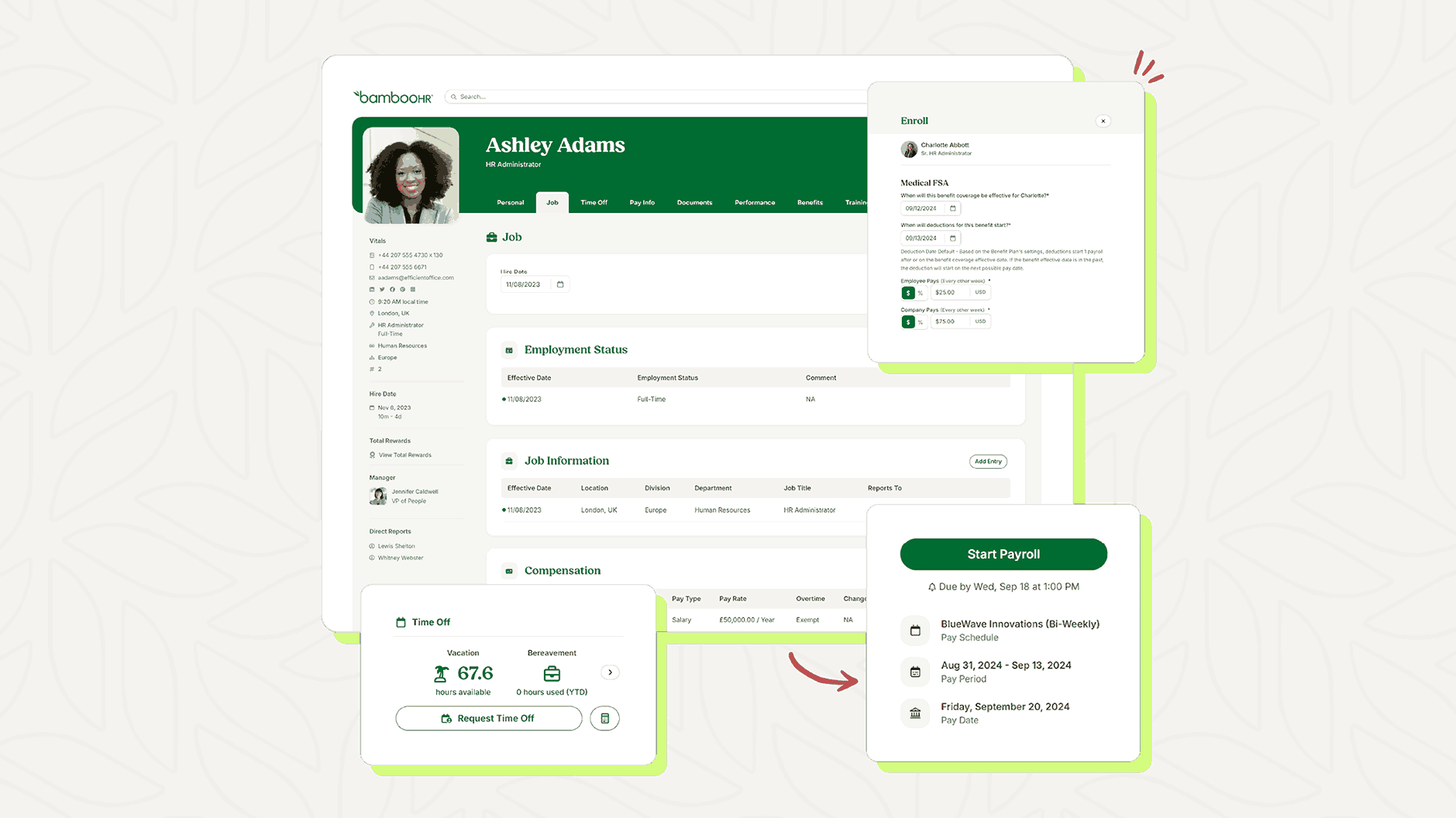
Features:
-
Applicant tracking system (ATS) for streamlined hiring
-
Employee self-service portal
-
Performance management tools
-
Time-off tracking
-
Mobile app for on-the-go access
Pros:
-
Easy to use with a clear and simple design
-
Strong employee engagement and performance tools
Cons:
-
Limited payroll capabilities in the base plan
-
Reporting customization can be restrictive
Pricing: Visit the website for customized pricing
2. Gusto
Gusto began as a payroll program, but it has since expanded into a complete HR platform that makes it easier to handle payroll, benefits, and compliance all in one location. It is popular because of straightforward pricing and simple processes, which are easy to use. This makes it a good choice for small business owners who don't have an HR department.
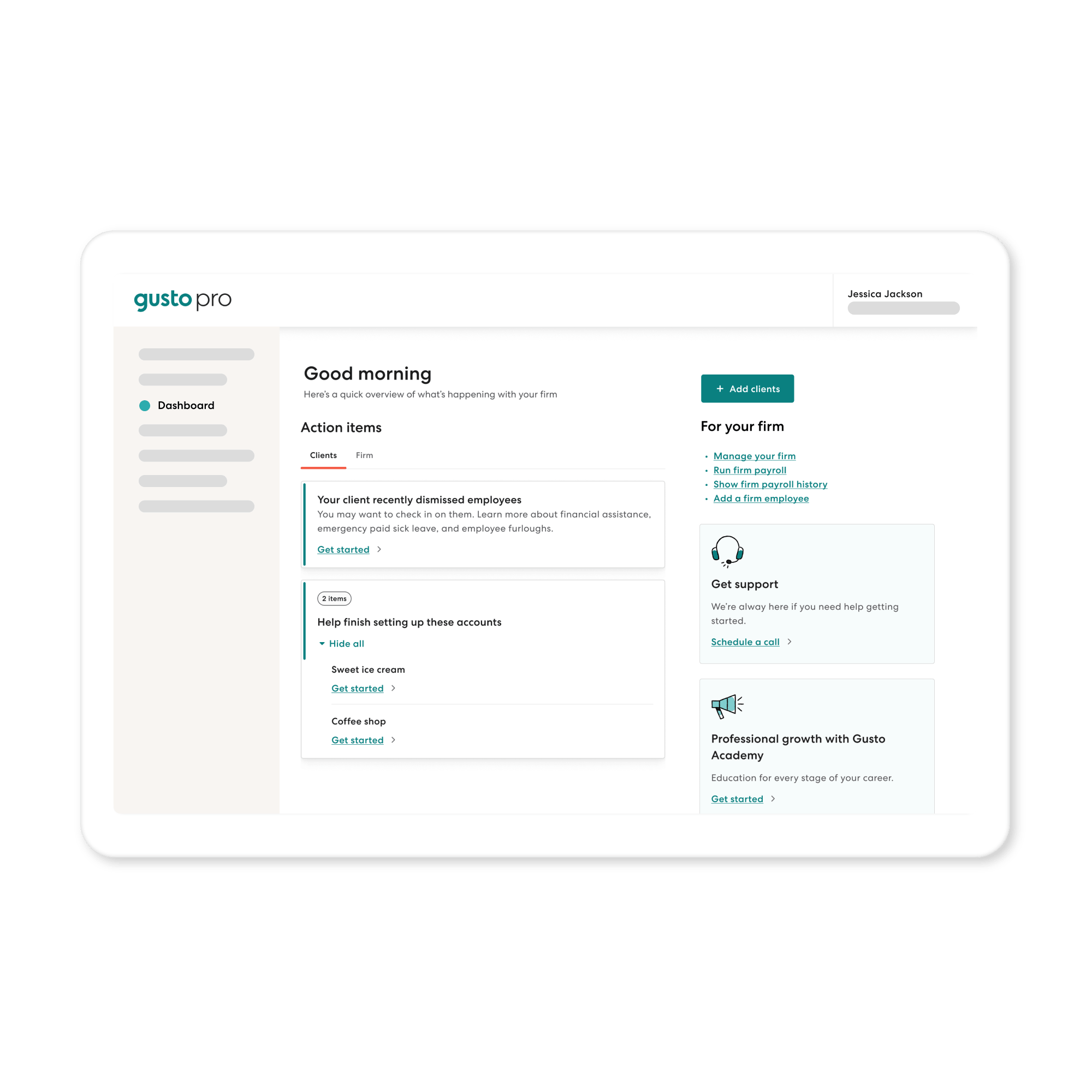
Features:
-
Automated payroll with multi-state tax filing
-
Provides benefits administration
-
Time tracking and PTO management
-
Hiring and onboarding checklists
-
Compliance alerts and document e-signing
Pros:
-
Excellent payroll and tax compliance automation
-
Easy to use and simple to navigate.
Cons:
-
Limited global payroll support
-
No advanced performance management module
Pricing: Pricing starts at $80/month + $12/mo per person
3. Zoho People
Zoho People is an affordable and scalable employee attendance SaaS solution that conveniently fits into the small business budget. You have the option of what modules you wish to select and add more as your team expands. As it is within the larger Zoho framework, it integrates perfectly with other tools that you may be employing. The system has an app for mobiles that assists the remote and field workers to clock in and out, request leave, and maintain their data.
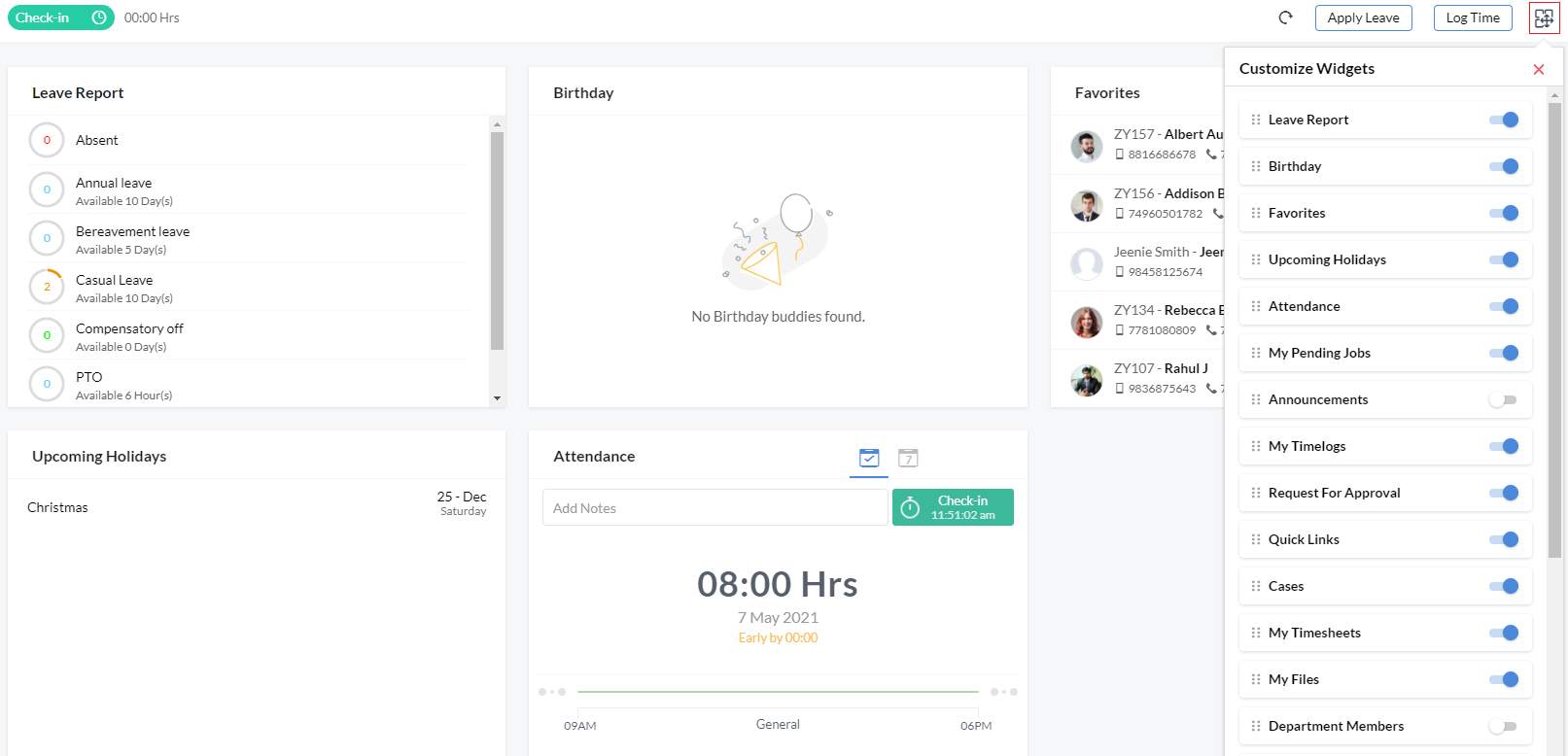
Features:
-
Attendance and shift scheduling
-
Leave management with automated accruals
-
Employee database with document storage
-
Workflow automation
-
Performance appraisal management
Pros:
-
Highly customizable workflows
-
Strong core HR features
Cons:
-
Advanced features require add-ons
-
May require external integrations for advanced analytics and reporting.
Pricing: Pricing starts at $0.55/user/month, billed annually. Offers a free trial
4. HiBob
HiBob is a modern employee engagement software in US, built for today’s remote and hybrid teams. Many new businesses and firms that are growing quickly like it since it helps them retain their culture while scaling. HiBob's social media-style interface makes HR tasks feel more interactive and keeps everyone connected, even if they are working from home or in the office.
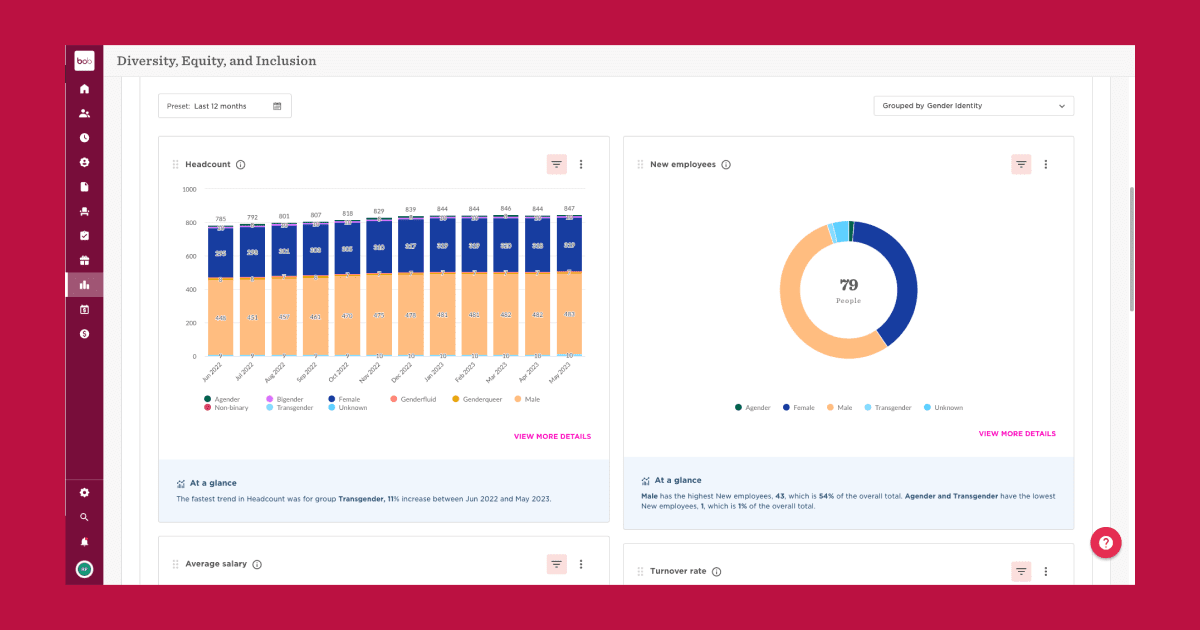
Features:
-
It has a central database for employee info that you can customize.
-
It gives performance management with 360-degree reviews and goal tracking.
-
It tracks time and attendance easily, with automatic approvals and reminders.
-
It has integrated recruitment and applicant tracking (ATS).
-
It gives people analytics for data-driven HR insights and reporting.
Pros:
-
Excellent tools for remote team culture
-
Modern, intuitive user interface
Cons:
-
Mobile app functionality is less robust than the desktop version.
-
Configurability might not be as extensive as larger global HRIS solutions.
Pricing: Visit the website for customized pricing
5. Rippling
Rippling is an all-in-one best talent acquisition software and IT management solution that integrates HR, payroll, benefits, and even device management in one system. This is great for small organizations that want to manage people and technology without having to jump between different solutions. Rippling has strong automation features that cut down on unnecessary effort and make sure everything runs properly, from hiring new employees to setting up their laptops.
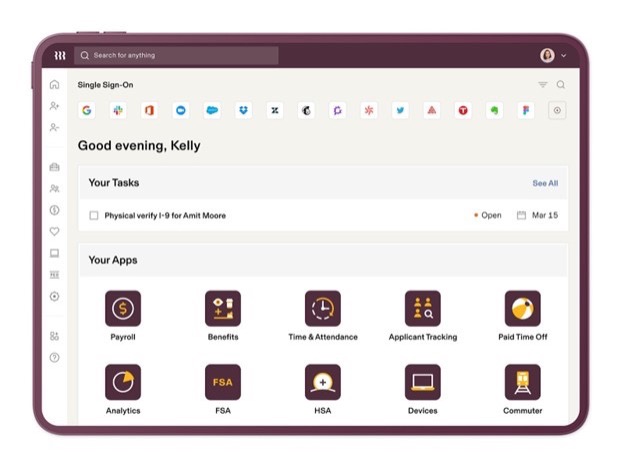
Features:
-
Payroll processing and tax filing
-
Benefits and compliance tracking
-
Automated onboarding, including device and app provisioning.
-
Device and app management for employees
-
Custom workflow automation
Pros:
-
Combines HR and IT in one platform
-
Strong automation and integration capabilities
Cons:
-
Reporting features can be limited in customization and lack depth.
-
Some modules require additional purchase
Pricing: Pricing starts at $15/employee/month + $35/month base fee
7. HR System Challenges for Small Businesses
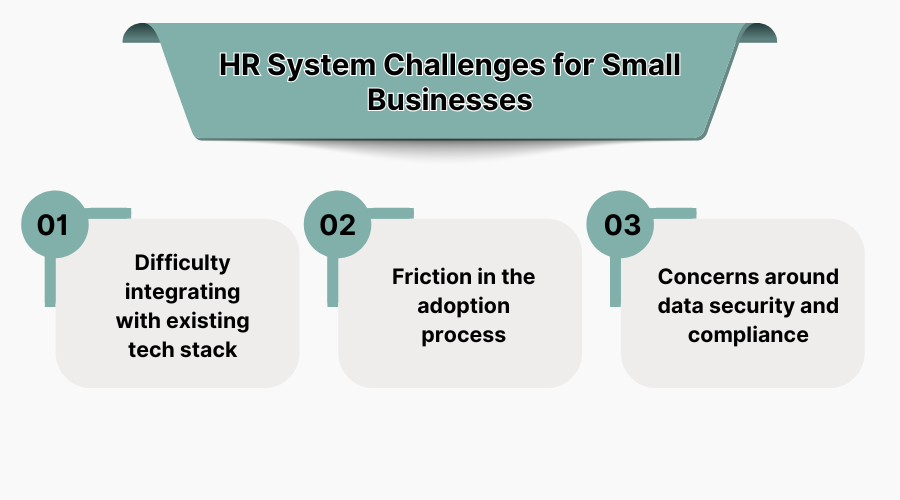
Though HR software has numerous advantages, small companies encounter many challenges while implementing and streamlining HR software solutions.
1. Difficulty Integrating with Existing Tech Stack
One of the bigger issues for small businesses is integrating new HR software with existing systems, including accounting software and CRMs.Without smooth integration, teams will have to manually enter the same information in multiple systems. The problem can be reduced by partnering with workforce management software vendors that offer built-in integrations or APIs with their software.
2. Friction in the Adoption Process
If an employee is comfortable with the existing way of doing things, they will resist a new HR system when it is introduced in the organization. Training and communication in an organization should be clear and precise. Low or poor adoption will be experienced where the employees are not well trained, or communication is inefficient. It would be a good idea for the organization to roll out the system step by step and offer help to employees during and after the implementation
3. Concerns Around Data Security and Compliance
HR software stores sensitive payroll and employee records, making security a top concern. Platforms should have encryption, role-based permissions, and compliance updates to keep up with changing labor laws and safeguard against legal liabilities. HR Chatbot Software can complement these systems by providing secure, guided assistance to employees while ensuring sensitive information is handled correctly.
