
Best Benefits Administration Software in
Are you looking for Benefits Administration Software for your Business in ? SaaS Adviser brings you the best Benefits Administration Software to ease your worries. In order to make your work smooth and swift, SaaS Adviser has compiled a list of the best software available. Compare the Best software features, pricing, free demo, and trial to select the best Benefits Administration Software for your organization.
 Researched and Written by Akash Patel
Top 3 Featured Softwares


List of Top Benefits Administration Software

Get Free Consultation


Deel is a cloud-based global payroll and compliance platform designed to help businesses hire, manage, and pay remote employees and contractors across 150+ countries. By provid...
View Profile

ebm

Meet your new benefits technology department
ebm is a business management software designed to optimize various operational aspects. It aims to enhance efficiency by integrating key functions such as CRM, ERP modules, project...
View Profile

optavise
We guide employees to make informed healthcare decisions
Optavise is a trusted benefits partner for business owners and human resources professionals who work hard to build and maintain a healthy, happy workforce.
View Profile
Selerix BenSelect
By Selerix BenSelect
Selerix Systems produces software (Selerix BenSelect and Selerix Engage) that is used by employers, brokers & carriers to facilitate employee engagement, benefits administratio...
View Profile
Businessolver
Benefits Administration Technology, Powered by People
Businessolver is the creator of Benefitsolver, a cloud-primarily based, single-source, SaaS platform which affords a advanced advantages administration solution. Our total ...
View Profile

abs125
LATEST NEWS, ONLINE STORES & MOBILE APPS
Advanced Benefit Strategies (ABS), founded in 1993, is a third party administrator of pre-tax employee benefits.
View Profile

CobraHelp
Your COBRA and HR compliance administrator should be too.
COBRA - State Continuation - Retiree Billing - ACA Compliance - HR Solutions - Broker & Consultant PartnershipsWith nearly forty years of COBRA and ERISA experience, CobraH...
View Profile

Your Money Line
Change your employees’ financial lives
What Is Your Money Line?Your Money Line is a powerful financial wellness software that helps employees take control of their finances with confidence. This secure, cloud-based ...
View Profile

What is Rippling?Rippling is an all-in-one workforce management software that unifies HR, IT, and finance functions on a single platform. It enables businesses to manage payrol...
View Profile

APS Payroll is a cloud-based payroll and human capital management (HCM) software designed to help businesses streamline payroll processing, tax compliance, HR functions, and workfo...
View Profile

Native Teams
Your Global Platform for for Work Payments
Native Teams is a comprehensive workforce management platform designed to streamline the hiring, payment, and administration of remote employees across the globe. Serving as a ...
View Profile

What is Paychex Flex? Paychex Flex is a U.S.-developed, cloud-based human capital management (HCM) software built to simplify payroll, HR, and benefits administration for ...
View Profile

Papaya Global is a cloud-based workforce management and payroll software designed to simplify global hiring, payroll processing, and compliance. Established in 2016, Papaya Glo...
View Profile

Remote
Scale 13x faster with Remote
Remote is a cloud-based global HR and payroll platform designed to help businesses hire, manage, and pay employees and contractors worldwide. It simplifies international expans...
View Profile

Justworks Hours
By Justworks Hours
Rely on a mobile-first experience with geo-fencing, shift management, and automated alerts. Get more detailed information on timesheets, overtime and time off, payroll, expenses an...
View Profile

Maxwell Health
By Maxwell Health
Maxwell Health is a benefits and HR platform designed to simplify the process for small-to-mid-sized employers. The platform includes an intuitive marketplace for employees to bu...
View Profile

PlanSource is a technology company that creates a better benefits experience for employers and their employees. They approach benefits with a laser-like focus so that they can pr...
View Profile
PeopleKeep helps organizations offer hassle-free health benefits their employees love. They automate all the most time-consuming tasks like preparing and updating legal documenta...
View Profile
Omniprise
By Omniprise
OmnipriseCRM has revolutionized the way businesses manage their customer relationships by creating new iPhone and iPad apps. With these apps, customers can access the system on dem...
View Profile

Gym Insight
Software BY Gym InsightGyminsight the best gym management software makes it easier for you to handle your fitness center. This gym system is one of the best fitness center software and it can maintain al...
View Profile

Table of Content
Find the Best Benefits Administration Software
Effective employee benefits management has evolved into a vital competitive advantage for modern organizations. With organizations now managing multifaceted benefit packages, ranging from health insurance to various fringe benefits, the demand for technology that eases complexity has peaked.
Unlike other software solutions, Benefits Administration software distinguishes itself by automating essential activities. Such automation decreases the volume of manual errors and administrative tasks while providing real-time insights to enable HR teams to improve their benefit strategies. Furthermore, these portals facilitate greater transparency and employee satisfaction since all the team members can conveniently access and manage their benefits.
Let’s know more!
1. Who Uses Benefits Administration Software Systems?
1. HR Personnel:
The administration of benefits software is utilized mainly by the HR teams of the organization. They are responsible for employee enrollments, benefits plan updates, compliance tracking, and report generation. Such automation minimizes manual efforts while guaranteeing precision and effectiveness in benefits management. If you own an enterprise, we suggest you implement an enterprise HR software to smooth the process.
2. Managers:
These systems help managers keep track of the organization’s welfare activities. They check the analytics to see how the parameters of the plans are working and decide on the parameters that should assist in meeting the organizational objectives. This oversight helps analyze the costs and enhance the satisfaction levels of employees.
3. Employees:
Through user-friendly, self-service portals, employees access benefit administration software. They can enroll in their benefits, check them, and even make changes as necessary. This access empowers employees and provides a great deal of transparency and communication between staff and HR departments.
2. Conclusion:
We understood the fringe benefits definition and various intricacies of benefits software. A strong Benefits Administration software approach will greatly enhance your organization’s efficiency in HR dealings. These systems will automate online enrollments, interact with HR and payroll systems, and even automate compliance reporting, all of which will minimize errors, maximize efficiency, and enhance employee satisfaction. From Fringe to Gusto, every platform has attractive features suited for different organizations. The choice of software for effective benefits management is essential to remain competitive in the ever-changing business environment. For more expert insights and recommendations, explore SaaSAdviser.
3. Top 5 Benefit Administration Software System:
1. Fringe:
The highlight of the Fringe client benefits system is the management of fringe benefits. It also has an intuitive interface that simplifies setting up and administering fringe benefits, giving an accurate understanding of both fringe benefits' meaning and definition. Fringe works perfectly with HR systems, making it a perfect choice for organizations wanting to manage employee benefits efficiently.
Features:
- Manages fringe benefits efficiently
- Intuitive interface for easy administration
- Seamless HR system integration
Pros:
✔ Simplifies fringe benefits setup and management
✔ Ensures accurate benefits allocation
✔ Works well with existing HR platforms
Cons:
✖ Limited customization for specific company policies
✖ Focused mainly on fringe benefits, lacks broader HR tools
Pricing:
- $5 per employee per month (with a minimum fee of $200/mo)
2. Remote:
Remote enables companies to manage employee benefits for their distributed workforce with ease. The platform offers features like online benefits enrollment and compliance, catering to Remote’s broad audience. Accurate and-up-to date benefit data is captured and processed real time, reducing administrative work and increasing accuracy.
Features:
- Online benefits enrollment and compliance management
- Real-time data capture for accuracy
- Supports distributed workforce benefits administration
Pros:
✔ Ideal for remote teams and global workforce
✔ Reduces administrative workload through automation
✔ Ensures benefits data accuracy
Cons:
✖ May not be ideal for companies with localized operations
✖ Advanced features require higher-tier plans
Pricing:
- Recruit talent pricing is kept at $299
- Employer of record monthly pricing is $699
- HR Management is free!
3. Deel:
Deel has an international focus and builds tools for international employee benefits administration. It is multi-currency and multi-regulatory, so it is useful for companies operating in multiple jurisdictions. Deel’s employee benefits administration software is designed for usability, so all company employees can manage and access their benefits without any friction.
Features:
- Multi-currency and multi-regulatory compliance
- Global employee benefits management
- User-friendly interface for easy access
Pros:
✔ Best for international companies managing multiple locations
✔ Simplifies compliance across different regulations
✔ Provides frictionless benefits management for employees
Cons:
✖ Higher cost for advanced global features
✖ Complex setup for companies new to global HR solutions
Pricing:
- Deel US Payroll is the cheapest plan that starts at $19 per month. Deel EOR is the biggest plan at Deel, which is kept at $599 per month.
4. Rippling:
Rippling is best known for its remarkable consolidation of HR including payroll, benefits, and IT services. As a full-service provider, it automates essential processes like reporting and online benefits enrollment, lowering the probability of manual mistakes. Organizations wishing to scale their benefit administration services often turn to Rippling due to its customizable workflows.
Features:
- Integrates payroll, benefits, and IT services
- Automates reporting and online benefits enrollment
- Customizable workflows for scalability
Pros:
✔ All-in-one HR, payroll, and IT management
✔ Reduces manual errors through automation
✔ Scalable for growing organizations
Cons:
✖ Expensive for small businesses
✖ Requires training for full utilization of advanced features
Pricing:
- Rippling charges on a monthly subscription basis. The costs range from $21 to $29 per month per employee.
5. Gusto:
This online benefits enrollment software is famed for its affordable, easy-to-use solution that combines benefits, payroll, and HR services for easy management. The firm's employees’ benefits enrollment software is efficient in simplifying the choices employees have to make regarding their benefits. With its straightforward pricing and strong customer service, Gusto remains a preferred provider among small to medium enterprises that desire efficiency and value.
Features:
- Combines benefits, payroll, and HR services
- Easy employee benefits enrollment
- Transparent pricing and strong customer support
Pros:
✔ Budget-friendly for small and medium businesses
✔ Simplifies benefits selection and management
✔ User-friendly with excellent customer service
Cons:
✖ Limited advanced automation for large enterprises
✖ Customization options may not fit all businesses
Pricing:
- The monthly pricing for Gusto Core subscription is $39 per month. Concierge is the most expensive plan, which costs $USD149/month.
4. Pros of Using Benefit Administration Software:
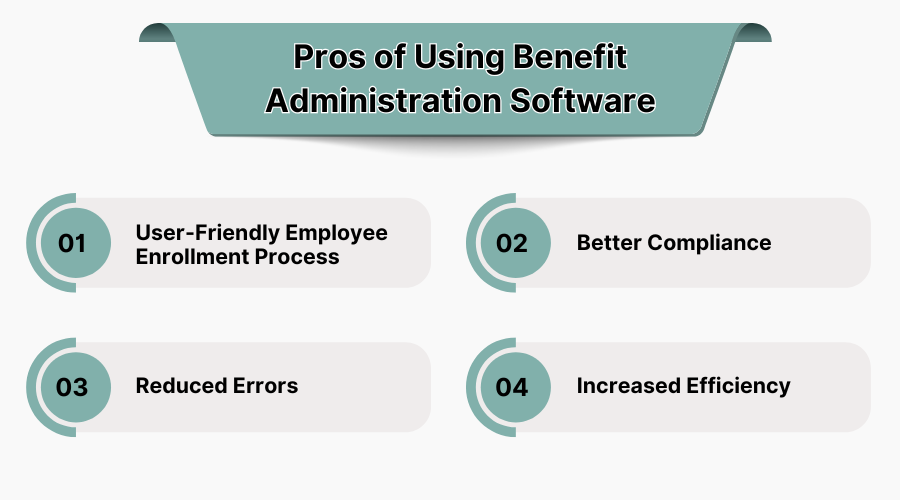
1. User-Friendly Employee Enrollment Process:
The use of benefit management software makes the process of employees enrolling in benefits offered by the company slower, thus ensuring that employees fully understand the entire procedure. This enhances the overall experience by ensuring employees select their benefits easily and accurately.
2. Better Compliance:
With integrated compliance management features, the software monitors pertinent regulation changes, processes documentation whenever recommended, and helps comply with laws and industry standards specific to the region. Timely and accurate reporting and proactive document management reduce potential legal issues for the organization and ensure compliance with relevant policies within the specified timeframe.
3. Reduced Errors:
Less manual data entry means lower chances of making mistakes. Beneficial software designs are always integrated with other features like HR and payroll, which guarantee correct and complete information on employee benefits throughout the entire organization. This enhances the benefits of record accuracy and reduces discrepancies.
4. Increased Efficiency:
Routine task automation and centralization of benefits data lead to increased productivity of personnel. Strategically, human resources is able to reallocate time from administrative duties to value-adding activities, which improves productivity of the firm and employee perception towards the organization as services offered become more efficient. Also, we suggest you check out employee performance software to ensure maximum productivity.
5. Cons of Using Benefit Administration Software:
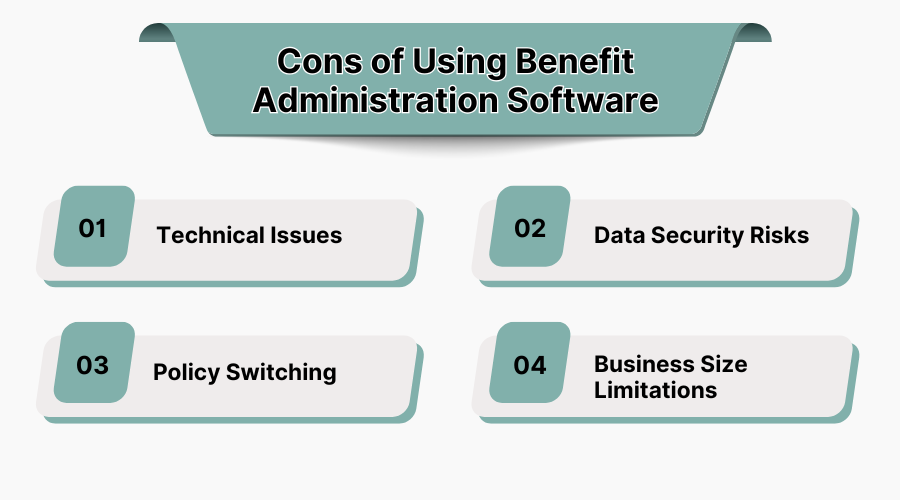
1. Technical Issues:
- Server Downtimes: Server outages can happen at any time, which can limit access and interfere with employee onboarding and servicing of administrative functions.
- Software Glitches: Defects or errors in the system may cause unsynchronized data, which disables the trust users have in the whole system.
- Less Customization: Some software applications, unlike in-house applications, may be less configurable, which limits the customizability of the software to the specific requirements of the organization.
2. Data Security Risks:
If appropriate security measures are not implemented, the sensitive data of employees being stored online can lead to a greater likelihood of cyberattacks and data breaches.
3. Policy Switching:
Benefits policies or regulatory changes, which happen quite often, require constant revisions, which have the potential to cause discrepancies and interruptions within the system.
4. Business Size Limitations:
While larger organizations are forced to have more adaptable, scalable solutions to meet their multifunctional requirements, smaller businesses might find the expense and intricacy of the software to be too extreme.
6. Why Use Benefit Administrative Systems?
The benefits administration software market size is expected to hit a market size worth $2,045.5 Million by 2032. Integrating comprehensive and up-to-date benefits plans and ensuring compliance with current regulations continues to pose an issue for modern HR departments. These complicated processes can be solved with the use of benefit administrative systems which fully automate the benefits process.
Given that these systems lower administrative overheads and manual errors, HR teams can transition into high-level strategic initiatives rather than focusing on daily processes. Employees can easily self-service their benefits through these systems, which simplify online benefits enrollment and benefits accessibility. This is critical when explaining fringe benefits and ensuring employees are provided with the proper information and options.
In addition to improved decision-making and reporting, these systems provide real-time data integration with HR and payroll software, which enhances a company’s reporting capabilities. Another primary strength lies in enhanced compliance management, as platforms assist organizations in meeting external and internal policy standards, effectively simplifying organizational compliance issues.
7. Features of Benefits Administration Software System:
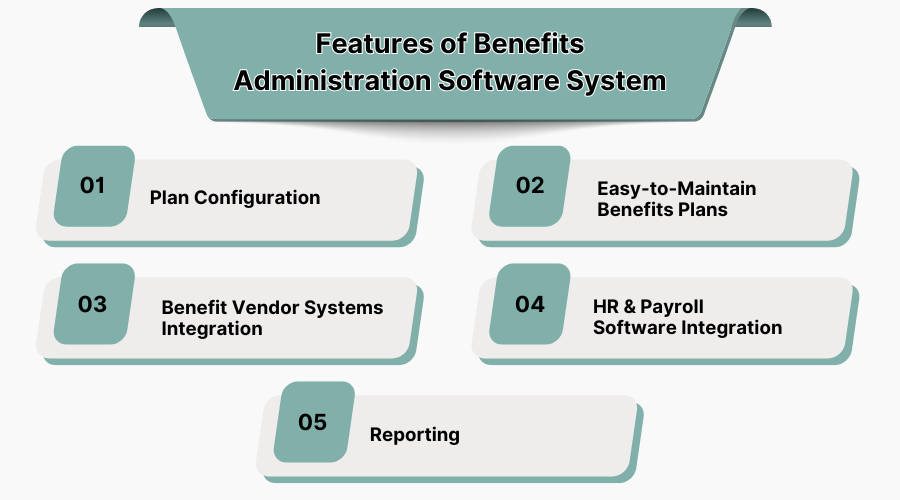
As with any software systems, benefits administration optimization comes with several features that aim to improve the quality and efficiency of employee benefits management. The areas this system has particular strengths:
1. Plan Configuration:
Effective benefits management cannot happen without effective plan configuration within Benefits Administration Software. It makes it easy for the HR teams to create, edit, and update employee’s benefits packages. The feature has a user-friendly experience for creating various options for benefits, which may include health insurance, retirement plans, fringe benefits, defining eligibility levels, and applying changes across the entire system.
2. Easy-to-Maintain Benefits Plans:
The interface is so intuitive that it is hard for HR teams to fail to create cost-effective benefits plans. The designed processes guarantee that employees are always accurately updated, no matter how frequently existing plans are renewed or new ones designed.
3. Benefit Vendor Systems Integration:
Having multiple benefits providers connected to an organization automatically allows other plans to be managed without the need for additional employee effort. Employees are assured of receiving the most current information from their selected vendors.
4. HR & Payroll Software Integration:
The software synchronizes with HR and payroll systems, which aids in data accuracy across different systems. This reduces enrollment errors and administrative workloads, further improving operational productivity.
5. Reporting:
The software includes powerful reporting capabilities that are important for monitoring the spending, utilization, and compliance of the organization’s benefits. It provides thorough reports and benefit utilization analytics, as well as real-time dashboards showing the performance of benefit programs. With this information, organizations can strategize on benefits allocation and regulatory compliance, making business decisions without guesswork.
8. Related Articles:
9. Types of Benefits Administration Software:
Legacy software for benefits administration purely manages employee benefits, whereas many new systems have advanced to provide full HR software integrated with background screening. These functions help organizations not only to manage benefits but also to maintain compliance with stringent hiring practices and policies. Below are the key types of screening functionalities often incorporated in benefits administration systems.
1. Criminal Checks:
Background checks are one of the most important safeguards incorporated within any organization's benefits administration system because they help ensure workplace safety. Existing and incoming employees are automatically checked for any criminal records. Such investigations assist in detecting previous legal disputes that may pose a threat or risk within an organization.
By automating this process, employers are able to mitigate the risks of workplace violence by filtering out unsuitable applicants in a timely manner. All information is processed in a confidential manner, thus maintaining employee privacy while complying with legal and ethical standards.
2. Credit Background Checks:
For some roles that involve a financial degree of trust or the handling of sensitive monetary information, credit background trace examinations are required. These examinations verify the subject’s credit report and other financial dealings, which helps evaluate their trustworthiness.
In cases where the staff is responsible for the custody of cash or has access to important financial facilities, knowing how an employee uses credit may be essential in managing potential fraud or competent spending risks. Placing credit checks in the benefits administration systems not only provides additional security but also fosters a responsibility culture.
3. Drug Testing:
In many cases, the prevention of inefficient work performance alongside ensuring workplace safety means that drug testing must be conducted on a regular basis, which many benefits administration systems feature as a scheduling and management module. Automated functionalities for drug testing guarantee that policies regarding the use of drugs at the workplace are adhered to.
It serves not only in the early detection of substance abuse but also helps reinforce attempts to monitor a disciplined, health-conscious, and productive workforce. From a non-administrative burden perspective, this automation enables organizations to maintain a commitment to safety by streamlining the scheduling and tracking of tests and results.
4. Professional License Checks:
In industries with strict regulations, credential verification plays an important role in making sure that compliance is met, and that high standards are maintained. Professional license verification guarantees that employees possess the appropriate, relevant certifications and have fulfilled all regulatory obligations.
This is particularly important in healthcare, engineering, and finance, where the industry’s performance competency and safety are determined by having the right license issued. Professional license verification can be seamlessly integrated within benefits administration, thus enabling effortless record maintenance and guaranteeing that all employees’ qualifications are up-to- date and relevant.
10. What is Benefits Administration Software?
Let’s understand the fringe benefits first. It’s a non-monetary compensation offered to employees and their normal wages. Benefits Administration software is an application that simplifies the ongoing complexities of managing employee benefits, including enrollment, payment, compliance, and reporting, to eliminate redundancy and errors. It acts as a single point of contact for human resources departments for all activities such as vendor enrollment to benefit compliance and everything in between.
The employee benefits administration software, substitutes most of the manual processes associated with managing benefits with automated processes. This covers anything from administering benefit packages, allocating fringe benefits, and even modifying employee’s status or eligibility. Coupled with human resources and payroll systems, it helps maintain organizational data integrity and accuracy.
