
What we'll cover
Share with your community!


Get Free Consultation


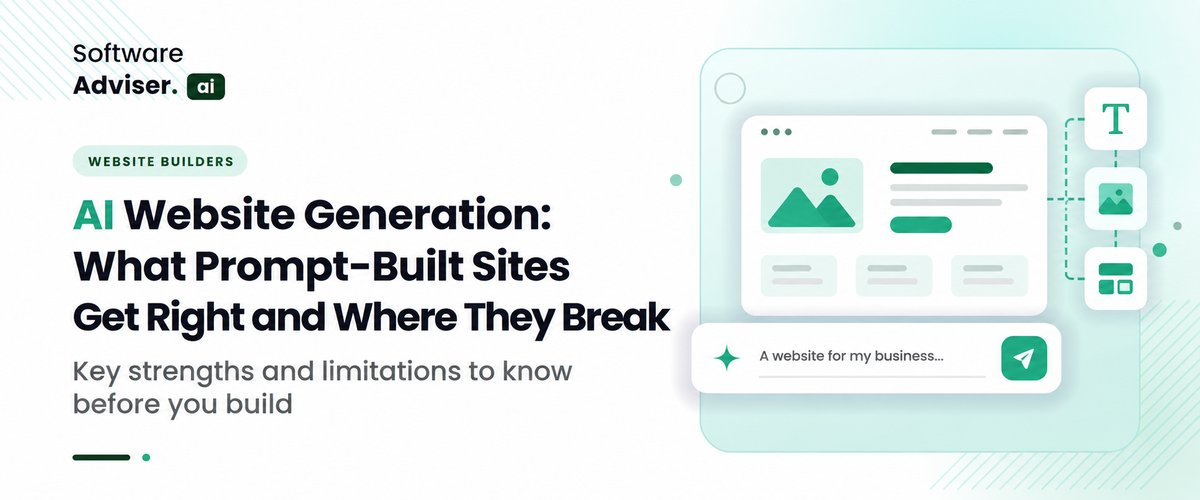
AI Website Generation: What Prompt-Built Sites Get Right and Where They Break
 Dokas mile
Prompt-powered AI website-making applications are revolutionizing web design in the US economy, where North America has over 40 percent of the global market share, and minimizes weeks-long creation processes to mere minutes. Small companies in the States, new ventures, and creative firms increasingly turn to ordinary language requests to deliver functional web pages and web applications for a small fraction of typical developers’ costs. However, although prompt-to-site programs are good at speeding up the deployment and democratizing design, they face serious obstacles when dealing with complicated or enterprise-level requests.
What is AI Website Generation?
AI website generation is the technology for making websites on its own using algorithms that come to life through artificial intelligence, meaning that it needs only a text version of what the customer wants. A customer does not need to create code anymore because he or she only needs to provide some information about the business, target customers, and particular aspects of a layout. The use of such technology means that websites can be created with the help of the latest technology that will revolutionize web development, making it an easy and instant job.
The trend is radically changing how American small enterprises, startups, and AI event marketing operate in the marketplace. By diminishing launch periods from weeks to minutes, prompt-built websites have created an opportunity for entrepreneurs to examine business concepts while conducting targeted ad campaigns and leaving their digital mark on the internet without spending a lot of money that is usually required by official agencies.
Though these tools are beneficial in terms of their designs, they do not replace the necessity of using qualified human resources to consider brand messaging, designing back-end databases, and improving the site for tough competition in the US market.
Do You Know?
The North American market of artificial intelligence website builders instigates the trend towards the creation of instant software around the world. AI-builders are expected to reach the level of several billion dollars in the near future. However, it is noteworthy that almost 60 percent of small business owners utilizing AI website creators have reported using this technology mainly for creating quick landing pages for various product tests and marketing experiments.
What makes AI Site Builders so Fast for MVPs?
- No Setup Hassle: Unlike traditional methods where selecting tech stacks and configuring hosting environments requires a lot of setup time, modern AI services take care of everything.
- Prompt to Graphic Conversion: Rather than making wireframes or design systems to create products, AI makes layouts, responsive grids, and navigational elements with just a prompt.
- Content Done Automatically: Instead of working with copywriters or writing boring text, startup founders are able to get headlines, value propositions, call to actions, and such from AI автоматом.
- Boilerplate Backend Integration: Almost all the standard MVP logic such as basic authentication, forms, databases, and payments is taken care of by modern technologies.
- Immediate Parallel Testing: Now founders can test multiple versions of their landing pages or app interfaces at the same time without going into full development.
What are the Design Limits of AI Websites?
- Using Similar Design Aesthetics: Because generative designers utilize similar AI training management system datasets, these similar design layouts appear across different websites, leading to standard layout implementations and design repetition by many websites.
- Rigidity in Design Systems: The prompts fail to produce elaborate systems,
sophisticated grid configurations, typography scales, and complex spatial arrangements without modifications. - Inability for Interactive Animations: Complicated micro-animations and canvas animations are yet to be recreated through coding instead of AI.
- Loss of Brand Specificity: Converting brand principles such as branding weight, branding features, and branding icons into designs leads to generic solutions in many instances.
- Problems with Manual Modification: Changing the AI-generated design components then brings problems with CSS coding of redesigning the website through the already edited designs.
- Disrupted Level of Content Hierarchy: Prompts in many cases produce simple structures that do not comply with complex data-driven website structure and layered product catalogs.
What Technical Walls Do Prompt-Built Sites Hit?
1. Architectural Decline (Prompt Sprawl)
- The Problem: The problem faced is the absence of long-term memory in AI tools necessary for remembering the whole context of the codebase. As features are added through the use of natural language, the generator is responsible for producing similar utility functions, mismatched state logic, and diverging styles.
- The Technical Barrier: The codebase gets too complicated when little modifications are made, leading developers to abandon the prompt-made codebase and code the application from scratch.
2. Stateful and Multi-Tenant Data Complications
- The Problem: The tools for making prompts work easily provide the ability to create CRUD forms connected to lightweight hosted databases like Firebase or Supabase. However, the creation of complex relations cannot be performed efficiently.
- The Technical Wall: Inability to cope with the tasks connected to real-time WebSockets synchronization, RBAC, multi-tenancy, and complicated transactions without any programming of backend systems.
3. State Management and Heavy Client Performance
- The Problem: It is common to see that many models simply load all state management on top-level client components and fail to structure proper SSR, global state trees, or server actions.
- The Technical Obstacle: The result will be memory leaks, needless re-renders, slow first-page load, and a shaky application state when user interactions get more sophisticated than pure linear.
4. External Integration and Webhook Reliability
- The Problem: The prompts can connect to most of the simple API endpoints, such as a standard Stripe checkout flow, but edge cases seem to be very challenging for them.
- The Technical Obstacle: It’s common to either fail silently or expose hard-coded secrets during the asynchronous processing of webhooks, rate limitations of APIs, retries, and refresh cycles of OAuth tokens.
What is the impact of AI Sites on Google Rankings?
Google does not take sides on the ways in which content is produced and focuses on the quality of websites instead. Unfortunately, in practice, AI-generated websites have issues with their quality and structure that affect their search ranking.
- Prioritize E-E-A-T Over Content Source: In accordance with Google’s guidelines for ranking, websites are assessed based on their Experience, Expertise, Authoritativeness, and Trustworthiness (E-E-A-T). Although automated pages that provide accurate and useful content could score high on Google’s ranking system, those that provide poor, generic content without verification risk being downgraded quickly.
- Eliminating Scaled Content Abuse: Google prefers sites that provide authentic content created by its own employees or authors instead of generating low-value, template-based pages created by artificial intelligence.
- Loss of Information Gain: Although artificial intelligence writing software is known for its automated content-generation abilities, it is still dependent on existing data found online. This means that websites using writing software for generating random content fail to provide “Information Gain” to the readers.
- Technical Issues Associated with Writing Programs: It is well known that the quality of webpages built with writing software is often compromised by technical hindrances, poor-quality code, and poor mobile versions.
- Optimization for AI Descriptions (GEOs): Well-designed AI webpages that take advantage of the proper formatting via JSON-LD schema and the direct-answer format, as well as crisp headings, are referred to in Google AI Descriptions, which still enable them to gain traffic at a time when conventional organic CTRs are declining.
- Susceptibility to Core & Spam Updates: Websites that are completely created using AI generators with no editorial control are the ones suffering the most from Google’s algorithmic updates, particularly facing a drastic drop in traffic during the quality sweeps.

Pro-tip
Treat the site as the first draft instead of the finished product. Always perform manual edits of the site to include the unique content, case studies, and information about the author. Remove unnecessary auto-generated code and apply the structured schema (like Article, FAQ, HowTo, etc.) in order to enable Google to easily index the information on the webpages. In addition, make sure that the first 200 words of each key page give an answer to the question that the potential visitor has in mind using lists and summaries.
What are the Risks of AI Platform Lock-in?
If a company's software relies on one vendor’s lock-in platform, it generates too many technical and operational risks because a company’s products, workflows, and pipelines tightly integrated into the lock-in platform. One of the most severe technical risks is the resulting technological dependency, so that the exclusive vendor API cannot migrate or export its product or technology to other platforms. If a vendor increases prices, abandons major models, or modifies the general terms of the service, it will lead to incurable problems with the adaptability of the product and complete breakdown of the entire company's operation process.
From a financial and strategic standpoint, technology lock-in severely hampers future innovation and efficiency. Due to the ongoing developments in the AI field, locked-in organizations cannot implement new innovative models faster, at a lower price or of better quality developed by other vendors or open-source communities. Businesses also lose their bargaining power when renegotiating new contracts and face risks associated with high and unpredictable costs of API tokens. Moreover, in case of a system failure or termination of crucial features by a service provider, businesses heavily reliant on such a vendor will have immediate consequences without a chance of transferring operations to an alternative provider.
Being dependent on one AI platform leads to serious issues in terms of compliance, governance, and security. Most proprietary platforms are essentially black boxes, making auditing of processes related to confidential corporate data quite a challenge. Locked-in businesses may fail to comply with such regulations as the EU AI Act or strict laws on data sovereignty that provide for transparency of models, tracking and auditing of processes, and specific data residency requirements.
Conclusion
Prompt-built websites may be the fastest to implement and the easiest in terms of startup costs, but they lack custom design and offer fewer advantages on the back end. Moving through this quickly changing ecosystem means choosing your technology carefully, utilizing tools that correspond to your desired outcome. To get an overview of the best AI site builders and enterprise tech stacks on the market, visit softwareadviser.ai to learn about the best platforms and compare their verified features.
FAQ's
No, AI platforms excel at rapidly generating initial design layouts and boilerplate code, but complex business logic, backend security, and custom API integrations still require human developers.
Yes, provided you manually optimize the auto-generated code, add original human-written content, and configure proper structured schema data.
It depends on the platform; tools like Bolt.new or v0 allow clean code exports, whereas proprietary visual builders often lock your site into their hosted ecosystem.
Basic frontend components are generally secure, but AI-generated custom backend logic often lacks advanced CSRF protection, secure auth cycles, or proper environment variable handling.
Most AI generators automatically create responsive desktop layouts, but manual adjustments are usually required to perfect mobile spacing, touch targets, and load speeds.

The integration of artificial intelligence across US factory floors is no longer a futuristic concept it is a baseline requirement for operational eff [...]

David N. Wilks
Nowadays, many look for immediate solutions when issues arise a single delayed answer might lead them elsewhere. This reality adds significance to com [...]
David N. Wilks
Marketing teams are drowning under a heavy wave of unstructured digital assets. The speed of creative execution forces content departments to manage t [...]