
What we'll cover
Share with your community!


Get Free Consultation
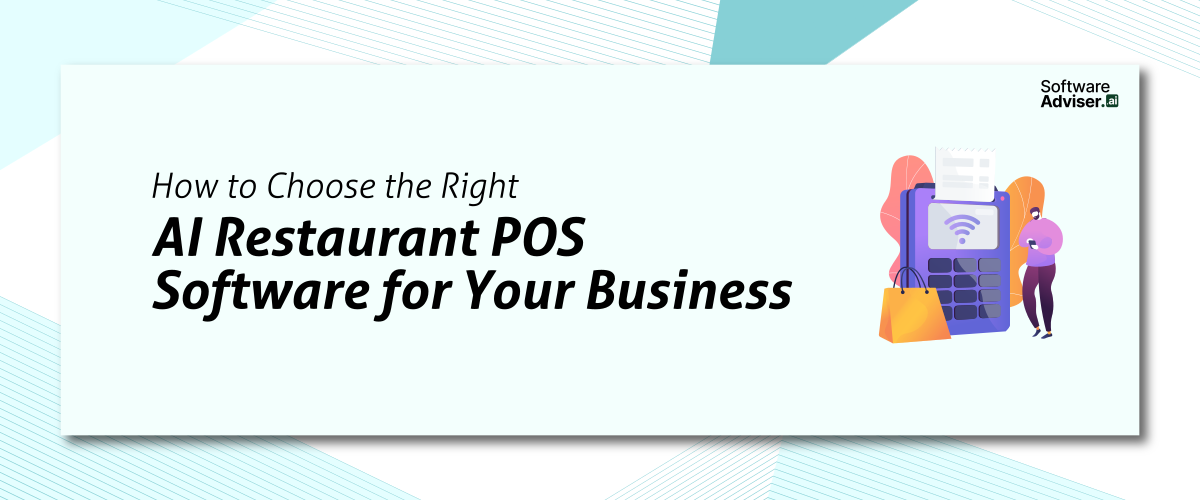
How to Choose the Right AI Restaurant POS Software for Your Business
 David N. Wilks
Finding the best AI restaurant point-of-sale (POS) software isn’t just about transactions anymore; it’s about making your business better. Modern AI-powered technologies perform the heavy lifting for you, from forecasting the inventory needs for Friday night to scheduling staff based on previous traffic. But with so many alternatives on the market, it may be daunting to locate the right fit for your layout, whether you’re running a busy quick-service location or a small fine-dining institution. Here’s a no-frills, how-to guide to breaking through the tech jargon and choosing the AI POS that truly boosts your bottom line.
What Is AI Restaurant POS Software And How Does It Work?
AI restaurant POS software is the contemporary eatery’s central nervous system and does much more than just handle transactions. In the hyper-competitive US hospitality sector, where labor shortages and inflation have driven margins to the bone, these platforms use machine learning to function as an extra manager. They evaluate real-time sales data, consumer preferences, and even local weather trends to assist businesses in making choices proactively, as opposed to reactively. It transforms your traditional terminal into a predictive machine that knows what you need before you even know you are running low.
It is the wonder of what happens in the background through constant data aggregation. Orders begin to pile up, and the AI starts ingesting thousands of data points, popular dish combinations, staff efficiency, and table turnover rates. It cross-references this with previous trends to deliver automatic insights, such as recommending dynamic pricing during peak demand rushes or notifying chefs to buy extra inventory before a supply chain shortfall strikes. Automating these monotonous analytical procedures allows your management staff to focus on the human element of hospitality, enjoying the visitor instead of gazing at spreadsheets.
Why Do US Restaurants Need AI Restaurant POS Software Today?
The current pressure cooker atmosphere of the US restaurant business has turned old cash registers into a huge problem. Operating an AI restaurant management in 2026 requires continually fighting against razor-thin margins, soaring food costs, and persistent staffing shortages, which make execution uncertain. That’s exactly why owners are quickly turning to restaurant automation software. By implementing POS machine learning directly into everyday operations, operators can remove the uncertainty from profitability in an instant. Instead of reacting to a terrible food cost percentage or inflated labor report at month’s end, restaurants employ these solutions to safeguard their margins in real time.
The real superpower of the new platforms is the capacity to do intricate operational arithmetic using predictive analytics for hospitality. Labor cost optimization solutions solve the riddle, projecting accurate hourly sales volume and aligning staff schedules accordingly. Managers no longer have to concern themselves with the tedious task of manually matching fluctuating guest traffic to scheduling requirements. At the same time, AI-based inventory management cuts food waste to the bone, with precise predictions of ingredient use based on prior ordering trends, local happenings, and seasonal variations. For restaurateurs in the US, implementing this technology is no longer about chasing a digital fad; it’s a fundamental survival strategy to keep the doors open and the dining room viable.
What Features Should You Look For In AI Restaurant POS Software?
1. Real-time Inventory Management: Look for systems that give you immediate updates on ingredient levels as well as the automatic forecasting of order quantities based on future weather events, local happenings, and historical sales data to minimize your food waste.
2. Optimal Scheduling of Staff: The software must analyze historical traffic patterns to anticipate your busiest times and develop optimal staffing plans that minimize your staffing costs and keep your floor appropriately staffed.
3. Dynamic Menu Pricing and Planning: Choose a platform that enables you to monitor each menu item's sales and ingredient costs in real-time, providing immediate suggestions on menu prices and increasing focus on high-profit margin items on your menus.
4. Automated Marketing & CRM: Use software that tracks each customer's purchasing history and preferences so that you(r) will automatically send personalized promotional offers, loyalty rewards, and targeted mailings to invite them back, without you having to lift a finger.
5. Unified Order Processing: Streamline your back-of-house operations through an automated consolidation of all of your order types (Dine-in, Tableside Tablets, Online Orders, 3rd Party Delivery Providers) into one electronically prioritized kitchen display screen.
How Do You Choose The Best AI Restaurant POS Software Options?
1. Assess the hardware ecosystem
Your physical arrangement determines your software demands. Physical hardware footprint. Look attentively at the physical hardware footprint when you are comparing systems. Quick-service places need speedy counter terminals, full-service enterprises live or die on the battery life and drop-resistance of their tableside ordering tablets.
2. Core AI Depth Audit
Not all 'AI' features are the same. A lot of old systems have just slapped the label “AI” on simple spreadsheet calculations. Real machine learning alternatives will learn and evolve. Do you have to manually enter rules (e.g., Let me know when tomatoes hit 10 lbs) or does it learn your habits by itself (e.g., It’s Thursday ahead of a sunny holiday weekend, auto-buy 40% more tomatoes)? Don’t chain the predictive AI HR analytics layer to a back-office PC. A star system sends real-time labor alerts and floor optimizations directly to an executive mobile app so you can make choices on the go.
3. Browse the Integration Marketplace
Your POS has to play well with the software you already use. If you’re using specialist accounting solutions, the AI has to be natively hooked into those data streams. If your data is connected via a dirty third-party middleware bridge, the machine learning algorithms will often get delayed or incorrect information, making their predictions meaningless.
What Mistakes Should You Avoid When Choosing AI Restaurant POS Software?
An AI-powered POS is a big investment, and the wrong decision might keep you locked into a costly, irritating system for years. When independent restaurants and small chains improve, they typically fall into the same few expensive pitfalls.
Steer clear of these four major blunders, and you’ll save your restaurant money, time, and hassles in operation.
1. Living Inside the Franken-System
Many traditional POS vendors talk about advanced AI capabilities but when you dig beneath the hood, such capabilities are really just clumsy add-ons from third-party vendors.
Things will break if you need to route data via many middleware applications to make a weekly work schedule or meal prep list. Data is late, sync issues arise, and your team spends time debugging instead of running the floor. Lean toward systems with native machine learning underpinnings where inventory, scheduling, and sales analytics are inside the same software ecosystem.
2. The Hidden Cost of Lock-In Credit Card Processing
Restaurateurs sometimes get blind sided by low upfront software subscriptions or free terminal gear, then get wrecked by the processing contract. Most AI POS companies will make you utilize their own in-house payment processing engine at a hefty flat fee (say 2.9% + $0.15/transaction). For every $1 million a restaurant processes in credit card purchases annually, a 0.5% variation in processing rates is a hidden $5,000 yearly tax that never goes away.
3. Forget about the reality of your kitchen staff
We can get caught up with attractive front-of-house iPads and sexy consumer checkout screens, but if your backend system is too much for your line cooks, your business will come to a grinding halt. An intelligent AI POS that alters ticket priority might cause total pandemonium if the physical architecture of the KDS is unclear or poorly located during a huge Friday night rush.
4. Buying More Tech Than You Really Need
The buzz around premium AI feature suites is so easy to get caught up in. But if you manage a fast-casual bagel store or a high-turnover coffee truck, you don’t need high-end multi-room floor mapping modules or intricate tableside split-check algorithms. Usually, purchasing unnecessary features adds $50 to $150 a month in wasted software expenses per terminal. Start with a light, modular software solution that lets you turn powerful AI modules on and off quickly as your business needs.
How Do You Get Started With AI Restaurant POS Software For Your Business?
When taking your business to an AI-based restaurant POS software, you need to do it step by step to avoid any service interruptions on your floor. In the US market, where data accuracy drives everything from automated inventory orders to predictive scheduling, the onboarding step starts with developing a clean data foundation. Before you purchase any software, you need to check that your restaurant’s Wi-Fi network is strong enough to handle constant cloud data syncing across powerful portable devices and kitchen display panels. Collaborate with your vendor’s data conversion team to prepare and convert your old sales history, menu item matrices, and ingredient logs in a clean CSV format. When you import data in a disorderly way, the system’s machine learning algorithms will compute the first predictions incorrectly, and hence it is important to build up a complete and well-organized system before the real hardware arrives at the location.
The last piece to getting started is very much dependent on sequential, role-specific staff training and a very controlled deployment phase. Don’t just flip the switch to live overnight, but create dedicated training blocks that are laser-focused on what each team member needs to know. Cashiers, supervisors, and culinary personnel need completely separate processes. Your line cooks are learning the predictive ticket pacing of the kitchen display screens, and your servers are practicing tableside layout recommendations with a dummy test account. If the team is confident, roll out the program on a quiet Tuesday morning or during an off-peak period to safely resolve minor hardware sync issues. It’s a conscious, methodical process that preserves your front-end client experience and enables your management team to confidently delegate the optimization of day-to-day operations to the automation engine.
Conclusion
The trick to choosing the best AI restaurant POS software is to strike a balance between predictive machine learning and your venue’s physical architecture and real-world daily activity. With no hidden processing traps, native back-of-house connectors, and a defined implementation timeframe, you can be assured your profit margins are protected. When you’re ready to shop around, visit softwareadviser.ai, the leading SaaS marketplace to effortlessly find, compare, and purchase any business software. It gives you verified reviews and clear data you need to invest with 100% confidence.
FAQ's
Unlike traditional systems that merely record past sales, AI POS software uses machine learning to predict future inventory needs, optimize labor schedules, and automate daily tasks.
Yes, most modern AI cloud systems feature an offline mode that allows you to securely process card payments and print tickets until your connection is restored.
The machine learning models typically require two to four weeks of clean, consistent sales and inventory data to begin delivering highly reliable operational forecasts.
Generally, no, because advanced AI platforms require proprietary, modern hardware configurations and updated processing chips to run their real-time automation algorithms.
You can effortlessly discover, compare, and buy top-tier restaurant platforms by visiting softwareadviser.ai, the complete SaaS marketplace for business software solutions.
Sales teams across the US are under more pressure than ever, and the tools most of them rely on were simply not designed for what the market demands t [...]
David N. Wilks
The management of dispersed office computers, servers, and employee-owned devices is challenging for companies to maintain. In a world where rapid tec [...]

Dokas mile
Production houses face a severe computational and creative bottleneck. Traditional polygonal sculpting, topology mapping, and asset rigging consume hu [...]