
What we'll cover
Share with your community!


Get Free Consultation

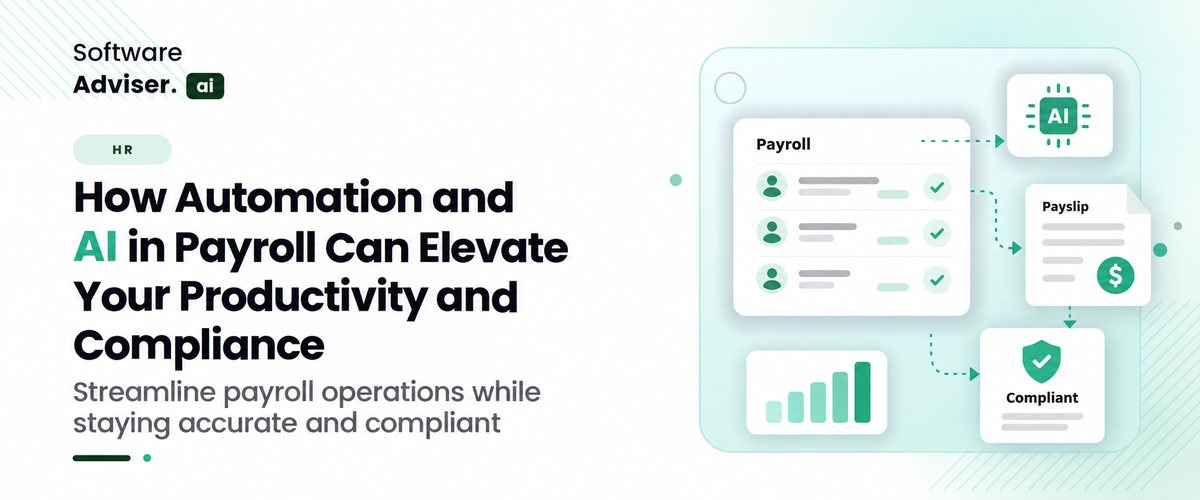
How Automation and AI in Payroll Can Elevate Your Productivity and Compliance
 Dokas mile
Payroll rarely gets difficult because of one complex calculation. Things become challenging when there are a lot of small tasks that need to be done around each payroll run, such as tracking hours, managing employee changes, processing deductions, payments, tax obligations and processing payroll queries.
This is where AI in payroll can come in handy. While payroll automation manages repetitive tasks, AI reviews payroll data, notifies of any irregularities, detects errors, and assists teams in investigating payroll issues.
Payroll also entails tax reporting, tax deposits, wage records and federal and state requirements for U.S. businesses. The aim is not only to speed up payroll, but to make it easier to track, auditing, and scaling.
 Looking for AI Payroll Software? Check Out Software Advisor. AI List of best AI Payroll Software in USA for your business.
What Does AI in Payroll Actually Do?
AI in Payroll involves leveraging artificial intelligence and machine learning, along with other advanced technologies such as natural language processing, to help with payroll tasks and payroll decisions.
Traditional payroll automation usually follows predefined rules. For example, an automated payroll system can calculate wages based on an employee's hours, apply configured deductions, schedule a pay run, or send payroll data to an accounting system.
AI adds another layer. It can spot trends in payroll information and highlight any unusual data.
For instance, a worker's normal work hours are 40 per week and 75 hours are now in their account. A rules-based system might process the number if it falls within the configured workflow. An AI payroll system may identify the unusual change and prompt someone to review it.
That distinction is important. Automated payroll processing is mainly about executing defined processes. AI payroll can help interpret data, identify exceptions, and support decisions within those processes.
|
Feature / Capability |
Traditional Payroll Automation |
|
Operational Logic |
Follows predefined rules |
|
Workflow Management |
Automates repetitive workflows |
|
Calculation Processing |
Performs configured calculations |
|
Adaptability |
Uses fixed workflows |
|
Decision & Output Basis |
Predictable and rule-based |
How Payroll Automation and AI Improve Productivity
The productivity benefit does not come from eliminating every human task. It comes from reducing the amount of repetitive work payroll professionals have to perform manually.
1. Less manual data entry
Information about payroll may be provided via HR systems and time tracking systems, scheduling systems, benefits systems, expense systems, and employee records.
These systems are seamlessly connected, so that payroll automation software can transfer the data from one system to the other without duplication.
This is particularly beneficial where there is a high turnover of employees in a company. Each pay period, you may have more work to do because of new employees, changes in pay rates, overtime, bonuses, deductions, and leave.
2. Faster payroll processing
With an automated payroll system, you can have calculations, validations, approvals, and reporting done following a workflow.
AI can help by prioritizing exceptions. Payroll teams can now solely review transactions flagged as unusual, instead of manually going through each one.
This reduces the repetitive checking needed for payroll processing and provides payroll professionals with more time to devote to reconciling, reporting, supporting employees, and other higher-value tasks.
3. Faster answers to routine questions
Employees often ask questions such as:
- Why did my paycheck change?
- How was my overtime calculated?
- Where can I find my pay statement?
- Why did my deduction change?
AI assistants can provide answers to common questions based on the data within the payroll or HR system. For instance, QuickBooks now features a Payroll AI assistant, which can gather payroll data, proactively identify issues, create a payroll draft, and await approval prior to running the payroll.
While in some rare or specialized instances human input is still necessary, in others AI can help to decrease the number of simple queries that end up on payroll workers' desks.
How AI in Payroll Supports Compliance
Compliance is one of the more important reasons companies are exploring AI in payroll.
Employers have continuing obligations with regard to employment taxes in the United States. Employers are generally required to withhold Federal income tax, social security and Medicare tax, and to report and pay employment taxes and file applicable returns in a timely fashion, the IRS says.
Payroll technology cannot remove those legal responsibilities. It can, however, make the processes used to meet them more controlled and easier to monitor.
Do You Know?
Payroll compliance extends well beyond just making calculations. Covered employers are obligated by the U.S. Department of Labor to keep accurate records, including hours worked, wages, overtime, deductions and pay dates.
Detecting unusual payroll activity
Payroll anomaly detection is one of the most practical AI use cases.
An AI system can look for patterns such as:
- Unexpected changes in gross pay
- Unusual overtime
- Large changes in deductions
- Duplicate or suspicious entries
- Missing employee information
- Significant differences from previous pay periods
The system does not need to automatically decide that an error occurred. Its job can simply be to bring the issue to someone's attention before payroll is finalized.
That distinction reduces the risk of treating AI output as a final decision.
Supporting payroll tax compliance
Payroll tax compliance involves more than calculating tax amounts. Businesses also need appropriate records, deposits, reporting, and deadlines.
The IRS says employment tax records generally need to be retained for at least four years.
A payroll compliance software solution can assist in consolidating relevant documents, automating repeatable tasks, monitoring needed actions, and establish audit trails. AI can be useful in uncovering inconsistencies or pointing out information that should be reviewed.
But the businesses should not take it for granted that an AI feature is a compliance. Tax laws may change, state laws and regulations vary, and unusual employment issues may warrant professional judgment.
Where AI Payroll Software Can Deliver the Most Value
The biggest gains usually appear where payroll involves a lot of repetitive data and frequent exceptions.
1. Growing companies
A small company may manage payroll with a relatively simple process. As headcount increases, the number of employees, pay changes, time records, benefits, and questions increases too.
Payroll management software can streamline these processes, and AI can be used to detect anomalies, preventing them from turning into issues for employees.
2. Companies with hourly workers
Hourly teams often have more complex time and overtime data. Integrating time tracking with payroll can reduce duplicate entry and create a more consistent data flow.
AI can then help identify unusual time patterns or changes that deserve review.
3. Multi-state employers
U.S. payroll is more complex when an employee works in several states and local jurisdictions. The needs of the employees of businesses need to be taken into consideration and some records need to be kept.
This is an area where payroll compliance software and centralized employee data can be particularly useful.
4. Businesses preparing to scale
A payroll process that works for 20 employees may become difficult to manage at 200.
Using payroll automation software in advance of payroll becoming unmanageable can help to establish repeatable workflows and minimize reliance on manual processes.
For companies managing international workers as well, Software Adviser AI's AI Global Payroll Software category can help buyers explore software designed for more complex payroll environments.
What AI Cannot Replace in Payroll
While AI can detect potential errors and compliance issues, there are still human interactions that are crucial to payroll decisions. For instance, if overtime is applied in an unusual manner, it may be necessary for the payroll professional to review time records and figure out what's occurred.
Any top-notch AI payroll solution should feature approval processes, access restrictions, audit trails, clear exceptions handling and human check.
How to Choose an AI Payroll System
Do not choose a product simply because the vendor use "AI" in its marketing.
Instead, look at how the technology works in your actual payroll workflow.
Check data integrations
The system should be seamlessly connected with HR, time tracking, benefits, accounting and other systems that contribute to the payroll system, and should connect reliably.
Ask what the AI actually does
Search for particular features like payroll validation, payroll preparation, compliance monitoring, employee Q&A, or anomaly detection.
Review human approval controls
You should be able to review important changes before they affect employee pay.
Examine auditability
Payroll teams need visibility into changes, approvals, calculations, and relevant records.
Consider data security
Employee data is quite sensitive content in payroll. Discuss access controls, data encryption, data retention, vendor security measures, and data use by AI features.
Test real payroll scenarios
A demo should not only show a clean payroll run. Request the vendor to perform a sample overtime entry, a new hire, a pay-rate change, a failed integration, and correction.

Pro-tip
Before buying AI payroll software, take three recent payroll cycles and list the manual checks your team performs. Use that list during vendor demos. You will get a much clearer picture of whether the software actually solves your workload instead of simply adding another AI feature to your technology stack.
Common Challenges When Implementing AI in Payroll
The technology can create productivity gains, but implementation still requires planning.
Poor data quality can undermine automated payroll processing. If employee records or time data are incorrect, faster processing only moves bad information through the system faster.
Integration problems can also create gaps. However, the accuracy of payroll relies on the other systems because they are all a part of the workforce, HR, and accounting operations. Disconnected HR, accounting and workforce systems can restrict automation.
Employee privacy needs careful attention because payroll data includes financial and personally identifiable information.
Then there's the question of reliability of AI. AI systems can generate inaccurate recommendations or flag on the side of caution as unusual what is otherwise legitimate payroll activity. This risk is managed with human review, clear permissions and well-defined escalation processes.
The best way to do this is typically not "let AI do payroll jobs without human involvement. It's about getting repetitive tasks done while leveraging AI to identify, investigate and resolve exceptions.
What the Future of AI in Payroll Looks Like
The direction of AI in payroll is moving toward proactive assistance rather than simple automation.
These are all features currently found in some existing products, including AI-powered payroll preparation, anomaly detection, compliance monitoring, and natural-language interactions.
The following phase will probably be an integration of these capabilities more closely. An AI system might detect an irregular payroll data outcome, clarify why it is unusual, request relevant details, and assign it to the relevant individual for approval.
This isn't necessarily a fully automated payroll system. It makes the payroll team more focused on making exceptions and decisions rather than repetitive administrative work.
Conclusion
The ROI of AI in payroll lies not in the collection of AI capabilities.It's not about adding more AI capabilities, but about the real value of AI in payroll. Having a payroll process that can identify what needs to be addressed before it becomes a larger issue.
The U.S. businesses who are successful will follow the simple rule of automating predictable tasks, uncovering the unusual with AI, and ensuring that people are still making critical payroll choices.
Also Read-
- How Smart Payroll Automation with AI Cuts Down Manual Work
- AI in Payroll Management: How It’s Revolutionizing Businesses
- AI in Payroll: The Smart Way to Save Time, Cut Costs, and Improve Accuracy
- How AI Payroll Accounting Software Simplifies Tax Calculations
- AI Global Payroll Software vs. Traditional Payroll: Is It Time to Switch?
FAQ's
AI in payroll uses technologies such as machine learning and natural language processing to analyze payroll data, detect anomalies, assist with payroll tasks, and support compliance workflows.
Payroll automation reduces repetitive data entry, calculations, approvals, reporting, and other manual tasks, allowing payroll teams to spend more time on review and employee support.
AI can help identify unusual data and potential payroll errors before a pay run is finalized. Human review is still important for investigating and correcting flagged issues.
No. AI payroll software can support compliance, but businesses remain responsible for meeting applicable federal, state, and local requirements.
Yes, especially when payroll involves manual work, multiple systems, hourly employees, or a growing workforce. Small businesses with simple payroll may not need advanced AI features.
A major promotional campaign needs to go live tomorrow morning. The internal design team is fully booked with long-term product releases, the standard [...]

David N. Wilks
The landscape of people management has shifted. If you’re running a startup or an SMB in 2026, you likely already know that the "human" in Human Res [...]
David N. Wilks
In today's highly competitive US marketplace, where consumer expectations have never been higher, traditional support staff are overwhelmed by an incr [...]