
What we'll cover
Share with your community!


Get Free Consultation
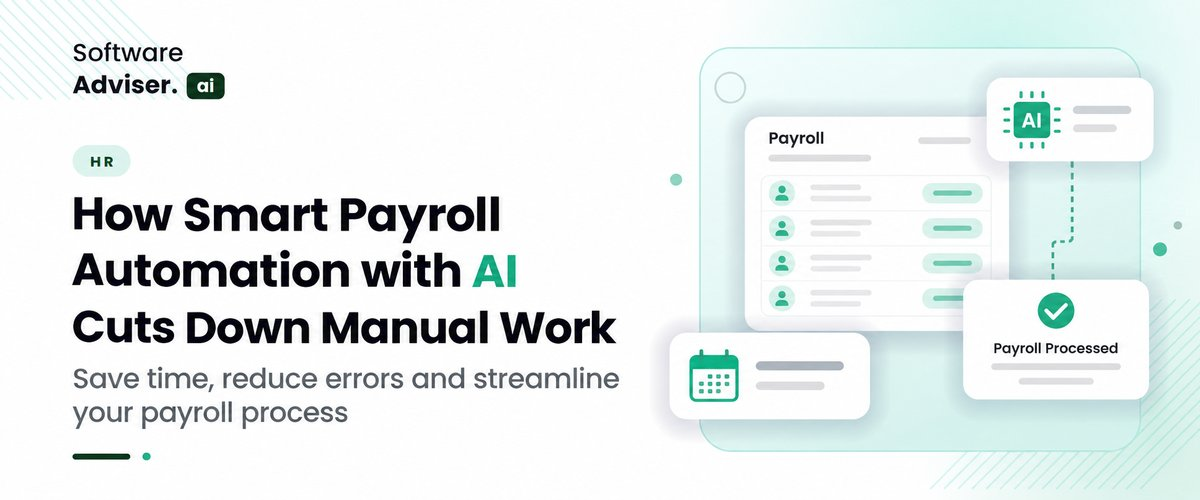
How Smart Payroll Automation with AI Cuts Down Manual Work
 Dokas mile
All payroll managers know the process well: gathering timesheets, verifying tax tables, seeking approvals, then hoping no errors occur before the due date. The task is repetitive, prone to mistakes, and consumes many more hours than expected. Payroll software utilizing AI is altering that calculation for businesses throughout the US, ranging from small groups employing simple payroll accounting tools to large firms operating worldwide payroll systems across numerous entities. Rather than manually matching hours, deductions, and benefits each period, HR departments allow automation to manage standard duties so they can concentrate on choices requiring actual human input.
Why Manual Payroll Still Costs Companies So Much
Payroll rarely breaks in dramatic ways. It breaks in small, quiet ways a misclassified employee, a missed overtime calculation, a benefits deduction that didn't sync properly with the HRIS software feeding it. Add these up across a mid-sized company processing hundreds of paychecks a month, and the hours spent catching and fixing errors start to rival the hours spent running payroll in the first place.
Smaller companies often overlook how much of this cost is hidden. It's not just the payroll specialist's time. It's the finance team reconciling the general ledger afterward, the compliance officer flagging a state tax filing that slipped through, and the employee calling HR because their paycheck looked off. None of this shows up as a line item, but it adds up in turnover, in trust, and in the sheer number of hours nobody planned to spend.
What AI Actually Automates in Payroll
The term "AI payroll" gets used loosely, so it helps to be specific about what's actually happening under the hood.
Data Collection and Validation
Current payroll and benefits tools grab time records, cost figures, and benefit choices from linked platforms on their own, then mark oddities prior to them turning into wage mistakes. When a person enters 60 hours within one week while they usually enter 40, the program finds it rather than allowing it to pass into handling.
Tax and Compliance Calculations
Here is where AI accounting tools truly pay their way. National, regional, and municipal tax laws move all the time, and doing manual tracking for each area needs almost no work after a firm works in over several states. Computerized programs refresh tax lists in nearly live time and put right withholdings without anyone checking a grid sheet.
Approval Routing
Rather than payroll admins manually emailing managers for sign-off, automated workflows route approvals based on role, department, or exception type only escalating to a human when something actually needs judgment.
Multi-Country and Multi-Entity Processing
Firms having workers or sites beyond America find that global wage tools manage exchange rates, regional laws, and different payment schedules without needing distinct manual steps for every area.
Where Enterprise Payroll Software Changes the Math
At small scale, payroll errors are annoying. At enterprise scale, they're expensive and, in some cases, legally risky. Enterprise payroll software with AI built in isn't just a bigger version of a small-business tool it's designed to handle volume, complexity, and audit requirements that would overwhelm a manual process.
Teams usually discover this after a growth spurt or an acquisition, when payroll suddenly spans multiple entities, benefit plans, and compliance jurisdictions at once. What worked with 50 employees on a single spreadsheet doesn't hold up at 5,000 employees across a dozen states. This is typically when finance and HR software leaders start evaluating enterprise payroll software seriously, not as a nice-to-have but as a way to avoid the compliance exposure that comes with manual reconciliation at scale.
That said, enterprise-grade automation isn't the right fit for every company. A ten-person startup doesn't need the same infrastructure as a company managing global payroll across six countries, and buying more capability than the business needs just adds cost and complexity without a clear return.
The Case for Integrated HRIS and Payroll Accounting Software
One issue that often appears during implementation is disconnected systems. A company might have solid payroll software but an HRIS that doesn't talk to it, forcing someone to manually re-enter employee changes a new hire, a raise, a termination in two or three places. AI-driven platforms that combine HRIS software with payroll accounting software close this gap by keeping employee records and pay calculations in sync automatically.
This matters more than it sounds. When HR updates an employee's status or pay rate, that change should flow into payroll and the general ledger without anyone touching a second system. Companies that skip this integration tend to accept the double entry as a cost of doing business, without realizing how much time and error risk it's quietly creating.
Common Mistakes Businesses Make When Adopting AI Payroll Tools
Many businesses assume that switching to automated payroll software means the work disappears entirely. In practice, it shifts. The manual data entry and reconciliation shrink dramatically, but oversight still matters someone needs to review exceptions the system flags, confirm tax filings are accurate, and audit the automation periodically rather than assuming it's flawless indefinitely.
A few patterns show up repeatedly during rollouts:
- Skipping a parallel run: Teams that switch systems without running old and new payroll side by side for a cycle or two often miss discrepancies until an employee complains.
- Underestimating data cleanup: AI systems are only as reliable as the data they're built on. Migrating messy, outdated employee records into a new platform tends to surface errors that existed long before the automation did.
- Assuming compliance is fully hands-off: Automated tax calculations reduce risk significantly, but regulatory changes still benefit from a compliance review, especially for companies operating across multiple states or countries.
When Manual Processes Still Make Sense
It's worth saying plainly: not every payroll function needs automation. Very small teams with straightforward, single-state payroll may find that a lightweight tool and a careful process work fine without investing in a full AI-driven platform. The return on automation grows with headcount, jurisdictional complexity, and the number of systems that need to stay in sync. A company evaluating global payroll software for five contractors in one country is probably solving a problem it doesn't have yet.
How to Evaluate AI Payroll Software
When teams compare choices, some queries usually divide a solid match from an expensive error:.
- Does it connect to your current HRIS platform, or will you continue manually syncing staff information across systems?
- How does it handle multi- state or cross-border rules apply to your staff soon or today? How is exception management handled? Systems marking irregularities for people checking them seem better than those approving all things automatically or needing hand signs on each row.
- Can finance settle this simply? Payroll accounting programs ought to simplify month-end closing, rather than introducing another batch of reports to confuse matters.
- When is the real schedule? Suppliers frequently downplay duration needed for moving data and running parallel tests, particularly regarding corporate payroll systems holding complicated old records.
Conclusion
Automating payroll using artificial intelligence does not eliminate staff from workflows; instead, it eliminates repetitive tasks which never required human involvement initially. Organizations deriving maximum benefit view automation as an instrument to cut down on manual labor and potential errors, rather than viewing it as a substitute for supervision. Regardless if this involves implementing combined HRIS and payroll systems, shifting towards large-scale enterprise solutions for regulatory adherence, or expanding into international payroll platforms for scattered teams, the objective remains constant: less time correcting preventable faults, and greater assurance that each payment is accurate immediately upon issuance.
FAQ's
No. It reduces manual data entry and calculation work, but teams still need to review exceptions, confirm compliance, and handle judgment calls the system can't make on its own.
Not exclusively, but the value increases with headcount and complexity. Small, single-state businesses may not see enough return to justify enterprise-level tools yet.
It flags anomalies in hours, deductions, or tax data before processing, and keeps tax tables updated automatically instead of relying on manual tracking across jurisdictions.
Payroll software typically focuses on calculating and issuing pay, while payroll accounting software ties those calculations into the general ledger and broader financial reporting.
Usually not right away. It becomes more valuable as headcount, currencies, and local compliance requirements grow beyond what a manual process can reasonably handle.
Walk into any modern workplace today, and you may observe a massive shift in how groups deal with their everyday workloads. The antique days of counti [...]

David N. Wilks
A startup’s life or death question in 2026 will be about speed and accuracy and a traditional CRM just won’t cut it. Today’s AI-empowered CRM so [...]
David N. Wilks
As Generative AI technology rapidly standardizes business activities, managers across the country begin using applications like ChatGPT or specific HR [...]