
What we'll cover
Share with your community!


Get Free Consultation
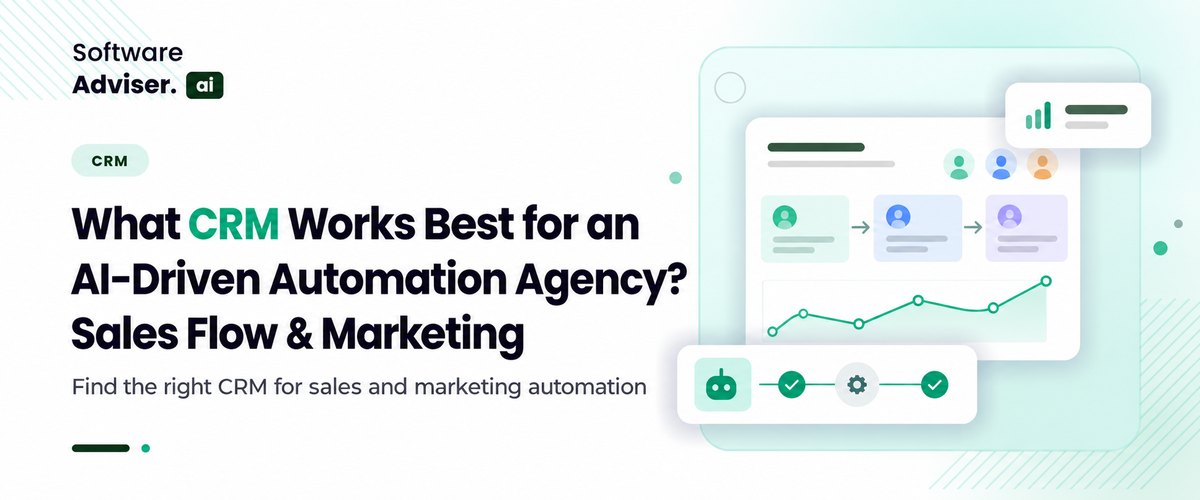
What CRM actually works best for an AI-driven automation agency?
 Dokas mile
Once around the third or fourth client, the typical automated agency comes into play. Leads come out of a form, a DM, a referral call, and a cold outreach sequence, and none live there. One of the many manual ways a lead becomes a discovery call, a proposal, a signed retainer will in itself occur when there is not a single lead on one of your lines in your company system, or you can simply insert the information, for example from the spreadsheet or in the inbox, and whichever piece of documentation is to invoice.
 Looking for AI CRM Software? Check out Softwareadviser’s List of the Best AI CRM Software in USA for Your Business.
When you build an automation for other businesses, you are forced to manually copy the info into an automated tool, an automatic mail folder, or whatever, so a sales agent does its own copying, rather than an automatic process at all. That hole is a big push for most agencies toward an AI CRM at some point in the future since an AI CRM typically starts off just around the time the spreadsheet goes back online. What exactly meets this demand is determining which type relates best to the agency selling automation and AI implementation work, rather than a generic sales team moving boxes of inventory or SaaS seats.
Why a Generic CRM Rarely Fits an Automation Agency
However, most CRM systems are still based around a fairly standard B2B sales process: a rep sorts a list, schedules demos, and settles the deals that look roughly the same way from one to the next. An AI automation agency’s sales flow appears a little bit different in a number of specific ways. When it comes to importing inbound content into sales, sales often go through a series of sites at once; here, both the client side and the product side- a referral in a cold mail sequence and, first and foremost, a partner intro- and the provider side have to go through different follow-up logics.
The entire sales cycle itself usually has a scoping or discovery call that's just as similar as a mini consulting engagement before any proposals come in. And after a client signs, there is not the last step; their relationship does not just end; it switches to delivery, support, and renewal, something which most sales CRM software treats as an afterthought rather than an integral element.
Do You Know?
Multiple comparisons among agents-focused CRM software found that general-purpose sales CRMs are generally strong at track pipeline tracking but in weak areas on the client lifecycle work, onboarding, recurring billing, and retainer management, which is normally seen daily in service agencies.
What Your Sales Flow Actually Needs to Track
Before you compare tools, let’s make sure you know exactly which tiers of an AI automation organization do all the work of its tier. For the vast majority of AI automation organizations, that sounds like: lead captured, discovery call booked, discovery call completed, proposal sent, contract signed, onboarding, active client, and renewal or upsell conversation.
A CRM that keeps everything beyond 'contract signed' as a closed deal is going to leave your team tracking the entire client relationship somewhere else, which is what you were trying to replicate with your fragmentation problem. With the integration of AI sales tracking, it's essential to understand how a tool not only manages sales but also handles the handoff from sales to delivery. Instead of being swayed by a clear pipeline view during a sales demo, delve into how the CRM supports ongoing client interactions and ensures a seamless transition throughout the relationship.
Where Marketing Actually Fits In
For a company that offers artificial intelligence and automation services, marketing and sales appear to be far better put together than for a typical SaaS business. If it's a LinkedIn post, a case study, or a webinar, it generates the lead straight, with no independent marketing team passing any over. That makes CRM software built-in marketing automation an exceptionally useful device here as well, since it allows the same system that manages a deal to have nurture sequences for this new customer.
In this phase, AI features within CRM come to carry more weight in practice than as a sales pitch, and at a point in the game where we're seeing the gap between AI in CRM marketing copy and AI in CRM reality first come to pass the most: lead scoring that is more authentic vs. sanity, follow-up sequences that drive particular behaviors rather than a constant day count, and reporting enough to know which channel is really creating clients rather than leads.
The AI CRM Options Actually Worth Shortlisting
Five AI CRM tools come up repeatedly in comparisons built around agencies and service businesses rather than generic B2B sales teams. None of them is universally correct. Each fits a different stage or shape of agency.
GoHighLevel was built specifically for agencies managing multiple clients. As an AI CRM option, that makes it an unusually direct fit for this use case. As of this year, it offers CRM, marketing automation, booking, and client communication in one system with flat monthly tiers of around $97, $297, and $497 a month instead of per-seat pricing. Several AI features, conversation handling and lead management among them, moved from paid add-ons into the base plans on its higher tiers recently. The trade-off is a steeper learning curve than a simpler sales CRM. It can feel over-built if you only have a handful of clients.
Agencies wishing for really connected marketing and sales instead of loosely linked ones still find HubSpot the natural choice. Its free tier is good for a small team just starting; paid plans range from a low starting price to a much greater range once you need the whole marketing and sales hub combination. Baked into the current processes, the artificial intelligence functionalities tend toward content generation and lead scoring rather than added on independently, a rather common design for AI CRM software developed by a firm that began as a marketing platform.
Pipedrive is something to consider if your actual restriction is pipeline visibility rather than marketing. Entry-level CRM is a visual, sales-first system costing roughly $14 per seat per month with artificial intelligence features kept almost at the deal itself: win-probability forecasts, suggested next actions, and report generation. If that's what you need, it's a disadvantage; if you simply want a clean pipeline your employees would really utilize, it's a plus, as it doesn't try to be a marketing tool.
For a technically capable team especially, Attio is the more recent, more adaptable choice to be aware of. It's designed to be read and written by artificial intelligence and automation agents as much as by a human entering information into a form, which is important if your agency currently resides within Zapier, Make, or custom API processes and wants the CRM to live inside that stack instead of outside of it. Pricing is seat-based instead of flat; it's a more recent product, so anticipate less hand-holding and more setup than GoHighLevel or HubSpot offers.
Budget-friendly choice with real complexity once you get in is Zoho CRM. Though precise numbers vary by area and bundle, its Zia AI assistant covers lead scoring, anomaly identification, and workflow recommendations; entry paid levels are normally in the mid teens per user monthly. The trade-off is that Zoho's interface and setup process ask more of you upfront than Pipedrive's more plug-and-play approach.
AI Workflow Automation Inside the CRM vs Your Existing Stack
Another difference is worth more than being a buyer for this audience: a CRM has its own built-in AI workflow automation as well as automation tools like Make, Zapier, and n8n that you probably already run customer work through. Almost all CRMs today use AI sales CRM features that provide automatic follow-ups, deal scoring, email drafting, and the AI sales CRM label goes pretty well across the product category. Those are indeed a big asset when managing your own pipeline.
They aren’t as effective as the automation system you’re selling to customers, and even trying to force your CRM to do those two functions would end in messy, hyper-customized setups. The question that really counts is how easily a CRM translates to automation tools that are already at your disposal, such as native integrations, an API that does pretty good work, or support for webhooks, rather than how many AI features it advertises on its own pricing page. An automation tooling agency gains more benefits from a CRM that resonates with that stack than the agent trying to move away from it.
Mistakes Agencies Make When Choosing This Tool
The second is skipping the post-sale stages altogether during assessment. A CRM that carries the pace of lead generation and proposals beautifully but makes onboarding and renewal a question for someone else doesn't go unintentionally, which turns the deal upside down, which is an entirely disavowal of making all the details a single tool in the first place.
By having one person behind the scenes who ensures everything goes smoothly and gives feedback directly to the project or group at the forefront, you can be much more likely to maintain relationships of this magnitude.

Pro-tip
From first contact through onboarding, map your real sales flow stages first and see whether every CRM allows you to depict every stage without requiring a workaround before you commit to any of these. A tool that looks great in a sales demo but cannot model your post-signature process will eventually cost you more time than a simpler tool that exactly matches your workflow.
Conclusion
The true answer in selecting the CRM the right CRM product for an AI-powered automation agency is one in which your leads actually come from and the sales flow beyond the signature determines it! GoHighLevel and HubSpot complement agencies that wish to do marketing and sales together in a very real manner. Pipedrive can serve as a lean, pipeline-first group. Attio suits a technically savvy team that wants to integrate the CRM inside its underlying automation stack, not beside it. Zoho can meet with a savvy team who will customize things correctly. By mapping your sales stream before you demo anything, it will show you what works better than any feature comparison will.
Related Reads
FAQ's
It depends on your lead sources and sales flow: GoHighLevel and HubSpot suit agencies wanting marketing and sales combined, Pipedrive suits a pipeline-first team, and Attio suits agencies already built around automation tooling.
Yes, it was built around managing multiple client accounts and bundles CRM, marketing automation, and client communication, making it a close fit, though it has a steeper learning curve than simpler sales CRMs.
Some do, particularly lead scoring and behavior-triggered follow-ups, but features like automated email drafting matter less than how well the CRM tracks your full client lifecycle.
No. A CRM should manage the sales and client relationship, while dedicated automation platforms should keep handling the workflow automation you deliver to clients.
It varies widely: Pipedrive starts around $14 per seat monthly, HubSpot has a usable free tier, and GoHighLevel uses flat agency pricing starting around $97 a month rather than per seat.
Modern email marketing has moved a long way beyond primary merge tags and static weekly newsletters. Today, scaling overall performance requires deepe [...]

David N. Wilks
Enterprises lose thousands of effective work hours every year to repetitive obligations like invoice processing, facts access, approvals, and status u [...]
David N. Wilks
Hiring the wrong individual costs significant funds. According to the US Department of Labor, a bad hire can cost up to 30% of the employee’s first- [...]