
What we'll cover
Share with your community!


Get Free Consultation

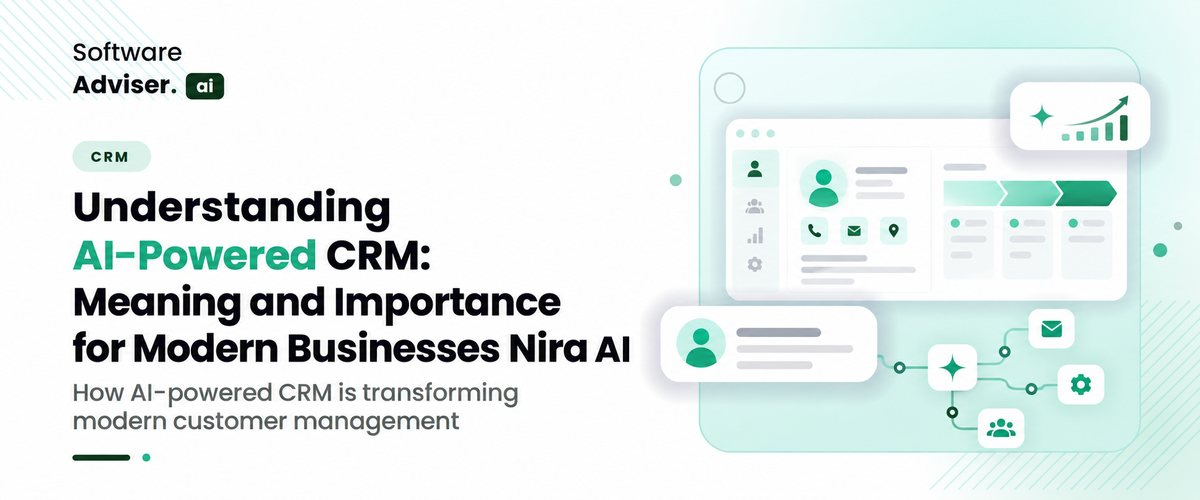
Understanding AI-powered CRM: Meaning and Importance for Modern Businesses Nira AI
 Dokas mile
A CRM may store thousands of customers' records, sales activities, emails and notes. It's not enough to have all of that information in one place—your team needs to know what needs to be done next.
That is where an AI-powered CRM can come in handy. It can not just store customer data, but also analyze that data, find patterns, perform repetitive tasks, and assist teams in determining where to invest their time, resources, and money.
This can translate to fewer record-keeping minutes and more action in the real-time data that can help a modern U.S. company.
 Looking for AI CRM Software? Check out Softwareadviser.ai's list of the Best AI CRM in USA for Your Business.
What Is an AI-Powered CRM?
AI-powered CRM is customer relationship management software that leverages artificial intelligence to process customer information, automate processes, provide insights, and help sales, marketing and service departments.
The traditional CRM software systems traditionally focus on the management of customers' data and interactions. An AI CRM adds intelligence that can operate with that data.
In contrast, for instance, an AI CRM can summarize the conversation, identify key moments, and propose the next steps for the sales rep when reaching out to a prospect rather than having to have a representative look back at all of their previous interactions.
This does not imply the system will make all decisions for your team. It's designed to limit manual effort and to assist people with making decisions in context.
How Does AI-Powered CRM Work?
An AI-powered CRM works by combining customer data with AI models and automation.
The process usually looks like this:
- Collect customer data: The CRM pulls data from emails, calls, forms, meetings, sales activities, and other systems that are integrated.
- Analyze the data: AI identifies patterns, changes, and signals within that information.
- Generate insights: The system can surface leads, unusual activity, risks for customers, and significant conversations.
- Automate actions: The CRM can make updates to records, generate tasks, summarize interactions, or help with communication based on your workflows.
- Support decisions: Your team can use those insights to prioritize leads, follow up with customers, and manage opportunities.
What Can AI-Powered CRM Software Do?
The value of AI-powered CRM software becomes clearer when you look at the work it can handle.
Automate Routine CRM Work
Salespeople often find themselves taking time to enter notes, updating records, record activities, and organize customer information.
CRM automation can reduce some of this repetitive work. AI can also help extract useful information from conversations and interactions so employees do not have to document every detail manually.
Summarize Customer Interactions
Long email threads and sales discussions can be confusing about what has just happened.
AI can provide a summary of interactions and highlight key points, providing your team with a more streamlined understanding of the customer's history before they enter the next interaction.
This becomes especially useful when accounts are handled by multiple employees.
Identify and Prioritize Leads
Not every lead deserves the same amount of attention at the same time.
AI-generated lead scoring allows a CRM to analyze customer behavior and other data it has on hand to identify leads that might require follow-up.
Teams can then focus their time on higher-priority opportunities instead of treating every lead equally.
Assist With Customer Communication
AI can draft an email, customize an email, provide a few ideas for the subject line, summarize an email, or adapt the tone of an email for sales representatives.
The employee will check the communication before sending it, but the first draft writing may be less time.
Support Sales Forecasting
AI can look at past and present data on sales and identify trends that can help with sales forecasting.AI can identify patterns in past and present sales data that can help with sales forecasting.
For instance, it could identify deal activity or pipeline behaviour that is changing in a way that requires further investigation.
Forecasts should always be reviewed by sales leaders, since the quality and completeness of the available customer data influences the accuracy of the forecasts.
Surface Useful Next Actions
An AI CRM can pull relevant information together, rather than forcing employees to trawl through various records.
For instance, it could point out that somebody has read a number of emails, participated in a product meeting and hasn't had any follow-up from you lately. Such context can assist a salesperson in making decisions on what to do next.
Why Is AI-Powered CRM Important for Modern Businesses?
The main value of an AI-powered CRM is not simply adding AI to an existing CRM. It is making customer information more useful in everyday work.
Here are some of the practical ways businesses can benefit.
Less Manual Work
Update of CRM records is required, but can be time consuming. By alleviating repetitive data entry and administrative tasks, automation and AI can free up time for employees to focus on customer interactions and other revenue-generating activities.
Faster Access to Customer Context
Employees do not always have time to read every email, note, and activity connected to an account. AI can provide context for customers and summarize it into a summary prior to meeting, call or follow-up.
Better Lead Prioritization
When a sales pipeline contains hundreds of leads, deciding where to focus can become difficult. AI can review the data on engagement and customer information to highlight opportunities that teams should pursue.
More Consistent Customer Engagement
When teams have better visibility into customer history, they can make follow-ups more relevant. AI can also ensure that all employees are communicating with the same tone and message while still having the opportunity to personalize the message that is spoken.
More Useful Business Insights
A CRM already contains valuable business information. AI can help turn that information into patterns and insights that may be harder to identify manually. Predictive analytics can be used to help with activities like lead prioritization, customer risk analysis, and sales forecasting.
AI-Powered CRM vs Traditional CRM
Both systems can manage customer relationships, but they approach the data differently.
|
Feature / Capability |
Traditional CRM |
|
Data Handling |
Stores and organizes customer information |
|
Sales Tracking |
Tracks sales activities |
|
Automation |
Uses rules and workflows for automation |
|
Information Review |
Requires more manual review |
|
Reporting & Insights |
Provides reports and dashboards |
|
Prioritization |
Employees decide what needs attention |
An AI CRM does not necessarily replace traditional CRM functionality. In many cases, it builds on it by adding AI capabilities.
Do You Know?
AI in the CRM doesn't necessarily imply complete decision-making autonomy. In fact, there are numerous AI CRM tools that are intended to help the employee by summarising their information, recognising patterns or making suggestions.
Where Can an AI-Powered CRM Help?
Customer data is utilized across the customer lifecycle making it possible for an AI-powered CRM to back various teams.
1. Sales
AI can help sales teams prioritize leads, provide summaries of conversations, support with email, analyze opportunities, and predict sales.
AI Sales Tracking Software can also aid teams in providing them with better visibility into sales activity and delivery insights and tracking data.
2. Marketing
Customer information can be leveraged to get a better handle on engagement, customer segments, and customer behavior patterns for marketing teams.
AI can be used to identify those patterns, but the marketing team will need to decide how they can be used to drive campaigns and messaging.
3. Customer Service
AI can provide a summary of past interactions, bring up customer history, and enable service agents to grasp an issue more quickly.
This can be helpful when the customer has had several interactions with staff or answered to support multiple times.
Nira AI: An Example of AI in CRM
Nira AI provides a practical example of how AI can be built into CRM workflows.
Instead of treating AI as a separate tool, Nira AI is designed to assist with activities that already happen inside customer relationship management.
It has been noted for its abilities to provide summaries of conversations, suggestions for conversation, provide email drafts tailored to users, suggest subjects, suggest tone for emails, adjust email tone, and provide email summaries.
For a sales rep, it might result in spending less time on past conversations or writing a new email.
But the bigger takeaway is significant: A good AI solution for CRM should be something that complements your existing processes—not require employees to operate a new system.
What Should You Consider Before Choosing AI CRM Software?
When paired with AI, not all CRM systems are appropriate for all business models. When choosing AI CRM software, think about how it will fit into your workflow.
-
Data Quality and Integrations
The more information that is fed into AI, the more its power can be enhanced. Lack of accurate, current, or consistent data can impact the value of the AI-generated insights. See how well the CRM system works with systems your team currently uses.
-
AI Capabilities
Be wary of platforms that claim to have AI but don't deliver. Look into the features you require, like AI lead scoring, conversation summaries, email support, predictive analytics, or sales forecasting.
-
Human Oversight
Any information or suggestions that AI provides must be verified before taking important decisions or addressing customer inquiries.
The decisions that impact customers, sales opportunities, and business relationships should continue to be made by your team.
-
Security and Privacy
Business and customer data can be sensitive and might end up in customer relationship systems. Ensure that the AI capabilities are deployed after verifying the provider's security measures, data handling practices, permissions, integrations, and privacy policies.
-
Ease of Adoption
A CRM can have advanced AI features and still fail to deliver value if employees do not use it. Select software that works with your existing workflow that is not making something which doesn't need to be made.

Pro-tip
Try one workflow of an AI CRM, like the lead prioritization feature or email assistance. Try to see if AI is really saving time; then don't apply AI across the entire customer lifecycle until it has been demonstrated to do so.
What Are the Limitations of AI-Powered CRM?
While an AI-powered CRM can decrease manual work and reveal valuable insights on the surface, it is not necessarily accurate or unbiased.
Poor data can produce poor recommendations. You might also need to tweak AI-generated emails to align with your brand tone and customer interactions.
Another limitation is context. A system may identify a pattern in customer activity without understanding the full business relationship behind it.
There are also privacy, security, integration, and employee adoption considerations.
For this reason, AI should be employed alongside, rather than instead of, human analysis when it comes to important customer actions.
What Is the Future of AI-Powered CRM?
AI CRM is moving beyond simple task automation.
With the growth of AI capabilities, CRM systems are now more than ever looking at the whole of the customer conversation and making predictions about future outcomes, suggesting actions, As AI capabilities improve, CRM platforms are increasingly focused on understanding customer conversations, predicting potential outcomes, recommending actions, and supporting employees across sales and service workflows and aiding employees through the sales and service processes.
This could make CRM systems more proactive. Instead of waiting for employees to search for information, the system can surface relevant signals when they matter.
Meanwhile, companies will require improved data governance, increased controls and oversight of AI, and human oversight in the growing sophistication of these systems.
The future of AI CRM software isn't just about automation – it's about doing more. It's all about to empower teams to make customers' data work for them without compromising human oversight.
Conclusion
There is more to an AI-powered CRM than simply introducing another layer of technology to your CRM. It's because it can streamline how your team searches, updates and sorts customer information—and how much time they spend on them.
The simple answer to this is to automate predictable tasks, use AI to find relevant signals and let humans take responsibility for critical customer decisions.
FAQ's
An AI-powered CRM uses artificial intelligence to analyze customer data, automate tasks, generate insights, and assist teams with sales, marketing, and customer service.
A traditional CRM mainly stores and organizes customer information. An AI CRM can also analyze that information, identify patterns, and provide recommendations or automation.
It can reduce manual work, improve lead prioritization, speed up access to customer information, and support more informed sales and service decisions.
No. AI CRM software is designed to assist sales teams with tasks, insights, and recommendations. Human judgment remains important for customer relationships and business decisions.
Yes. Small businesses can use AI CRM tools to reduce administrative work, organize customer information, prioritize leads, and support customer communication.
Look at the AI features, integrations, data security, usability, automation capabilities, reporting, and how well the software fits your team's existing workflow.
For years, Drift and Intercom led the way in chat-based customer interactions. By 2026, the picture changed quickly. Intercom moved beyond simple mess [...]

David N. Wilks
Marketing teams are drowning under a heavy wave of unstructured digital assets. The speed of creative execution forces content departments to manage t [...]
Dokas mile
Walk onto any modern factory floor or look at a city's traffic control room today, and you will notice a common problem. Legacy systems cannot manage [...]