
What we'll cover
Share with your community!


Get Free Consultation

AI Payroll Anomaly Detection: Catching Overpayments Before the Run Closes
 Dokas mile
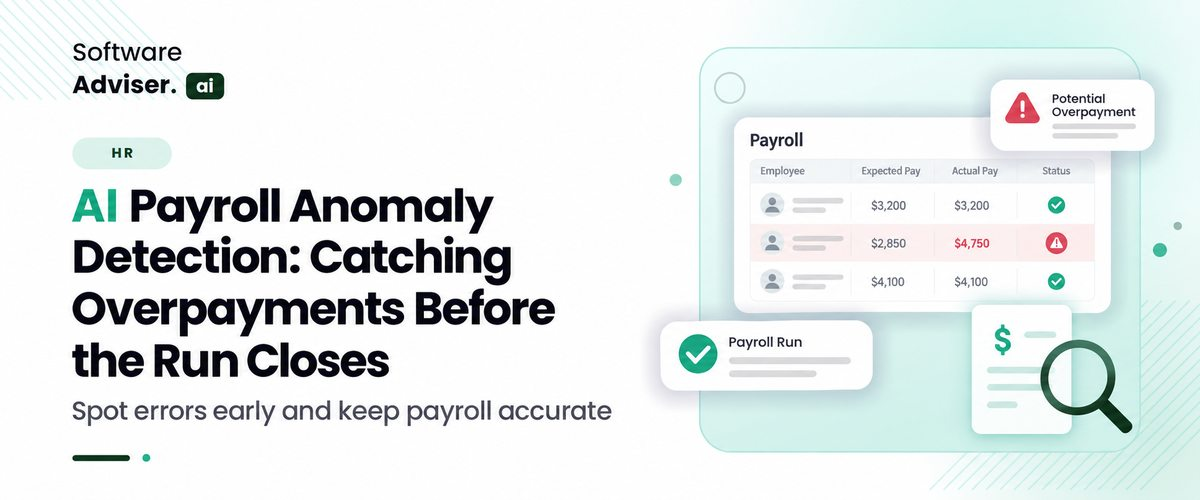
In the dynamic environment of US corporate finance, finalizing the AI payroll process can be a race against time. The finance teams involved in the payroll cycle face various problems that have escalated in complexity, such as issues associated with multi-state tax continuities, various hourly shifts, and manual adjustments, which can all result in errors that are not resolved before paying out the salaries. Due to the nature of the traditional software setup, it can identify the apparent problems, but that may not always be enough to avoid the smaller issues and discrepancies before the money has already gone out. That is why innovative companies that are looking for solutions to make sure no money gets lost have opted for AI-based solutions to the payroll process instead.
What is the Financial impact of undetected Payroll Overpayments on US Companies?
Negligent payroll overpayments result in a significant accrual of expenses for US companies, gradually diminishing revenues long before any department discovers a problem. As per the research conducted by Ernst & Young, resolving a single payroll mishap costs about $291 on average, which, for a large company carrying out thousands of payroll operations, amounts to losses of over $900,000/year. Apart from losing the cash, businesses incur considerable operational costs in total service time that covers manual adjustments, tax processes, and various AI financial CRM operations, such as clawing back and recalling payments through banks.
If we consider the impact more broadly, the consequences are significantly more severe due to strict penalties and risks of noncompliance with tax laws. The Fair Labor Standards Act (FLSA) and labor laws of various states stipulate that any mistakes in the payroll system may lead to tax penalties and compliance fees, at the same time putting companies at risk of conducting audits related to wages and hours of work.
Do You Know?
In the American market, more than 20% of ordinary payroll runs have mistakes that result in financial losses of millions of dollars due to capital loss, penalties due to non-compliance, and unproductive work efforts.
How are US Finance Teams using AI to spot Payroll mistakes before Processing day?
- Behavioral Baseline Matching: The AI keeps learning from the previous 12-24 months’ payroll history, developing personal and departmental profiles to discover various anomalies such as sudden salary increases of 30% without any reason, unearned commission accruals, and sudden changes in bank account details.
- Automated Timesheet & Overtime Verifications: Before processing salary payments, AI systems verify hours from timecards with the stipulated shifts, swipe cards, and overtime history to detect duplicate records of overtime, unpaid meal-time, or unauthorized shift extensions beforehand.
- Employees & Inactive Check Audits: AI systems verify active payroll runs with employee statuses in real-time, halting payments for ex-employees and inactive contractors credited with getting their salaries.
- Dynamic Multi-State FLSA Control: For businesses in the US, Remote or multi-state teams, AI constantly checks the rules of the Fair Labor Standards Act (FLSA) in accordance with specific states. It points out to the finance team the chances of overtime violations in particular states or discrepancies in tax deductions based on the location of the employee where he/she worked.
Instead of spending time on thousands of lines of code and finding out mistakes manually, AI offers the finance managers a list of the exceptions sorted by risks and urgency of compliance.
What is the Technology that allows AI to Catch Payroll errors faster than Traditional Rules?
- Unsupervised Anomaly Detection Algorithms: Most of the systems rely on if/then rules, which miss minor, complicated mistakes. AI uses the principle that has been used for unsupervised machine learning (e.g., by applying the Isolation Forest method) for continuous processing of thousands of data sources to find hidden violations without the need for humans to make rules on the basis of the information received.
- Dynamic Machine-Learned Baselines: AI doesn’t implement the same limits for employees of different departments. It builds behavior models for all the employees for different periods of time on the basis of their payment history from 12 to 24 months.
- NLP, along with rules-based engines based on Rules: AI platforms are capable of parsing complex timecards, several different pay rates, and tax codes of different states; thus, all overtime compliance with local laws can be verified before payroll lock.
- Knowing that there are Numerous disconnected Data Sources: AI online HR databases, timecards, bank accounts, and accounting books- AI relies upon graph analytics to cross-reference which, if any, of these sources the investigation is taking place. It allows detecting both ghost employees and employees who continue to receive payments even though they have been terminated.
What is the Key Feature AI uses to Detect Employees and Unapproved Overtime?
AI platforms employ a complicated mechanism of flagging discrepancies in the transmitted data in order to identify potential overpayments in advance.
- Duplicate Banking & Identity Indicators: To uncover non-existent employees or those that should have been removed but weren't, AI checks active payroll records for cases of duplicate routing numbers for direct deposits, similar Social Security Numbers, or the use of the same address by different people.
- HR-Payroll System Discrepancies: The abnormality detection device compares current payroll entries with HR logs. If a payment was made to a worker who has been terminated, who has taken unpaid leave, or who is not using the swipe pass or performing logins, that employee's payment details are flagged by the system automatically.
- Timetable and Overtime Discrepancies: To prevent unauthorized overtime, AI compares hours worked with the AI global payroll, tagged time, schedule of shifts, and product life. Alerts are issued in case of overtime being worked unexpectedly, unauthorized hours worked on weekends, or hours logged without the approval of the supervisor.
- Wrong Classification of Exempt vs. Non-Exempt Employees: AI performs regular audits of employee jobs in compliance with federal and state laws. The AI system will flag an error in the payment calculations if an employee with a salaried position is improperly classified as being entitled to overtime.
What is the Role of AI in enforcing complex state-by-state FLSA and US overtime Regulations?
- Dynamic Overtime Mapping Across Multiple Jurisdictions: The Federal FLSA law outlines that any employee of the company is entitled to remuneration for hours worked in excess of 40 in a week; as a consequence, several states like California and Colorado mandate the payment of overtime in case employees worked more than 8 or 12 hours, respectively. This means that any employee needs to be in his/her physical location so that the right federal, state, or municipal thresholds are applied. The developed AI detects the person’s real location and applies the proper regulations.
- Real-Time Regular Rate Combined Calculations: In the case of non-exempt employees, in the case when they get a shift differential, nondiscretionary bonus, or commission, FLSA requires recalculating the regular rate of pay for purposes of calculating overtime pay. The developed AI performs the calculation of the regular rate of pay without requiring any person to do the calculations; thus there is no possibility of making a calculation mistake during such operations.
- Automated Exemption vs. Non-Exemption Procedures: AI will analyze the job positions, total yearly salaries, and timecard patterns of job positions to make sure that they do not exceed federal and state exemptions.
What are the Measurable Cost Savings and ROI for US Enterprises using real-time AI validation?
- Removing the $291 Direct Error Correction fees: Research shows that correcting a single payroll error after completing the process takes an average of $291 in administrative costs, bank wire recalls, and tax refilling costs. Artificial intelligence is equipped to detect errors prior to the payroll process and save thousands of dollars in costs incurred monthly.
- Direct capital loss recovery of 1.5%: The American Payroll Association estimates that companies lose up to 1.5% of their gross research costs because of such unnoticed overpayments, errors while inputting information manually, and mistakes made while filling out the time sheets. Artificial intelligence allows detecting discrepancies and halting the leakage of funds before any payment is made.
- Reduction in time spent conducting manual audits by 90%: Companies using artificial intelligence save up to 90% of the time spent conducting manual audits and employ automated technologies to carry out repetitive tasks, thus allowing accountants to focus on exception approval only.
- Avoidance of IRS penalties of 10%-20%: The fact that overpayment of funds miscalculates tax withholdings exposes American companies to the thought of suffering serious penalties imposed by the IRS. Such violations can be eliminated by means of real-time tax compliance validation.
- Mitigated Fraud Losses of 100 percent Employee: Payroll fraud constitutes a large part of corporate losses in the USA, being performed unnoticed for around 18 months. Artificial intelligence takes advantage of data, comparing HR active logs with banking routes to stop payments made either for fake or vacated employees altogether.
Conclusion
Detecting payroll errors before the real processing ends is no longer regarded as a luxury but is considered rather a must for modern companies in the USA. The transition from reactive auditing to automated payment validation makes it possible for finance departments to save the company from losses, comply with the Fair Labor Standards Act, and avoid costly overpayment. Using an appropriate tool to track payroll fraud turns it from a process with a lot of potential risks to a straightforward one.
FAQ's
AI payroll anomaly detection is an automated software layer that scans pay runs in real time to catch overpayments, calculation errors, and fraud before payments close.
Unlike rigid, rule-based software, AI analyzes historical wage patterns, timecards, and cross-system records simultaneously to flag subtle behavioral and numerical anomalies.
Yes, AI cross-references active HR records, badge logs, and banking details to instantly flag duplicate routing numbers and unapproved timecard hours.
AI automatically maps multi-state labor laws, tracks local overtime thresholds, and calculates complex blended regular rates to ensure regulatory compliance across US jurisdictions.
US enterprises usually recover their full software costs within 90 days and achieve a 3x to 5x ROI in the first year by stopping overpayments and reducing manual labor.
Retail in the United States is undergoing a huge transition as brick-and-mortar establishments and e-commerce platforms battle to suit the wants of th [...]

David N. Wilks
Long live the pulse of real-time data; the typical annual staff survey is dead. With workplaces transitioning to hybrid models and the rise of quiet r [...]
David N. Wilks
As organizations are increasingly integrating artificial intelligence into their talent acquisition processes, automatic interview scoring tools compu [...]