
What we'll cover
Share with your community!


Get Free Consultation

AI Supply Chain Management: How AI Is Transforming Modern Logistics
 David N. Wilks
Think for a second about a global network that truly breathes, learns from its mistakes, and anticipates trouble before it begins. This isn't a scene from a sci-fi movie; it is the residing kingdom of AI in Supply Chain these days. In an era plagued by sudden climate events, shifting geopolitical boundaries, and hyper-fickle consumer demands, the "static" supply chain is basically a relic. Today, smart businesses rely on artificial intelligence for supply chain management to build a self-healing ecosystem that doesn’t just break and wait for a repair; it adapts.
When we sit down to discuss AI in supply chain and logistics, we are looking at a system capable of predicting a labor strike at a Southeast Asian port two weeks before a single picket sign is raised. It then automatically reroutes vital cargo to a secondary hub without a human ever having to click a mouse. This level of pure autonomy is exactly what defines our modern landscape.
How AI Is Transforming Modern Logistics Operations
The massive shift sparked by AI in Supply Chain is multifaceted, essentially touching every single link in the chain from the moment raw materials leave the ground to the final mile delivery at a customer’s doorstep.
1. Real-Time Visibility and "Glass Pipeline" Logistics
For decades, supply chains were essentially "black boxes." Once a crate left the warehouse, your visibility was spotty at best. Today, however, AI in supply chain management provides what we call a "glass pipeline”.By leveraging a mix of IoT sensors and satellite tv for pc telemetry, AI monitors the exact coordinates, ambient temperature, or even the vibration levels of products in transit.
2. Dynamic Autonomous Routing
The deep integration of AI in logistics and supply chain has fundamentally changed how we define "the route."In 2026, a route isn't always a set line drawn on a map. Instead, AI systems process live visitors' feeds, sudden storm fronts, fluctuating gas charges, or even local carbon emission taxes in real-time. This ensures that each AI in Supply Chain operation remains lean, cost-effective, and ecologically responsible.
3. Predictive Maintenance for Fleet Longevity
Smart logistics firms are now heavily utilizing AI in supply chain and logistics to keep a digital pulse on vehicle health. By crunching engine telemetry and subtle wear-and-tear patterns, artificial intelligence for supply chain management spots a mechanical failure before it actually happens. This "zero-downtime" strategy is saving modern companies millions in avoided emergency repairs and missed delivery slots.
Major Applications of AI in Different Industries
The real beauty of AI in Supply Chain technology lies in its incredible flexibility. Every industry has its own unique nightmares, and AI provides a specific flashlight for each one.
-
AI in Food Supply Chains: Fighting Perishability
Perhaps the most high-stakes use case exists within AI in food supply chains. In a world where food waste is both a moral and financial crisis, AI acts as a digital watchdog. Sensors track the "shelf-life" of perishables in real-time. If a refrigerated container’s temperature fluctuates by even a fraction, the AI in food supply chains immediately alerts the carrier or reroutes the goods to a closer distribution center to prevent total loss. This is the difference between a profit and a write-off.
-
AI in Retail Supply Chain: Predictive Consumerism
In the retail world, consumer tastes change at the speed of a viral video. AI in retail supply chain allows brands to synchronize their physical inventory with digital trends. If a specific product goes viral on social platforms, the ai in Supply Chain architecture automatically scales production orders and shifts existing stock to the neighborhoods showing the highest engagement.
-
High-Tech and Manufacturing
For manufacturers relying on hyper-complex components like semiconductors, AI in supply chain management identifies "hidden" risks in tier 2 and tier 3 suppliers. If a sub-component factory in a distant region hits a power snag, the AI maps the ripple effect across the global line, allowing the manufacturer to pivot before the assembly line grinds to a halt.
-
Generative AI & Agentic AI in Supply Chain: The New Frontier
As we move deeper into the mid-2020s, two specific heavy-hitters are dominating the board: Generative AI in supply chain and the rise of agentic ai in supply chain. These aren't just trendy buzzwords; they represent a total shift in how decisions are made.
-
Generative AI in Supply Chain
While your standard AI is great at math, Generative AI in supply chain is a master of communication and simulation. It can draft nuanced vendor contracts in seconds, simulate ten thousand "what-if" disaster scenarios, and provide clear, natural-language summaries of massive logistics reports for the board of directors. It is the bridge between cold data and human strategy.
-
Agentic AI in Supply Chain
The true game-changer, however, is agentic ai in supply chain. Unlike basic automation, these AI "agents" have the actual authority to execute tasks. If an agent detects a delay in a steel shipment, it doesn't just send a "FYI" email. It proactively scans for a backup supplier, verifies their compliance certificates, negotiates a fair market price, and has the purchase order sitting in a human’s inbox for a final "OK." This is the undeniable future of AI in supply chain.
Benefits of AI in Supply Chain Management
The global stampede toward AI in supply chain management is driven by one thing: undeniable ROI.
- Massive Cost Reduction: By squeezing every drop of efficiency out of fuel and warehouse space, ai in Supply Chain can slash operational overhead by up to 25%.
- Hyper-Accurate Demand Forecasting: Old forecasting was basically an educated guess. Artificial intelligence for supply chain management now uses thousands of external variables from local festivals to global fuel hikes to predict exactly what needs to be on a shelf.
- Risk Mitigation: AI in logistics and supply chain serves as a 24/7 early warning system. Whether it’s a trade war or a hurricane, AI builds the "Plan B" before the "Plan A" even hits a snag.
How AI Enhances Sustainability in Supply Chains
One question I hear constantly from stakeholders is: How can AI enhance sustainability in supply chains? In 2026, being "Green" is finally synonymous with being "Profitable."
By adopting ai in Supply Chain, firms are finally achieving "Circular Logistics." AI manages the return of products (reverse logistics) so that recycled parts are fed back into production with zero waste. Additionally, AI in logistics and supply chain enables "load pooling," where unique corporations proportion cargo space so no truck ever travels half-empty.
So, how can AI enhance sustainability in supply chains?It does so by aggressively pruning carbon footprints and slashing physical waste, particularly within the AI in food supply chains sector where efficiency saves both money and resources.
Challenges & The Future of AI in Supply Chain
No revolution comes without its growing pains. The future of AI in supply chain relies on how we navigate a few key hurdles:
- Data Integrity: AI in supply chain management is only as smart as the data it’s fed. Many firms are still fighting "data silos" where vital info is trapped in old, legacy software.
- The Talent Gap: We need a new breed of logistics pros who understand data models as well as they understand shipping lanes.
- Ethical Oversight: As we lean on agentic AI in supply chain, we have to ensure these algorithms are transparent and free from regional biases.
The future of AI in supply chain is ultimately about "Human-Centric Automation," where machines handle the data-heavy drudgery, leaving humans to focus on the high-level relationships.
How Businesses Can Start Using AI in Supply Chain Management
You don't need a multi-billion-dollar war chest to start. Most modern Supply Chain Management software now features built-in AI modules.
- Audit Your Tech: Make sure your Supply Chain Management software is cloud-based and ready to talk to other apps via API.
- Start with a Pilot: Don't overhaul the whole company overnight. Apply AI in logistics and supply chain to your most expensive shipping route first.
- Prioritize Integration: The magic of ai in Supply Chain takes place when your sales, warehouse, and transport data subsequently begin talking to one another.
To stay beforehand, I recommend looking into related categories like Automated Procurement Systems, Last-Mile Delivery Innovation, and Predictive Warehouse Analytics.
Comparison Table: Traditional vs. AI-Powered Supply Chain
|
Feature |
Traditional Supply Chain |
AI-Powered Supply Chain (2026) |
|
Forecasting |
Historical sales only |
1000+ real-time variables |
|
Visibility |
Milestone-based (Arrived/Shipped) |
Real-time GPS & condition health |
|
Problem Solving |
Reactive (Fixing it later) |
Proactive (Preventing it now) |
|
Sustainability |
Rough approximations |
Real-time carbon & waste tracking |
|
Decision Making |
Human-led and often slow |
Agentic AI-led and near-instant |
Conclusion
The rapid evolution of AI in Supply Chain is easily the biggest shift in trade since the internet itself. By embracing AI in supply chain management, businesses are no longer victims of global chaos; they are ready for it. Whether you are using Generative AI in the supply chain to tighten your contracts or AI in the retail supply chain to catch the next consumer wave, the message is clear: the future belongs to the prepared.
Investing in a high-caliber Supply Chain Management software that puts AI at the forefront is, quite simply, the smartest move any logistics professional can make in 2026.
FAQ's
Unlike a human planner, AI in supply chain management can digest millions of data points at once. It watches social media shifts, weather, and macro-economics to provide a forecast that is lightyears more accurate than traditional spreadsheets.
Absolutely. Today’s Supply Chain Management software is modular. Small firms can use ai in Supply Chain tools for specific needs like inventory tracking without needing a massive tech department.
While everyone wins, AI in food supply chains and AI in retail supply chains usually see the fastest ROI because their inventory moves so quickly.
By using AI in logistics and supply chain, companies can see a bottleneck at the border days in advance and switch transport modes (like moving from sea to rail) before the delay ever touches the customer.
The architectural foundation of modern commercial technology has experienced a massive shift toward microservices and decentralized cloud platforms. M [...]

Dokas mile
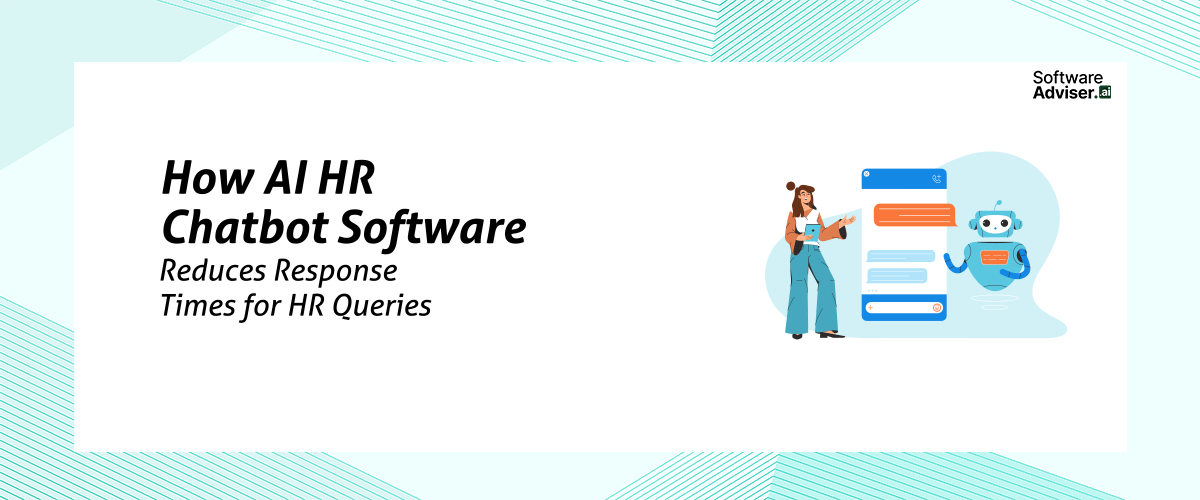
HR professionals can easily be overwhelmed by the questions they receive from employees, which results in delayed replies and unsatisfied employees. A [...]
Dokas mile
Corporate learning is changing at a rapid pace. For years, businesses relied on static systems to store training videos, host presentation slides, and [...]