
What we'll cover
Share with your community!


Get Free Consultation
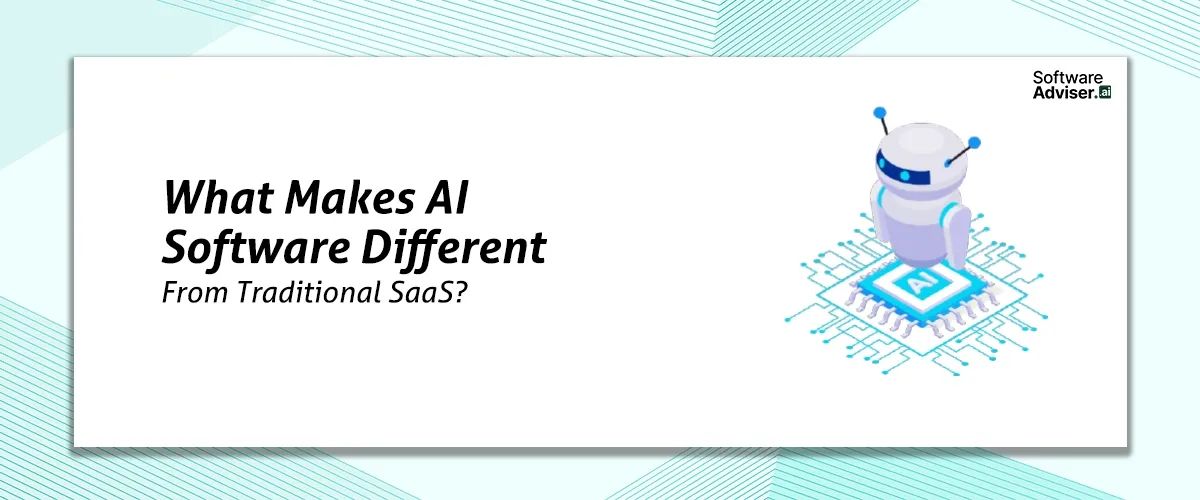
What Makes AI Software Different From Traditional SaaS?
 Dokas mile
The global enterprise landscape has hit a major turning point. Corporate leadership teams everywhere are forcing a complete rethink of digital infrastructure. For over two decades, cloud-based subscription toolsets dominated the business world. They moved local hard-drive tools into smooth, internet-hosted platforms. But simply hosting static database fields on a remote cloud server no longer gives companies a competitive advantage. The modern corporate environment is rapidly shifting away from rigid data storage buckets. Businesses want dynamic execution systems. This shift highlights the fundamental differences between smart adaptive tech and legacy setups. Relying on an application that merely holds your information creates massive bottlenecks. Your staff still has to log in, read the data, make decisions, and execute every workflow manually. Organizations are actively upgrading their core setups to deploy interactive AI Software layers. These systems expect consumer needs, generate complex content, and manage large-scale enterprise moves without steady human oversight. Understanding the core structural, economic, and operational differences between those two digital architectures is crucial for constructing a scalable, automatic commercial enterprise model in 2026.
What Is Traditional SaaS?
To understand how modern tech is evolving, you must first look at the foundation of traditional cloud setups. Software-as-a-Service, commonly known as SaaS, is a software delivery model where a vendor hosts applications on a central cloud network. Enterprise clients access the tools through web browsers via a recurring subscription fee.
The defining mechanical characteristic of a traditional cloud setup is that it is completely deterministic. The application follows strict, fixed code paths written by engineers. When your employee enters an information factor into a cloud spreadsheet, the utility runs a pre-programmed method. It gives you an equal, predictable output every single time. It works as a digital submission cabinet. It is tremendously dependable for storing data and performing primary calculations, but absolutely incapable of learning from its surroundings or converting its very own inner common sense.
What Is AI Software?
Moving past simple data storage brings us to the next generation of business technology. Modern AI Software refers to intelligent digital platforms that use machine learning models, neural networks, and deep text engines to process complex data, spot hidden patterns, and take autonomous actions.
Unlike old cloud tools, this architecture is probabilistic. Instead of blindly following rigid rules, it studies data history, calculates statistical likelihoods, and changes its behavior based on incoming user habits. This dynamic setup allows the program to handle messy, real-world information like unformatted customer messages or broken data logs. This structural flexibility moves the technology away from being a simple passive utility that holds data. It becomes an active digital assistant that makes smart decisions alongside your workforce.
Core Differences: AI Software vs. Traditional SaaS
The structural split between these two technology generations shows up across four major operational categories:
-
Data Processing Mechanics
Traditional cloud setups rely entirely on structured data entered into neat spreadsheet rows. Intelligent systems can read unstructured data. This allows the platform to analyze audio recordings, read legal PDF files, and understand context without human data cleaning.
-
Automation Depth
Old-school tools use basic rules: if an employee clicks button A, the system sends email B. Modern cognitive systems use adaptive logic loops to analyze customer emails. They figure out the underlying complaint, look up order logs, and draft custom resolutions automatically.
-
Code Upgrades and Growth
To improve a traditional cloud app, software engineers must manually write and deploy new code blocks. An intelligent system continuously tunes its own performance by analyzing user selections and processing outcomes. This makes it smarter over time without human software patches.
-
Computing and Infrastructure Costs
Legacy systems run on standard cloud servers. This results in highly stable, predictable hosting fees. Cognitive platforms rely on complex graphics processing units (GPUs) to run deep learning models, which demands more fluid infrastructure management.
Key Capabilities of Modern AI Software
Deploying clever systems gives businesses unique competencies that conventional cloud setups clearly cannot reflect:
- Predictive Analytical Modeling: The device tracks stock sales cycles, identifies upcoming consumer buying drops, and routinely alerts providers earlier than a warehouse runs out of inventory.
- Hyper-Personalized Interfaces: Instead of displaying an equal dashboard to every worker, the software alters its visible layout based on a worker's each day responsibilities and operational behavior.
- Continuous System Optimization: The application tracks its personal internal system speeds, spots record transfer lag, and adjusts its history queries to preserve top efficiency.
To keep these complicated tools completely strong, employer teams use complete AI Machine Learning Software to screen gadget protection, track processing speeds, and confirm algorithm selections from a unified command panel.
Real-World Applications Across Industries
Deploying intelligent frameworks changes daily operational workflows across several major corporate sectors:
-
Human Resources and Talent Acquisition
Old HR portals merely save resumes in a directory. This forces recruiters to read every file manually. Deploying AI hiring software goperfect completely automates the screening process. It scores candidates based on real skill metrics, schedules technical interviews, and answers basic applicant questions instantly.
-
Digital Media Production
Traditional video editing applications require artists to cut clips and mix audio tracks manually over several days. Modern AI video creation software allows marketing teams to turn raw text scripts into high-quality marketing clips. It adds realistic voiceovers and generates custom backgrounds in a few minutes.
-
Creative Prototyping and Simulation
Instead of a human artist spending hours drawing fantasy concepts, developers use a fantasy world map AI generator software download to build expansive, interactive digital terrains for testing inside gaming environments instantly.
Managing these multi-layered connections requires linking your applications directly with secure AI Workflow Automation Software channels. This structural setup ensures your autonomous applications can handle high-volume data transfers. It cleanly routes complicated files to human managers whenever an entry needs an actual person's review.
How AI Changes Software Development and No-Code
The shift in the direction of sensible tech is basically converting how agencies construct and check proprietary packages. Traditional software program development calls for engineering groups to write thousands and thousands of traces of code manually. They have to manage server frameworks and run manual debugging cycles over several months.
Modern AI software development leverages advanced coding models to auto-generate code blocks. It translates legacy scripts into modern languages and pinpoints security vulnerabilities in real time. This acceleration has led to the rise of intelligent no-code development setups.
Using an AI no-code software program sandbox environment, non-technical managers can describe a business tool in plain English, and the platform builds the total application structure instantly. This secure sandbox lets in groups to safely run, test, and tweak computerized workflows without risking database errors or disrupting live client files.
Operational Benefits and Challenges
Shifting your organisation's workflow to a lively, clever framework gives your brand a big edge.But it introduces distinct operational challenges that require constant IT oversight.
-
Primary Operational Benefits
The single biggest perk of moving to an intelligent setup is the absolute precision of your corporate data automation. Instead of forcing employees to spend hours handling repetitive data entry tasks, your systems use predictive modeling to optimize pipelines on the fly. This massive efficiency boost lowers overhead costs, speeds up project delivery times, and provides deep data insights from a central hub.
-
Core Implementation Challenges
However, these systems introduce data governance challenges. Machine learning models require massive volumes of data to maintain accuracy. If your data pools contain errors, the software can amplify those mistakes. This leads to algorithm biases or text hallucinations. Navigating these data privacy layers requires using robust data anonymization rules and keeping human managers in the loop to review high-risk corporate outputs.
Choosing the Right Technology Layer for Your Business
Deciding whether to buy a traditional SaaS utility or spend money on a modern-day smart platform relies entirely on your particular operational targets and technical assets. If your number one intention is clearly to maintain file logs or run general accounting calculations, a conventional cloud tool is completely fine.
But if you need to run complex, automated business operations, you must deploy an integrated AI Business Management Software suite. Look for vendors that offer robust data encryption, flexible API connections, and clean developer dashboards. Ensuring your new cognitive tools connect smoothly with your current AI Machine Learning Software prevents data silos and keeps your records safe.
The Future of Enterprise Systems
Workforce automation is moving incredibly fast. If you follow emerging tech trends, you will see a massive industry shift toward fully autonomous business platforms. These systems manage entire company departments inside a single, unified framework.
To put together for this shift, agencies are upgrading their internal infrastructures with employer-grade AI Workflow Automation Software layers. This allows brands to connect their specialized models seamlessly, protect customer records, and handle massive data scaling without breaking their existing software frameworks.
Conclusion :
Choosing between traditional SaaS and present-day shrewd applications isn't always about selecting one device over any other. It is about information on how to layer these technologies collectively to construct a surprisingly efficient company workflow.Moving past simple data storage and embracing autonomous software networks allows your brand to handle complex business processes with absolute precision.
Whether your primary operational goal this quarter is to upgrade your data infrastructure using an advanced AI Business Management Software platform, optimize your daily pipelines via modern AI Workflow Automation Software, or track your model data using AI Machine Learning Software, the ultimate target remains identical. You need a workspace that runs smoother, faster, and smarter. Taking that first simple step these days guarantees your business stays aggressive, resilient, and completely geared up to win.
FAQ's
AI software uses machine learning and automation to perform intelligent tasks.
AI software learns from data, while traditional SaaS follows fixed rules.
No, many businesses use AI software alongside traditional SaaS solutions.
AI improves automation, decision-making, efficiency, and personalization.
The traditional "payday" turned into a source of dread, described by past due-night spreadsheets and the consistent fear of a unmarried decimal errors [...]

David N. Wilks
Building a dominant online brand requires publishing fresh content daily across multiple networks, answering hundreds of customer comments, tracking t [...]
Dokas mile
For decades, learning animation required months of practicing complex drawing, rigging, and lighting. However, generative media has completely shatter [...]