
What we'll cover
Share with your community!


Get Free Consultation
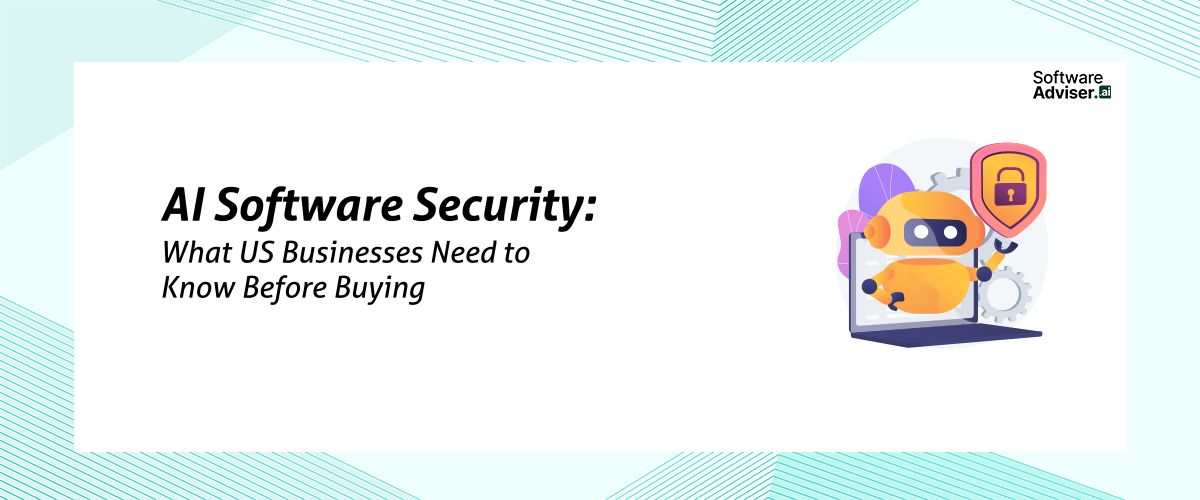
AI Software Security: What US Businesses Need to Know Before Buying
 David N. Wilks
The moment your data enters an AI vendor's system, their security practices become your security practices. That is the uncomfortable truth most US businesses discover too late, often after an employee has already pasted a client list or a financial spreadsheet into a free tool. AI adoption has moved faster than almost any technology in history, with most organizations now using it in some form, but the security questions have not kept pace. AI software security is not a feature you check at the end; it is something you have to evaluate before you buy, because a tool that mishandles data can expose you to breaches, regulatory penalties, and lost customer trust.
This guide explains, in plain language, exactly what US businesses need to know about AI software security before purchasing, from the real risks to the questions that should make or break a vendor decision.
Why AI Software Security Is Different
Ordinary software does what it is told and stores what you give it. AI software is different in a way that raises the stakes. It often learns from the data you feed it, connects across many systems the same way an AI machine learning software does, and may even act on its own, which means a single weak setting or unclear data policy can quietly create real exposure
The core issue is what happens to your inputs. When an employee types a question or uploads a document, that data can be logged, cached, or sent to an external model provider and, in some cases, used to train future models. Researchers have shown that AI systems can even memorize sensitive inputs and surface them later in responses to other users. So the data risk is not only a breach in the traditional sense; it is the possibility that your confidential information becomes part of a system you do not control. That is why AI software security deserves its own evaluation rather than being lumped in with general IT checks.
The Regulatory Landscape for US Businesses
Here is something that surprises many buyers: the United States has no single comprehensive federal AI law. That does not mean AI is unregulated. Federal agencies are actively applying existing authority to it, with the FTC bringing enforcement actions under consumer protection and fair lending laws and the EEOC addressing AI-related employment discrimination. State attorneys general have also stepped up enforcement, and the number of AI-related privacy incidents has climbed sharply, with Stanford documenting a 56 percent year-over-year jump in 2024.
On top of that sit the data laws you already know. The California Consumer Privacy Act gives California residents the right to know what data is collected and to request its deletion, GDPR applies if you handle data from people in the EU, and HIPAA governs health information. If you operate across state lines or serve customers in multiple regions, you generally need to meet the strictest applicable standard. The practical takeaway is simple: AI software security and compliance are linked, and a tool that cannot meet your regulatory obligations is a liability no matter how capable it is.
The Biggest AI Security Risks to Understand
Before evaluating vendors, it helps to know the specific risks that matter most for a business buyer. These are where problems usually start.
The first is model training exposure. Many AI tools collect user prompts and may use them to train their models, which means sensitive information you enter could resurface elsewhere. The second is shadow AI, the unsanctioned tools employees adopt on their own. A marketing person uses one AI writer, a support rep uses an AI help desk software summarizer, an accountant runs a spreadsheet tool, and none of it goes through IT. If leadership does not know which tools are in use, there is no way to evaluate their data handling, and audit trails develop gaps.
The third risk is the vendor itself. A provider's privacy practices effectively become yours the moment your data enters their system, so a weak vendor is your weak link. The fourth is unstructured data leakage, since emails, documents, and chat logs often contain private details that people share with AI tools without thinking. And the fifth is integration risk: insecure APIs and overly broad permissions widen the attack surface, especially when an AI tool connects deeply into your other systems. Strong AI software security means accounting for all five before you sign.
What to Ask a Vendor Before You Buy
This is the heart of the matter. Good AI software security comes down to asking the right questions and refusing to proceed without clear answers. Vague or evasive responses to any of these should remove a vendor from consideration.
Start with the data itself. What data does the tool access, where is it physically stored, and how does it move during processing? For anything touching customer, financial, or health data, you want specifics on data residency and confirmation that your information stays in environments you control. Next, ask the single most consequential question: is our data used to train your models, and can we opt out? If a vendor cannot give a straight answer, treat that as a warning.
Then move to credentials and controls. Ask which certifications apply, whether SOC 2, ISO 27001, GDPR, HIPAA, or others relevant to your industry, and request them in writing. Confirm that the tool encrypts data both at rest and in transit, supports role-based access controls so only the right people can see sensitive information, and provides audit logs. Finally, ask how the vendor handles incidents: what happens if there is a breach, how fast will you be notified, and what is their track record. A provider that takes AI software security seriously will answer all of this readily.
A Practical Pre-Purchase Security Checklist
To make this concrete, here is a checklist US businesses can run before committing to any AI tool. If a vendor falls short on the items that matter to your situation, keep looking.
|
Security factor |
What to confirm before buying |
|
Data usage |
Whether your inputs train the model, and if you can opt out |
|
Data residency |
Where data is stored and processed, and that it stays in your control |
|
Encryption |
Data protected both at rest and in transit |
|
Access controls |
Role-based, least-privilege access and strong authentication |
|
Certifications |
SOC 2, ISO 27001, GDPR, HIPAA, or others for your industry |
|
Audit logs |
A record of who accessed what and when |
|
Incident response |
Clear breach notification process and timelines |
|
Integration security |
Secure APIs with authentication and rate limiting |
|
Compliance fit |
Meets the regulations that apply to your business |
Treat this as a filter. The tools that pass are the ones worth trialing; the ones that cannot answer are the ones that become tomorrow's problem.
Free Tools and the Hidden Security Cost
One of the most common AI software security mistakes is using free, consumer-grade tools for business data, whether it's an AI CRM software or something simpler. Free versions often have weaker privacy protections, and some explicitly use your inputs to improve their models. Inputting confidential data into a public AI tool has been compared to whispering secrets in a crowded room, since you cannot be sure who is listening or where the data ends up.
The fix is not to ban AI, which only drives shadow usage underground. The better approach is to provide approved, business-grade tools with clear security protections, so employees choose the sanctioned option because it meets their needs. Enterprise versions of major tools typically offer stronger guarantees, including the ability to keep your data out of training. Pair that with a simple internal rule that many security teams recommend: if you would not post it publicly, do not put it into an AI tool. That one habit prevents a large share of accidental exposure.
Building Basic AI Security Habits
Strong AI software security is not only about the vendor; it is also about how your team uses the tool. A few practical habits go a long way, and none require an enterprise budget.
Set a clear AI usage policy now rather than after an incident, defining what is safe and unsafe to input. Know which tools are actually in use through a quick discovery exercise, since you cannot secure what you cannot see. Apply least-privilege access so AI tools, including AI employee monitoring software, only reach the data they genuinely need, and keep humans in the loop for decisions that significantly affect people, which is also a legal expectation under several frameworks. Finally, make AI part of your existing security training, the same way you train staff on phishing and data protection, because a single careless paste can trigger a costly breach. These habits turn AI from a blind spot into a managed part of your security posture.
What Getting It Wrong Actually Costs
It helps to be clear-eyed about the stakes, because AI data security failures are not abstract. They show up as money, legal exposure, and lost trust, often all at once.
The financial damage is direct. A single data breach can cost a business heavily in cleanup, downtime, and lost work, and AI-related incidents are climbing fast. There is also a growing insurance angle: many insurers now require specific security controls before they will approve or renew cyber coverage, so weak AI data security can quietly raise your premiums or leave a claim unpaid. On the legal side, state attorneys general have increased enforcement, and a violation of CCPA, GDPR, or HIPAA tied to an AI tool can bring real penalties, especially when you cannot even say which tools were handling the data.
The quietest cost is trust. Customers share information expecting it to be protected, and a public incident, particularly one involving an AI tool nobody vetted, can damage a reputation far longer than the breach itself lasts. None of these costs appears on the purchase invoice, but all of them are real, which is exactly why treating AI software security as a pre-purchase requirement is cheaper than treating it as a cleanup project. Good data security is an investment, not an expense.
Who Should Be Involved in the Decision
One practical point that smooths the whole process: AI software security is not a solo decision for whoever found the tool. Bring in the people who can actually judge the risk before you commit.
Loop in IT and security early so they can assess data flows, integration safety, and access controls. Involve whoever owns compliance in your business since they understand which regulations apply and what proof you need, especially for tools like AI expense management software that touch financial data directly. And include the end users who will handle the data day to day, because they know what information will actually pass through the tool. Getting these voices in before purchase prevents the common situation where a tool is bought, deployed, and only then found to clash with a security or compliance requirement. Shared ownership of the decision is one of the simplest ways to keep AI software security strong without slowing the business down.
Conclusion
AI software security is no longer a niche concern for big enterprises; it is a core part of any smart buying decision for US businesses in 2026. The risks are real and specific: your inputs may train someone else's model, shadow AI creates blind spots, and a weak vendor inherits the keys to your data. But the protections are equally concrete. Before you buy, confirm where your data lives, whether it trains the model, what certifications the vendor holds, and how they encrypt, control access, and handle incidents. Match the tool to the US regulations that apply to you, favor business-grade options over free consumer tools for sensitive work, and back it all with a clear usage policy and basic team training. Handle AI software security as a pre-purchase question rather than an afterthought, and you can adopt these powerful tools with confidence instead of exposure, whatever the size of your business.
FAQ's
AI software security protects sensitive business data, ensures regulatory compliance, and reduces the risk of data breaches and cyber threats.
Look for data encryption, role-based access controls, compliance certifications, audit logs, secure integrations, and strong privacy policies.
Free AI tools may lack enterprise-grade security and privacy protections, so sensitive business data should only be used with trusted business-grade solutions.
Evaluate AI software by reviewing its data handling practices, compliance certifications, security controls, incident response process, and vendor transparency.
Businesses should use secure AI platforms, establish clear AI usage policies, restrict access to sensitive data, and provide ongoing employee security training.
A decade ago, recording your screen meant hitting record, talking for twenty minutes, then spending another hour trimming dead air and adding captions [...]

Dokas mile
Staring at a clean display, looking a blinking cursor even as trying to draft the right message is an absolute productivity killer. Whether you need t [...]
David N. Wilks
For years, sales teams were stuck using CRMs they grumbled about daily. Meant to simplify tasks, these tools too often piled on chores, typing endless [...]