
What we'll cover
Share with your community!


Get Free Consultation
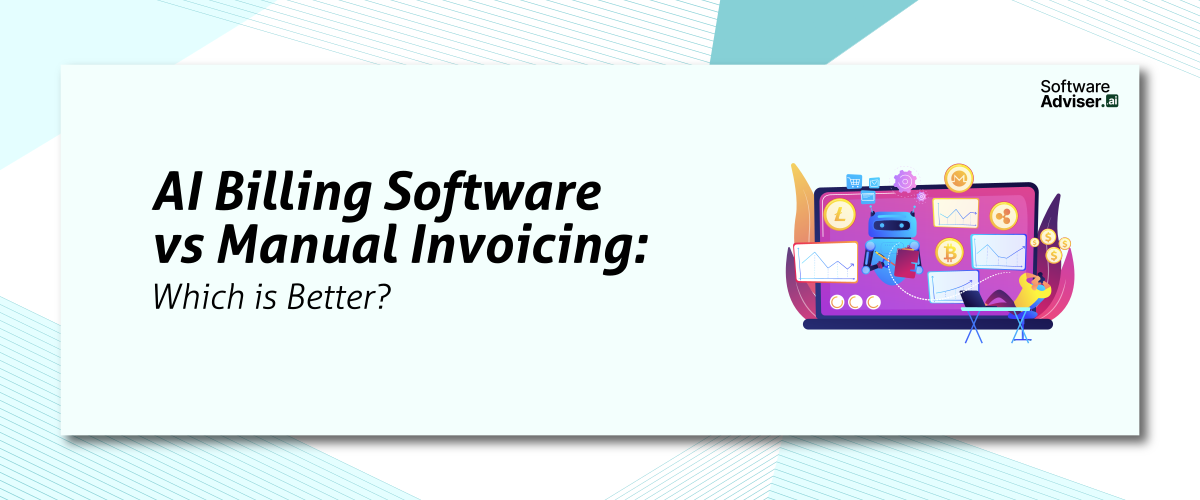
AI Recurring Billing Software vs Manual Invoicing: Which is Better?
 David N. Wilks
Small business owners in America often have only one way to manage their cash flow - by sending invoices out the door. As their businesses grow, however, using word processors, spreadsheets and paper templates to create invoices creates significant bottlenecks in the invoicing process. where you can see some examples of how AI-enhanced recurring billing applications can remove most of the headaches that come with manual invoicing tasks like chasing late payments, fixing typographical errors and sending invoices to customers by automating many of the recurring manual processes involved in creating and sending invoices.
What is AI Recurring Billing Software, and how does it differ from Manual Invoicing?
An AI recurring billing application is an online product that brings together members of the artificial intelligence and machine learning communities to provide solutions to help manage the payment process without having to always enter data manually. Instead of you calculating hours, inputting line items, and emailing a PDF file of your invoices, an AI system will immediately pull the relevant data from your project tracking application or contract to generate an accurate invoice.
AI recurring billing software will automatically apply local and state taxes, route your invoices to the appropriate department, and include instant click-to-pay links for US customers to pay via credit card or ACH (Automated Clearing House). So instead of waiting hours or days for payment, AI recurring billing can help you get paid right after sending out an invoice.
The primary distinction between AI billing and manual invoice creation is that AI eliminates human error and wasted time. When you create invoices manually with spreadsheets or word processors, you will be stuck repeating the same mind-numbing tasks over and over: following up on overdue payments, correcting spelling mistakes, and entering information into updated financial spreadsheets. However, AI software will take you out of the billing process altogether and ensure that you no longer have to chase after customers for payment.
AI recurring billing will allow you to see exactly when your clients opened their invoices, send automated reminders for payment at the most opportune times, and automatically reconcile your bank account as soon as a payment is received. Instead of spending time chasing money, you will simply monitor your cash flow as it updates in real time.
How does AI Recurring Billing Software compare to Manual Invoicing in Overall Cost?
1. Invoicing with Staff (Staff Time is Money)
If you or an employee spends only five hours a week creating invoices, managing receipts, and emailing customers to receive payment, that's twenty hours of lost time each month. If you can define your time at fifty dollars an hour, mammal recurring billing is costing you one thousand dollars a month in lost billable time or as a type of labour overhead.
Utilizing software for your recurring billing process provides you with the automated generation, sending, and tracking of invoices, which allows for minutes spent on billing and provides you with twenty hours a month to do revenue-generating activities.
2. Cash Flow and DSO (Days Sales Outstanding)
When you use a manual system to create invoices, your payment period can be extended. Because it takes longer to send invoices and to follow up with customers who are late in paying their invoices to you, your average time to collect your accounts (DSO) will increase, thus tying up your working capital.
With AI recurring billing platforms, such as those that provide automatic late payment reminders and one-click payment links (credit card and AHC) built into the platform, you can expect to receive payment days or weeks earlier than you would through using a manual process. This increases your liquidity significantly.
3. The Cost of Human Error
When invoices are entered manually, there are often mistakes like typing errors, forgetting line items, entering an incorrect tax rate, double-billing, etc. Fixing these types of errors is expensive, can delay payments even longer, and could negatively affect the relationship with your client.
Instead of entering the data into the invoice manually, the AI pulls the data directly from your CRM systems, contracts, or time-tracking devices. This eliminates nearly all data entry mistakes.
Which US Businesses Benefit Most from Switching to AI Recurring Billing Software?
AI is utilized by many different businesses in order to provide a more efficient means of creating and managing invoices.
- Companies that offer B2B or SaaS solutions often use AI technology to calculate complex invoices in real time without needing any human interaction, using either subscription pricing models or usage-based pricing models.
- Professional service-based businesses (such as law firms and consulting companies) utilize AI technology to help manage recurring billing in any number of ways.
- Agencies and consultants can now automatically create accurate invoices for their respective clients' projects using AI-based automatic ingestion of contract terms and conversion of actual time worked into accurate line-item cost amounts.
- Wholesale distributors and e-commerce distributors that deal with large volumes of transactions often utilize AI technology to manage invoicing at scale when inventory is available, and also have the ability to eliminate duplicate invoices and errors in pricing with the help of using AI technology.
- Medical providers and medical billing service providers use AI to parse and sort billing codes and identify opportunities to automate invoice recurring billing by automatically matching patient health records to the proper billing codes, resulting in much lower volumes of denied insurance claims due to improper billing practices.
- Subscription box or digital media companies that serve consumers generally rely on AI technology to maintain a high level of customer satisfaction by providing them with recurring monthly charges that are automatically created based on AI predictive dunning AI workflow automation, which utilizes intelligent retry algorithms to process failed payment attempts before losing a customer.
How does AI Recurring Billing Software handle US tax compliance and regulations?
Tax compliance for US companies today can be daunting, with different taxes in each of the fifty states, plus various surcharges from local counties and constantly evolving economic nexus laws (specifically those related to the Supreme Court's Wayfair decision). Additionally, manual invoice generation often leads to mistakes(inadvertent tax fraud or excess charging) while creating invoices to send out to customers. Recurring billing software Using AI Has Eliminated This Issue Because It Has Transformed How The Back Office of An Organization Completes Required Filings with the IRS and State Departments of Revenue. Here are some of the capabilities of These Technologies/Platforms For Compliance Management:
1. Dynamic Tracking of Economic Nexus:
With economic nexus laws in place (that is, states that require out-of-state remote sellers to collect sales tax once they reach a certain threshold, most commonly $100,000 in total sales revenue or 200 individual transactions), you will never have to worry about being notified retroactively by Ohio or Texas that you owe sales tax based on sales you made in their states. You can have immediate access to this information via your automated invoice software, which tracks on an ongoing basis your transaction volumes for each of the fifty states and notifies you once you reach either seventy-five percent (75%) or ninety percent (90%) of the total sales volume required by a state so that you can take the necessary steps to register with that state before fines start accruing.
2. Accurate Tax Calculations with Rooftop
The United States has over 13,000 different tax jurisdictions. Because of the boundaries of municipalities and special local transit districts, a single zip code could be used to assign many different tax rates. Instead of using an arbitrary number, new cloud-based billing software for small businesses will be able to determine where a buyer's physical or digital "rooftop" is through geolocation coordinates. The software will calculate the correct state, county, and city sales tax rate at the same moment the invoice is created.
3. Smart Taxability Rules for Products
Product tax laws vary dramatically by jurisdiction. A digital download may be tax-exempt in California but fully taxable in New York. If your platform manages subscription recurring billing for SaaS businesses, you would find that, in addition to the other SaaS services offered, some states would charge sales tax on the software itself, whereas other states would charge sales tax on it as a service, and then some states would not charge sales tax at all.
AI recurring billing platforms utilize machine learning algorithms to find the correct regulatory codes for your inventory or service catalogs. If you change your prices or launch a new product line, the AI automatically references all active tax databases to verify tax compliance without you having to perform extensive research on your own.
What key Features should you look for in AI Recurring Billing Software?
- AI Contract Ingestion: Using Machine Learning, the platform can scan signed contracts (or PDF versions of your contracts) and translate complicated contract terms automatically to create active billing schedules.
- Real-Time Usage Metering: This should include an integrated rating engine that tracks consumption events (active seats, storage space for data, and the number of API calls) while accurately calculating the final total for your hybrid or usage-based invoices.
- Smart Dunning Workflows: The system should do an automatic analysis of the customer’s previous behaviors to determine when, via which channel(s), and how often to send overdue payment reminders.
- Automated Payment Reconciliation: This needs to be able to provide seamless reconciliation between all bank wires, ACH transfers, and credit card payments received against all open invoices in your accounting system.
- Top-Level Roof Tax Automation: Ensure that the software has been coded so that it continues to update to apply accurate, location-based US Sales Tax recorded at the correct level of granularity down through to the very last local municipal line.
How Long Does It Take To Set Up AI Recurring Billing Software For A Small Business?
For a small business in the US, it can take anywhere from one afternoon to two weeks for a complete setup of an AI billing software solution, depending on how organized your existing data is, as well as how many other software applications need to be connected during this process.
Setting up your billing system occurs in three distinct phases:
Phase: 1 Technical Integration
If you’re using a modern, cloud-based system (like QBO, Stripe, or Xero), integration will typically take less than an hour on day one. Following authorization via an API link, the platform will immediately import your existing customer lists, historical records, and product catalogs from those systems.
Phase: 2 Data Configuration & Tax Setup
During these few days, you’ll complete most of the manual configuration of your automated processes:
-
Tax Compliance: You will map products and/or services to US sales tax codes automatically so that your system processes location-based tax regulations to the municipal level.
-
Payment Gateways: You will link your banking institution or your payment processor (ACH/Credit) to the billing solution so your customers can process payment directly from your invoices.
-
Automation Rules: You will build/create templates for your automated email sequences as well as define what constitutes a "Smart Reminder" and when to create one for a customer whose invoice has not been fulfilled by the due date, which occurs approximately 1-2 business days following their invoice's due date.
Phase: 3 The AI Learning Curve
The first week of the system running automatically means that you will be able to generate automated invoicing for your clients. However, to implement the AI aspect of the system, a 4-Week observational period is required. By way of machine learning algorithms over the first month, your clients' historical payment data/behavioral patterns will be analyzed to determine the optimal day and time to send a reminder for follow-up collections. By the fourth week of the 4 weeks, the system will have identified the best days and times for sending out follow-up reminders, thereby improving collection speed.
Which Accounting or ERP Tools Integrate Smoothly with AI Recurring Billing Software?
AI recurring billing systems are the perfect match with popular cloud-based accounting software solutions used by small to medium businesses. By linking these applications together, companies can create an integrated financial ecosystem that allows front-end billing automation to speak directly with back-end accounting systems. The moment the AI creates a usage-based billing statement or auto-retries a failed payment, the associated transaction is immediately written to the company's general ledger. This eliminates the need to perform time-consuming activities such as exporting files manually, entering data multiple times, or generating labor-intensive spreadsheets at the end of each month to reconcile recurring billing against accounting practices.
In larger companies or organizations with many subsidiaries that employ a multi-entity corporate structure, these AI recurring billing solutions interface directly with Fortune 500 companies' Enterprise Resource Planning (ERP) systems using extremely high-level integration built to support high transaction volumes as well as numerous different revenue recognition processes. The AI acts as an intelligent sub-ledger, providing clean, pre-reconciled simulate transactions from billing to the company's central ERP. As a result, the executive leadership team has real-time, accurate visibility into cash flow and taxation on the horizon with accurate forecasting of their financial outcomes, all while relieving administrative strain on the core accounting team.
What ROI can US Companies Realistically expect from AI Recurring Billing Software?
In the majority of US businesses, AI recurring billing software implementation typically will provide a full return on investment (ROI) from 3 to 6 months after going live. Three main contributors to the financial returns are direct labour savings, increased cash flow, and reduced revenue leakage.
Take a closer look at the numbers to see the impact of this transformation on the bottom line of your business.
The ROI Breakdown:
1. Reclaimed Labour Hours (Administrative ROI)
- Your company’s average back office employee spends approximately 15 to 20 minutes each creating, checking, and sending one traditional invoice, then spending additional time following up with all of the late payments associated with those invoices.
- With automation, the amount of time taken to create, check, and send that invoice drops to less than one minute, and for companies that process 200 invoices per month, this equates to an estimated 50 hours of tedious administrative work that has been eliminated each month. With an average labour rate of $40/hour, this equates to $2,000/month ($24,000/year) of reclaimed operation expense.
2. Shorter Collection Cycles (Cash Flow ROI)
- Manually managed invoices typically remain unpaid for 30+ days, sometimes 60+, due to sporadic follow-up(s) and a myriad of complications related to the payment process.
- By utilising auto-scheduled smart reminder notifications, which are sent at mathematically optimal intervals, along with instant access to click-to-pay links (both ACH and credit card), companies have typically experienced a decrease in Days Sales Outstanding (DSO) of 15% - 25%, which resulted in a net cash benefit from the elimination of collections associated with overdue invoices.
Conclusion
As companies grow and service larger numbers of clients, manual procedures can quickly require more resources, leading to longer delays in payment and a higher level of compliance risk than if they were using automated solutions. Upgrading to automation can ensure that your invoicing continues to scale alongside your company. To assist in ensuring you transition smoothly from using manual to automated processes, consider utilizing SoftwareAdviser.ai, a leading digital hub that provides all the tools needed to find, evaluate, and acquire the best B2B solutions available for your company’s unique operating requirements.
FAQ's
Yes, reputable AI billing platforms use bank-grade encryption and comply with strict SOC 2 and PCI-DSS standards to protect sensitive financial records.
While it drastically reduces errors by automating calculations and syncing data, humans still need to verify the initial contract inputs and system settings.
No, most clients prefer the convenience of automated invoicing because it provides clear, transparent breakdowns and instant, one-click payment options.
If your client count is that low, manual invoicing is sufficient; the cost and setup of an AI billing platform are best justified once your business begins to scale.
The software flags payment anomalies, uses smart dunning logic to handle failed cards gracefully, and routes complex customer exceptions to your support team for manual review.
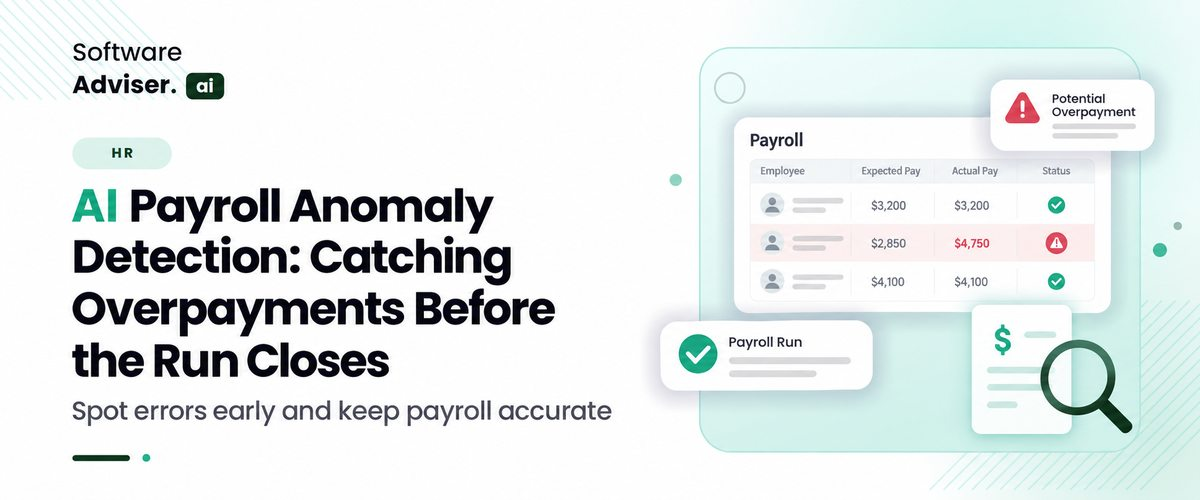
In the dynamic environment of US corporate finance, finalizing the AI payroll process can be a race against time. The finance teams involved in the pa [...]

Dokas mile
Operating an expanding business in the Indian market involves the need to manage customers, keep track of inventory stock, and ensure compliance with [...]
Dokas mile
A CRM may store thousands of customers' records, sales activities, emails and notes. It's not enough to have all of that information in one place—yo [...]