
What we'll cover
Share with your community!


Get Free Consultation
SAP vs Oracle: Which is the Best AI ERP in 2026?
 David N. Wilks
Picking an ERP system shapes a company's path like few other choices can. Years down the line, it handles money matters, people, teams, and deliveries, along with daily workflows, so getting it wrong carries weight. By 2026, firms sorting through options often land on SAP or Oracle; it keeps happening, simply because size matters here. These two stand tallest globally when it comes to enterprise resource planning tools. Thousands rely on them, true, but their inner logic? Not even close. One grows outward from deep process roots, the other builds inward from data control. They solve similar problems while thinking in opposite directions

Looking for AI ERP software? Check out Software Adviser’s List of the Best AI ERP Software in USA for your business.
This walk-through sorts out SAP vs Oracle piece by piece, looks at price tags and long-term expenses, yet points each company, big or small, to the right AI-powered ERP choice for 2026.
Why Choosing the Right ERP System Matters in 2026
Running a company today means relying on more than just programs. What ties together money tasks, buying stuff, moving goods, making products, and people management? One connected setup does. Enter information one time and see it show up where needed no retyping. This shift breaks down isolated pockets of data. Mistakes from hand entry drop off sharply. Decisions come from live figures now, not reports that were already outdated when printed.
One wrong pick might slow everything down past 2026, since AI now shapes how ERP systems behave. By that year, most major ERP providers will likely bake generative AI into their tools, helping teams decide faster while cutting repetitive tasks, according to Gartner. SAP uses AI throughout its setup; so does Oracle. Picking one over the other? That’s really choosing which system handles more daily effort for your people. Growth speed depends on it. So does whether information moves smoothly across units. Even timing on choices ties back to this.
What Is SAP ERP and How Does It Support Complex Operations?
Back in 1972, a tech firm started up in Germany, now known as SAP, and grew into the top ERP provider worldwide when measured by market presence. Running everything through one unified platform, its main offering, S/4HANA, operates at speed thanks to the powerful SAP HANA database built for live data handling. Instead of separating operations from insights, this setup computes both on the fly. Built for big organizations, it blends functions seamlessly inside a single environment.
Deep expertise defines SAP. Not just broad features, but detailed tools for making things, moving goods, staying compliant. Operations link directly to money tracking, with no gaps. You might run it online publicly, privately, or right inside your own servers. What sets it apart? The ability to reshape almost every part to match how you work. That fit explains its hold in factories, stores, and places where logistics matter most. Smarts built in include a chat helper named Joule, plus quiet automations tucked into finance, HR, and supply tasks. Big companies wrestling with rules and scale still turn here first.
What Is Oracle ERP and What Are Its Cloud-First Capabilities?
Back in 1977, a U.S.-based business started what would become a tech giant, Oracle. Databases were its first big hit. Over time, it shifted toward cloud tools without losing momentum. Today, one of its main offerings runs entirely on the internet by design. That system, called Oracle Fusion Cloud ERP, did not evolve from outdated programs. Instead, engineers created it specifically for modern infrastructure.
Quarterly upgrades happen automatically, keeping everything current without extra effort. Innovation flows steadily thanks to built-in improvements rolled out over time. A single data backbone connects financials, logistics, buying processes, and analytics so insights stay aligned across departments. Getting started tends to go quickly since setup steps are straightforward.
User-friendly design means fewer adjustments before going live. Finance-focused industries like banking, insurance, universities, and tech firms often find it fits well. Smart tools powered by artificial intelligence help spot odd patterns, predict cash flow, and answer spoken queries instead of making users click through screens. One question pops up naturally after another when exploring reports. Behind the scenes, machine learning smooths repetitive tasks. NetSuite belongs to Oracle now, a separate system made for smaller operations needing full business management online.
SAP vs Oracle: Core Differences Explained
Understanding the fundamental differences between the two platforms is the fastest way to narrow the SAP vs Oracle decision.
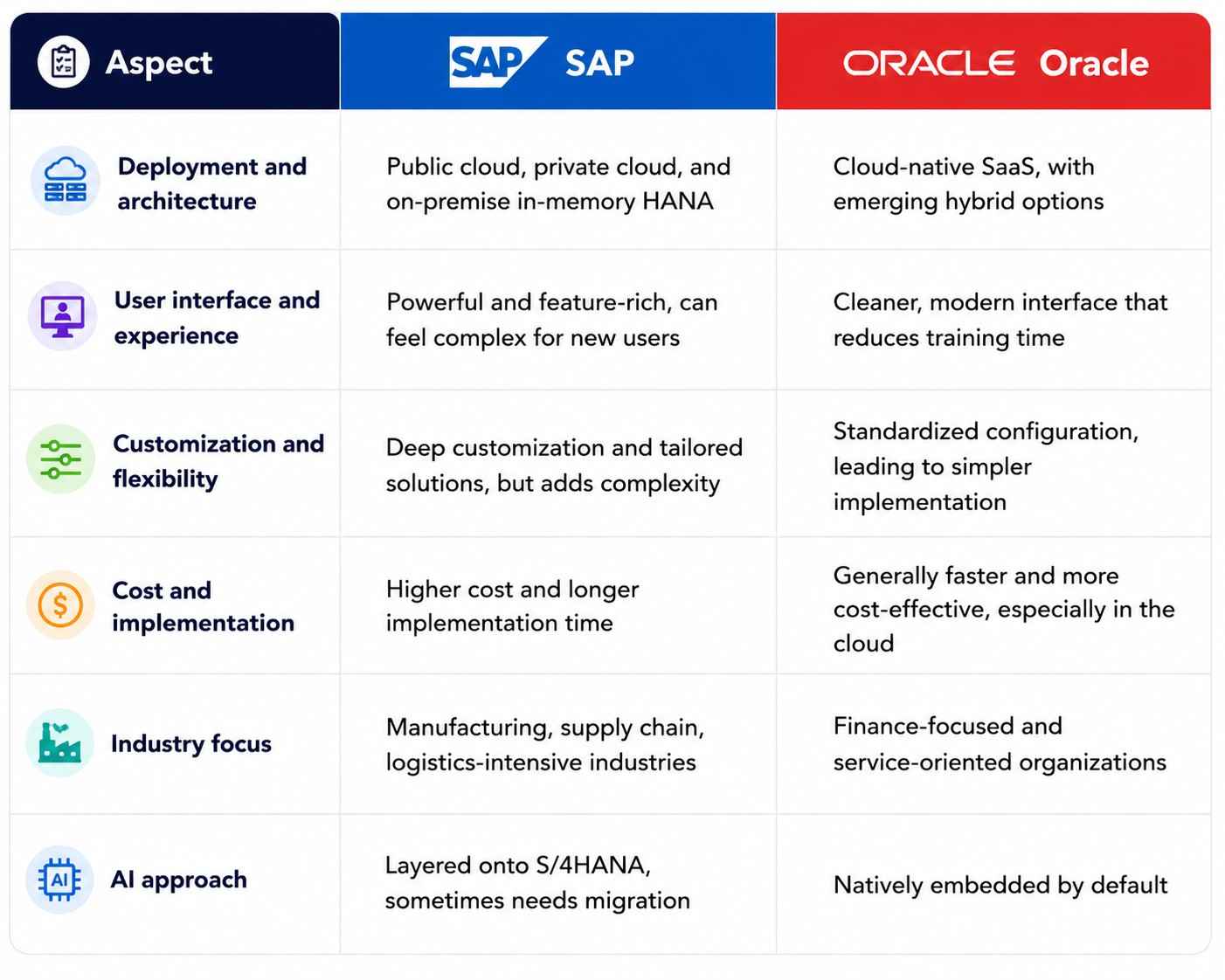
In short, the SAP vs Oracle comparison comes down to deep customization and operational depth with SAP versus cloud-first ease of use and finance automation with Oracle.
Key Features Compared Between SAP and Oracle
Here is how the two platforms compare across the features that matter most in 2026.
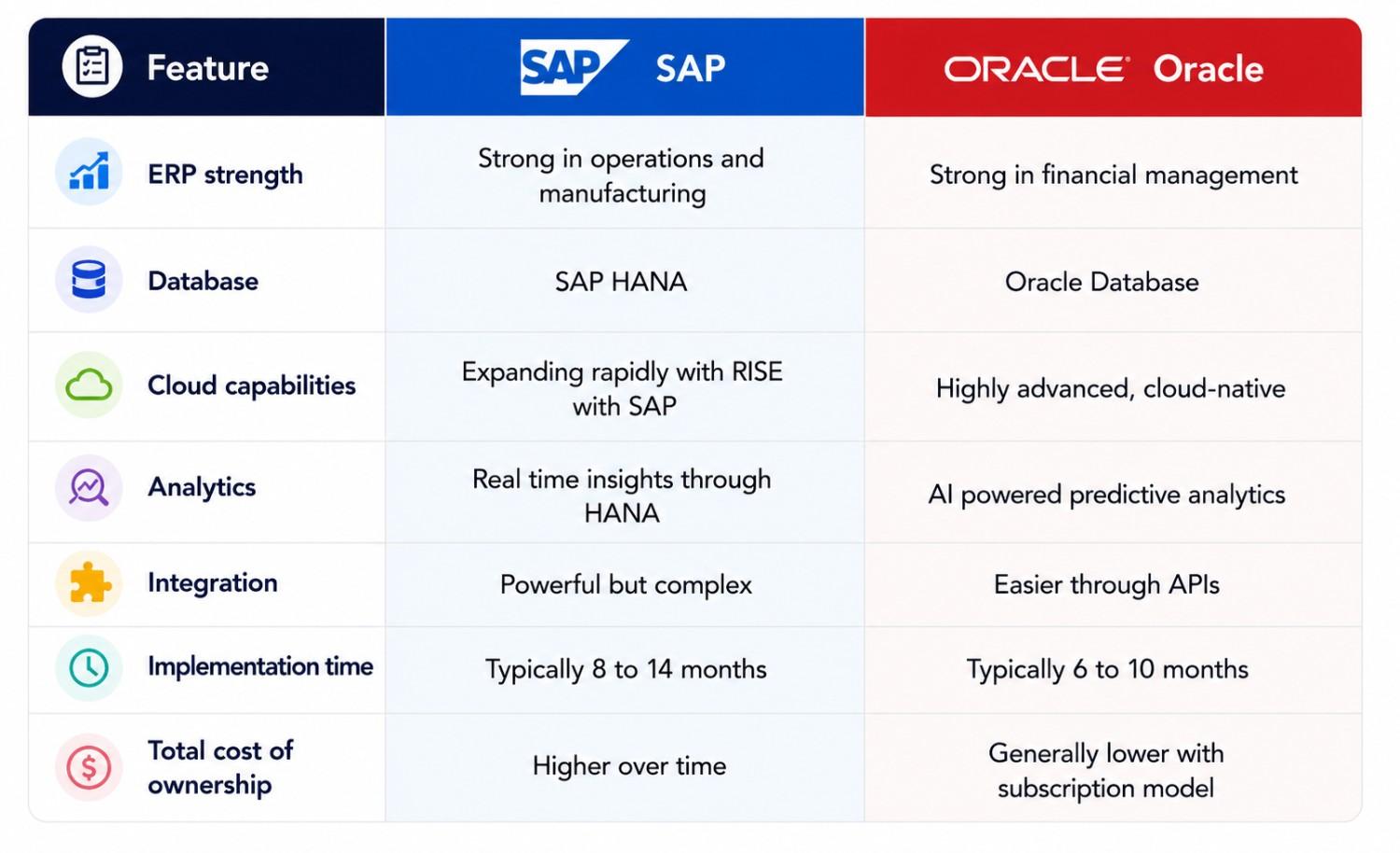
SAP is strong in complex operational workflows and suits large enterprises with intricate procedures. Oracle is better for financial reporting and cloud integration, with a faster and smoother user experience. The SAP vs Oracle choice depends on whether a business most values operational depth or cloud efficiency.
A Key 2026 Market Shift Worth Knowing
Something shifted how people see SAP vs Oracle lately. Not long ago, Oracle climbed past SAP in ERP earnings, hitting about 8.7 billion dollars compared to SAP’s 8.6 billion in 2024. That jump came thanks to Fusion Cloud ERP, built fresh for the cloud, along with stronger demand for NetSuite among mid-sized firms. Even so, SAP remains dominant where production gets intricate think heavy industry and detailed supply chains while also holding a wider slice of the total market. What matters now isn’t which brand sits higher in rankings, but what kind of operations your company runs. Choice leans on need, nothing more.
SAP and Oracle Help Reduce Business Workload
What makes an ERP pay off? Cutting out busywork. That is exactly what AI-driven systems deliver. Running tangled supply chains takes way less time with SAP, especially when handling multiple business units its cost controls are seen as the strongest around. Closing finances gets quicker under Oracle, thanks to deep workflow automation; regular refreshes also cut down how often teams wrestle with big software changes.
Duplicate typing and hand-matching numbers fade away in both, swapped for linked workflows that run themselves. Employees then shift toward tasks that matter more. When comparing SAP vs Oracle, time savings pop up in separate areas. Still, one thing holds true either way: fewer repetitive chores, faster choices.
Comparing SAP and Oracle ERP Pros & Cons
SAP ERP Pros and Cons
Pros:
- Mature suite for complex manufacturing and supply chain
- Unmatched cost-management depth, widely regarded as the best in enterprise ERP
- Flexible deployment across public cloud, private cloud, and on-premise
- Real-time processing through the in-memory HANA database
- Huge global partner ecosystem
Cons:
- Higher cost and longer implementation time
- Steeper learning curve for users
- Customers on older ECC systems often face a migration to S/4HANA before reaching the newest AI features
Oracle ERP Pros and Cons
Pros:
- Cloud-native platform with continuous quarterly innovation
- Unified data model that reduces data silos
- Deep AI-driven finance automation, including forecasting and anomaly detection
- Generally faster time to value and lower total cost of ownership
Cons:
- Multi-tenant cloud limits very deep customization
- Business processes may need redesign to fit cloud standards
- Teams moving from on-premise systems require retraining for the cloud interface
Which ERP System Is Best for Different Business Sizes?
Big companies often lean one way, small ones another. Which path fits? Depends on what kind of work you do. Size changes everything. So does industry. Choices bend based on both.
Big companies running many divisions plus making lots of physical goods usually go with SAP because it handles detail well, keeps costs in check, and gives setup options. When finance teams drive decisions at big firms, they lean toward Oracle; its financial tools live fully in the cloud and automate tasks smoothly.
Starting out, mid-sized firms often pick Oracle NetSuite, a cloud-based ERP system that works smoothly but skips heavy corporate setup. Another path? SAP’s lighter cloud versions suit those who trust SAP yet need something scaled down.
Most small firms just starting out pick cloud solutions to save money at the beginning and get going fast. Oracle fits right in with its pay-as-you-go approach, along with NetSuite doing heavy lifting. Still, SAP Business One also works for compact teams needing simpler tools.
Which One Should You Choose?
Choosing between SAP vs Oracle comes down to what your company actually requires and where it aims to go next. Not every path fits all.
Choose SAP if:
- You run a large enterprise with complex, multi-entity operations
- Your business requires deep customization and tailored workflows
- You operate in manufacturing, retail, or supply-chain-intensive industries
- You need some systems kept in house, not just in the public cloud, because where your data lives, the rules you follow, or legal requirements sometimes mean you need a private, walled-off setup that gives you control without handing it to an outside provider
Choose Oracle if:
- You prefer a cloud-native ERP with automatic updates
- You want a quick setup that saves money over time, since dragging out the rollout just runs up the bill, while a system that runs smoothly keeps your budget in check and leaves room to grow later
- Finance leads the way at your company, not customer needs, so the money side calls the shots and service takes a back seat
- A clean, modern look matters most to you, where the smart features just work quietly in the background and the automation stays out of your way, so the whole thing feels easy instead of clunky
Decision Makers Considering Final Steps
Start by looking beyond just what tools are offered. Shifting away from old systems brings extra burdens transferring records, adjusting setups, and time lost to learning curves. Change hits hard when routines break. For SAP users stuck on ECC, stepping up to S/4HANA isn’t optional; it’s bulky work, yes, yet opens doors to smarter automation later. Folks using Oracle locally must brace for fresh training once they shift workflows, twist, screens differ, and habits won’t fit. One way or another, after half a decade the full expense for either system tends to differ by roughly 15 percent when comparing similar setups. What matters most isn’t the upfront number but how neatly it fits your field and current tech stack. Shifting gears takes effort. Plan room for learning curves instead of counting on instant results. Given thoughtful setup, picking between SAP vs Oracle pays off down the road.
Conclusion
Picking between SAP and Oracle isn’t really a contest of quality both power countless global businesses. Where one digs deep into intricate production setups, the other moves fast through cloud-built tools for financial workflows. Flexibility shapes how you install it; some need servers inside their offices, and others prefer remote access without extra gear. One cuts time spent on repetitive tasks using smart software, just like the other does. What matters comes down to your field, team scale, and current systems in place. Cost plays its part when shifting gears not just upfront but later too. Long-term gains grow where setup matches actual needs, not trends or claims. Value sticks around when choices reflect reality instead of reputation.
FAQ's
SAP is ideal for large enterprises with complex operations, while Oracle is a strong choice for cloud-first and finance-driven organizations.
Oracle offers a cloud-native ERP with faster implementation and finance automation, while SAP provides deeper customization and operational capabilities.
Look for AI automation, financial management, supply chain tools, analytics, scalability, cloud deployment, and integration capabilities.
Yes, AI ERP software can automate finance, procurement, inventory, supply chain, HR, and reporting workflows to improve efficiency.
Choose an AI ERP platform based on your business size, industry, operational complexity, cloud strategy, budget, and long-term growth plans.
Search engines have changed more in the last two years than they did in the decade before that, and a lot of business owners are scrambling to keep up [...]
David N. Wilks
Managing US payroll is difficult, with a web of federal, state, and local tax compliance obligations that go beyond basic automation. For American bus [...]
David N. Wilks
Let’s be honest about what happens when a customer runs into an issue today. Nobody wants to sit around on a muted phone line for twenty minutes jus [...]