
What we'll cover
Share with your community!


Get Free Consultation


AI Software ROI: How to Measure the Value of AI Tools at Work
 David N. Wilks
Here's an uncomfortable number. Only 25% of AI initiatives deliver their expected AI software ROI. Not because AI doesn't work. Wrong measurements. Late measurements. Or the right things measured so badly the result is still useless. The tools are generating value in places nobody thought to look, and the dashboards are reporting activity instead of impact.
This guide breaks down how to measure AI agent software ROI properly, which calculations hold up, which numbers matter, and what most businesses get wrong before they ever run a calculation.
Why Most Businesses Struggle to Measure AI ROI
Ask executives whether they can measure AI ROI confidently, and roughly 29% say yes. The rest? Sitting with a vague sense that things are running faster, but no number they can defend in a board meeting. That gap between adoption and actual value realization is the defining challenge of 2026.
The structural problem is that AI creates value differently from traditional software. A CRM software license saves time on contact management. Easy to calculate. AI is harder. It changes how decisions get made. It speeds up how work moves through a pipeline. It shifts how many customer questions need a human at all. None of that sits in a single measurable column. It spreads across the organization at the same time, touching workflows, employee output, customer experience, and operational costs simultaneously, which is exactly why traditional ROI models come up short when applied to it unchanged.
There's one more thing that quietly derails measurement. Most organizations end up tracking AI activity instead of AI impact. Models deployed. Employees with access. Data processed. All of those are inputs. None of them tell you whether the AI investment changed anything for the business. Usage counts show what people opened. They don't show whether it helped.
The Two Types of AI Software ROI
Not all returns from AI tools are the same kind of number, and conflating them causes measurement problems that compound quickly.
Hard ROI is measurable in dollars. Hours saved multiplied by fully loaded hourly cost. Error rates reduced multiplied by average resolution cost. Fewer support tickets handled by human agents. These appear on financial statements and survive scrutiny from a CFO.
Soft ROI is real but harder to quantify directly. Better decisions made faster. Employee satisfaction is going up because repetitive work is off their plate. Customer experience is improving because response times dropped from 48 hours to under five minutes. These matter, and they should be tracked. What they shouldn't do is cover for the absence of hard ROI. IBM draws the line cleanly: hard ROI is dollars, costs saved, revenue gained, and hours recovered. Soft ROI is harder to put on a balance sheet, decision quality, and employee satisfaction. Both belong in the measurement framework. Separately. Never combined in a way that lets soft ROI cover for the absence of hard ROI.
How to Measure AI Software ROI Step by Step
Step 1: Establish a Baseline Before Deployment
Most AI implementations fail here. Before they start. No baseline means no ROI calculation means no result anyone can verify. Just opinions dressed up as outcomes.
Before anything gets purchased or built, write down what the process currently costs. Labor hours. Error rates. Cycle time. Dollar cost per unit of output. Then define what success looks like in financial terms, not "faster" but "reduces cost-per-transaction from $4.20 to $2.10. " Get that number agreed on and signed off by someone. The baseline is what every later calculation compares against. Without it, measurement is just storytelling.
Step 2: Define Business Metrics, Not Activity Metrics
A dashboard that lives inside the AI vendor's own analytics is measuring tool engagement. Not business impact. The vendor's job is to show how much their tool is being used. Whether it's working for your business is a different question, and their dashboard isn't designed to answer it.
Revenue growth, cost reduction, customer satisfaction, market share, cycle time. Those are business metrics. Prompts submitted, documents generated, suggestions accepted. Those are activity metrics. Useful for diagnosing adoption, not for calculating AI software ROI.
Step 3: Apply the AI ROI Formula
The formula itself is straightforward. (Value Generated − Total Cost) ÷ Total Cost × 100. The complexity sits inside "Value Generated." It has three components that need to be measured independently: hours saved multiplied by loaded hourly rate, errors avoided multiplied by average resolution cost, and revenue acceleration multiplied by whatever that sprint or cycle is worth. Bundle them and finance can't verify the number. Separate them, and the calculation holds up.
The total cost is bigger than the license fee. Always. Integration costs sit on top. Training time. Ongoing maintenance. The overhead of managing the thing. A 30-developer team on a $25/seat/month tool is paying $9,000 per year on licensing alone. By the time integration and training overhead are added in, that first-year number is usually far higher. That bigger number is what the ROI calculation needs to justify. Not the license sticker.
Step 4: Review at Week Six, Not Month Twelve
No trackable outcome by week six to eight? The tool is becoming a budget line item, not a capability. The businesses extracting the most value from AI set week-six reviews as a non-negotiable, not a maybe. And the data backs that approach: organizations that measure AI after implementation and report results formally are 21x more likely to capture significant value than those that skip it. The gap isn't better technology. Earlier, more disciplined measurement.
Step 5: Track Soft Returns with Proxy Metrics
Develop proxy metrics for intangible benefits. Employee retention rates can proxy for morale. Time-to-decision can proxy for decision quality. These let soft ROI sit alongside hard ROI in the same report without being vague. "Employee satisfaction improved" is a feeling. Year-over-year retention in teams using AI tools is up 8%" lands differently. That's a number. That gets into a report.
Common Mistakes That Undermine AI ROI Measurement
Starting measurement after deployment: No baseline makes every number collected just a snapshot floating without context. Nothing to compare it to. Nothing that proves anything changed. Measure the process before the tool arrives, not after.
Letting the vendor define the metrics: Most AI tools come with built-in dashboards that measure their own usage. That's marketing, not ROI. Define your own success metrics independent of what the vendor shows you.
Expecting ROI in the first quarter: Two to four years is the realistic window for most AI initiatives to deliver satisfactory return. Even the platforms designed to accelerate that timeline take months, not weeks. Expecting ROI in three months creates two bad outcomes: pressure to overstate early results or abandoning tools before they've had enough time to deliver.
Measuring one department in isolation: AI tools rarely generate value in one place at a time. A customer service AI that reduces ticket volume touches support costs and agent availability and customer satisfaction scores, all at once. Look at one column and the ROI calculation misses most of what's happening.
Real AI ROI Numbers Worth Knowing
5.6 hours per week. That's what the average worker saves using AI tools. Managers come in at 7.2 hours. Run that math across a five-person team and the business gets a full working day back every single week.
High-performing AI implementations achieve 500%+ ROI through superior change management and comprehensive measurement. That number isn't the norm, but the methodology behind it is tight adoption support, regular measurement, and connecting tool use to business goals rather than leaving adoption to chance.
For finance use cases, 2026 industry data shows time-to-measurable ROI averaging eight months. For manufacturing, twelve to fourteen months. If a deployment is past eighteen months with no measurable signal, something structural needs fixing, not more patience.
What Good AI ROI Measurement Looks Like
Here's what a solid measurement framework looks like in practice. Baseline before deployment. Business outcome metrics defined before the tool goes live. Week-six review against those same metrics. Hard and soft ROI reported separately, never combined. Month-twelve review to catch model drift and adoption gaps that weren't visible in the first sprint.
The measurement infrastructure takes time to build. It's worth it. The alternative is guessing whether an AI investment is working while making budget decisions based on activity data that doesn't answer the question. The teams that measure rigorously know their AI software ROI down to a number. The ones that don't eventually realize they've been chasing vanity metrics while technical debt compounds.
Conclusion
Measuring AI software ROI comes down to discipline, not a smarter formula. Baseline the process before the tool goes live. Track business outcomes, not vendor usage stats. Separate hard ROI from soft ROI and never let one cover for the other. Review at week six, then again at month twelve. Skip any of those steps, and the number at the end is a guess with a decimal point. The gap between the 25% of AI initiatives that deliver expected ROI and the rest isn't better technology, it's earlier, more rigorous measurement applied to the same tools everyone else has access to. Build the baseline, measure what the business actually cares about, and report hard and soft ROI side by side. That's how AI software ROI stops being a hopeful estimate and becomes a number the business can act on.
FAQ's
Measure AI software ROI by comparing the value generated from time savings, cost reductions, and revenue growth against the total implementation cost.
Track metrics such as time saved, cost savings, productivity improvements, revenue growth, customer satisfaction, and error reduction.
Most businesses begin seeing measurable AI software ROI within a few months, although larger implementations may take longer to deliver full value.
Hard ROI measures financial gains like cost savings and revenue, while soft ROI measures improvements such as employee satisfaction and decision quality.
Businesses can maximize AI software ROI by setting clear goals, measuring performance with business metrics, optimizing workflows, and continuously refining AI adoption.
Hootsuite, Sprout Social, and Buffer handle AI social media management in dissimilar ways with varying approaches to publishing, analytics, and automa [...]
David N. Wilks
Think of an HR partner you know and trust completely. A person who can help you find the right solution for your current situation. An AI Employee Ass [...]

Dokas mile
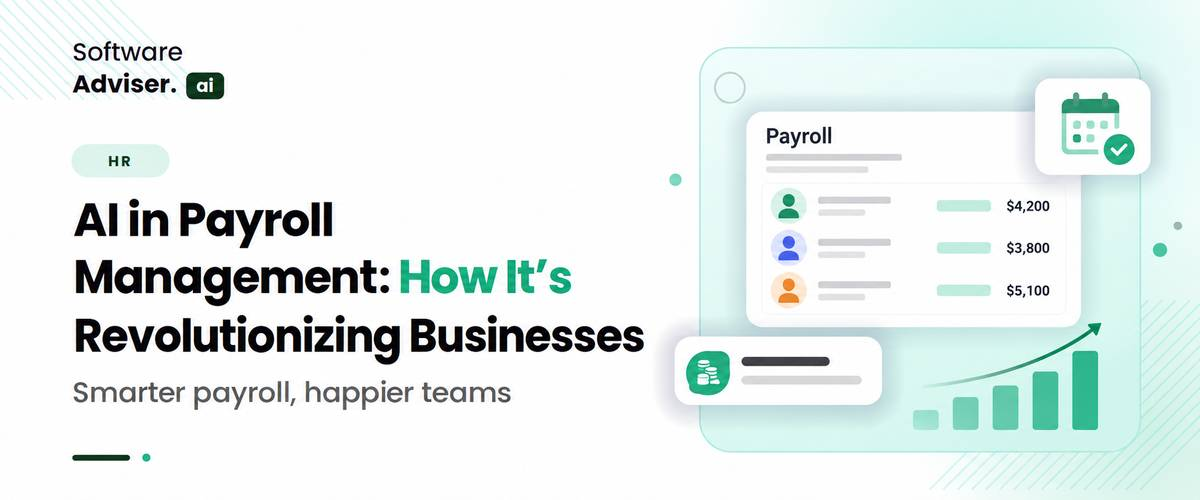
A timesheet contains an unusual number of overtime hours. A new employee's tax information does not match the expected setup. A benefit deduction sudd [...]