
What we'll cover
Share with your community!


Get Free Consultation
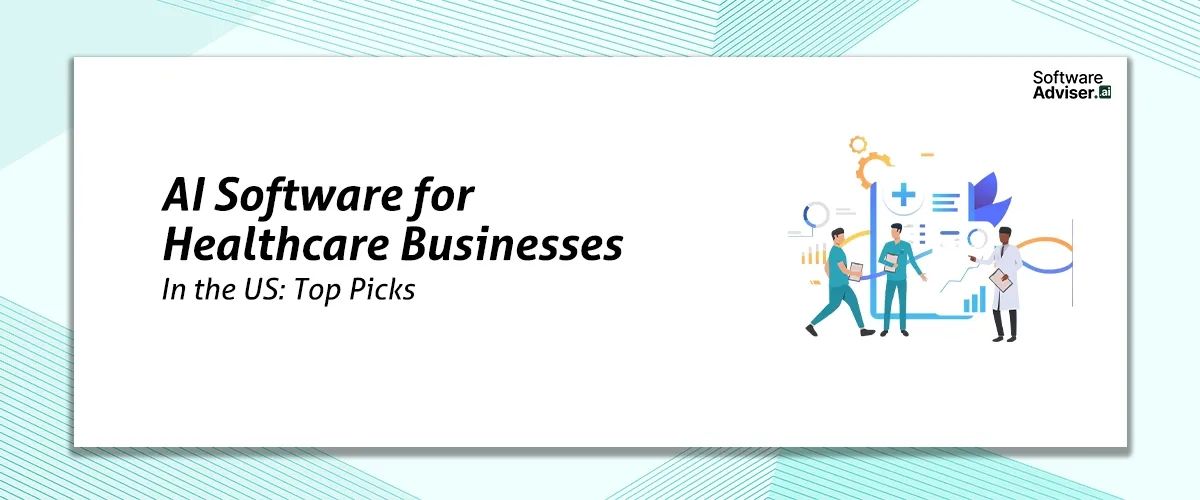
AI Software for Healthcare Businesses in the US: Top Picks
 David N. Wilks
A typical small-to-midsize US medical practice runs on 8 to 12 separate software platforms. One handles scheduling. Another does billing. Patient reminders live somewhere else entirely, and the fax machine in the corner simply refuses to die. The fragmentation has a human cost, too. For every hour a physician spends with patients, close to two more go to paperwork.
That's the problem AI software for healthcare is actually solving in 2026. Not robot doctors. Paperwork, phone calls, coding, and the administrative grind that burns out clinical staff and leaks revenue.
This guide covers the top picks for US healthcare businesses, organized by what each tool automates. Every option here operates under a Business Associate Agreement (BAA) and is built for HIPAA-compliant workflows, because in this industry, that's the entry ticket, not a feature.
What Counts as AI Software for Healthcare?
Not every healthcare tool with an "AI" badge qualifies. Rule-based alert systems and workflow portals are traditional healthcare software. Real AI software for healthcare uses machine learning and natural language processing to do things rigid systems can't: listen to a patient visit and write the note, read a claim and predict the denial, answer a phone call and book the appointment.
In practice the technology sorts itself into a few buckets. Ambient AI scribes sit in the exam room and turn conversations into clinical documentation. Over on the revenue side, autonomous coding engines and medical billing tools assign codes and scrub claims before payers get a chance to reject them. Patient engagement has its own wave of AI agents answering phones with AI call center software, running intake, and chasing follow-ups. Then comes the clinical end, where algorithms support imaging and pathology, and the operational end, where AI untangles scheduling, prior authorizations, and capacity planning.
Which bucket matters most? Whichever one contains your most painful workflow. Buying the platform with the longest feature list has burned more practices than it has helped.
How We Picked These Tools
Every pick had to clear four bars: a signed BAA available on day one, real EHR integration (not "coming soon"), a track record with US medical practices, and pricing or a model transparent enough to budget around. Vendors that couldn't produce HIPAA documentation upfront didn't make the list, no matter how good the demo looked.
Top Picks for US Healthcare Businesses
1. Microsoft Dragon Copilot: Best Ambient AI Scribe for Health Systems
Formerly Nuance DAX Copilot, Dragon Copilot is the enterprise benchmark for ambient clinical documentation. It listens during the visit, drafts the note in the physician's style, and now extends into order capture and nursing workflows.
For large healthcare businesses already on Epic or Cerner, this is the safest bet in the AI scribe category. The physician reviews and signs; the AI does the typing. The typical result is a few minutes shaved off every encounter. Multiply that across a full patient panel and a provider gets back hours each week, usually the exact hours they were spending on notes after dinner.
Expect enterprise contract pricing, generally several hundred dollars per provider monthly. The natural home is a health system or large multi-specialty group.
2. Freed: Best AI Scribe for Small Practices
Not every clinic can absorb enterprise pricing, and Freed exists for precisely that reason. Ninety dollars per clinician per month buys ambient clinical documentation with a free trial upfront and no contract locking anyone in. Record the visit, get a SOAP note back, and watch the tool gradually learn how you phrase things. It handles most specialties without complaint.
Why do small medical practices love it? Setup. An afternoon, not a quarter. For a solo provider or a therapist, that's usually the whole decision.
3. Notable: Best for Administrative Workflow Automation
Notable comes at the problem from the administrative side. Its AI agents work patient intake, scheduling, prior authorizations, registration, and care gap outreach at more than 12,000 care sites, chewing through over a million tasks every day.
The mental model here is a digital workforce sitting on top of the EHR you already run. A patient finishes intake from their couch. An authorization moves along without anyone chasing a fax. The front desk, for once, breathes. Healthcare businesses short on staff, which right now is most of them, tend to find this brand of workflow automation pays back faster than anything else they try.
Pricing is custom by module and volume, and the buyers getting the most from it are hospitals and large practices carrying heavy administrative load.
4. Hippocratic AI: Best Patient-Facing Voice Agents
Voice agents that call patients sound risky until you see how carefully Hippocratic AI has fenced them in. The agents handle non-diagnostic patient care work only. Post-discharge check-ins. Medication reminders. Pre-op instructions and chronic care outreach. Anything ambiguous escalates to a human, and diagnosis is off the table entirely, by design.
That restraint is exactly why conservative compliance teams will sign off on it, and the traction backs it up: over 180 million patient interactions completed, with more than 50 health systems and payers on board. Pricing runs custom and usage-based, aimed at large systems scaling outreach programs rather than small clinics.
5. PracticeSuite: Best AI-Powered Medical Billing Platform
Medical billing is usually where AI pays for itself first. PracticeSuite builds the intelligence into a full practice management and RCM platform, so claims get analyzed for likely denials before submission rather than after rejection. Charges get captured automatically using AI Billing And Invoicing Software. Billing workflows bend to each staff role instead of forcing everyone through one screen.
One benchmark worth memorizing: practices adopting AI-driven medical billing commonly see first-pass claim acceptance improve somewhere between 15% and 25%. If your billers still work denials by hand, that percentage is money showing up every month with zero new hires attached. Tiered pricing keeps the entry point reachable for small practices that want billing, PM, and AI in one system.
6. CodaMetrix: Best Autonomous Medical Coding
CodaMetrix goes past assisting coders. For a large share of encounters, it simply is the coder. The engine reads clinical documentation in context and assigns ICD-10 and CPT codes on its own, and in early 2026 it took the number 1 spot in the Best in KLAS segment for autonomous coding.
So what happens to the coding team? They stop keying routine charts and start auditing exceptions, which is where their judgment was always needed anyway. Claims move faster, error rates fall. Enterprise pricing, built for health systems and specialty groups with serious coding volume.
7. Viz.ai: Best for Imaging Triage and Care Coordination
A stroke scan should never sit in a queue. Viz.ai runs FDA-cleared algorithms over medical imaging the moment it's captured and pages the right specialist when something critical appears, stroke, pulmonary embolism, the conditions where minutes decide everything.
This is AI software for healthcare at its most clinical, and it's proven: faster time to treatment directly changes patient outcomes in time-sensitive conditions. Sold as enterprise, per-module contracts to hospitals and stroke or cardiology networks.
8. K Health: Best AI Symptom Triage for Virtual Care
K Health puts an AI symptom checker at the front door of virtual primary care. The patient answers a series of adaptive questions, the engine weighs their case against millions of clinical records, and a human clinician reviews the structured summary before anything resembling a care decision gets made.
Telehealth programs like it because the front door finally does real triage. Fewer unnecessary visits. Faster routing to the right level of care. Better patient engagement too, since somebody anxious at 11 p.m. gets an answer instead of a voicemail box. Consumer plans exist, and health systems partner at the enterprise level.
9. Qventus: Best for Hospital Operations
Qventus points machine learning at the least glamorous problems in a hospital: OR schedules, discharge planning, patient flow, using AI resource management software. Rather than reporting yesterday's bottleneck, it predicts tomorrow's and nudges the team with a specific action, like flagging tonight which discharge will probably stall in the morning.
Hospitals using it report meaningful gains in OR utilization and reduced length of stay. Unsexy, high-dollar problems, which is exactly where AI belongs. Enterprise contracts only, and the fit is hospitals optimizing capacity and throughput.
10. DoctorConnect: Best All-in-One for Independent Practices
DoctorConnect combines an AI scribe, patient reminders, recall campaigns, a multilingual AI receptionist, and insurance automation in one platform, with 150+ EHR integrations. For small healthcare businesses that can't manage five vendors, consolidation is the feature.
Thirty-plus years in business and a clean HIPAA record make it an easy pick for risk-averse practice managers. Pricing is custom and positioned for small and midsize practices, and the natural buyer is an independent practice wanting one vendor for engagement and documentation.
Comparison Table
|
Tool |
Category |
Best For |
Pricing |
|
Dragon Copilot |
AI scribe |
Health systems |
Enterprise |
|
Freed |
AI scribe |
Small practices |
$90/clinician/mo |
|
Notable |
Workflow automation |
Large practices, hospitals |
Custom |
|
Hippocratic AI |
Patient voice agents |
Health systems, payers |
Usage-based |
|
PracticeSuite |
Medical billing + PM |
Small to midsize practices |
Tiered |
|
CodaMetrix |
Autonomous coding |
High-volume systems |
Enterprise |
|
Viz.ai |
Imaging triage |
Hospitals |
Enterprise |
|
K Health |
Symptom triage |
Virtual care programs |
Consumer + enterprise |
|
Qventus |
Hospital operations |
Hospitals |
Enterprise |
|
DoctorConnect |
All-in-one engagement |
Independent practices |
Custom |
How to Choose the Right Tool for Your Practice
- Start with your biggest leak: If physicians chart at home every night, buy an AI scribe. If denials are climbing, fix medical billing first. The right AI software for healthcare is whichever one is aimed at that leak. One painful workflow, one tool, one measurable trial.
- Demand the BAA on day one: A vendor that stalls when you ask for HIPAA paperwork has answered your question already. Nail down data residency, who can access what, and what happens after a breach, all before a single patient record moves.
- Verify real EHR integration: Ask for a reference customer on your exact EHR. "We integrate with everything" usually means "we have an API and good intentions." Genuine EHR integration experience with your system is worth more than any feature.
- Keep humans in the loop: The best deployments use AI for drafting and detection while clinicians make final calls. Regulators expect it, and frankly, so do patients.
- Measure in 90 days: Minutes saved per note, first-pass claim rate, no-show rate, phone hold times. Give it a full quarter, and if nothing moves, stop paying for it.
Common Mistakes to Avoid
- Buying the demo, not the workflow. Generative AI demos beautifully. Clinical-grade, EHR-connected systems are harder to build, so dig past the interface.
- Ignoring staff adoption. Clinicians are burnt out. A tool that needs a week of training won't get used. Pilot with your most enthusiastic provider first, then let their results sell it internally.
- Treating AI output as final. Every note, code, and claim still needs review processes. AI reduces the work of patient care documentation; it doesn't remove accountability.
- Stacking more silos. Adding a 13th disconnected platform recreates the original problem. Favor tools that consolidate or integrate deeply with what you run today.
Conclusion
Notice what none of these tools attempt: medicine. The winners in AI software for healthcare are all aimed at the administrative weight that's been grinding down US medical practices for a decade. The notes. The codes. The claims. The phones that never stop ringing. So skip the grand AI strategy. Name the workflow that hurts most, shortlist two tools built for exactly that job, and run 90 days with real numbers attached. Most healthcare businesses find the first win arrives sooner than expected, and it often looks like something wonderfully simple. A clinician leaving the office on time for the first time in years.
FAQ's
The best AI software depends on your needs, with top options for clinical documentation, medical billing, patient engagement, and workflow automation.
Reputable healthcare AI platforms support HIPAA compliance through Business Associate Agreements, data encryption, and secure access controls.
AI software streamlines clinical documentation, automates medical billing, enhances patient communication, and reduces administrative workloads.
Yes, small practices can use AI to save time, improve patient care, reduce paperwork, and increase operational efficiency with affordable solutions.
Look for HIPAA compliance, EHR integration, workflow automation, ease of use, reliable support, and proven results for your specific healthcare needs.
The way in which employers manage human resources in the United States is going through an unprecedented transformation. As organizations continue to [...]
David N. Wilks
Each year, innovators, corporations, and startups submit millions of new applications to patent offices around the world. For corporate legal teams an [...]

Dokas mile
Scale matters, but smart marketing teams refuse to sacrifice quality to get there. The old way, losing half your week to writer's block or babysitting [...]