
What we'll cover
Share with your community!


Get Free Consultation

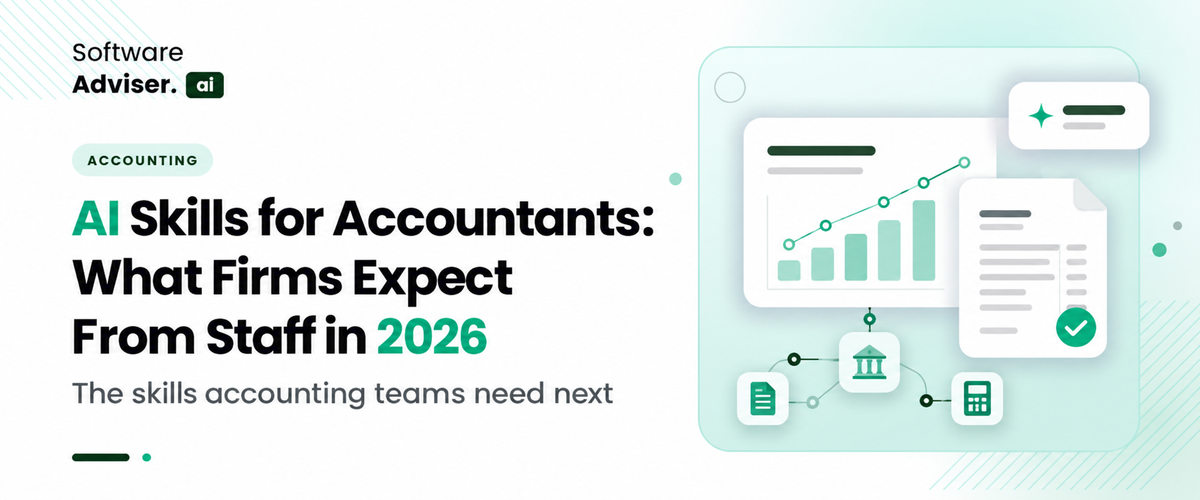
AI Skills for Accountants: What Firms Expect From Staff in 2026
 Dokas mile
Two staff accountants get the same month-end package.The first returns a variance report that travel costs increased by 18% and does nothing else. The second one utilizes a permitted AI aid to arrange the changes by merchant, contrasts every number with the ledger, identifies a duplicate payment and records a mini-notice for the client to review. Same data, very different value.
That gap is what AI skills for accountants are about.Choosing which tool to use is the easy part. Companies are looking for individuals who can integrate accounting expertise with prudent application of AI, a critical sense of skepticism and good data privacy practices with clients. This guide also distinguishes between what is increasingly expected from what is actually required in the form of a single standard, and provides an illustration of what competence is seen on a regular day's work.
 Quick Answer
The most useful AI skills for accountants in 2026 are prompt engineering, data analysis, AI output verification, and responsible data handling. Professional judgment should also be used to verify results and adequately communicate findings, while accountants learn to leverage AI in auditing, tax preparation, and financial reporting.
What AI Skills Do Accounting Firms Expect From Staff in 2026?
The top six traits that most companies look for in an AI accounting tool are: AI literacy, clear prompting, data analysis and automation, verification and professional judgment, client data handling responsibilities and explaining results to clients. It’s the concise version of what skills accounting firms will look for in 2026, and specifics vary from firm to firm.
A five-person tax practice may only ask staff to use one approved assistant safely. A larger firm may expect people to redesign parts of the close process. Either way, AI skills for accountants are emerging practical expectations, not licensing requirements. What has not changed is the professional baseline: the AICPA’s ethics team reminded members in the Journal of Accountancy that competence, due care, and confidentiality still apply when technology is involved.
7 AI Skills Accountants Should Develop in 2026
1. AI Literacy and Understanding Tool Limitations
AI literacy means understanding what an AI system can do, where it struggles, and which tasks require human review.
Generative AI, for example, is one of the AI tools that can summarize financial documents, explain strange expenses and organize information from long reports. But an artificial intelligence generated explanation might seem convincing even if it is based on incomplete information.
Traditional automation works by following predefined rules. Generative AI creates responses based on what it has learned and what it is given. Traditional automation is rule-based automation. Generative AI is AI that generates responses based on patterns it has learned through its training and the data it is provided.
2. Prompt Engineering for Accounting Tasks
Prompt engineering for accountants means giving an AI tool clear instructions, sufficient context, and a defined output format.
A vague prompt often produces a generic answer. A specific prompt gives the accountant something more useful to review.
Consider a month-end expense analysis.
Weak prompt
"Explain why expenses increased."
Better prompt
"Compare the monthly expense totals by category against the previous month. Identify the three largest increases, calculate the percentage change using the supplied figures, and list possible explanations separately from confirmed facts. Flag missing information and do not assume a cause without supporting evidence."
The second prompt sets up the task, comparison time, product produced, and boundaries on unsupported conclusions.
Accountants should learn to refine prompts when the initial response is incomplete, ask follow-up questions, and provide only information they are authorized to share.
3. Data Analysis and Spreadsheet Automation
While AI can assist in creating formulas, interpreting trends, and generating reports, it is essential to have strong spreadsheet proficiency for tasks such as troubleshooting, tracking data, and handling complex calculations.
Key data analytic capabilities for an Accountant are analysing and comprehending source data, ensuring calculations are accurate, identifying irregular transactions and interpreting trends in financial performance. It is possible to use AI to support these activities, but it cannot replace the understanding of the figure-making process.
For example, an accountant may take a look at a profit and loss statement for a particular month and see that travel expenses are on the rise and then complete a spreadsheet to enter that information. An AI assistant can assist you in organizing possible explanations, but ultimately the responsibility falls on the accountant to check on receipts, transaction descriptions, department budgets and the reporting period.
For a closer look at how businesses evaluate AI accounting software for small businesses, compare the available features with the accounting tasks your team needs to improve.
AI can help in creating formulas, cleansing data, and automating repetitive reports. Before applying any formula or transformation generated, test them.
4. AI Output Verification and Professional Judgment
One of the most crucial AI skills that accountants need to master is being able to assess the AI-generated results before trusting them. An answer could seem convincing, but have the wrong calculations, assumptions that are not justified, or missing information.
Suppose that an AI tool identifies a possible duplicate in supplier payments, for instance, the accountant should check the invoice numbers, payment dates, amounts, and documents to confirm the duplicate.
Accountants should also be aware of the need for further investigation or review by a senior accountant when the result is generated by AI. While AI can be helpful in detecting potential problems, human expertise is needed to determine what the evidence represents.
What firms expect: Employees should be able to assess AI-generated results, identify errors or inconsistencies, and explain the reasoning behind their decisions.
5. AI Skills for Auditing, Tax, and Financial Reporting
Accountants also need to understand how AI applies to their specific responsibilities.
AI can help in auditing by summarizing documents, organizing evidence, detecting suspicious transactions, and creating preliminary audit reports. The auditor will be responsible for assessing evidence and adhering to the relevant professional standards.
Artificial intelligence can help organize client data, summarize tax research and draft explanations in tax work. Artificial intelligence can be used in tax work to organize client data, summarize tax research and write explanations. Tax interpretations are subject to change and different jurisdictions, and should be checked against current guidance by tax authorities before being relied upon.
In the financial reporting area, AI can create reports and give management commentaries like variance explanations and summarise performance. The accountant keeps checking the figures and ensures the explanation is correct, given the situation of the business.
 You may Also Check- Top 10 AI in Accounting Tools for US Businesses 2026 Guide
6. Data Privacy, Security, and Responsible AI Use
Accounting professionals handle sensitive information, including payroll details, bank records, tax documents, and client financial statements. Knowing how to use AI safely is therefore a core professional skill.
Before uploading a document, an accountant should check whether the tool is approved by the firm, what data it collects, how information is retained, and whether its terms permit the intended use.
They should also follow access controls, remove unnecessary identifying information where appropriate, and avoid entering confidential records into unapproved public AI tools.
Did You Know?
Creating a document using an AI doesn't mean that you have the right to share it. Confidentiality must be respected and accountants should examine the manner in which the tool will handle their client's information. The AICPA recommends companies review the data protection capabilities of the providers and set guidelines for their AI use.
What firms expect: Employees should follow firm policies, identify privacy risks, and know when to stop and ask for approval rather than uploading sensitive data.
7. Communication, Critical Thinking, and Client Advisory
AI can help prepare a report, but an accountant must explain what the findings mean.
This is where critical thinking in accounting and communication become especially important.
As an accountant, you should question your own beliefs, uncover the missing context, and communicate financial information to clients and business leaders in a way they can understand.
An AI-generated cash flow report could point out that there's a potential cash flow deficit next month. Before making a recommendation for action, an accountant should review and discuss with the client anticipated receipts and payments, outstanding invoices, and assumptions that were made in the forecast.
The accountant might then explain which payments need attention, what could change the forecast, and which decisions require further discussion.
The Journal of Accountancy highlighted critical thinking, creativity, empathy, strategic vision, and interpersonal relationships as important human competencies in the AI era.
What firms expect: Staff should turn AI-assisted findings into clear explanations, useful recommendations, and better client conversations.
How Do AI Skill Expectations Differ by Accounting Role?
The same AI skills for accountants apply differently at each stage. Treat these as practical examples, not universal hiring requirements.
|
Role |
Priority Skills |
What Competence Can Look Like |
|
Junior or staff accountant |
Prompting, spreadsheet use, verification |
Produces a checked reconciliation or variance summary |
|
Senior accountant |
Workflow improvement, analysis, review |
Reviews AI-assisted work and investigates exceptions |
|
Accounting manager |
Risk assessment, quality control, team training |
Sets review procedures and evaluates workflow results |
|
Partner or firm leader |
Governance, client advisory, adoption strategy |
Sets usage policies and weighs business value against risk |
Junior staff face a real challenge. The tradition was to teach judgment in the context of routine tasks, and in the age of AI writing first draft, it is useful for seniors to take juniors, step by step, explaining why it is right/wrong. As an accountant's role expands, so do the responsibilities and opportunities for the use of AI, from creation to review and supervision.
How Can Accountants Build AI Skills Without a Technical Background?
How accountants can learn AI skills is less about a degree and more about a short, supervised routine.
A realistic 30 days looks like this:
- Week 1: Learn the fundamentals. Understand how generative AI works, where it can make mistakes, and which tools your firm permits.
- Week 2: Practice prompt writing. Use non-confidential examples to summarize reports, explain expense variations, or organize accounting information.
- Week 3: Test an accounting workflow. Try AI-assisted spreadsheet analysis or report drafting. Check the calculations and compare the output against source records.
- Week 4: Document the workflow, note time saved and errors caught, and ask a senior colleague to review it.
Good AI training for accountants pairs structured courses with supervised practice on work you already know. Most AI skills for accountants don’t require coding, though custom integrations and data pipelines do call for extra technical skills.
Pro-tip
Store a small note with the task you have completed with AI in such a way that you will have a record of the problem, the prompt used, the checks you made, and the outcome. This provides specific examples for discussions in interview or review sessions.
For structured learning, ICAEW's 2026 GenAI resources cover foundational concepts, practical applications, and responsible adoption.
How Can Accounting Firms Assess AI Skills During Hiring and Performance Reviews?
Self-reported familiarity with AI skills for accountants says little. Firms learn more by watching people work:
- A practical task using synthetic or anonymized accounting data
- A prompt engineering for accountants exercise with a clear business goal
- A review of AI output with deliberate errors planted in it
- Questions on AI ethics in accounting, such as confidentiality and approved tools
- A short explanation of findings for a non-technical client
Score accuracy, reasoning, documentation, and safe working practice. Speed makes a poor lead metric, because the fastest answer is often the unchecked one.
Common Mistakes Accountants Should Avoid When Using AI
Most mistakes with AI in accounting come from treating AI skills for accountants as tool knowledge instead of work habits.
- Accepting AI-generated calculations without checking the underlying figures.
- Sharing confidential client information through unapproved tools
- Treating AI-generated tax research or accounting interpretations as authoritative.
- Automating a process before understanding its existing controls.
- Measuring success only by time saved rather than accuracy and work quality.
The aim is to make AI-driven processes more meaningful and standardized, not to eliminate professional review safeguarding clients.
The AI Skills Accountants Should Prioritize First
The most useful AI skills for accountants include good prompting, verifying output, and responsibly managing financial information. With these skills, accountants can use AI for analysis, reporting, audit support, and communication with clients.
Start with one recurring task, try out a trusted AI tool, and evaluate its output before moving on to other tasks. Then develop your skills in data analysis, workflow automation and advisory. Businesses need accountants who can fact check AI responses, explain what they mean and be accountable for their results.
FAQ's
Accountants benefit from AI literacy, prompt engineering, data analysis, output verification, privacy awareness, and professional judgment. The most important skills depend on their role and the tasks they perform.
AI can automate or assist with certain accounting tasks, but it does not remove the need for professional judgment, accurate interpretation, accountability, and client communication. Accountants who learn to use AI responsibly can apply it to support their work.
No. Many everyday AI applications, including summarizing reports and assisting with spreadsheet analysis, do not require coding. Advanced integrations and custom automation may require additional technical skills.
Start with AI fundamentals, practice prompts using non-confidential data, and test AI-assisted work against source records. Structured training and feedback from experienced colleagues can help build practical competence.
Firms should establish approved-tool lists, confidentiality policies, output verification procedures, access controls, and documentation requirements. Employees should know which tasks require additional review or approval.
There is a lot of operational pressure on corporate event teams. Audiences want customized, seamless experiences, but coordinators battle disorganized [...]

David N. Wilks
Experiencing the unfortunate outcome of sending a massive email blitz and realizing too late that all emails are being filtered to the junk folder is [...]
Dokas mile
By 2026, hospitality technology must migrate away from labor-intensive legacy platforms and move towards flexible, AI-based automated solutions that d [...]