
What we'll cover
Share with your community!


Get Free Consultation
AI Send-Time Optimisation: How Models Decide When Each Contact Gets Email
 Dokas mile
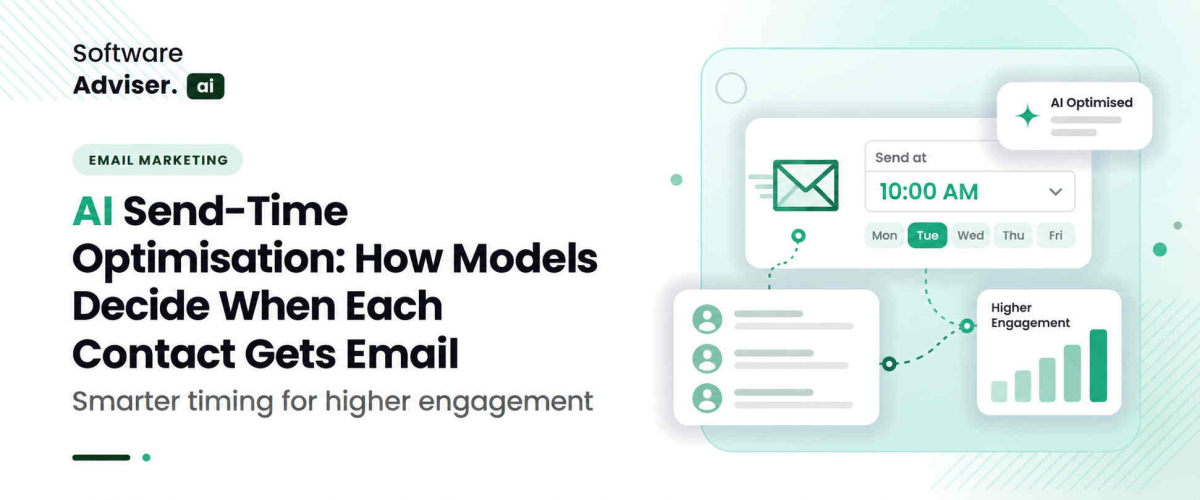
Artificial intelligence’s send-time optimization (STO) makes use of established machine learning systems to turn email distribution from a generalized batch process into a method of prediction for each subscriber. In response to an email marketing activity, the AI systems will analyze the previous activity of every subscriber, evaluating the history of their email interactions, including open times and click channels, time zones, device patterns (for instance, desktop vs. mobile activities depending on work time or evening), and additional contextual signals. After that, machine learning models (including gradient-boosted trees or deep neural networks) will estimate the probability distribution curve for the time when the email needs to be sent. When there is insufficient data on the marketing activities of subscribers, cohort-based predictive modeling will be used to assign a control time for each contact until there is enough data on their previous activities.
What is AI Send-Time Optimization (STO) in Email Marketing?
Send-Time Optimization (STO) is an application of advanced machine learning in modern mailing solutions enabling emails to be sent to every recipient precisely at the moment when they are most likely to read their messages. Instead of sending one email to everybody at the same time, the algorithm examines each user’s reaction history since it calculates personalized delivery time for every recipient using previously collected AI sales engagement data, such as time of opening emails, click behavior, and time zones. This makes it possible for the machine to reach the top of a subscriber’s inbox just as he or she is checking emails. Thus, the use of STO raises each campaign’s number of opened emails, clicked links, and successful conversions.
Importantly, while working, STO continuously adjusts delivery time to the changes in human behavior and signals from different platforms. When sending emails to a new group of contacts, the system uses principles of targeting similar audiences until it obtains enough information about each of them necessary for attribution creation.
Did you know?
The AI Send-Time Optimization feature monitors whether users check their e-mails on their mobile devices in the morning hours or on their computers when they are taking breaks from work to determine their ideal time of engagement and automatically accommodates lifestyle changes such as changes in time zones or working hours to guarantee that the message lands at the forefront of the user’s inbox. What’s more, it also makes sure that the messages are delivered gradually throughout the day instead of sending them all out at the same time, thus avoiding the spam filters.
What is AI Send-Time Optimization and how does it work?
AI Send-Time Optimization (STO) is a unique machine learning technology embedded in today's marketing platforms, and it allows sending emails to every user at the particular moment when the chance that the user opens the email marketing software is the highest. Instead of sending out email blasts to the entire customer base at one specific time, the technology utilizes a thorough analysis of the previous behavior of each recipient to make sure that the email is delivered at the exact moment when the customer checks their mailbox.
The underlying algorithms calculate dynamic probability scores for each contact to determine the optimal time when they are most likely to read messages in the following 15-60 minutes. When there is no history of interaction with the subscriber, the model would use cohort modeling to find a similar audience until it gathers the unique engagement data for this specific subscriber. After launching a campaign, the automated system will trigger emails on a staggered schedule during 24 hours. The feedback loop will update automatically as habits change, while the staggered sending helps maintain domain health and satisfy ISP requirements.
Why is traditional batch-and-blast emailing failing in the US market?
- More Stringent Deliverability Requirements in the Inbox: Major email providers like Gmail and Yahoo have introduced tough requirements for bulk senders (SPF, DMARC, DKIM) along with strict caps on domains. A flood of untargeted messages sends a signal of abuse to the algorithm, which marks the domains as spam.
- Significant Saturation in the Inbox and Reader Fatigue: The average American employee gets over 120 emails daily, which means that there is a huge chance that non-targeted mass mailings will go unnoticed amidst the flow of information.
- High-level demand for personalization: Consumers in the US have a need for personalization. Communications are expected to be more dynamic and behavioral, including localized content, personalized product offerings, and reminders about lost carts. The result is that standard one-size-fits-all messages end up being considered irrelevant.
- Sending time mismatch across different time zones: Sending messages across four different time zones can lead to sending the message during non-prime-time hours, which may lead to subscribers receiving messages at odd hours (for example, during late-night hours). By the time subscribers check their inbox, new messages push the old ones back.
- Low-cost returns of marketing relative to the use of automated triggers: Sending messages on a one-to-one basis leads to higher returns in terms of revenue, loyalty, and in terms of profitability than the use of mass marketing messages.
What key Data Signals do AI models use to Predict Open Times?
- Historical Interaction Timestamps: Knowing the precise UTC and local time of when people opened your email and clicked on links in your past email marketing campaigns.
- Device & Client Telemetry: Knowing whether the user is on a mobile phone during different hours (in the morning) or on a desktop computer while working.
- Recency & Frequency Signals: Determining how old the user is and how often he or she is active (active every day versus sometimes coming along on weekends).
- Day-of-Week Variation: Noticing how the user behaves differently on weekdays as compared to weekends.
- Time Zone & Geolocation Data: Being able to discover the geographical region where the user lives and what time it is there.
- Cross-Channel Behavioral Triggers: Making use of secondary signals such as the website being visited or the app being installed.
How do machine Learning Algorithms Calculate the ideal Delivery slot for each Contact?
- Data Collection and Time Segregation: The technology begins with the collection of basic engagement activity records, which include opens, clicks, and website visits, and categorizes them into 24-hour time slots observed within a week to determine the activity history of each subscriber.
- Modeling of Engagement Weightage Using Decay Function: Machine learning algorithms involving the application of the decay function are employed with the aim of entailing greater weight on the most recent rather than on the old engagement activity, thereby making it possible to generate the current routine rather than an outdated one.
- Probability Density Function for Engagement Activity: The algorithm entails the application of different technologies like Gradient Boosted Decision Trees or Neural Networks to develop an engagement probability density function for users while AI accounting software for the entire duration of the week.
- Clustering for Lookalike Group: In case of newly engaged users, where no sufficient engagement activity data exists, cluster analysis involving k-nearest neighbor gets to be performed so that new users can be placed in a group sharing similar demographic information to ensure proper scheduling.
- Continuous feedback process and improving the quality of email marketing transit: Open and click-through rates for all email campaigns feed back into the training pipeline, resulting in constantly updated predictions about delivery.
What are the main Benefits of STO for US Email Marketers?
- Improvement in open rates and click-through rates: Getting at the top of the inbox when contacts are checking their emails contributes to improving the key performance indicators by 5% – 25%, compared to conventional methods of sending emails.
- Protection from Gmail and Yahoo restrictions: Distribution of the campaign over 24 hours helps balance traffic spikes and avoid penalties related to bulk sending.
- Reduction of email fatigue and unsubscriptions: The solution is designed to take into account the personal schedule of people and not disturb them during the ‘do not disturb’ hours.
- Automatic distribution of messages regardless of time zones: No more wasting time on splitting the lists and calculating delivery time in the time zone of the recipient.
- Increase in conversion and revenues: Send emails once customers are engaged and ready to purchase, hence increasing sales with every campaign.
- Long-term reputation development of the sender: Getting subscribers’ engagement from the very beginning is a clear signal to ISPs that the domain sends valued emails.
- Dynamic Adaptation to Changes in Behavior: Constantly changes delivery time based on customers' shifts in AI free scheduling, travel, or whether they use a mobile or desktop device.
What Common Challenges or Limitations do Brands face when Adopting STO?
- Cold Start Data Dependency: To produce relevant predictions, machine learning models require previous records of customers' engagement. For new customers or contacts with very few interactions, machine learning models would have to rely on standard cohort bases or enact immediate email delivery until enough individual data is collected.
- Non-compatibility with Time-Sensitive Sales: for certain campaigns with deadlines like one-day promos, limited discount codes, and alerts, it becomes impossible to wait for the 24-hour STO process, since delays destroy the point of the offer.
- Facilities for privacy protection: (such as the automatic background image loading by Apple) produce fake open dates. This means that if an algorithm is based on raw open events without moderating it with click metrics, it will strain incorrect machine-derived engagement schedules.
- Postponed Reporting and Longer Measurement Periods: Because of the fact that campaigns are being started step by step over the course of 12-24 hours, advertisers cannot have fresh performance analytics or hold hourly tests.
- Merging Campaigns and Lots of Messages: The systems that work independently can send promotional letters at the same second when the receiver gets the transaction receipt, SMS, or automated journey letter.
- Restraining the Platform and Limits to Sending: Big volume sending during the period of peak global activity can disturb sending limits established at the level of the platform or the restrictions imposed on the domain.
Conclusion
AI Send-Time Optimization combines the accuracy of machine learning and consumer behavior to turn boring email campaigns into money-making opportunities. By predicting when emails will receive maximum engagement from potential clients, STO increases email open rates, ensures the health of the domain, and relieves senders from the hassle of manually scheduling emails across all time zones. Nevertheless, in order to fully realize its potential, one needs to combine predictive algorithms with strict deadlines and clean data concerning email engagement. To scale up the strategy, one should find a good email service provider that has the STP function available. Visit softwareadviser.ai to check out business software that meets your requirements.
FAQ's
AI Send-Time Optimisation is a machine learning feature that dynamically calculates and delivers an email to each subscriber at their individual peak engagement window.
For contacts with no interaction history, STO uses lookalike cohort clustering or immediate fallback sends until sufficient engagement data is collected.
No, urgent or time-sensitive promotions should bypass STO because a 24-hour delivery window risks delivering discount codes after the offer expires.
Privacy pre-fetching creates false open signals, forcing modern STO algorithms to place higher prediction weight on true click behavior rather than opens alone.
Yes, staggering email sends across a 24-hour timeline prevents server traffic spikes and maintains clean engagement signals with inbox providers like Gmail and Yahoo.

Artificial Intelligence has fundamentally changed email marketing. For years, email marketing relied on static rules, standard drip sequences, and man [...]

David N. Wilks
As US companies keep expanding globally, or trying to manage remote talent across dozens of different state tax lines and also international borders, [...]
Dokas mile

To build a resilient and secure cloud setup, modern tech businesses need a smart approach to cloud architecture management. When running complex code [...]