
What we'll cover
Share with your community!


Get Free Consultation
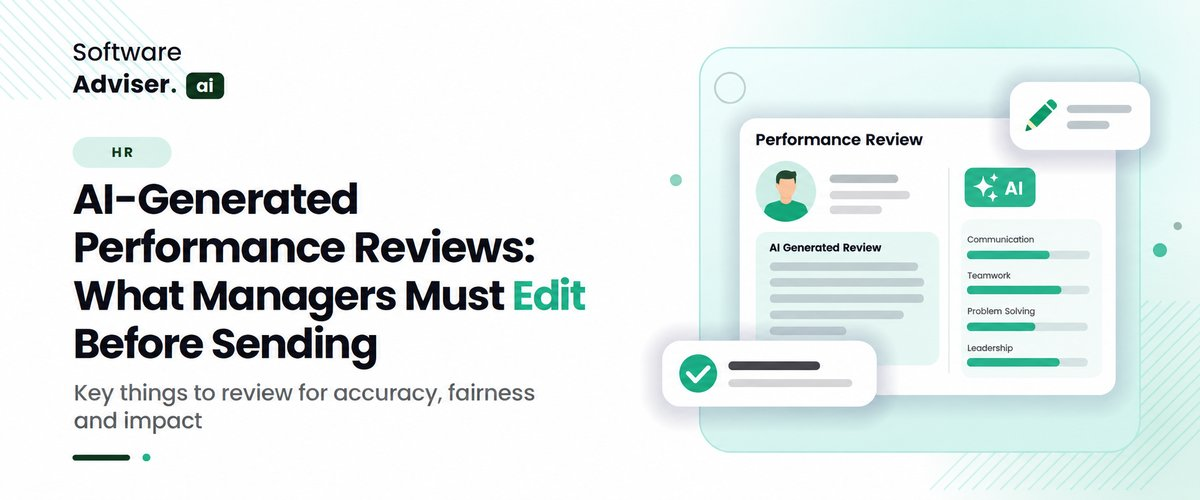
AI-Generated Performance Reviews: What Managers Must Edit Before Sending
 Dokas mile
As Generative AI technology rapidly standardizes business activities, managers across the country begin using applications like ChatGPT or specific HR platforms to prepare performance evaluations. Although these AI programs are excellent at gathering information, they also come with significant operational, legal, and relationship issues if we use non-revised automated writing. Indeed, the large language models do not have any personal experiences, often inventing accomplishments and metrics, providing too much cleaned-up feedback, and forming simultaneous systemic bias, which would spoil the trust towards the employee or create liability under American labor laws. For this reason, AI-prepared assessments can be regarded as a structural primary draft only; therefore, managers should double-check, customize, and confirm all the information before sending it to the employees’ inbox.
What Confidential Employee Data must be Removed before using AI?
Before providing any work-related information to any external generative AI platforms, managers must ensure that any records containing personally identifiable information (PII) and sensitive AI medical store data are eliminated from the records. Details such as full names, Social Security numbers, home addresses, dates of birth, personal phone numbers, and employee identification numbers should be entirely removed from performance records. Moreover, as per federal laws like HIPAA and state regulations, all medical condition information, as well as information regarding disability adjustments, approved sick leave, and use of the Family and Medical Leave Act (FMLA), should never be provided.
Apart from the uniqueness of individuals, AI input must be cleansed of sensitive business information, payment details, and privileged HR activities. These include complete details regarding salary history, equity structure, precise percentages for commissions, and important non-public indicators like unreleased sales figures or restructurings, which are to be scraped or replaced with placeholders. It is also important to omit important human resource-related matters, such as pending preview warnings, current inquiries or information about unions. AI suppliers use prompts from clients to improve their publicly available AI models, which makes using proprietary business data in the prompts dangerous from a confidentiality point of view and raises potential concerns related to labor and trade secrets laws in the US.
Do you know?
Before sharing company documents with outside generative AI companies, executives should make sure to eliminate any personally identifiable data, sensitive medical records, confidential financial information, and classified human resources components. To achieve this goal, executives need to identify and erase any elements of personal identification that may appear in their records, such as full names, Social Security numbers and employee identification numbers, as well as legally protected health data, such as medical histories, Reasonable Accommodation records and Family and Medical Leave Act leave information. The same applies to confidential knowledge about companies, such as salary systems and commission rates, as well as important facts about a business, such as statistics on income, disciplinary history and any information about unions.
How do Managers edit AI text to make it sound Empathetic and Authentic?
U.S. managers should make sure that they motivate their employees by transforming some terms that have become commonplace in the corporate world into ones that sound genuine and show how the manager has deep empathy. Since some phrases like demonstrates exceptional leverage or continuously optimizes deliverables lose meaning and sound boilerplate, it is important to provide feedback in simple and understandable language. It is important to use an active voice and encourage employees using a humane tone and steer the critique toward sharing ideas for improving the situation instead of punishing the subordinate.
Besides, true sincerity lies in the need to stay away from terms that do not mean anything and use only phrases taken from previous experiences of cooperating with employees. Thus, the AI may state that a worker is a real team player but can’t say how he/she helped with the process. In this light, constructive criticism should replace the AI’s polite softening expressions. In this case, the manager should speak directly about what should be improved, what this improvement means, and how the management will help the employee achieve these goals.
Which metrics and facts must managers double-check for AI hallucinations?
- Quantitative Performance Data: Check factual data metrics such as sales figures, quota percentages, resolution speeds, or revenue increases. AI systems can distort numbers or create fictitious figures.
- Project Ownership & Key Achievements: Investigate the stated achievements to check whether the workers were the managers or the developers of these particular projects, not just part of a bigger team project.
- Timeline & Attendance Accuracy: Check starting dates, project delivery times, and promotion dates. AI makes false claims about particular dates or uses past performance as if it refers to current Q3/Q4 results.
- Certifications & Skill Accreditations: Make sure that professional qualifications, technical skills, software knowledge, or completed courses of training are confirmed by facts.
- Client & Inter-departmental Feedback: Check real-life client statements, colleagues’ positive feedback, or CSAT scores to ensure that the AI didn’t make up imaginary praises from beneficiaries.
- Goal Alignments (OKRs/KPIs): Compare the generated text with the AI employee performance plan to prove that it corresponds to the stated objectives.
How can managers spot and remove subtle bias in AI-generated drafts?
- Gendered Action Verbs and Adjectives: The world of AI emphasizes the importance of gender in evaluating performance. For instance, assessments of the AI workforce management are made in terms of how they operate within a group and how well they perform their jobs, while men are rewarded for good leadership or managerial skills. The best way to eliminate the gender bias is to base assessments on actions and results.
- The Likability Penalty and Competency: Be aware of biases in terms of how soft skills are perceived. In women and minorities, assertiveness appears as a negative characteristic, whereas in men the same trait is regarded as an indicator of strong presence. You can ask yourself the question: would I use the same words to evaluate the actions of someone broadly in terms of behavior?
- Age-based Language and Tech Assumptions: AI invocations are almost always saturated with age-based assumptions. A younger worker may be referred to as digitally adept, while an older one will be labeled as traditional. It would be wise to utilize only numbers and metrics when gauging people’s performance.
- Systematic Benefits Versus Personal Contributions: AI usually hands out praises to mainstream community members if a group accomplishes any goals, whereas for minorities it usually suggests that they are lucky, helped by others, or simply follow instructions. Make sure that you treat all group members fairly in terms of responsibilities.
- Distance and Working Style Discrimination: Language models tend to punish those who work remotely by focusing on the visible behavior instead of the actual outcome.
How do Managers Convert vague AI suggestions into Clear Employee Goals?
How to Turn Suggestions Made by AI into Clear Objectives
- Utilize SMART Model: Assign precise targets, deliverables, and fixed timelines to broad statements generated by AI.
- Explain How in Addition to What: Explain in detail the necessary operational processes, technology, or activities needed to achieve the objective.
- Identify Specific Metrics for Success: Determine how progress is going to be monitored, whether it is in terms of error reductions, revenue goals, or completion dates.
- Determine the Resources Required and their Source: Clearly state the instruments, financial resources, or mentors needed for your team to achieve success in task accomplishment.
Changing AI Drafts to Human Objectives
- One AI Draft says: An employee should focus on improvements in the efficiency of project delivery.
- Converted into a Human Objective: Set up automation of all reports weekly using Jira to decrease preparation time from 3 hours to an hour by 15th October.
- Another AI Draft says: Stronger collaboration across functions is necessary.
- Converted into a Human Objective: To set up bi-weekly meetings with the technical lead to reduce rework by 15% during the current quarter.
- AI Draft states: The employee should work on improving leadership skills.
- Final conversion states a Human Objective: Guide a junior employee through Q4 while supervising the process of onboarding and leading code review meetings once a week.
What Legal and HR Compliance Risks do US Companies face from unedited AI Reviews?
- EEOC Disparate Impact & Title VII Violations: Title VII of the Civil Rights Act holds employers liable for discriminatory practices in their review processes, which means that they are legally responsible for any discrimination based on race, sex, nationality, or religion, regardless of whether the discrimination took place through a third-party artificial intelligence tool. Drafts prepared by artificial intelligence tools that have not been altered have traces of bias because underrepresented employees are assessed using stricter or subjective criteria.
- ADA and FMLA Penalties: Generally speaking, AI language programs negatively judge employees for not being productive enough. If artificial intelligence submits a draft that shows lack of productivity and does not mention Family and Medical Leave Act (FMLA) approved leaves or accommodations provided due to the Americans with Disabilities Act (ADA), using it opens the organization up for lawsuits regarding discrimination based on disability and medical condition.
- Lack of Defense for Wrongful Termination: Under the American employment law principle of performance review, performance evaluations provide important evidence when a person is terminated or demoted. If an employee sues an employer for wrongful termination, employing an AI evaluation that contains false project failures will invalidate the organization’s justification and leave it vulnerable.
- State Privacy and Trade Secret Breaches: The practice of copying raw employee performance notes into commercial AI software can often put personal confidential employee data, the pay scale, or trade secret information in the external server system. By doing so, a company can violate data privacy regulations at the state level (for instance, California's CCPA/CPRA) as well as breach business confidentiality obligations.

Pro-tip
US managers have to keep in mind that AI-generated performance evaluations should be considered an outline of the whole report, while the final paper must be highly customized. They should make sure to remove all sensitive information about employees and verify all data collected to avoid serious legal troubles and AI hallucinations. Generic business jargon must be replaced with real-life examples and clear law-abiding goals.
Conclusion
Performance appraisals of AI are nothing more than a company’s administration, which, to be compliant with the law and to be accurate and sincere, requires significant human modification. U.S. managers protect companies from the court for discrimination claim by eliminating PII, verifying metrics, and substituting dry terminology for understandable and humane SMART goals. To ease HR processes at work, visit softwareadviser.ai for reviews and reviews of the software. Automated appraisal techniques combined with managers’ continuous monitoring make it possible to receive an optimum level of efficiency with no loss of trust and integrity at workplaces.
FAQ's
Unedited AI drafts contain factual hallucinations, lack authentic human context, and expose companies to major EEOC and legal compliance liabilities.
Managers must strip all personally identifiable information (PII), medical/FMLA leave details, compensation figures, and pending disciplinary records.
Cross-check every generated sales metric, project milestone, timeline, and client quote directly against verified internal HR systems and company records.
Replace generic corporate jargon with direct conversational language, specific personal memories, and supportive framing focused on shared growth.
Translate broad statements like "improve communication" into SMART goals complete with clear targets, operational steps, success metrics, and assigned deadlines.
Most sales teams are sitting on a problem they've normalized. The rep who spends twenty minutes after every call reconstructing notes before they forg [...]

David N. Wilks
Buying the wrong An AI tool isn't usually a technology problem. It's a process problem. A demo impressed someone. A competitor was using it. The fear [...]
David N. Wilks
The software tools for finding email addresses are revolutionizing the process of identifying prospects and enabling teams to concentrate on finalizin [...]