
What we'll cover
Share with your community!


Get Free Consultation
AI CRM Software for Startups: Features to Look for in 2026
 David N. Wilks
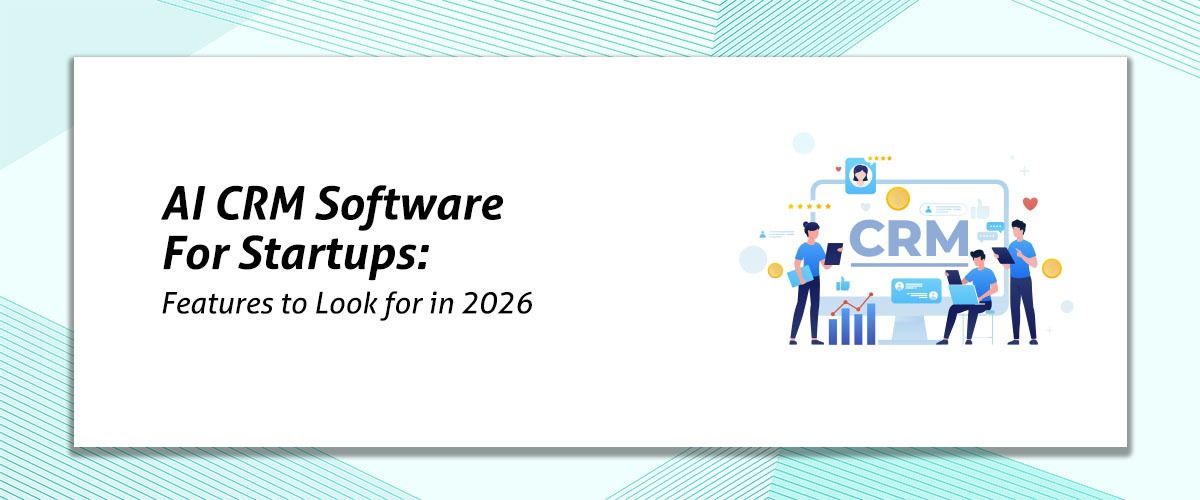
A startup’s life or death question in 2026 will be about speed and accuracy and a traditional CRM just won’t cut it. Today’s AI-empowered CRM software is not just a digital rolodex; it’s a growth engine that’s proactive, automates the boring stuff in data input, anticipates churning customers before they churn, and hyper-personalizes outreach at scale. The perfect AI CRM is an additional data scientist and sales strategist in one for companies that are short on resources. Choosing a platform with the proper forward-looking features can let your lean team punch above its weight and scale easily in a hyper-competitive industry.
What is AI CRM Software?
A platform known as AI CRM uses vast amounts of data (data-driven) combined with standard ways of managing customers (standard ways of managing customers) to produce results derived from the latest advances in artificial intelligence (including machine learning, natural language processing, and predictive analytics). An AI CRM is not simply a static database where sales staff enter phone numbers and emails manually it analyzes that data. It does the heavy lifting for you by automatically recording client interactions across AI email finder tools ,social media and support requests, converting raw communication into meaningful business analytics.
This technology is radical . Instead of waiting for a client to complain or churn, the AI recognizes minor alterations in how users behave or speak to flag account managers of possible issues before they even exist. It delivers company executives a mix of very accurate sales forecasting and deep behavioral insights so lean teams can create the kinds of fully tailored, 24/7 client experiences that once required a big corporate infrastructure.
Why do US Startups need AI CRM Software in 2026?
The US startup scene in 2026 is hypermarket saturated, a fierce fight for venture money and operational efficiency is a matter of life and death. In today’s world, lean teams can’t afford to spend precious hours on manual data entry, fractured communication or pursuing cold leads. Automated force multipliers such as an AI CRM create an equal playing field.
A small team of founders and early team members can, through the use of this technology, act quickly and accurately (with data intelligence) at the speed and productivity equivalent to that of larger companies without employing as many personnel. AI CRM will quickly identify high-value prospects, enable hyper-personalized marketing campaigns, and handle all back office administrative tasks.
American consumer expectations have evolved drastically towards fast, hyper-customized experiences. Startups employing old, static CRMs can’t compete with AI-driven competitors that reply to inquiries in seconds and risk losing buyers to quicker moving firms. An AI CRM fills that gap by studying customer behavior in real time, detecting sources of friction, and advising the precise appropriate timing to bring in human assistance. It turns raw data into predictive tactics that help businesses boost the lifetime value of customers, lower customer acquisition expenses and develop a scalable foundation that appeals to contemporary, data-driven investors.
What key Features should startups look for in AI CRM Software?
1. Predictive Lead Scoring: Leverages machine learning to evaluate historical data and score prospects so your sales staff only pursues leads with the highest probability of converting.
2. Generative Email & Content Automation: Generates hyper-personalized outreach emails and follow-ups, leveraging the prospect’s real-time behavioral data and prior interactions.
3. Automated data Capture and Enrichment: Removes laborious recording by automatically AI applicant tracking system, calendar invitations and social interactions while getting missing corporate data from the web.
4. In-moment Conversational Intelligence: Analyzes client conversations or video meetings to deliver live recommendations and automatic summaries to sales agents based on the tone and attitude of the conversation.
5. Proactive Churn & Behavioral Forecasting: Scans customer behavior and communication trends to identify accounts losing engagement before they cancel.
How does AI CRM Software improve Sales for Startups?
1. Eliminates the Pipeline Guessing Game
Rather than sales professionals wasting time chasing cold leads or guessing who to call first, the AI analyzes historical data and real-time behavior to evaluate prospects. It alerts your team to the particular purchasers who are demonstrating high intent signals (such visiting a pricing page numerous times or viewing third-party reviews), so your salespeople can take quick action.
2. Accelerates the Automated Outreach
Timing is essential for a startup. AI CRMs leverage generative AI to write hyper-personalized emails in seconds for a prospect’s unique industry, job, and pain points.
Your sales team can now follow up with hundreds of prospects a day with highly personalized messaging, something that would typically require a big corporate marketing staff.
3. Automatically Captures Key Data
Data input is notoriously hated by salespeople. An AI CRM will automatically log emails, organize meetings, track phone conversations and update the pipeline stages without any human interaction.
Reps are doing the work they’re paid for selling to people and not wasting their time updating spreadsheets, which greatly increases their daily productivity.
What are the Top US Companies providing AI CRM Software?
Here are the briefs for the best firms that provide AI CRM software, written in just 5 lines each:
1. Salesforce
Salesforce is the undisputed behemoth of the business, dominating the enterprise market with its fully integrated Agentforce AI ecosystem. It lets entrepreneurs design and deploy autonomous AI agents that can execute complicated customer support activities and sales operations without human interaction. It has the most customizability and predictive forecasting algorithms, and is the gold standard for fast-growing organizations. However, its premium pricing tier and steep learning curve means that it needs a specific deployment plan.
2. Zoho CRM
If you’re a cost-conscious company, you’ll love Zoho. It offers a highly complete suite driven by its proprietary AI assistant, Zia. Zia also has the ability to observe consumer behavior patterns and anticipate the win percentages on ongoing sales. Zia can also recommend the exact optimal moment to contact a lead. The platform is clean and user-friendly, and the pricing levels are incredibly competitive, startup friendly, and not compromising on sophisticated automation features. It bridges the gap between simple contact management and powerful enterprise-grade, data-driven sales analytics.
3. Twozo CRM
Twozo CRM is an emerging market contender intended for fast-growing companies that need lightweight, highly accessible customer lifecycle automation. The platform leverages its native AI buddy, Nira, to cut out on administrative tedious labor for lean sales teams. Nira is an embedded text assistant that writes tailored email content instantaneously, corrects tone and language, and auto-summarizes difficult client discussions. It has very easy drag-and-drop visual pipelines and low pricing, making it a perfect fit for organizations looking for quick efficiency without the baggage of software.
4. Creatio CRM
Creatio is uniquely positioned combining a sophisticated AI customer management system with an innovative no-code business process automation platform. It has a conversational AI copilot that enables non-technical business founders to construct whole bespoke automated sales workflows in plain daily natural language. We love the platform for its adaptability. Teams can modify sales, marketing and support structures on the fly in minutes as company demands evolve. That’s an excellent solution for firms wanting sophisticated, customized machine learning without the need to recruit costly software engineers.
How does AI CRM Software help startups Scale Faster?
1. Unlocks unfair efficiency (less hiring, more output)
- Scaling used to require the need to engage a small army of sales development representatives and ops managers just to manage the number of administrative region work. An AI CRM turns this dynamic on its head.
- Autonomous Operations Let the AI do the grunt work. Auto-log emails, update pipeline stages, enrich contact profiles and cleanse bad data.
- It enables a firm with 3 sales people to run a pipeline that would ordinarily require a staff of 15, keeping overhead costs extremely low while optimizing the revenue production.
2. Standardizes Top-Performer Strategies
- In a lean business you can’t afford to have your growth stagnate because your best salesman is ill, or your single customer support worker is overwhelmed.
- The program is always monitoring your winning deal routes, your best performing email templates and how you engage your target customers. Then it actively trains the rest of your team in real time, providing next-step ideas and content templates to help everyone operate at the level of your top performance.
3. Provides Immediate, 24/7 Global Support
- You can't grow worldwide if your customer service structure is tied to a single time zone. AI CRMs are powered by powerful, context-aware AI agents that never sleep.
- At 3:00 AM they are handling first line customer calls, troubleshooting technological issues, and making immediate basic account adjustments.
- Route just the most complicated, high-value issues to your human staff and keep your customer satisfaction levels high without building a worldwide, round-the-clock support center.
What is the Cost of AI CRM Software for startups in the US?
The cost of AI CRM software for US companies can vary significantly dependent on the intricacy of the platform. It ranges from $15 to over $300 per user, per month. Entry-level packages from vendors key AI-powered capabilities such as basic automatic email drafting, contact enrichment and basic predictive grading for around $15 to $35 per user per month, making them a good option for early-stage firms with limited budgets. This means that lean teams may use strong automation solutions without having to make a huge upfront cash commitment.
Costs explode as a firm matures and needs advanced corporate capabilities. Mid-tier solutions that enable deeper conversational intelligence, automated sales forecasting and bespoke process builders often cost $50 to $150 per user, each month. At the high end, industry titans like Salesforce are charging $165 to $300+ per user each month to access their cutting edge autonomous AI agent ecosystems. Startups should also consider hidden charges like as data storage overages, third-party integration add-ons, and potential setup or onboarding fees if the platform requires external technical expertise to implement, in addition to the standard subscription.
How to choose the Right AI CRM Software for your Startup?
1. Evaluate the technical skills of your team: Pick a platform that suits your internal capabilities, opting for easy no-code interfaces like Creatio or Twozo if you don’t have a dedicated IT or development staff.
2. Evaluate the Hidden Costs of Implementation: Look for hidden costs like data storage overages, third-party connectors and onboarding help. Consider the real total cost of ownership.
3. Native Data Integration First: Your CRM should be able to integrate with your existing tech stack (your email client, Slack, marketing tools, etc. ) out of the box, without requiring bespoke APIs.
4. Test the scalability of the price tiers: Look at the vendor’s higher pricing tiers to ensure the software doesn’t break the bank as your team expands and you tap into more sophisticated AI capabilities.
5. Focus on the Specific Features that Drive ROI: What is the largest bottleneck in your startup right now lead creation, automatic follow-ups, customer service – and choose a CRM that is good precisely in that area.
Conclusion
By 2026, a firm will no longer be able to afford not to have an AI CRM for fast, sustainable development. With automation of administrative overhead, prediction of buyer behavior, and real-time data insights, these technologies allow lean teams to outmaneuver big competition. The best software fit for you relies entirely on your specific workflows, technical skills and scalability ambitions. To make this important choice easier, creators can turn to softwareadviser.ai. This specialized SaaS marketplace helps you discover, evaluate and purchase the best business software to power your startup’s future.
FAQ's
it depends on your needs. Reevo is excellent for founders who want an all-in-one revenue platform, Clarify suits smaller teams wanting hands-off data entry, and Lightfield is ideal for solo founders managing early relationships. Teams already may prefer their built-in AI agents.
Pricing varies widely. Some tools, like Clarify, offer free tiers, while Salesforce Einstein Agent starts around $50/user/month and HubSpot's agents require Professional ($100/seat/month) or Enterprise ($150/seat/month) plans plus credits. Many providers, including Reevo, offer startup discounts.
No. AI CRM Software is built to support your sales team, not replace it. It automates admin tasks, drafts outreach, and surfaces insights so your people can focus on building relationships and closing deals.
A traditional CRM relies on you to manually log data and update records. AI CRM Software captures, structures, and analyzes that data automatically, acting as an active co-pilot rather than a passive database.
Yes, especially for lean teams. AI CRM Software gives small startups the power to handle higher volumes and respond faster without hiring more people, making it a smart investment for fast-moving US founders.
The architectural foundation of modern commercial technology has experienced a massive shift toward microservices and decentralized cloud platforms. M [...]

Dokas mile
As organizations are increasingly integrating artificial intelligence into their talent acquisition processes, automatic interview scoring tools compu [...]
Dokas mile
Managing corporate trips has turned into an expensive, chaotic puzzle for modern finance teams. Between fluctuating flight prices, unoptimized hotel b [...]