
What we'll cover
Share with your community!


Get Free Consultation
The Best AI in HR Tools for Startups and SMBs
 David N. Wilks
The landscape of people management has shifted. If you’re running a startup or an SMB in 2026, you likely already know that the "human" in Human Resources is being significantly augmented. The integration of AI in HR isn’t just a luxury for Silicon Valley giants anymore; it’s the survival kit for smaller teams trying to scale without burning out. Let’s be honest: manual payroll, sifting through thousands of resumes, and tracking employee sentiment via spreadsheets is a relic of the past.
Why AI in HR Is Becoming Essential for Startups and SMBs
Startups operate on a "do more with less" philosophy. When you have a team of 20, you often don't have a dedicated HR department. This is where AI in HR steps in as your silent co-founder. By leveraging AI equipment for HR, small businesses can automate the mundane, like screening for unique ability sets, permitting founders to focus on lifestyle and method.
The move toward artificial intelligence for HR professionals is driven by the need for speed. In a competitive talent market, losing a candidate because your feedback loop took three days instead of three hours is a costly mistake. AI in HR ensures that no data point is missed and no candidate is left hanging.
How Artificial Intelligence in Human Resources Is Transforming HR Operations
When we communicate about synthetic intelligence in human resources, we aren't talking about robots changing managers. We’re talking about ai-powered hr solutions that provide deep insights. For instance, artificial intelligence in hr can now predict "flight risks" employees who are likely to quit by analyzing engagement patterns long before they hand in a resignation letter.
This transformation is central to modern HR TRENDS. We are seeing a shift from reactive control to proactive intervention. Using AI in HR, organizations can now customise the onboarding experience, ensuring that a new hire in Berlin feels as relevant as one in New York. This level of AI in hr management was unthinkable five years ago for anyone without a million-dollar software budget.
Key Features to Look for in AI Tools for HR
Before diving into the tools, you need a checklist. Not every AI in HR platform is built for the chaos of a startup. Here is what actually matters in 2026:
- Predictive Analytics: Does the tool just show data, or does it tell you what’s coming?
- Natural Language Processing (NLP): Can the AI tools for human resources recognize the nuance in employee surveys, or does it best music "Happy/Sad" emojis?
- Integration Capability: Your AI in HR stack must talk to Slack, Zoom, and your accounting software.
- Bias Mitigation: Artificial intelligence for hr professionals must have built-in "blind" screening to ensure diversity.
Best AI in HR Tools for Startups and SMBs in 2026
Selecting the right ai-powered hr solutions can be overwhelming. To help you navigate, we’ve analyzed the top players in the AI HR Software and AI HR software for Startups categories.
1. BambooHR
- Overview: The gold standard for SMBs that need an "all-in-one" feel without the enterprise price tag.
- Best Features: Their "Employee Satisfaction" AI uses sentiment analysis to gauge office vibes.
- Pricing: Custom quotes, typically starting with a free trial for core modules.
- Best For: Growing SMBs (50–500 employees).
- Pros: Ultra-clean UI; excellent mobile app.
- Limitations: The AI in HR features are great, but less "deep" than niche AI tools.
2. Rippling
- Overview: The "everything store" of employee management. It handles IT, Finance, and HR in one move.
- Best Features: Automated "Recipes" that cause moves (like sending a pc) based on hiring recognition.
- Pricing: Starts at $8 per user/month.
- Best For: Tech-heavy startups that need to manipulate a ways-off hardware and software programs.
- Pros: Incredible automation scales effortlessly from 1 to at least 1,000 personnel.
- Limitations: It can become expensive as you upload "bricks" to the platform.
3. Deel
- Overview: If your group is global, Deel is your satisfactory pal.
- Best Features: AI-driven compliance exams that make certain you aren't breaking hard work laws in 150+ nations.
- Pricing: Free for a few HRIS functions; paid for international payroll.
- Best For: Fully far-flung startups.
- Pros: Best-in-magnificence global felony aid.
- Limitations: Primary cognizance is payroll, so "cultural" HR features are secondary.
4. Workable
- Overview: An ATS (Applicant Tracking System) on steroids.
- Best Features: AI tools for hr that endorse applicants from a massive database of four hundred million profiles.
Pricing: Pay-in keeping with-activity or annual plans. - Best For: Startups in a hiring blitz.
- Pros: "AI Recruiter" function saves hours of sourcing.
- Limitations: Not a complete HRIS; focuses totally on the "hiring" a part of AI in HR.
5. Zoho People
- Overview: Part of the huge Zoho surroundings.
- Best Features: Their AI assistant, Zia, can answer employee questions on go-away balances or policy updates.
- Pricing: Very low-priced; starting at roughly $1 according to the consumer.
- Best For: Budget-conscious SMBs.
- Pros: Highly customizable.
- Limitations: The UI can feel cluttered compared to Rippling or HiBob.
6. HiBob
- Overview: Built specifically for "Modern" corporations that prioritize lifestyle.
- Best Features: Advanced AI in HR management that maps social connections among employees to locate "lifestyle champions."
- Pricing: Custom pricing based on modules.
- Best For: Mid-sized tech corporations and creative organizations.
- Pros: Beautiful layout; specializes in the "human" revel in.
- Limitations: Might be "too much" for a 5-character crew.
7. Gusto
- Overview: The favorite for US-based small businesses.
- Best Features: AI-guided benefit selection for employees.
- Pricing: Simple monthly fees + per-person fee.
- Best For: Very small businesses (1–50 people).
- Pros: Extremely easy payroll and tax filing.
- Limitations: Limited international capabilities.
8. Leena AI
- Overview: An independent "Workplace Concierge."
- Best Features: It uses artificial intelligence in hr to automate 80% of repetitive worker queries through chat.
- Pricing: Enterprise-centered, however, it has SMB stages.
- Best For: Companies with high inner help tickets.
- Pros: Dramatically reduces the workload on HR personnel.
- Limitations: High setup time to "educate" the AI on your precise policies.
9. monday.com HR
-
Overview: A workflow device tailored for HR.
- Best Features: Visual "Drag and Drop" automation for onboarding pipelines.
- Pricing: Tiered, with a loose version for small groups.
- Best For: Companies that love to see project manage.
- Pros: Extremely flexible; you could construct precisely what you need.
- Limitations: Requires guide setup; is not a "plug and play" HRIS.
Comparison Table: Top AI HR Tools at a Glance
|
Tool |
Primary Focus |
Best For |
AI Strength |
|
BambooHR |
All-in-One HR |
Mid-sized SMBs |
Sentiment Analysis |
|
Rippling |
Unified Workforce |
Global Startups |
Workflow Automation |
|
Deel |
Global Compliance |
Remote Teams |
Legal/Tax AI |
|
Workable |
Recruitment |
Fast Hiring |
AI Candidate Sourcing |
|
HiBob |
Culture & Engagement |
Tech Companies |
Social Mapping |
|
Gusto |
Payroll & Benefits |
US Small Biz |
Automated Tax/Benefits |
Top AI Use Cases in HR for Growing Businesses
How are real companies actually using AI in HR? It's not just about chatbots. Here are the most impactful AI use cases in hr we are seeing this year:
- Resume Anonymization: Artificial intelligence in human assets is being used to remove names and photographs from resumes to save you from unconscious bias.
- Hyper-Personalized Learning: An AI tool for hr specialists now advocates particular publications to employees based on their performance gaps.
- Attrition Prediction: Using artificial intelligence in hr to identify when a key developer is disengaging and needs a check-in.
- Real-time Feedback: Instead of yearly reviews, AI in HR facilitates weekly "nudges" to managers to give praise or feedback.
Benefits and Challenges of Using AI in HR Management
Implementing AI in hr management is not all sunshine and rainbows. While the blessings of AI in HR consist of big time savings and data-driven hiring, there are hurdles.
The Benefits:
- Efficiency: AI tools for human resources can do in seconds what takes a human hours.
- Accuracy: No greater payroll errors or missed compliance deadlines.
- Employee Experience: Modern employees assume on-the-spot, tech-ahead interactions.
The Challenges:
- Data Privacy: Handling sensitive employee data with artificial intelligence in hr requires strict security.
- The "Human" Touch: Over-automating can make a startup feel cold and robotic.
- Algorithm Bias: If your training data is biased, your AI in HR will be too.
Future HR TRENDS: What’s Next for AI in Human Resources?
Looking ahead, HR TRENDS proposes a path towards "Generative HR." Soon, AI in HR might not just examine information; it's going to create it. We’ll see AI tools for hr professionals that can draft entire employee handbooks tailored to local laws in seconds or create personalized career maps for every single employee.
The convergence of artificial intelligence in human resources and the metaverse is also on the horizon. Imagine AI-led virtual reality onboarding, where a new hire "walks" through a digital twin of the office. This is the future of AI in HR.
Conclusion :
Embracing AI in HR is no longer optionally available for startups and SMBs that need to compete with the massive gamers. Whether it’s via AI tools for hr that streamline your hiring or ai-powered hr solutions that keep your group satisfied, the goal remains the same: using technology to make the administrative center more human, not less. By choosing the right AI HR software for Startups, you're investing in your most valuable asset, your people.
FAQ's
Yes, AI personalizes employee experiences, feedback, and learning opportunities.
AI improves hiring, automates HR tasks, and enhances workforce productivity.
AI screens candidates, schedules interviews, and identifies the best talent faster.
Choose a platform with automation, analytics, integrations, security, and scalability.
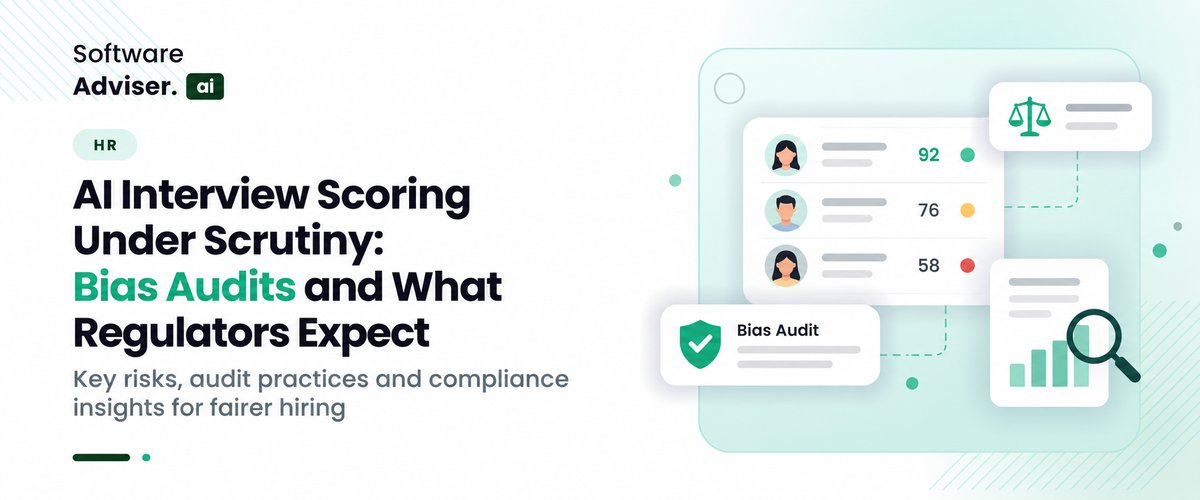
As organizations are increasingly integrating artificial intelligence into their talent acquisition processes, automatic interview scoring tools compu [...]

Dokas mile
In the current rapidly developing digital world, it is not sufficient for traditional file cabinets and cluttered cloud folders to provide what busine [...]
David N. Wilks
Advanced algorithms implemented across enterprises can produce astronomical gains in efficiency, but also expose the organizations that utilize them t [...]