
What we'll cover
Share with your community!


Get Free Consultation
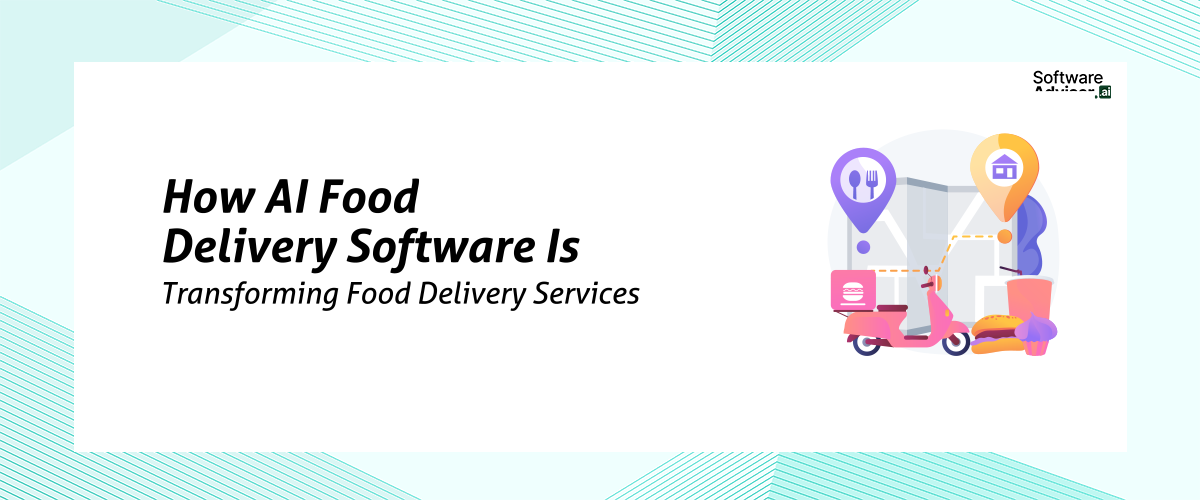
How AI Food Delivery Software Is Transforming Food Delivery Services
 David N. Wilks
The global demand for modern convenience has turned the simple act of ordering a meal into a massive digital pipeline. Today, standard food delivery networks handle billions of transactional orders every single day. To ensure that customers continue to buy from a business, staff must provide fast service and prepare orders correctly. Because of those requirements, regional restaurants and global cloud kitchens operate within a difficult environment. As fuel prices increase and the number of available couriers decreases suddenly, businesses find that manual methods to send out orders are no longer effective.

Looking for AI Food Delivery Software? Check out Softwareadvisor’s List of the Best AI Food Delivery Software in USA for Your Business.
By installing a modern food delivery software suite, operators can change their methods from responding to events after they happen to predicting logistical needs. If a business deploys the systems, it can match couriers to orders automatically and find the most efficient paths for travel as conditions change. On a financial level, this technology protects the small amount of money left after the business pays its expenses. With this upgrade, the process of managing many deliveries changes from a disorganized task into a reliable system that increases the size and earnings of the brand.
What is AI Food Delivery Software and Why Is It Gaining Popularity?
A modern food delivery app ecosystem powered by automated workflows represents a massive technical leap past legacy, rigid ordering scripts. Historically, early delivery platforms operated on simple database tracking: a customer placed a digital order, a kitchen worker clicked a button to accept it, and a basic dispatch alert pinged the closest available driver.
While this system removed the need for phone orders, it was entirely reactive. It could not handle sudden traffic jams, kitchen prep delays, or unexpected bad weather without causing long delivery wait times and cold meals.
Modern automated networks introduce intelligent decision-making right into daily operations. Instead of waiting for manual updates, these platforms continuously analyze live operational data, weigh kitchen prep speeds against driver transit tracking, and coordinate multi-step workflows independently.
For example, if a massive downpour suddenly slows down a local delivery hub, the platform doesn't just display a delayed status bar. It groups orders that are near each other immediately - at the same time, the software changes the schedule for food preparation so it aligns with when drivers arrive. And it provides updated arrival times to customers on their mobile devices without a person needing to help.
How Smart Automation Improves the Food Delivery Experience for Businesses and Customers
Modern restaurant operations require strict, precise execution across order entry, kitchen workflows, and final courier tracking. Integrating an intelligent delivery engine ensures data moves cleanly across the entire fulfillment lifecycle, removing operational blind spots.
Smarter Order Management
The initial phase of high-volume digital ordering involves intense administrative work that can quickly overwhelm busy kitchen staffs. Modern automated processing modules shorten this setup by acting as an intelligent processing layer. When an order drops, the platform instantly checks inventory levels across connected POS systems, coordinates kitchen routing, and schedules dispatch flows.
Simultaneously, predictive demand forecasting engines analyze local calendar events, active weather patterns, and past sales histories to predict exact ingredient needs. This step helps managers cut down on kitchen waste and prevent awkward menu out-of-stock notices before the busy rush begins.
Faster Deliveries
When a courier departs from the restaurant with an order, the goal of the logistics system is to lower the duration of the trip. For this purpose, large scale platforms use data about current traffic to update routes constantly. Instead of sending drivers down standard, congested roadways, navigation systems calculate alternate pathways on the fly to avoid sudden construction or traffic slowdowns.
This structural efficiency links directly with smart driver allocation systems. The software groups matching orders heading toward the same residential neighborhood into a single courier run. This smart grouping slashes total fuel spend and shortens delivery windows, keeping food fresh and customers happy.
Better Customer Experiences
Modern online ordering relies on personalized user interfaces to drive higher conversion rates. App dashboards automatically adapt their layouts to showcase menu options tailored to a user's past ordering preferences, local dietary choices, and current time of day.
This personalization extends right into customer service workflows. When a courier departs from the restaurant with an order, the goal of the logistics system is to lower the duration of the trip. For this purpose, large-scale platforms use data about current traffic to update routes constantly.
Improved Business Performance
The clear proof of a platform upgrade shows up directly on the company's balance sheet. Automating order and route assignments eliminates manual errors, allowing businesses to cut delivery costs and improve overall courier efficiency.
Also, the system directs data on customers’ interactions back to a central CRM database. Through this monitoring, operators gain deeper operational insights. Moreover, executives no longer have to guess the exact bottlenecks in workflows. Consequently, kitchen prep times are optimised. Finally, they develop growth strategies based on data with complete clarity.
Top 5 Food Delivery Software Solutions to Watch in 2026
Choosing a modern optimization and delivery toolkit requires matching your specific business structure with a vendor's technical capabilities. These five major market solutions lead the industry in embedding smart automation directly into daily food logistics.
1. SpotnEats
SpotnEats provides customizable or white-labeling solutions your new growing food delivery startup needs or an independent restaurant chain looking to offer their own branding.
- Core Capabilities: Automated courier dispatch loops, white-label app customization, and real-time fleet tracking maps.
- Best-Fit Business Type: Emerging regional delivery startups, franchise restaurant networks, and local courier fleets.
- Delivery Automation: Use different types of grouped order assignment rules for multi-stop drops by one driver.
- Customer Engagement: Customized in-app promotion engines that broadcast discount messages according to user location.
- Operational Insights: Consolidated management dashboards tracking driver performance score and restaurant payout total.
2. DoorDash
As a dominant player in consumer food delivery, DoorDash runs on massive analytical models that optimize millions of meal deliveries daily across massive urban centers.
- Core Capabilities: Highly accurate predictive fulfillment tracking, smart geographic zone batching, and dynamic merchant dashboards.
- Best-Fit Business Type: Independent local restaurants and national enterprise chains wanting access to a massive courier network.
- Delivery Automation: Smart proprietary matching algorithms that allocate orders based on driver vehicle types and current traffic.
- Customer Engagement: Highly customized store frontpages that recommend new menu additions based on deep historical user trends.
- Operational Insights: Entail deep operational analytics that break down exact customer acquisition costs, retention rates, and average delivery times.
3. Deliveroo
Deliveroo is the leader worldwide in high-density urban logistics, using deep algorithmic tracking for food distribution in Europe and Asia-Pacific.
- Core Capabilities: Capability to forecast network demand, manage rider supply in real-time, set up integrated cloud kitchens, etc.
- Best-Fit Business Type: The best-suited venture for high-volume inner-city restaurants, dark kitchens, and premium gourmet grocery sockets.
- Delivery Automation: Real-time route calculation models that alter drop paths based on active street-level pedestrian flows.
- Customer Engagement: Dynamic loyalty reward modules that incentivize repeat ordering through tailored subscription plans.
- Operational Insights: Live operational monitoring portals that allow restaurant partners to track exact kitchen prep times against driver arrivals.
4. Grubhub
Grubhub offers deep software integration options for campus environments and traditional corporate dining networks, focusing heavily on structured enterprise ordering.
- Core Capabilities: Centralized multi-brand orders aggregation, smart kitchen inventory management, and smart menu routing.
- Best-Fit Business Type: University campus Dining Services, corporate office Catering complexes, and traditional downtown Restaurants.
- Delivery Automation: Operators can coordinate their own drivers with third-party networks on a single screen, thanks to flexible hybrid dispatch rules.
- Customer Engagement: Target group ordering workflows that allow multiple corporate users to add items to a single shared checkout cart.
- Operational Insights: Detailed corporate compliance reports and tax tracking summaries built directly into backend merchant dashboards.
5. Faasos
Operating as a massive pioneer in the cloud kitchen space, Faasos uses a centralized technology model to run multiple virtual restaurant brands out of a single kitchen hub.
- Core Capabilities: Centralized multi-brand orders aggregation, smart kitchen inventory management, and smart menu routing.
- Best-Fit Business Type: Multi-bran cloud kitchen, virtual restaurant format, and centralized delivery hub.
- Delivery Automation: Unified courier management systems that allow single drivers to bundle orders from separate virtual brands at once.
- Customer Engagement: Personalized menu recommendations that cross-promote different food categories based on user histories.
- Operational Insights: Real-time ingredient tracking and automated stock alerts that prevent over-ordering across all virtual brands.
Emerging Trends Shaping the Future of Food Delivery
The connectedness of digital infrastructure will make the food delivery business follow privacy-free, automated systems to keep the speed without compromising data rights.
Predictive Delivery Scheduling
The management of restaurant logistics is shifting away from reactive, manual adjustments toward completely proactive order planning. Future scheduling models will run continuous background analytics to predict incoming restaurant volumes before customers even hit checkout. The system can ‘book’ area delivery drivers in advance, trigger ingredient prep notices and alter local promo pricing on auto, smoothing kitchen rushes, and defending delivery speeds before peak order times.
Voice-Powered Ordering Channels
On-site user interfaces are moving past traditional mobile app screens toward hands-free, natural voice interfaces. Customers can place detailed, highly customized family dinner orders using voice controls on their smart home speakers or connected car consoles. This no-touch ordering option provides delivery incentives for platforms to seize instant consumer demand for meal purchases during commutes or at home.
Hyper-Personalized Food Recommendations
The old approach of showing an identical homepage menu layout to every user in a city is disappearing. Advanced ordering frameworks link consumer profile data with real-time contextual tracking to build custom menus on the fly. This structural personalization ensures a fitness enthusiast views high-protein meal options after an afternoon workout, while family accounts see bundled dinner deals, maximizing order totals from every unique customer segment.
Autonomous Delivery and Smart Logistics
Delivery operations are testing innovative on-site hardware integrations to completely bypass urban traffic bottlenecks. Logistics networks are pairing smart dispatch platforms with sidewalk rovers and automated drone delivery lines for short-range drops. Using a trolley for small and quick delivery saves us on labor, pollution, and time.
Data Privacy and Ethical Considerations
Evolving data governance laws and user tracking limitations require a major shift in how delivery apps manage customer data. Modern architectures are moving away from invasive third-party tracking cookies, choosing secure, first-party consent data models instead. Processing delivery addresses and payment details through encrypted data silos ensures logistics brands maintain absolute operational tracking while respecting consumer privacy rights.
Conclusion
Food delivery software has come a long way from being just a simple online menu. As customers are expecting faster service, courier costs are increasing, and businesses are loosing money. Hospitality brands need to update their technology. Businesses that invest in integrated automated platform, optimized routing engines, and smart data-driven personalization will have an advantage of running efficient delivery services and making lots of profits.
FAQ's
It is an integrated digital platform that uses smart automation models to manage incoming orders, orchestrate kitchen prep times, and coordinate courier dispatch workflows.
It removes manual dispatch errors by analyzing live traffic data to calculate optimal delivery routes, group matching orders, and match drivers with nearby orders automatically.
These systems lower customers' wait time, lower the cost of operations, maximize driver earnings per hour, and track restaurants' demand.
Yes, smaller restaurants can deploy flexible, white-label software platforms or partner with global delivery networks to access enterprise-grade automation features without needing massive engineering budgets.
Industry leaders like SpotnEats, DoorDash, Deliveroo, Grubhub, and Faasos all feature advanced, automated routing, dispatching, and customer menu personalization tools.
Managing modern digital operations demands an efficient method to handle team alignment, track milestones, and keep information accessible. When moder [...]

Dokas mile
Small businesses get attacked more often than most owners assume. Verizon's data puts the number at nearly four times the rate of organizations with o [...]
David N. Wilks
Modern business environments demand fast automation, smart data processing, and highly secure digital structures. Relying entirely on costly public cl [...]