
What we'll cover
Share with your community!


Get Free Consultation
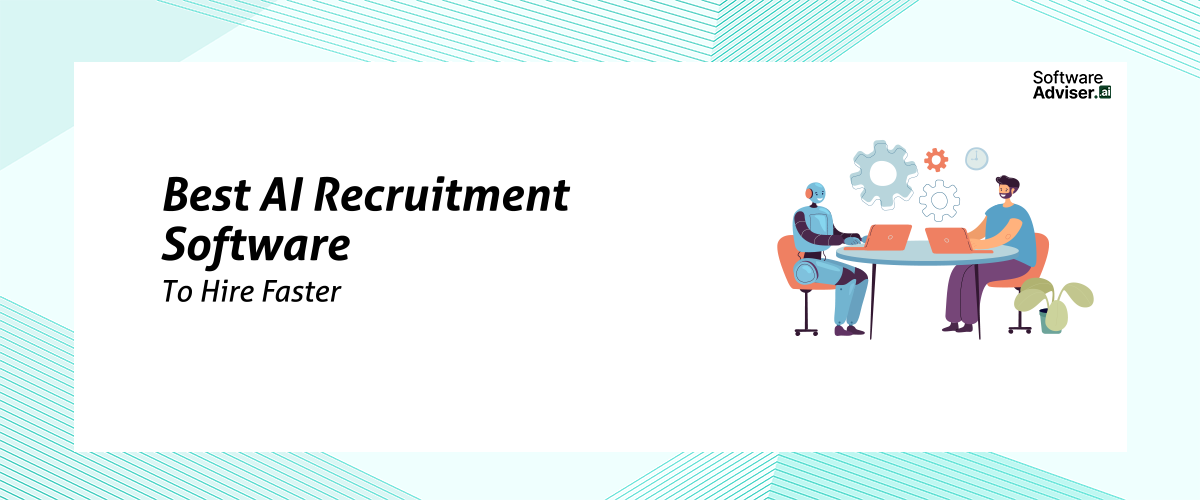
Best AI Recruitment Software to Hire Faster in 2026
 David N. Wilks
Post one job listing, and the applications can hit triple digits within a day. Sorting through that volume by hand was never realistic, and most recruiting teams gave up trying years ago. AI recruitment software exists specifically for this problem: the part of hiring that has scaled past what one person with a spreadsheet can manage on their own.

Looking for AI Recruiting Software? Check out software Adviser’s List of the Best AI Recruiting Software in the USA for your business.
This manual covers the quality AI recruiting tools to be had in 2026, what every platform does nicely, and the way to select based totally on where your hiring procedure is getting caught.
What AI Recruitment Software Actually Does
The honest version of this story is that AI doesn't replace recruiters. It removes the administrative weight that continues to keep recruiters from spending time on the part of the task that topics: speaking to people and making judgment calls. Think about where recruiter hours really go. A lot of it is reading resumes that were never going to go anywhere. A lot of it is sending scheduling emails back and forth until someone finds a slot that works. A lot of it is sourcing, reaching out to candidates who didn't apply because they weren't looking. Those aren't judgment calls. They're logistics, and AI handles logistics better than a person does.
The strongest AI hiring software shows its work. It tells a recruiter why a candidate scored where they did, not just what the score was. Look for that. A platform that hands back a number with no explanation is harder to trust, harder to defend when someone asks questions about a hiring decision, and impossible to improve because nobody knows what's actually driving it.
How We Evaluated These Platforms
Time-to-hire impact and screening accuracy drove most of the evaluation. Setup complexity mattered too, since a platform that takes six months to configure doesn't help anyone hire faster. Candidate experience quality counted, because an AI that frustrates applicants during screening isn't saving anyone time. And pricing transparency: a vendor that won't give a number until a sales call has been scheduled says something about how they work. Throughout all of it, the preference was strongly toward platforms that show their reasoning rather than handing back a score with no explanation attached.
Best AI Recruitment Software to Hire Faster in 2026
1. Greenhouse: Best for Structured, Scalable Hiring
Greenhouse built its AI features deliberately rather than rushing them out, and the result shows in how the pieces fit together. Upload a batch of mixed-quality resumes, and the filtering tool surfaces qualified candidates through keyword and skill matching that's accurate without needing constant retuning. The AI agent takes disjointed interviewer notes scribbled in a rush after a name and turns them into structured comments someone can use. Self-scheduling syncs at once with calendars, cutting the lower back-and-forth that used to devour whole mornings. None of this seemed overnight. The hiring framework running underneath all of this matters too. At a certain hiring scale, informal gut-feel processes break down. Consistency suffers. Fairness gets harder to demonstrate. Greenhouse addresses that structural problem, not just the speed one.
AI resume filtering, established interview kits, self-scheduling, and 500+ integrations are all included, with DEI-centered reporting built into the platform. Pricing requires a demo conversation. Mid-size to large companies scaling past informal hiring processes are the audience Greenhouse was built for.
2. Paradox: Best for Conversational Screening at Volume
The product itself is called Olivia, a conversational AI assistant that screens, schedules, and answers candidate questions through chat rather than a static form. The difference shows most sharply in retail, hospitality, and healthcare staffing, where a long application loses candidates before they finish it. At that volume and that dropout risk, conversational AI isn't a nice-to-have. It's the whole point. That said, a team filling five roles a quarter is probably looking at more tool than the situation calls for.
Core capability covers conversational AI screening, automated scheduling, candidate FAQ handling, and a mobile-first experience designed for candidates who aren't applying from a desktop. Pricing is custom, quoted based on hiring volume. The companies that get the most from this are running high-volume, repetitive hiring where candidate speed and engagement matter more than deep configuration.
3. HireVue: Best for Structured Video Assessment
Nobody has been doing AI video interviewing longer than HireVue, and the gap shows. Candidates record answers to questions on video. Responses get transcribed and scored. Game-based tests run totally along the interview, measuring how a person thinks through a hassle in place of simply what they say. Screening thousands of candidates that consistently, at that breadth, matters. What the platform asks for in return is setup time.
AI video interview evaluation, recreation-primarily based skills assessment, dependent scoring, and agency-scale throughput are all central to the platform. Enterprise pricing starts around $35,000 in keeping with yr. Large agencies jogging excessive-volume video interviewing who want steady, scalable evaluation are the target market this turned into built around.
4. Manatal: Best for Cost-Conscious Teams
Most of the platforms on this list price themselves out of reach for smaller teams, and Manatal exists specifically to close that gap. AI candidate scoring, social media enrichment, and solid search and filtering at $15 per user per month on the Professional plan is a different math entirely from the custom enterprise quotes everywhere else. Social enrichment pulls profile data automatically, advanced filtering narrows candidates without manual work, and both client and candidate portals come standard. The ceiling shows in enterprise reporting depth and back-office functionality, which won't match dedicated agency platforms. For small to mid-size recruiting teams and agencies that want capable AI without a six-figure annual commitment, that ceiling is usually nowhere near where work stops.
5. Workable: Best for Small Teams Wanting Simplicity
Ease of use was the explicit design priority here, not depth of AI capability, and for a smaller team without a dedicated recruiting operations person, that's exactly the right trade-off to make. Resume screening works with minimal setup. Job description generation runs without template expertise. Time-to-hire forecasting gives visibility without requiring someone to build custom dashboards. A hiring manager who's never touched an ATS can get through the platform without much onboarding.
AI resume screening, automated job ad generation, candidate sourcing, and time-to-hire analytics are all included. Plans start around $169 per month for small teams. Small to mid-sized companies wanting a practical, affordable ATS without the setup overhead are the core audience.
6. HireEZ: Best for Sourcing Passive Candidates
One problem, solved specifically. HireEZ doesn't try to cover the full funnel. It exists for sourcing, finding candidates who are not actively applying anywhere and wouldn't show up in a standard job posting. Over 750 million profiles indexed across more than 45 platforms give its AI matching a reach that in-house sourcing rarely touches. Outreach automation handles the follow-through. It works best sitting alongside an existing ATS rather than replacing one, since interviewing and offer management aren't part of what it does.
Core capability is AI-powered candidate search across that 750M+ profile database, cross-platform sourcing, and outreach automation. Pricing is custom based on team size. Recruiting teams with an ATS already in place that need stronger passive candidate sourcing are who this is for.
7. Ashby: Best for Data-Driven Recruiting Teams
Most recruiting platforms treat analytics as a secondary concern. Ashby treats it as the whole point. Pipeline health, conversion rates, and sourcing effectiveness are all visible inside the platform without exporting anything to a separate BI tool. The Ai workflow automation is there, candidate scoring is there, and integrated sourcing tools are there, but the reporting layer is what distinguishes the platform from competitors offering similar feature sets. Teams that want to make hiring decisions based on numbers rather than feel tend to find everything they're looking for in one place here.
AI-driven analytics, pipeline reporting, candidate scoring, and integrated sourcing tools are all core. Pricing is custom primarily based on crew length. Data-driven recruiting teams and hiring managers who need that analytical intensity constructed into the platform in preference to bolted on after the reality are the audience Ashby changed it to constructed for.
Quick Comparison Table
|
Tool |
Best For |
Starting Price |
|
Greenhouse |
Structured, scalable hiring |
Custom |
|
Paradox |
High-volume conversational screening |
Custom |
|
HireVue |
Structured video assessment |
$35,000/yr |
|
Manatal |
Cost-conscious teams |
$15/user/mo |
|
Workable |
Small teams wanting simplicity |
$169/mo |
|
HireEZ |
Sourcing passive candidates |
Custom |
|
Ashby |
Data-driven recruiting teams |
Custom |
How to Choose AI Recruitment Software for Your Team
Before any demo, name the specific thing slowing hiring down. Sourcing, screening, scheduling, and structured interviewing are different problems with different tools. The strongest setups usually combine two or three platforms rather than betting that one covers everything adequately. One platform rarely does.
One question worth asking every vendor: what does the AI show you when it scores a candidate? Not just the number. The reasoning behind it. Why this person, at this score, based on what signals? Without that visibility, the score is hard to trust. Hard to defend when someone asks about a decision. And when something goes wrong, there's nothing to adjust because nobody knows what drove the output in the first place.
Vendor demos run under ideal conditions. Your hiring data is messier than anything in a sales presentation. Before signing, ask for a proof-of-concept on a real sample of your own job descriptions and actual applicant files. That test is the real evaluation. Most platform disappointments don't show up during the demo. They show up after the contract is signed.
Conclusion
Wanting structure that holds up at scale? Greenhouse remains the strongest overall pick for mid-size to large companies. High-volume, repetitive hiring is where Paradox's conversational approach earns its place instead. For enterprises running serious video interview volume, HireVue justifies its price tag despite the setup investment. Budget-conscious teams will get more AI capability per dollar out of Manatal than anywhere else on this list, while very small teams that want simplicity over depth should start with Workable. If sourcing passive candidates is the specific bottleneck, that's HireEZ's whole reason for existing. And teams that want every recruiting decision backed by clear numbers rather than gut feel will find that combination in Ashby. The best AI recruitment software to hire faster isn't the one with the most features. It's the one that fixes whatever is slowing your hiring process down right now.

The manner people plan their private vacations and employer journeys goes thru a big trade right now. Nobody wants to spend hours searching through in [...]
David N. Wilks
US property groups face a constant struggle tracking endless lease renewals, multi-state commercial buys, and complex vendor disclosures. For years, r [...]
David N. Wilks
In 2026, the uncertain US labor market wants more than basic spreadsheets. It expects predictive velocity. And as organizations transition from tradit [...]