
What we'll cover
Share with your community!


Get Free Consultation
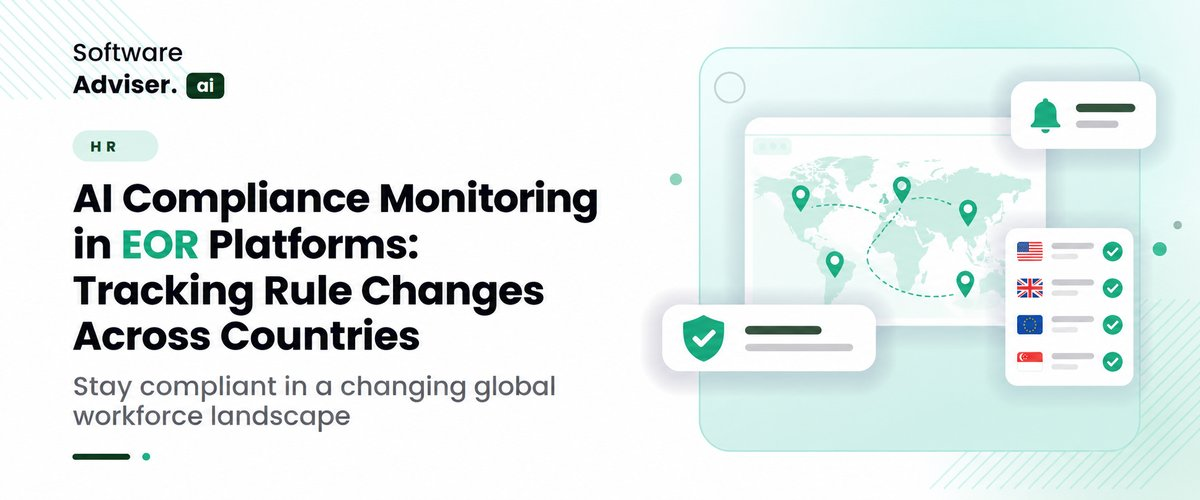
AI Compliance Monitoring in EOR Platforms: Tracking Rule Changes Across Countries
 Dokas mile
With the rapid growth of contingent workforces in many US multinational companies, managing local labor laws across numerous global jurisdictions has created an operational burden. Contemporary Employer of Record (EOR) platforms tackle the issue through their built-in compliance monitoring system, which utilizes AI to monitor global legal databases, laws gazettes, and tax changes in real time. Using machine learning to interpret cross-border regulations, these platforms allow US HR and legal departments to accommodate international payroll systems and avoid costly penalties for non-compliance from any of the jurisdictions involved.
How does AI Track Global Labor Law changes for US Platforms?
The AI keeps up with labor law developments across the world by employing the use of NLP technology with automated policy processors. AI employee monitoring US regulations the program utilizes specialized web data scrapers and direct application of programming interfaces, which check amendments in many local regulations such as government regulations, regulatory webpages, government tax laws, and others. After machine learning algorithms process the above-discussed laws, it transforms the local laws into structured data formats, putting regulatory changes into classes according to the law and determining the significance of the changes for international companies.
After the modifications are successfully analyzed, the AI puts these changes into the platform’s workflows. Therefore, the system generates the necessary contracts, prepares updated payrolls, and alerts HR departments about possible violations. However, the most reliable systems use both MI technology and human labor: the program signals of upcoming changes, and then experts check them in detail to implement the ideas mentioned above.
Do you know?
They review changes to the job rules in multiple systems. They pull details from each site. As new items appear, they ingest the latest feeds. They also scan for new public notices and tax forms when updates come in. Next, the tool cuts the material into smaller sections. It marks anything that is new. It also shows which lines were changed compared with the earlier version. After that, the platform refreshes the contract terms, the pay terms, and the steps tied to compliance. They try to reduce errors too. A quick check runs first on its own. After that, the legal group reads the key parts before a major release goes live.
Why is Manual International Rule Tracking Risky for US Businesses?
In the context of manual international regulatory AI sales tracking, US companies must keep up with hundreds of labor law amendments, local tax rules, and employment regulations across various jurisdictions. By relying on spreadsheets and manual labor, companies can miss crucial changes in legislation, such as changes in local minimum wage regulations, mandatory leaves, and new severance regulations.
If American companies do not comply with new local employment laws, they face different financial and legal consequences. Moreover, high fines are levied by international regulatory bodies for not following applicable employment regulations. Aside from these fines, misinterpretation of local independent contractor regulations leads to wrongful classification of employees and costly lawsuits.
Aside from the immediate fines incurred, the manual handling of compliance significantly hinders operational efficiency and damages the corporate image. The human resources and legal department ends up wasting a lot of time looking for localized legal consults instead of working on international business expansion strategies. A single public compliance failure in a prominent market can ruin the employer image and undermine trust in a US company.
How does AI detect real-time regulatory updates Across Countries?
- Automated Processing: Specific bots constantly retrieve texts from global legal information sources.
- Natural Language Processing: The advanced NLP model is able to translate non-English legal updates at once into normalized legal text.
- Document Analysis and Classification: ML models classify a legal text into the AI HR analytics field, such as tax, overtime, and minimum wage.
- Semantic Processing: AI technology enables reading the new law against the existing labor regulations in order to see if this update is a new legal norm, an amendment to the previous one, or a replacement of the previous legislation.
- Regulatory Impact Mapping: The algorithm maps legislative changes to current employee contracts, payroll systems, and benefits.
- Automated Risk Scoring: The system determines a risk score based on factors such as the deadline of the update, the gravity of penalties, and the geography impacted by the non-compliance.
- Instant Notification Deployment: AI automatically dispatches dashboard notifications and updates the systems of HR and legal departments in the U.S. for compliance review before the non-compliance takes place.
How does AI update Contract and Payroll Workflows in EOR Software?
- Automated Contract Clause Injection: AI receives information on changes in laws and updates the local contracts automatically, inserting clauses such as new terms of severance and PTO requirements.
- Real-Time Tax Engine Updates: With local tax rates changing, the system automatically revises gross-to-net payroll formulas.
- Dynamic Benefits & Deductions Recalibration: Statutory pension contributions, health insurance specifications, and territories of social security regulation are brought up to date for universal implementation.
- Automated Misclassification Safeguards: Algorithms evaluate the functions of the employees and their payments constantly by making the required changes in the templates of contracts for workers to be properly categorized.
- Instant Addendum Generation: The system automatically creates addenda to comply with the regulations of the country when it passes legislation concerning labor.
- Pre-Payroll Audit Rules: The AI checks payment runs against the laws of the country before payments are made, revealing violations of overtime limits and underpayment for people in HR to analyze.
How does Automated Tracking prevent Costly cross-border Compliance Penalties?
- Prevention of Worker Misclassification: Automatic audits allow the continuous checking of contractor status against the applicable legislation to avoid fines and back payments due to sham contracting.
- Prevention of Permanent Establishment Risk: The algorithms monitor the locations of employees and sales activities to inform US businesses ahead of time about possible tax obligations resulting from their activities abroad.
- Prevention of Hour and Wage Violations: Systems contrast present-day wage increases with working hour limits to guarantee compliant AI payroll processing.
- Prevention of Incorrect Statutory Deductions: Automated engines provide recalculation of the contributions to social security, taxation, and obligatory bonuses necessary to create payment processing without interest penalties or taxation fines.
- Prevention of Delay Penalties: Real-time monitoring of the deadlines ensures timely submission of the mandatory employee tax registration, social security payments, and local authorities’ reports.
- Guarantees Compliant Dismissals: Automated compliance is responsible for undertaking standard compensation for dismissals, notification processes, and warning periods to prevent expensive cross-border wrongful dismissal lawsuits.
What are the main Accuracy and Privacy limits of Compliance AI?
- Hallucinations and Context Blindness: Artificial intelligence (AI) models may fail to accurately interpret technical terms of law and ignore local judicial precedents, or provide false definitions of terms in the process of reading complicated international labor law.
- Delay in Local Law Indexing: Government databases in underdeveloped countries may not be presented in a digital form, which makes artificial intelligence programs unable to furnish information regarding recent and non-digitized legislative acts.
- Violations of International Data Transfer Regulations: Programs that work with data might be breaching international privacy regulations such as GDPR or HIPAA if information about foreign workers is not localized.
- Overuse of Predictive Risk Models: AI-powered models that conduct risk scoring might not clearly interpret uncertain labor regulations and provide false readings when related to the process of worker misclassification or defining tax liabilities.
- Biased Training Data: Generative AI technologies trained on legal databases can suggest outdated labor practices merely reflecting biases that were present in the historical enforcement of labor laws.
- Data Privacy and Leak Issues: Confidential contracts, wage data of employees, and unique company policy documents revealed to AI systems may be subject to unauthorized access or breaches of privacy.
- Absence of Accountability: The courts cannot hold artificial intelligence systems accountable for their mistakes, and any responsibility for noncompliance lies with the employer or the EOR service provider.

Pro-tip
In order to address the issues of AI privacy vulnerabilities and latency related to indexing, you should implement a model of a human-in-the-loop approach in which human attorneys will confirm each algorithm flag before launching it on your platform. Also, use only localized enterprise AI tools with strict data governance to keep confidential employee data foolproof, so that it will not breach international regulations like GDPR. Lastly, use AI mainly for real-time risk detection and retain complete internal responsibility for auditing AI-generated payroll and contract modifications.
Conclusion
As worldwide labor regulations become more complicated, AI-based compliance monitoring has transitioned from being an option for growing US companies to a fundamental aspect of business activity. This form of automation facilitates companies with necessary regulatory monitoring, allowing them to grow and operate without heavy penalties, legal liability, and the risk of misclassification. However, when selecting software that will help manage your distributed cross-border teams, you have to pay attention to its features, integrations, and coverage in terms of regulations. In case you need help choosing the right software for your expansion needs, visit softwareadviser.ai to compare various options on the market.
FAQ's
AI uses automated scrapers, APIs, and NLP to monitor global government registries, tax databases, and official gazettes continuously.
Yes, AI feeds statutory changes directly into EOR platforms to adjust tax formulas, benefits, and contract templates dynamically.
It continuously evaluates worker duties against local employment definitions to ensure compliant classification and prevent back-pay fines.
No, AI should be combined with human legal experts who verify algorithmic flags before system-wide policy updates are applied.
Processing employee contracts and wage data through AI tools can trigger GDPR violations or leaks if strict data-localization protocols are missing.
Enterprises are dealing with a quiet crisis of margins. Running a enterprise has in reality grow to be too steeply-priced, and traditional cost-reduci [...]
Dokas mile
We have passed over the threshold into AI driven IT project management changing the way technical teams ship software and manage infrastructure, movin [...]

David N. Wilks
Most sales teams are sitting on a problem they've normalized. The rep who spends twenty minutes after every call reconstructing notes before they forg [...]