
What we'll cover
Share with your community!


Get Free Consultation
AI in CRM in 2026: The Future of Customer Relationships
 David N. Wilks
Most sales teams are sitting on a problem they've normalized. The rep who spends twenty minutes after every call reconstructing notes before they forget. The lead that scored high because the title and company size looked right and still hasn't moved in six weeks. The customer went quiet two months ago and nobody followed up because there were forty other accounts demanding attention at the same time. These aren't edge cases. They're Tuesday.

Looking for AI CRM software? Check out Software Adviser’s List of the Best AI CRM Software in USA for your business.
AI in CRM refers to the use of artificial intelligence technologies such as machine learning, predictive analytics, and natural language processing within customer relationship management systems. In 2026, AI is helping businesses automate workflows, personalize customer interactions, and make smarter sales decisions at scale.
That's the formal definition. Here's what it actually means: ai in crm is the difference between a system that holds information and one that does something with it.
What Is AI in CRM?
There's a version of CRM that most people have experienced a place to log activity, store contact details, and run reports when leadership asks for them. Useful. But passive. The system doesn't care whether a deal is healthy or dying. It doesn't notice when a customer is about to leave. It just records whatever gets entered into it, accurately and without judgment.
Artificial intelligence in crm adds judgment. Not human judgment, but pattern recognition at a scale no human can match. What is ai in crm doing, specifically? It's watching how your customers and prospects behave, comparing those patterns to thousands of historical interactions, and surfacing the signals that matter. Which accounts are drifting. Which deals are softer than they look. Which leads are actually ready for a conversation versus which ones just downloaded something because it was free.
Crm and ai working together shifts the tool from passive record to active advisor. That's not a small change it changes what salespeople and account managers do with their time.
How AI Is Transforming CRM in 2026
Predictive Analytics
Quarter-end surprises are almost a rite of passage in B2B sales. Deals that were committed get pushed. Deals that nobody mentioned close unexpectedly. And the forecast that looked reasonable three weeks ago turns out to be fiction. Sales leadership has been tolerating this for years because there wasn't a better option.
Predictive analytics in ai powered crm gives the forecast a foundation in behavioral evidence rather than rep confidence. The model has seen what healthy deals look like versus stalling ones. When it flags a deal as risky, it's usually onto something consistently enough to change how managers allocate their attention.
AI-Powered Personalization
Send the same email to a thousand people and some percentage will respond. That's been the math behind mass outreach for years volume compensates for irrelevance. The problem is the math is getting worse. Inboxes are more crowded, attention is scarcer, and the bar for what makes someone stop scrolling has risen significantly.
Ai customer relationship management changes the equation not by sending fewer emails but by making each one actually relevant. An ai powered crm generates outreach from a prospect's role, their company's recent activity, their behavior on your site, and their position in the buying process. Sequences adapt to what each person actually does. What arrives feels tailored because it is.
Automated Lead Scoring
Most lead scoring systems measure what's easy to measure job title, company size, form fills. Proxies for buying intent, not evidence of it. Sales teams following high-scoring leads built on bad proxies end up frustrated when the numbers don't convert.
Crm ai automation builds scoring from behavioral evidence instead. The model learns from what buyers who actually converted did how they engaged, which patterns preceded closed deals. Leads score high because the data says they're behaving like buyers, and the practical effect on how reps spend their week is real.
Chatbots & Conversational AI
Customers don't wait for business hours. That's been true for years in B2C and is increasingly true in B2B as well. What they will wait for briefly is a fast, useful response. What they won't tolerate is a bot that sends them to the FAQ page for the fourth time.
Conversational AI through ai crm integration handles inbound volume in a way that's actually useful rather than just technically present. It qualifies leads, answers product questions with access to real account information, routes complex troubles to the right person with context attached, and captures everything automatically. The hole among a bot that attracts from real purchaser records and one that matches key phrases to canned responses is visible immediately in verbal exchange best, in resolution rates, and in how clients feel approximately about the emblem afterward.
Key Benefits of AI in CRM
Improved Customer Retention
The uncomfortable truth about most churn is that it wasn't a surprise to the customer. They'd been drifting for weeks using the product less, ignoring emails, submitting more support tickets with less patience. The signals were there. The vendor just wasn't watching.
Ai for crm makes watching scalable. Predictive churn models score every account continuously against patterns that historically precede cancellations the specific combination of signals that, when they show up together, mean trouble is coming. Account managers get notified before the customer reaches a decision point rather than after. The teams seeing meaningful retention improvements aren't using this to save customers who've already decided to leave. They're catching the drift before it becomes a decision.
Faster Sales Cycles
It's the small moments that slow a sales cycle down reconstructing context before a call, tasks that didn't get created, follow-ups that slipped a few days because something else came up. Crm ai automation removes most of that friction. Notes generated from calls. Follow-up tasks created from what was actually committed to. Next best actions waiting when the rep opens their day. Compounded across dozens of active deals, it changes how fast things move.
Smarter Decision Making
Artificial intelligence and crm working together give sales leadership a pipeline view that isn't downstream of how optimistic people are feeling this week. AI-generated deal scores reflect the data not the rep's belief, not the manager's hope. Forecasts get more grounded. Coaching gets more targeted. The managers getting the most value aren't replacing instinct with AI output they're using AI signals to ask better questions.
Top AI CRM Tools in 2026
- Salesforce Einstein is the enterprise standard predictive scoring, generative AI for emails and summaries, deep workflow automation, all running inside the platform most large sales organizations are already using. For Salesforce teams, ai crm integration isn't a migration. It's an activation.
- HubSpot AI brings ai powered crm within reach for mid-market teams without enterprise pricing or implementation timelines. AI email generation, behavioral lead scoring, chatbot automation, and content recommendations in an interface that non-specialists can actually configure and maintain.
- Zoho CRM with Zia is the most accessible entry point for smaller businesses. Forecasting, anomaly detection, and crm ai automation at a price point that makes artificial intelligence in crm practical for teams that can't justify larger platforms.
- Microsoft Dynamics 365 Copilot is the obvious choice for organizations running on Microsoft infrastructure. Meeting summaries, follow-up drafts, next best actions and native ai crm integration that doesn't require managing an external connector layer.
- Pipedrive AI focuses on what SMB sales teams actually need: pipeline scoring and activity recommendations without the overhead of platforms built for organizations ten times the size.
AI CRM Use Cases by Industry
Different industries are using ai crm in ways that show how flexible the underlying capability is.
Retail and e-commerce use it for personalized recommendations and churn prediction based on purchase patterns. Financial services firms run ai customer relationship management models to identify optimal timing for upsell conversations based on life events. Healthcare uses ai crm integration to flag patients disengaging from care plans before treatment gaps become clinical problems. SaaS companies run artificial intelligence and crm together to surface conversion-ready free users and approaching-churn accounts before any explicit signal arrives. Real estate uses crm and ai to match buyer behavior to inventory and automate follow-up that previously required constant manual coordination.
The common thread across all of them isn't the technology it's using data that was already there to do something that wasn't being done before.
Challenges of Implementing AI in CRM
The data problem is usually worse than expected: Most CRM databases have accumulated years of incomplete records, inconsistent field usage, and duplicate contacts that nobody cleaned up because cleaning CRM data is nobody's exciting project. AI models trained on that data learn the wrong patterns. This isn't a reason not to deploy ai in crm it's a reason to fix the data first, which most implementations underestimate the time required for.
Teams need to trust the outputs to act on them: A lead scoring model that reps don't understand is a lead scoring model reps ignore. The implementations that achieve real adoption invest in explaining the logic why this lead scored high, what signals the model is reading, what would change the score. Transparency earns trust. Opacity produces workarounds.
Integration scope expands quickly: Starting with ai for crm inside the CRM itself is straightforward. The AI becomes considerably more accurate when it pulls signals from marketing automation, billing data, support history, and product usage. Each additional data source adds integration work, and the scope of that work compounds in ways that initial project estimates rarely capture.
Compliance has to come first: Using customer behavioral data to train predictive models has regulatory implications under GDPR, CCPA, and other frameworks. What data can be used, how long it can be retained, how customers can request changes these aren't things to figure out after deployment. Getting clear on them before the work starts is just the professional approach.
Future Trends of AI in CRM
- The direction is toward less human involvement in execution and more in judgment which is arguably how it should have been distributed all along.
- The next version of ai in crm executes rather than recommends. Follow-ups get sent. Meetings get booked. Records get updated. Humans review and correct rather than initiate and do.
- Real-time personalization becomes a baseline rather than a differentiator. As AI customer relationship management matures, generic outreach stops being unremarkable and starts signaling that a company doesn't know its customers.
- Voice AI closes the logging gap call notes from the conversation itself, commitments flagged in real time, and documentation that appears without anyone writing it up.
- Tighter CRM and ai integration across sales, marketing, and customer success reduces the handoff friction where deals and relationships currently fall sideways between teams.
Conclusion
AI in CRM isn't the future of customer relationships. It's the present of customer relationships for the teams that have figured out how to use it. The gap between those teams and the ones still working the same way they did in 2020 shows up in retention rates, close rates, and forecast accuracy, and it's growing. The entry point is accessible. The real work is in the conditions: clean data, team adoption, and processes that turn AI signals into actual decisions and actions. Organizations that get those three things right don't just use crm and AI better. They build customer relationships that are more consistent, more responsive, and harder for competitors to displace. Artificial intelligence in crm, used properly, isn't about replacing what makes those relationships work. It's about giving them the attention they actually deserve.
FAQ's
AI in CRM uses artificial intelligence to automate workflows, predict customer behavior, and personalize customer interactions.
AI is improving CRM with predictive analytics, automated lead scoring, personalized outreach, and intelligent customer support.
Salesforce Einstein, HubSpot AI, Zoho CRM with Zia, Microsoft Dynamics 365 Copilot, and Pipedrive AI are leading AI-powered CRM platforms.
Yes, AI identifies churn risks early and helps businesses engage customers before they leave.
Yes, many AI CRM solutions offer affordable plans and easy-to-use features designed for small and growing businesses.
Step into almost any office floor today, and you will catch teams scrambling to get new software tools up and running to drop their daily workloads. Y [...]

Dokas mile
Putting an Artificial Intelligence AI Employee Assistance Program (EAP) into a workplace can, like, really modernize the way your organization support [...]
Dokas mile
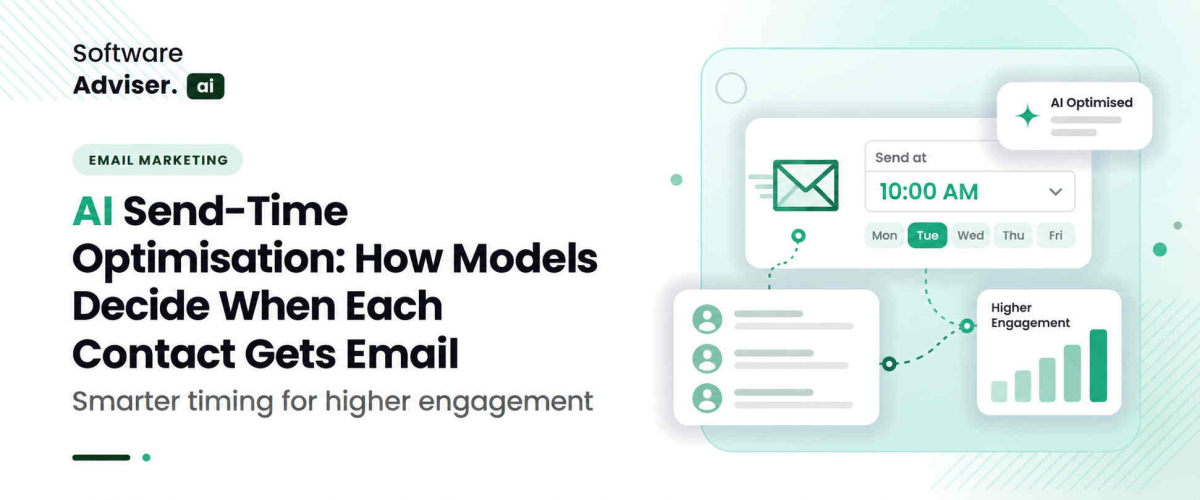
Artificial intelligence’s send-time optimization (STO) makes use of established machine learning systems to turn email distribution from a generaliz [...]