
What we'll cover
Share with your community!


Get Free Consultation
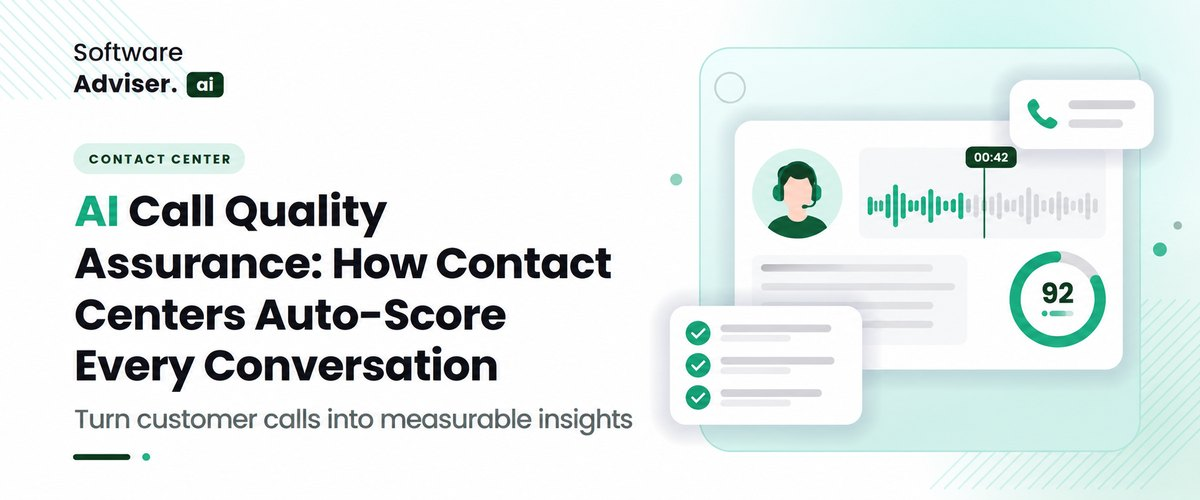
AI Call Quality Assurance: How Contact Centers Auto-Score Every Conversation
 Dokas mile
A quality analyst at a mid-sized contact center might review only a handful of calls per agent each month. The rest, including the ones where a customer was mishandled or a required disclosure was skipped, go unheard. AI call quality assurance changes that math. It transcribes every call, scores each one against the same criteria a human reviewer would use, and flags the conversations that need attention.How auto-scoring works, which data feeds it, how it connects to AI call center software, and where it still falls short in everyday practice. It also covers the US privacy and compliance rules that shape deployment, along with the key questions worth asking vendors before committing to a purchase decision.
Key Takeaways
- Auto-scoring evaluates every recorded conversation against a defined scorecard instead of a small manual sample.
- Scores are only as reliable as the scorecard behind them, so criteria must be specific and tested.
- Recording consent, payment data, and health information create compliance obligations that vary by state and industry.
- The best results come when scores feed coaching and process fixes, not just reports.
What AI Call Quality Assurance Means
Traditional quality assurance relies on sampling. A reviewer pulls a few recordings per agent, listens, and fills out a form. The method works for coaching, but a few calls rarely represent thousands.
AI call quality assurance replaces sampling with coverage. Software processes every call or chat transcript, applies a scorecard, and produces a score along with the evidence behind it.
This does not remove people from the process. Analysts still design the scorecard, review disputed scores, and decide what the results mean for coaching. The software handles the volume, and humans handle the judgment.
How Auto-Scoring Works
Most platforms follow a similar sequence, even when vendors describe it differently.
Step One: Transcription and Speaker Separation
Speech recognition converts audio into text and separates the agent from the customer. Accuracy depends on audio quality, accents, background noise, and industry vocabulary. A system trained on general speech may stumble over product names or insurance terms, so many vendors allow custom vocabularies.
Step Two: Detecting Behaviors and Signals
Language models and rule-based detectors then look for specific behaviors. Did the agent verify the caller's identity? Was the required disclosure read? Did the customer express frustration, and did the agent acknowledge it? Some systems also measure silence, interruptions, and hold time.
Sentiment analysis tracks how the customer's tone shifts during the call.
Step Three: Applying the Scorecard
Each detected behavior maps to a line on the scorecard, and the weighted total becomes the call score. Some items are pass or fail, such as a mandatory legal statement. Others are graded, such as empathy or clarity. Good platforms link each score to the exact moment in the transcript.
Step Four: Routing and Follow-Up
Low scores, compliance misses, and unusual sentiment patterns are routed to supervisors. Where a platform connects to AI workflow automation software, a failed compliance check can create a ticket, notify a manager, or add a coaching task automatically.
Where the Scoring Data Comes From
The call recording is only one input. Accurate scoring improves when the platform can see context from other systems.
Dialer and routing data show queue, campaign, and handle time. Records from AI call tracking software add the source of the call, such as a specific ad or landing page, which helps teams judge whether quality problems appear on certain channels. CRM records show the customer's history and the outcome of the interaction, including whether the issue was resolved or the sale closed.
Without that context, a score can mislead. An agent handling the angriest callers in a queue may receive lower sentiment results through no fault of their own. Segmenting results by call type, queue, and customer tier prevents unfair comparisons, and campaign tags from AI call tracking software make that easier.

Pro-tip
Before launching, ask two experienced reviewers to score the same 20 calls independently. If they disagree often, the scorecard needs clearer criteria. Fixing that first will improve any platform you choose.
How It Fits Within the Wider Contact Center Stack
Auto-scoring rarely operates alone. It sits inside a broader group of tools, and buyers often need to know which parts they already own.
AI call center software is the umbrella category. It typically covers routing, call handling, transcription, analytics, and agent assistance, with quality assurance as one module or a separate product.
AI voice assistants handle some calls before a human ever picks up. Those calls can be scored too, which matters because a poorly designed assistant can frustrate customers before they reach an agent. Enterprise AI chatbots software does the same on the text side, and the same scorecard logic can be applied to chat transcripts.
AI workforce management software handles forecasting and scheduling. Quality data adds a useful layer: if scores drop on a certain shift or during peak volume, it may point to understaffing rather than a training problem. AI employee performance software pulls call scores together with other metrics, such as attendance and productivity, to give supervisors a fuller picture of each agent.
For sales-focused teams, AI sales engagement software tracks outreach sequences, and its call data can be scored for discovery questions or objection handling. AI sales management software then rolls those results into pipeline and forecast reviews. At the top of the stack, AI business management software connects operational results, such as customer satisfaction and resolution rates, with finance and planning.
A Realistic Example
Consider a US insurance contact center with about 200 agents handling claims and billing questions. Supervisors manually review a few calls per agent each month, and compliance gaps tend to surface only after a customer complaint.
After adding auto-scoring, the team builds a scorecard with eight items, including identity verification, a required recording notice, a clear explanation of next steps, and empathy markers. In the first month, the system flags that the recording notice is skipped far more often on transferred calls than on direct ones. The cause turns out to be a gap in the transfer script, not individual agent behavior.
A manual sample might have missed that pattern entirely. Fixing the script solves the problem for everyone at once. This scenario is illustrative, not a measured result, but it reflects the kind of process-level insight that coverage makes possible.
Limitations and When It May Not Fit
Auto-scoring is not equally useful everywhere. A small team handling a modest call volume can often review conversations directly, and the cost of a platform may not be justified.
Accuracy limits matter too. Calls handled by AI voice assistants add another wrinkle, since scripted bot speech needs different criteria than human conversation. Sarcasm, regional dialects, overlapping speech, and poor line quality can all cause errors. Sentiment models in particular can misread tone, so a score should prompt a review rather than serve as a final verdict on an agent.
Another limit involves the scorecard itself. A vague criterion such as "showed professionalism" produces inconsistent results from software and humans alike. Teams get better outcomes by breaking it into observable behaviors, such as greeting the caller by name or confirming the next step before ending the call.
Finally, there is the human side. Sharing the scorecard in advance and letting agents see their own scored calls tends to build trust.
Compliance and Privacy for US Contact Centers
Recording and analyzing calls triggers several legal considerations, and they differ by state and industry.
Call recording consent is the first. Federal law allows recording with the consent of one party, but a number of states require consent from every party to the call. Contact centers that serve customers across states often adopt the stricter standard and play a recording notice at the start of every call.
Payment data is the second. Organizations that handle card numbers must follow the Payment Card Industry Data Security Standard, which restricts how card data can be stored. Many platforms offer automatic redaction of card numbers in recordings and transcripts, and buyers should confirm it works as described.
Health information is the third. Providers and their business associates handling protected health information fall under HIPAA, which requires specific safeguards and agreements with vendors.
Automated calling adds another layer. The Federal Communications Commission has ruled that the Telephone Consumer Protection Act applies to AI-generated voices in calls, which affects outbound campaigns that use synthetic speech. Requirements continue to change, so legal review before deployment is a sensible step.
How to Evaluate a Platform
A polished demo built on clean audio says little about real-world performance. These questions help separate platforms:
- How accurate is transcription on our own recordings, including accents and industry terms?
- Can we build and edit scorecards ourselves, and can we test them against human scores?
- Does each score link back to the exact moment in the call?
- Which phone systems, CRMs, and AI call tracking software does it integrate with?
- Can scores flow into AI workforce management software and AI employee performance software, and can failed checks trigger tasks through AI workflow automation software?
- How does it handle redaction, data retention, and access controls?
- Is pricing based on minutes, seats, or conversations, and what does implementation include?
The most useful test is calibration. Take 50 calls that experienced reviewers have already scored, run them through the platform, and compare results. Large gaps in specific scorecard items reveal where the model or the criteria need work.
Do You Know?
The biggest quality problems often sit in processes, such as transfers and handoff scripts, rather than in individual agents, which is hard to see in a small sample.
Common Implementation Mistakes
The most frequent error is automating a weak scorecard. If the criteria were poorly defined for manual review, automation only produces bad scores faster. Rewrite the form first.
Another mistake is treating scores as the goal. Teams sometimes publish leaderboards and push agents to chase numbers, which encourages scripted, stiff conversations. Scores work better as coaching inputs, paired with a review of the calls behind them.
Many teams also forget to close the loop. Findings should reach the people who can act on them: trainers, workflow owners, and managers. Connecting results to AI workflow automation software helps here, since a flagged issue can trigger a task instead of waiting in a report. Feeding the data into AI workforce management software and AI employee performance software gives planners and supervisors the same view.
Lastly, avoid overpromising; telling agents a machine now judges every call breeds resentment. Describing it as a way to find coaching opportunities and fix broken processes sets a fairer expectation.
Conclusion
AI call quality assurance gives contact centers visibility that manual sampling never could, but the value depends on the quality of the scorecard, the integrity of the data, and what the organization does with the findings. Teams considering a purchase should map the tool against their existing AI call center software, check how it connects with AI sales engagement software, AI sales management software, and AI business management software where relevant, and plan how Enterprise AI chatbots software and voice channels will be covered. Begin with a calibration pilot, keep humans responsible for coaching decisions, and measure outcomes such as resolution rates and compliance misses, not just average scores.
FAQ's
Most platforms are built to score every recorded call or transcript. The practical limit is recording coverage and transcription quality, not the number of calls.
No. Analysts still build the scorecard, review disputed results, and guide coaching. The software removes the manual sampling work.
Accuracy varies by audio quality, scorecard design, and vendor. Calibrating against human-scored calls is the most reliable way to judge it.
Often yes. Calls managed by AI voice assistants and chats handled by Enterprise AI chatbots software can be scored with similar criteria, although the scorecard usually needs adjusting for automated interactions.
Yes, for behaviors such as discovery questions and objection handling. Results can connect to AI sales engagement software, AI sales management software, and AI business management software to link conversation quality with revenue outcomes.

Using artificial intelligence in your business without clear boundaries can create serious legal exposure faster than most companies expect. Across th [...]

David N. Wilks

Small business owners in America often have only one way to manage their cash flow - by sending invoices out the door. As their businesses grow, howev [...]
David N. Wilks

If you've ever gone into a Target, scrolled through Sephora's app, or waited for a delivery from Amazon, then you have noticed an under-the-radar majo [...]