
What we'll cover
Share with your community!


Get Free Consultation
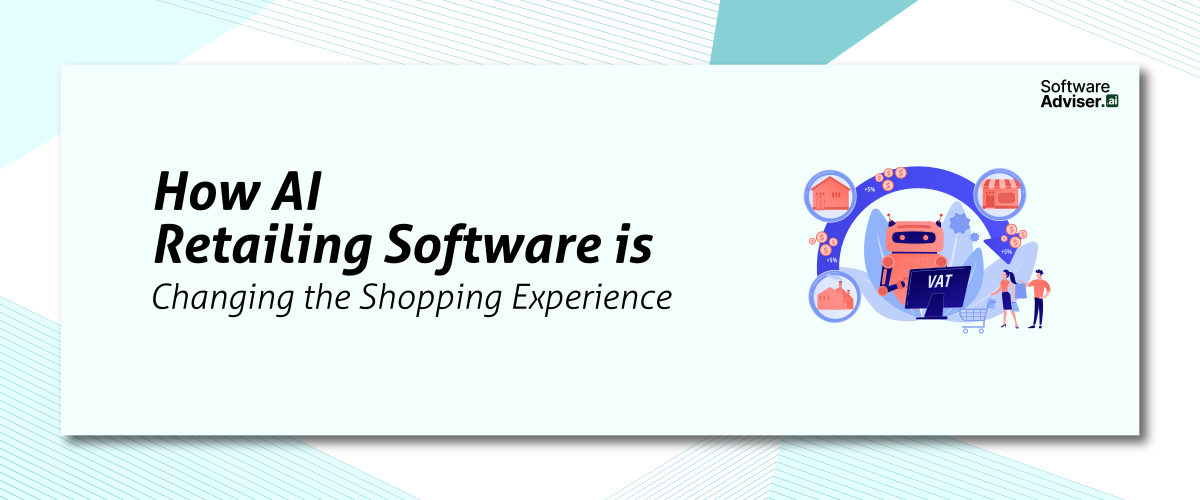
How AI Retailing Software is Changing the Shopping Experience
 David N. Wilks
If you've ever gone into a Target, scrolled through Sephora's app, or waited for a delivery from Amazon, then you have noticed an under-the-radar major transformation of how we shop here in the U.S. Previously, shopping meant wandering through brightly lit aisles, desperately trying to find your size on the shelves or scrolling endlessly through e-commerce pages with items you will likely never buy. Now, thanks to artificial intelligence (AI) based technology, retail is changing for the good. Shopping has transcended simply being a monetary exchange between buyer and seller; retailers can identify trends and consider each customer’s tastes to provide more tailored, personalized product recommendations, as well as anticipate future customer needs, so they have product in stock and can offer hyper-personalized automation tracking of each customer's shopping habits and provide an accurate count to the manufacturer for retailers who use this technology.
What is AI Retailing Software, and how does it change shopping?
AI retail software is the digital brain that modern marketers utilize to track, forecast, and affect the way consumers purchase. You may have noticed that your favorite clothes brand’s website now seems to know your particular style, or that your local grocery shop always has your specific munchies in stock when you want them. That’s this software in action. Major retailers and e-commerce sites in the US utilize these tools to sort through heaps of data about your prior purchases, local weather, and trendy social-media trends. It links the dots behind the scenes so that businesses can move away from generic, one-size-fits-all sales presentations and instead provide an experience that feels personalized precisely to you.
For the common customer, new technology totally changes the shopping journey from a laborious task to something very frictionless. Rather than wandering through endless aisles or scrolling past pages of irrelevant products, AI software powers features like virtual try-on tools for cosmetics and glasses, instant smart checkout systems that eliminate long lines, and hyper-localized inventory optimization so items are rarely out of stock. It’s the bridge between the ease of the internet and the real stores, making brick-and-mortar buying feel as fast and customized as clicking buy now from your sofa. It’s about taking retail into the future, as a proactive service that knows what you need before you even know you need it.
Which US Retailers Benefit most from AI Retailing Software?
1. Amazon
The e-commerce giant relies a lot on an automated supply chain to have the items stocked in local warehouses before you even buy them, strongly supported by predictive demand forecasting. They also use dynamic pricing algorithms that change millions of item prices every day depending on rival patterns and real-time buyer demand.
2. Wal-Mart
America’s biggest brick-and-mortar store uses smart shelves with weight sensors and cameras to tell personnel instantaneously when inventory is running short. They have also launched AI-powered chatbots such as “Sparky,” which serve as personalized mobile shopping assistants and have significantly increased digital basket sizes.
3. Objective
Target leverages advanced user data to support large hyper-personalization initiatives, serving out bespoke discount snippets and product suggestions from within their app. They also include computer vision to facilitate in-store shopping by helping stockers optimize store paths and avoid empty shelves.
4. Sephora
This beauty business revolutionizes the way consumers buy cosmetics with visual search technologies and virtual mirrors that find the correct skin tone. Their applications apply AI to scan face images and immediately offer tailored beauty regimes, merging digital ease with actual materials.
5. Sam’s Club
The warehousing business has successfully deployed AI-powered exit arches that allow its members to have a smooth, cashierless checkout experience. Computer vision scanners instantaneously verify the contents of shoppers’ carts as they go out, eliminating the annoyance of exit lineups to check receipts.
6. Home Depot
At Home Depot, predictive demand forecasting is used to make sure complicated regional demands, like storm prep items or seasonal lawn gear, are correctly stocked. Their digital platform also has powerful visual search capabilities, which let contractors take a picture of an unidentified part and instantaneously discover it in a local aisle.
What problems does AI Retailing Software solve for shoppers?
1. The ‘Out of Stock’ Disappointment
The frustration of arriving at a store with an expectation of locating a specific product only to find that the shelf was empty will never go away! Retailers can now use artificial intelligence software to project the demand for any item in their store based on seasonal trends, climate & weather patterns, as well as purchasing trends of their customers. It advises retailers precisely what to stock and when, so the things you want are available when you arrive.
2. Infinite Scrolling and Irrelevant Ads
Traditional AI retailing software is really good at throwing generic coupons at you for goods you never purchase. This is solved by AI through hyperpersonalization. It learns from your prior buying and browsing habits, so it creates a digital shop just for you, displaying goods, sizes, and styles that truly fit your tastes, saving you hours of useless scrolling.
3. Long, slow lines at checkout
Standing in a long line at the checkout counter can be very frustrating for the average shopper. Many retailers are implementing self-checkout systems and smart shopping carts as a way to alleviate this customer pain point. Self-checkout and smart carts utilize both artificial intelligence and computer vision to autonomously track what items you have placed in your cart and to provide a method of payment via a mobile phone. Once finished placing items in your shopping cart, you can simply use your phone to pay and leave the store without waiting in line!
4. Guesser’s Regret and Online Orders
Shopping for clothing, cosmetics, or furnishings online has always been a gamble since you can't know if it will look good. With AI-powered visual search tech and virtual try-on capabilities, you can try on things using your smartphone camera. Before you spend a dollar, you may examine how a shade of lipstick appears on your skin tone or how a couch fits in your own living space.
What Features Should I Look for in AI Retailing Software?
1. Enhanced forecasting and automation
The program must be able to estimate the demand by interpreting previous sales, weather fluctuations, and local buying tendencies to generate the precise inventory amounts your retailers require. This method might be plugged directly into an automated supply chain, enabling the platform to autonomously issue purchase orders and route supplies before a regional shortage even exists.
2. Smart Pricing & Conversational Tools
Seek out real-time dynamic pricing algorithms that AI employee monitoring competition pricing and marketplace shifts, and automatically modify your prices to safeguard your profit margins around the clock. At the same time, the platform should include AI-powered chatbots that can do conversational commerce and connect the shoppers with a particular product using natural language help.
3. Visual Search and Hyper-Personalized Storefronts
A top-tier platform has to be able to provide extensive hyper-personalization capabilities, using unified customer profiles to instantaneously serve individual customers with customized product feeds and app-specific promos. It should also offer visual search technologies, allowing your consumers to upload real-world images to rapidly find exact or visually similar goods throughout your complete digital inventory.
How much does AI Retailing Software typically cost for Small Businesses?
In the US, small business owners pay between $100 to $2,000 per month for off-the-shelf AI retailing software, typically on a Software-as-a-Service (SaaS) subscription basis. Your company's size, how many sales channels you would like to connect & how many of the features you need will greatly affect your actual cost. For example, entry-level plans can range in price from $500-$2,500 annually (typically offer basic AI chatbots, automated email marketing & relatively straightforward plug-ins like dynamic pricing for Shopify or WooCommerce) to about $5,000 monthly for a boutique or emerging e-commerce company that requires advanced technology such as real-time predictive demand forecasting & hyper-personalization engines.
What many US shops don’t know up front is that the quoted monthly rate is merely a fraction of the actual installation cost. When using AI technologies, small firms should plan for high hidden costs, including software setup fees, legacy system integration, and staff training, which can total $1,000 to $5,000 in the first year alone. Also, if your small firm is outgrowing typical out-of-the-box software and needs a custom-built low-code platform to manage complicated warehouse logistics or automated supply chain systems, the first development and integration might cost anywhere from $15,000 to over $75,000. It’s better to focus on a single bottleneck that occurs frequently first, such as automating repetitive inquiries in customer service, to get the most out of your expenditure, before making a major investment in complicated predictive analytics.
What Compatibility Requirements should I check before adopting AI Retailing Software?
1. Data Architecture and Extractability
AI systems need vast volumes of ongoing data to run. If your customer and sales records are stuck in an antiquated on-premises database that depends on nightly batch processing instead of real-time cloud data streams, an AI engine will not be able to provide you with reliable live suggestions.
Ensure that your data can be molded into neat, uniform pipelines (e.g., JSON or REST APIs). Keep in mind that your historical data must be clean and have no duplicate profiles, since unstructured data can bias predictive models.
2. POS, CRM, and ERP Integration Density
Your new AI software should serve as a connecting tissue between your Point of Sale (POS) registers, Customer Relationship Management AI CRM databases, and Enterprise Resource Planning (ERP) inventory backends. If you implement an AI dynamic pricing or hyper-personalization technology that does not have the ability to write back data instantaneously to your digital storefront or register terminals, you will have a total desynchronization of your pricing and loyalty benefits.
Pick AI platforms that come with native, pre-built webhooks or middleware interfaces for your tech stack so you don’t have to build new API code from scratch.
3. Limitations of Edge Hardware and Network Bandwidth
If you are implementing in-store physical AI features such as computer vision for cashierless checkout, visual product searches, or weight-sensing smart shelves, your present hardware footprint will probably require an update. These local tools depend on high-speed processors at the edge and huge network transfers to process video feeds and telemetry data without stalling.
Audit your in-store Wi-Fi infrastructure for high bandwidth and low latency. Ensure that your existing store cameras and sensory endpoints have the baseline resolution and processing standards required by the AI provider.
4. Zero Trust Security and Compliance Frameworks
AI retail platforms often deal with sensitive customer information such as buying habits, location data, and credit card profiles. If an external AI agent is not appropriately ring-fenced, it exposes additional security risks in your network architecture.
Make sure that the program is completely compliant with US security standards and data regulations (such as PCI-DSS for payment handling and CCPA/CPRA privacy compliance legislation). The software has to seamlessly dovetail with your business's existing identity management and multi-factor authentication (MFA) procedures to create a tight zero-trust security environment.
How do I measure Success after Implementing AI Retailing Software?
1. Financial and Operational KPIs
You’ll see these concrete numbers right there on your balance sheet, telling you if the program is streamlining your firm.
- Inventory Turnover Ratio & Holding Costs: If your predictive demand forecasting and automated supply chain systems are operating well, you should observe a significant reduction in dead stock and carrying costs. See whether your inventory turnover rate increases as your storage overhead decreases.
- GMROI (Gross Margin Return on Investment): Calculate your GMROI primarily on goods that are governed by dynamic pricing algorithms. That success looks like larger profit margins on hot-selling products, and faster sell-through of slower-moving inventory without heavy, arbitrary discounting.
- Average Order Value (AOV): Keep an eye on your digital and in-store basket sizes. Your AOV should naturally increase with effective hyper-personalization and AI product suggestions as clients find highly relevant add-ons.
- Automated Labor Hours & Fulfillment Speed: Have you automated? Get an idea of the number of hours saved by your employees in performing redundant tasks such as manual stock counts (as a result of having smart shelves) or responding to common questions (thanks to artificial intelligence chatbots).
2. Customer Experience (CX) KPIs
Customer Experience (CX) KPIs AI should reduce the friction of purchasing behaviours - monitoring measures that demonstrate this will validate that consumers are satisfied and annoyed less often.
- Cart Abandonment & Bounce Rate: The successful application of visual search and virtual try-on technology in online channels should produce a decrease in bounce rates and a decrease in cart abandonment rate.
- Customer Lifetime Value (CLV) & Repeat Purchase Rate: Hyper-personalisation promotes loyalty, track the ratio of repeat purchases in 30, 60, 90 days following implementation to find out if custom offers are driving repeat business.
- Checkout Speed & Wait Time: If you have installed friction-reducing technology (cashier-less checkouts, smart carts, etc.) inside the store, look at the average time spent from the customer's cart being full to leaving the store. The faster the throughput, the more successful you were.
- First Contact Resolution Rate (FCR): With customer service, assess whether your AI-driven chatbot is issuing complete resolutions for customers at the first point of contact without having to transfer them to human customer service agents.
Conclusion
The increasing deployment of AI retailing software suggests a permanent transition in the US market from an experimental luxury to a critical infrastructure. Those retailers that don’t embrace these clever solutions will be left behind as customer expectations reach new levels of rapid gratification, impeccable inventory, and hyper-personalized experiences. The future is for companies that take predictive algorithms above guessing, and transform data into a frictionless buying process. Browse the best platform for your business at softwareadviser.ai, a dedicated digital marketplace where you can browse, compare, and buy premium business software with ease.
FAQ's
It is a digital brain that analyzes shopper habits, weather, and sales patterns to help stores automate inventory, personalize marketing, and set competitive prices.
It uses predictive demand forecasting to track local buying trends in real-time, automatically ordering new stock before shelves sit empty.
Yes, subscription-based cloud platforms allow smaller brands to use advanced AI tools for manageable fees ranging from $100 to $2,000 monthly.
No, it eliminates tedious tasks like manual inventory tracking and basic data entry so human workers can focus entirely on helping customers.
Top-tier platforms secure customer data by strictly adhering to US privacy laws like CCPA and utilizing multi-factor authentication protocols.
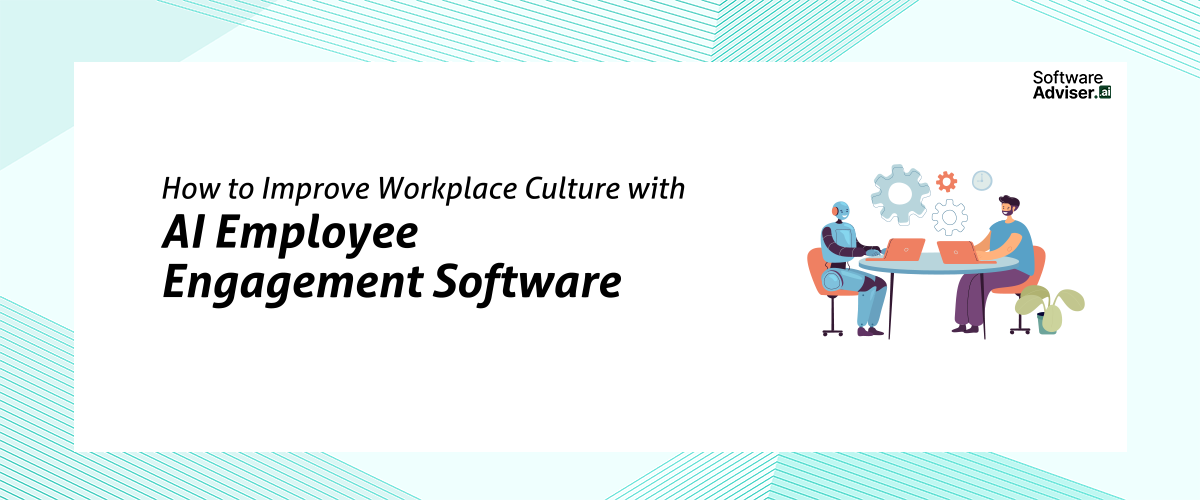
AI employee engagement software reinvents company culture by converting passive input into immediate action. These systems conduct sentiment analysis [...]
David N. Wilks
Managing staff requests for an expanding company sometimes seems like going against an ongoing stream of messages. Often, HR directors waste time answ [...]

Dokas mile
The enterprise technology landscape is undergoing a massive computational shift. Global business leaders no longer view advanced supercomputing as a d [...]