
What we'll cover
Share with your community!


Get Free Consultation
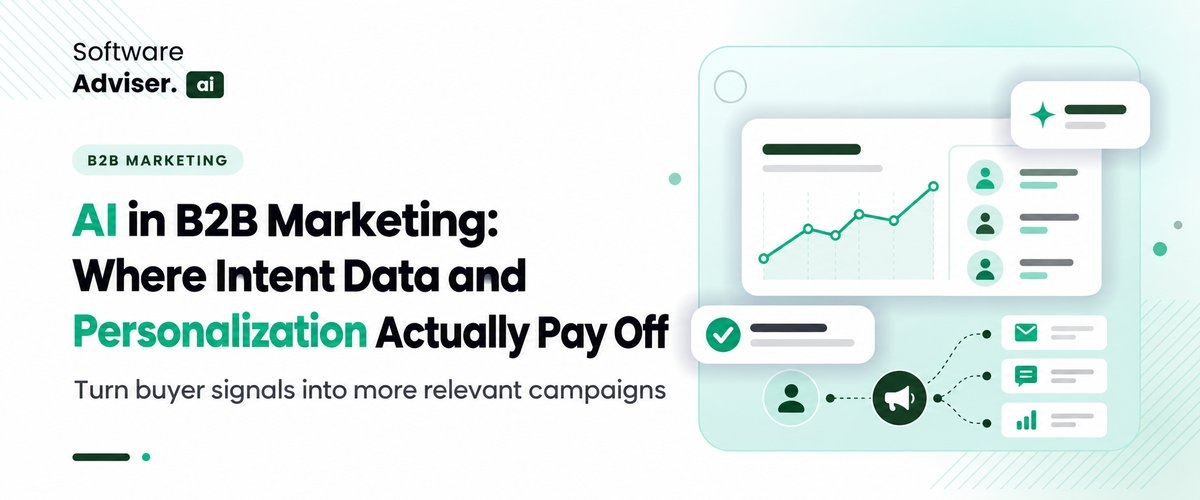
AI in B2B Marketing: Where Intent Data and Personalization Actually Pay Off
 Dokas mile
Your marketing team generates hundreds of leads a month, but sales can’t tell which accounts actually want to buy. Some prospects check your pricing page again and again. Others download a guide and disappear. Treating them the same wastes time and budget.
That’s where AI in B2B marketing helps. It reads buyer intent signals alongside customer data, so you can see which accounts to prioritize and what to send them next.
The payoff comes from spotting the right signals and responding with something relevant, not from sending more emails. This guide shows where B2B intent data and personalization fit in.
Key takeaways
- AI in B2B marketing works best when it helps you decide which accounts to prioritize and what to say next.
- B2B intent data shows interest, not purchase readiness.
- AI lead scoring should guide a decision, not make it automatically.
- Start with one use case and compare it against a baseline before you scale.
What Is AI in B2B Marketing?
AI in B2B marketing uses artificial intelligence to analyze buyer data, identify patterns, predict purchase intent, and improve marketing decisions. Common uses include lead scoring, audience segmentation, campaign optimization, content recommendations, and sales follow-up.
Traditional marketing automation follows predefined rules, such as sending an email three days after someone downloads a report. AI-powered B2B marketing analyzes multiple signals, including company profiles, previous interactions, and product-page visits, to recommend relevant next steps.
The key difference is that automation follows set workflows, while AI helps marketers choose actions based on available data. However, the accuracy of these recommendations depends on data quality.
 Looking for AI Marketing Automation Software? Check out SaaS Advisor. AI List of the Best AI Marketing Automation Software in USA for your business.
What Is B2B Intent Data, and How Does AI Use It?
B2B intent data is made up of signals suggesting that a company or its employees may be researching a business problem, evaluating solutions, or preparing to buy. These signals help marketers understand what an account might need before a prospect ever submits a contact form.
 Think of it this way
Think of B2B intent data like a shopper in a store. Someone who picks up a product, reads the label, and comes back to it twice is showing more interest than someone who walks past. You can’t read their mind, but their behavior tells you where to start the conversation.
First-party vs. third-party intent data
First-party intent data comes from interactions with your own business. Examples include repeat visits to product pages, webinar attendance, email engagement, and downloads from your website.
Third-party intent data comes from external sources that track relevant research activity across other websites or publisher networks. Depending on the provider, it may help identify companies researching topics related to your product.
Both can support buyer intent data analysis, but neither gives you the full picture. First-party data shows activity within your own channels, while third-party data adds broader research context. Availability, accuracy, and privacy requirements vary by provider.
How AI interprets buying signals
AI can combine intent signals with firmographic information and data stored in CRM software.
Consider three accounts:
- One visits your pricing page once but has no other engagement.
- Another repeatedly reads integration documentation and attends a product webinar.
- A third matches your ideal customer profile but hasn't interacted with your content.
An AI-assisted model may prioritize the second account because its behavior points to a more specific interest. The first account may need more nurturing, and the third could be reached through a targeted awareness campaign.
This is intent-based marketing in practice: using the evidence you have to decide what to do next, instead of assuming every lead is equally ready to buy.
Still, a buying signal isn't proof of purchase intent. An employee may be researching for a competitor analysis, an existing customer may be checking a feature, or several people at one company may be researching independently.
Where AI, Intent Data, and Personalization Actually Pay Off
The strongest use cases connect a clear business problem to a specific marketing action. AI in B2B marketing is most useful when its insights change how a team prioritizes work, talks to buyers, or allocates budget.
1. Prioritizing high-intent accounts and qualified leads
Sales teams often chase contacts with little interest while stronger accounts get generic outreach. AI lead scoring fixes this by ranking leads and accounts on company fit, engagement history, product interest, and intent signals.
This supports AI-driven lead generation by putting quality ahead of volume, so sales follows up with the prospects most likely to become qualified opportunities.
A score should guide the decision, not make it. Check regularly that high-scoring accounts actually convert.
2. Personalizing campaigns around buyer needs
Real personalization changes what a message says, not just the name at the top. If a prospect keeps reading your security documentation, send content on access controls and compliance. If they’re researching integrations, offer technical docs or a demo.
AI personalization in marketing uses observed behavior, account attributes, and past interactions to choose the right content. It supports B2B marketing personalization across email, websites, ads, and nurture campaigns.
Bad data can backfire, leaving a company feeling targeted without being understood.
3. Improving account-based marketing
In account-based marketing (ABM), marketing and sales focus on chosen companies instead of treating every lead as a separate opportunity.
AI helps identify accounts that fit your ideal customer profile, summarize their engagement, and show what each buying group member cares about. A technical evaluator wants integration details, while a finance leader wants cost and business value.
This keeps B2B demand generation focused. Rather than sending one campaign to everyone at a target company, you tailor messages to each stakeholder.
Keep one limit in mind: engagement from one person doesn’t mean the whole buying group is ready to buy.
4. Choosing better follow-up timing and content
Someone who attends an implementation webinar needs a different next step than someone who just downloaded an intro guide.
AI recommends relevant follow-up content, adjusts nurture sequences, and flags when an account’s activity changes. AI marketing automation then handles approved actions, like adding a contact to a nurture sequence or alerting a sales rep.
Set frequency limits and review rules. A sudden spike in activity shouldn’t trigger a flood of emails or an aggressive sales call.
5. Reducing wasted campaign spend
AI can help identify audience segments that respond differently to campaigns, detect weak-performing creative, and support budget allocation decisions.
Combined with predictive analytics in B2B marketing, these insights may help teams estimate which accounts or campaigns are more likely to produce useful outcomes. Predictions should still be tested against actual results before budgets shift significantly.
The commercial question isn't whether AI produces more engagement. It's whether the approach improves qualified opportunities, pipeline contribution, or acquisition efficiency without adding costs elsewhere.
A Practical Example: Turning Buyer Intent Into a Relevant Campaign
Imagine a US-based B2B software company selling project management software to mid-sized businesses.
Its marketing team notices that several people from one target account have visited its integration pages, viewed pricing information, and attended a product webinar. The company already matches the vendor's ideal customer profile.
Rather than sending another general newsletter, the team uses its CRM and available intent signals to prepare a more relevant next step. The account receives a comparison of integration options and an invitation to a product demonstration focused on its likely requirements.
Sales gets a summary of the account's known interactions, along with questions to clarify during the conversation. The representative doesn't assume the company has decided to buy. They use the information to start a more informed discussion.
The team then compares qualified meetings and opportunity creation against a similar group of accounts receiving its existing campaign.
This example shows how AI in B2B marketing can connect account prioritization, personalization, and follow-up. It also shows why measuring outcomes matters more than counting emails sent.
How to Implement AI-Powered Intent-Based Personalization
You don't need to automate every marketing activity to get started. A focused pilot can show whether the data and workflow are useful.
Step 1: Define your target accounts
Establish your ideal customer profile using factors such as company size, industry, technology needs, and the problems your product solves. Clear criteria make B2B customer segmentation more useful and keep you from prioritizing activity from poor-fit accounts.
Step 2: Connect relevant data
Bring together the data you need for the use case, such as CRM records, website engagement, and campaign interactions. Check for duplicate contacts, outdated company information, and inconsistent account records before relying on automated recommendations.
Step 3: Choose signals and scoring criteria
Decide which activities indicate meaningful interest and how they should be read alongside account fit. A pricing-page visit may matter, but it shouldn't automatically outweigh every other signal.
Step 4: Match the signal to an action
Create a clear response for each priority group. One account may need educational content, another a technical resource, and another a sales conversation. Use AI marketing automation to support these workflows where it adds value, with sensible limits and human oversight.
Step 5: Test before scaling
Start with one audience and one campaign. Compare its results with a reasonable baseline, document what worked, and adjust the scoring or messaging before expanding.
How to Measure the ROI of AI in B2B Marketing
AI marketing ROI should be judged against the business objective, not just the amount of activity a system produces.
Useful metrics include:
|
Metric |
What it tells you |
|
Qualified meeting rate |
Whether outreach attracts relevant prospects |
|
Opportunity creation rate |
Whether target accounts progress into sales opportunities |
|
Conversion rate |
Whether more prospects take the intended next step |
|
Cost per qualified opportunity |
How much it costs to generate a meaningful sales opportunity |
|
Pipeline contribution |
Whether campaigns help create or progress potential revenue |
|
Time to sales engagement |
Whether relevant accounts receive timely follow-up |
Email opens and clicks can help diagnose campaign performance, but they don't establish revenue impact. For a more reliable assessment, compare the AI-assisted campaign with a baseline or control group where practical, and account for differences in audience, budget, and sales cycle.
A useful measurement plan for AI in B2B marketing also includes implementation costs, data subscriptions, integration work, and ongoing maintenance. Otherwise, an improvement in campaign performance can look more profitable than it really is.
Common Mistakes That Limit Results
- Treating every intent spike as buying readiness: Research activity suggests interest, but it doesn't confirm a budget, timeline, or purchasing decision.
- Using poor-quality data: Outdated CRM records and incorrect account matching lead to irrelevant outreach.
- Overpersonalizing messages: Referencing activity too specifically can feel intrusive, especially when the data source or context isn't clear.
- Ignoring privacy and consent: Review applicable US privacy laws, data-provider terms, consent requirements, and internal data policies before activating signals.
- Measuring clicks instead of business results: Higher engagement isn't enough if qualified opportunities and pipeline stay flat.
- Removing human judgment: AI recommendations need review, especially when they influence account priority, messaging, or sales decisions.
The best AI-powered B2B marketing workflows support marketers and keep them accountable for the results.
How to Choose AI and Intent Data Tools for B2B Marketing
When evaluating B2B marketing tools, focus on the job you need them to do. A platform that's strong at content generation may not provide account-level intent insights, and an intent data provider may require separate tools for campaign execution.
Check data coverage, CRM integrations, account and contact matching, scoring transparency, workflow controls, reporting, and privacy safeguards. Ask vendors how their intent signals are collected and how often the data is updated.
Also consider whether your existing CRM and marketing automation platform can support the use case. Buying another tool may not fix a problem caused by disconnected data or unclear qualification rules.
For teams comparing options, the right investment is the one that fits their existing processes, gives them reliable information, and helps them make better decisions they can measure.
Conclusion
AI in B2B marketing delivers the most practical value when it helps teams recognize relevant buyer signals, prioritize suitable accounts, and provide useful information at the right time. Intent data supplies context, AI helps interpret patterns, and personalization turns those insights into a more relevant experience.
Start with one use case, define a business outcome, and test whether the approach improves results. If it does, expand carefully. Better decisions and stronger buyer relationships are the goal, not more automation.
FAQ's
AI in B2B marketing is used for lead scoring, audience segmentation, campaign personalization, and predictive analytics. Results depend on data quality and on whether its recommendations improve business outcomes.
B2B intent data is a set of signals showing that a company or buyer may be researching a problem or solution. Examples include relevant website visits, content engagement, and third-party research activity.
AI personalization in marketing uses customer data, account details, and engagement signals to recommend the right message, content, channel, and follow-up. Marketers should review the recommendations and follow privacy rules.
Intent data shows possible purchase interest. AI lead scoring combines those signals with company fit and engagement to rank which leads or accounts deserve attention first.
Track qualified meetings, opportunity creation, pipeline contribution, and cost per qualified opportunity. Compare against a baseline and include data, tool, and implementation costs in your AI marketing ROI calculation.

Think about the last time you waited two days for customer service to answer an easy query. Now believe your customers having that identical problem a [...]

David N. Wilks

Hidden costs pile up when companies ignore messy paperwork. Confusion strikes whenever duplicates float around email chains or lost folders hide criti [...]
David N. Wilks

Years back, business conversations around AI in offices sounded fuzzy, always "tomorrow this" and "someday that," with nothing solid to point at. Now [...]