
What we'll cover
Share with your community!


Get Free Consultation

HubSpot vs ActiveCampaign: AI Marketing Automation Showdown 2026
 David N. Wilks
Look at how those two usually get compared, and something comes out: maximum writes. They set the functions facet with the aid of the facet in tidy columns and by no means mention the element that actually drives the decision. ActiveCampaign began existence as an e-mail-automation specialist, and the CRM got here later. HubSpot began as a CRM-centered business platform, and the advertising automation came later. Once you notice that, the whole thing else makes sense: the form of the pricing, wherein everyone's AI absolutely earns its keep, and which sort of crew settles in fortuitously with which type of device. So set the feature checklist aside.
What you really need to answer is this: does email marketing sit at the heart of how you run, or is marketing just one moving part in a bigger sales-and-service setup?
What Are HubSpot & ActiveCampaign?
What Is HubSpot?
HubSpot describes itself as a unified platform for purchasers, and that description in large part assesses us. Marketing Hub, Sales Hub, Service Hub, Content Hub, and Operations Hub all collect around one shared CRM tool in the middle. Breeze, its AI layer, weaves through every one of them and takes on content material generation, prospecting help, predictive lead scoring, customer service automation, and AI-powered reporting as it is going. A loose CRM tier covers the necessities, touch management, and deal tracking; this means that stepping in charges you nothing. The snag turns up the second one you honestly need advertising automation: those workflows are tucked behind Marketing Hub Professional, and that runs $890 a month.
What Is ActiveCampaign?
ActiveCampaign constructed its name as an advertising automation expert, with email automation, because that is the component it, in reality, nails. Relaxation, the CRM, touchdown pages, SMS, and website monitoring gathered around that center as the years went on. Its automation builder is the standout, sporting 900+ pre-built recipes, visible workflow common sense, conditional branching, and multi-step sequences that flex to something a contact does subsequently. Full automation truly sits there at the Plus plan at $49 a month, with no $800 gate blocking the manner. For a group that practically lives internal to its inbox, that fee hole is commonly what closes the case.
HubSpot vs ActiveCampaign: Quick Comparison Table
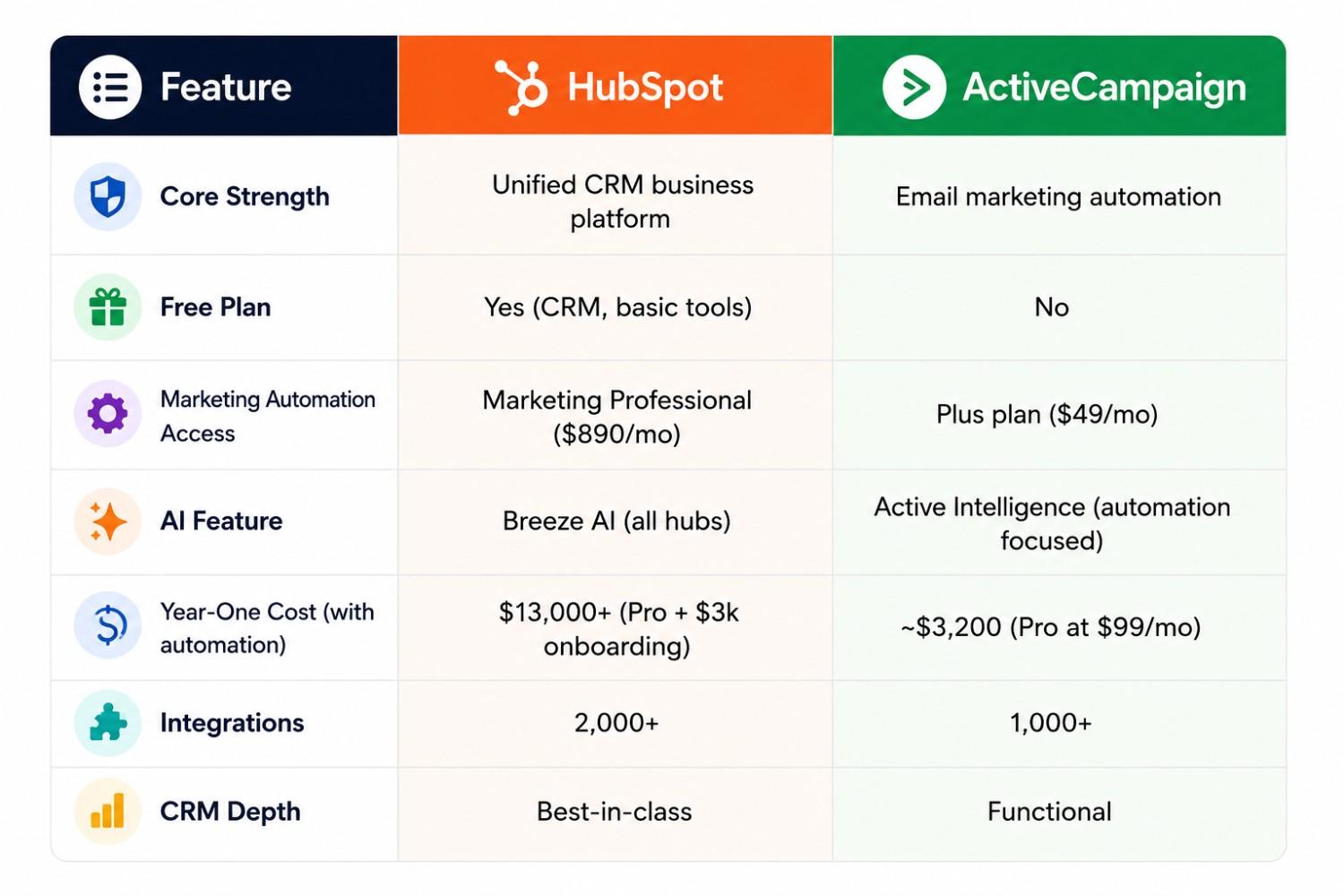
Feature-by-Feature Comparison
Email Marketing & Automation
This is the ground ActiveCampaign knows best. It arrives stocked with 900+ automation templates, abandoned-cart nudges, lead nurturing, onboarding, win-back flows, and plenty more past those. The AI-driven predictive sending sets delivery timing one contact at a time instead of treating the whole list the same. Split testing pits up to five variations against each other and crowns the winner on its own. Conditional content blocks swap sections of an email in or out depending on what a contact's data or history says. Every bit of it opens up at $49 a month on Plus.
HubSpot's email marketing has come a long way in 2026 and handles the everyday cases well. The sticking point is what's locked away: A/B testing, conditional content, and predictive sending all live behind Marketing Hub Professional at $890 a month. Teams sizing up both tools on email alone, at anything close to the same price, keep landing on the same conclusion, that ActiveCampaign hands you more for less.
CRM & Contact Management
Here the matchup flips. HubSpot's Smart CRM is one of the best out there, juggling contact records, pipeline management, deal stages, activity tracking, revenue attribution, and company hierarchies in a way that's genuinely hard to match at any price. Every marketing touchpoint writes back to the CRM record on its own. ActiveCampaign's CRM handles what's requested of it and fits teams whose income follow-up stays clear-cut; however, it never quite suits HubSpot's depth as soon as you're an income-led operation working through knotty pipelines.
Landing Pages & Lead Capture
Both tools build landing pages and lead capture forms. HubSpot's drag-and-drop builder is polished and ties straight into its CRM so leads route the moment they come in. ActiveCampaign's page tools do the job, though building pages was never the corner where the company spent most of its effort. When you need polished, high-converting pages stood up in a hurry, HubSpot's tooling is the more finished option.
Marketing Workflows & Sequences
ActiveCampaign's automation builder is still among the sharpest on the market. Site tracking, event-based triggers from page visits or form submissions, goal tracking inside automation flows, and split actions for A/B testing within a sequence are all just standard, not premium upsells. The visual automation map that shows how every workflow connects isn't a demo trick either, it's a genuinely useful way to keep a complex marketing stack legible.
HubSpot's workflow automation at the Professional tier is powerful and wired directly into CRM records, so you can fire automations off deal-stage changes, contact property updates, and pipeline movement. The hitch is getting in: serious marketing automation here means paying a real premium to reach it.
Reporting & Analytics
HubSpot gives you more reporting dashboards from the start and pulls advertising, income, and service data collectively into one analytics layer. Between cross-hub attribution, consumer journey analytics, and dashboards the entire business enterprise can pull up, it is the higher suit for management that wants a single supply of reality accomplished across each branch. ActiveCampaign's reporting is plenty sharp inside campaigns and automations, telling you which sequences are landing and which contacts are flashing buying signals. For an email-led team, that's enough. But when you need marketing data sitting alongside sales and service data in the same view, ActiveCampaign has to borrow extra tooling to pull it off.
Third-Party Integrations
HubSpot's market runs 2,000+ integrations deep and covers maximum corporations and mid-market stacks. ActiveCampaign brings 1,000+ local integrations of its own Shopify, WooCommerce, Salesforce, and Slack are covered, which handles the connections most organizations in reality use. Both lean on Zapier to plug whatever's left. HubSpot's wider ecosystem matters most for large organizations wiring into a lot of internal systems at once.
AI Capabilities Compared
HubSpot AI Features
Breeze is HubSpot's AI suite, and just how wide it reaches tells you everything about the platform's all-in-one instinct. Breeze Copilot carries content generation, email drafting, CRM data entry, and workflow creation, the whole lot driven through conversational prompts. Breeze Agents run prospecting, customer service responses, and content operations without needing a human to kick off every task. Predictive lead scoring flags high-conversion contacts from behavioral patterns. AI-powered reporting spots trends in customer data and writes narrative summaries straight off your dashboards. The breadth is real, and it keeps growing. What's thinner is the depth you get at the lower pricing tiers.
ActiveCampaign AI Features
Active Intelligence, the AI layer baked into ActiveCampaign, maintains its interest precisely where the platform makes its home: e-mail automation and behavioral advertising. Predictive sending adjusts delivery time for every contact in place of sending the whole listing out in one shot. The AI Campaign Builder assembles full email automation sequences from a single spark, choosing the templates and cause common sense for you. Content generation and optimization suggestions pop up properly within the workflow builder as you work. The scope sits tighter than Breeze, but for groups whose regular work is walking e-mail automation, that narrower goal turns out to be the more beneficial one.
Pricing Comparison: HubSpot vs ActiveCampaign
HubSpot Pricing Plans
The free tools cover basic CRM, contact management, and limited deal tracking, with no marketing automation in the mix. Marketing Hub Starter at $20 per seat a month brings in email marketing but still skips workflow automation. Step up to Marketing Hub Professional at $890 a month (billed annually), and that's where automation, A/B testing, and the full AI feature set finally come unlocked, with a mandatory $3,000 onboarding fee riding along on top. Add it up and the first year at Professional clears $13,000 before any contact overages. Marketing Hub Enterprise at $3,600 a month tacks on a $7,000 onboarding fee.
ActiveCampaign Pricing Plans
The starter at $15 a month covers basic email marketing for one user with limited automation steps. Plus, at $49 a month for 1,000 contacts, opens up full automation, all 900+ recipes, conditional logic, and multi-step workflows with no action caps. The Professional plan at $99 a month per 1,000 contacts layers on predictive AI features and priority support. Enterprise pricing is custom. There are no mandatory onboarding fees at any tier. Year one for comparable automation runs somewhere around $3,200 against HubSpot's $13,000-plus.
Which Tool Is Best for Your Business?
Best for Small Business Marketing
ActiveCampaign. The full marketing automation stack opens up at $49 a month, with no upfront onboarding fee and no mandatory annual contract at that level. Small businesses that need real automation can have it without signing on for an enterprise-sized commitment.
Best for Email-First Marketers
ActiveCampaign, and it isn't close. Best-in-class deliverability, the deepest automation logic you'll find at an accessible price, and an interface built by people who think about email campaigns all day rather than CRM pipelines.
Best for CRM-Led Growth
HubSpot. When sales and marketing share one CRM record, with attribution tying campaigns straight to pipeline movement, that's real value for growth teams that need the two sides working in lockstep, no separate integration required.
Best for Enterprise Marketing Teams
Each one serves enterprises in its own way. HubSpot Enterprise gathers the whole linked platform, CMS, CRM, Service Hub, and Operations under one roof. ActiveCampaign Enterprise tilts the other direction, imparting deeper automation customization and more potent deliverability after you're jogging at scale. The winner here depends on whether a unified platform or sheer automation depth matters more to you.
Best for eCommerce Brands
ActiveCampaign ships with native Shopify and WooCommerce hooks, reliable empty-cart automation, and behavioral triggers activated through product views and purchase facts. When you want e-alternate-unique predictive analytics and product-feed personalization, a tool like Klaviyo digs deeper, but ActiveCampaign covers what most direct-to-patron manufacturers are in truth after.
Pros & Cons of Each Tool
HubSpot Pros & Cons
Pros
- Best-in-Class UX Consistently rated the most polished CRM platform available; smooth interface, intuitive pipeline views, and drag-and-drop deal control that new reps can examine inside hours.
- Generous Free CRM Unlimited users, limitless contacts, deal monitoring, meeting scheduling, and a couple thousand advertising and marketing emails in keeping with the month protected free of charge.
- Powerful All-in-One Platform Marketing, income, career, and CMS hubs work together seamlessly, giving groups a unified source of truth throughout the whole purchaser lifecycle.
- Breeze AI Suite AI-powered assistant, prospecting agents, content generation, and predictive analytics built immediately into the platform as of 2026.
Cons
- Pricing Escalates Sharply The jump from Starter ($20/seat/month) to Professional ($100/seat/month) is a 5x growth, plus an obligatory $4,500 one-time onboarding charge at the Professional tier.
- Key Features Locked Behind Higher Plans Advanced automation, A/B checking out, custom reporting, and AI tools are gated in the returns of Professional and Enterprise, making the decrease ranges seem restrictive.
- Contact Threshold Billing Once your touch database grows beyond your plan restrictions, HubSpot automatically improves your billing mid-agreement without a grace period, which catches many clients off guard.
ActiveCampaign Pros & Cons
pros
- Best-in-Class Marketing Automation A visual automation builder helps you to create complex, branched workflows brought on with the aid of electronic mail opens, page visits, deal degrees, and purchases without writing any code.
- Advanced Segmentation Mix AND/OR situations, layer behavioral triggers with demographic facts, and build hyper-focused segments that cross a long way beyond primary list filtering.
- Strong Email Deliverability Consistently excessive inbox placement costs, with SPF/DKIM setup, unsolicited mail suppression, and devoted IP options for high-quantity senders.
- 900+ Integrations Connects natively with Salesforce, Shopify, Stripe, Zapier, and masses of other tools, making e-trade, CRM, and lead generation.
Cons
- Pricing Grows Fast with Contact List Costs scale aggressively as your listing grows; a Pro plan at $79/month for 1,000 contacts jumps to $339/month at 10,000 contacts, over 4x the starting price.
- Charges for Inactive Contacts Since November 2025, new debts are billed for all contacts, inclusive of unsubscribed, bounced, and unconfirmed, which inflates costs and frustrates customers.
- Steep Learning Curve The platform is powerful, however complex new customers often locate the automation builder and feature intensity overwhelming, and plenty of tutorial guides are primitive in comparison to the modern-day UI.
Conclusion
Email-first marketing team, a small or mid-size business, automation that earns its keep at a price you can actually swing? ActiveCampaign gives you at $49 a month what HubSpot keeps locked behind $890 a month. That value case argues for itself. But if what you're after is sales and marketing pulling in the same direction, unified CRM visibility, or a platform the whole company runs on instead of just the marketing side, HubSpot's integrated platform starts earning its premium once the full picture is on the table. Put plainly: reach for ActiveCampaign when marketing automation is the main event, and reach for HubSpot when the entire business needs to run on one connected system and the budget is built to back that up.
FAQ's
ActiveCampaign is the better choice for most small businesses thanks to its affordable pricing and powerful automation features.
HubSpot offers a complete CRM, sales, marketing, and service platform, while ActiveCampaign specializes in advanced email marketing automation.
Look for email automation, lead scoring, CRM integration, workflow automation, AI content generation, and detailed analytics.
Yes, AI marketing automation software can personalize campaigns, automate follow-ups, score leads, and improve conversion rates.
Choose a platform based on your business size, marketing goals, CRM requirements, automation needs, and overall budget.
With the pace of the American dining experience, an overwhelming number of customers during a typical Friday-night rush can produce miscommunication o [...]

Dokas mile
Managing staff requests for an expanding company sometimes seems like going against an ongoing stream of messages. Often, HR directors waste time answ [...]
Dokas mile
Selecting the right corporate training platform can feel overwhelming, but smart business leaders are focusing heavily on advanced AI Learning systems [...]