What we'll cover
Share with your community!


Get Free Consultation
What Is AI Marketing Automation? A Complete Guide for Growing Businesses in 2026
 David N. Wilks
Marketing automation used to have one component: cause an email when someone fills out a shape. Send a follow-up after a webinar. Assign a lead while a person visits the pricing page. Useful, but basically easy, a set of regulations that executes without question.
 Looking for AI Marketing Automation Software? Check out SaaS Adviser’s List of the Best AI Marketing Automation Software in USA for your business.
 That version nevertheless exists in the maximum systems groups use these days. It is just not the most interesting element that platforms do.
In 2026, AI has changed what automation is really capable of. By combining machine learning, predictive analytics, natural language processing, and generative AI, modern-day systems can make smart choices, pick out revenue possibilities, personalize consumer reports, and enhance marketing campaign performance continuously with minimum human intervention at the execution layer. For developing groups underneath real aid constraints, that could be a structural gain.
Why AI Marketing Automation Matters in 2026
Customer acquisition costs keep climbing. Buyer journeys have more touchpoints and longer consideration cycles. Marketing teams are increasingly held to revenue accountability rather than activity metrics. And customers expect relevance not just their name in a subject line, but the right message based on what they have actually done and where they genuinely are in a buying process.
AI marketing automation solves both sides of this equation. For the business, it multiplies what a lean crew can execute. For the purchaser, it grants studies that feel built for them as opposed to broadcast at them. A 5-man or woman marketing group running nicely-carried out AI automation can execute the extent and personalization sophistication of a team two times its length.
Core Capabilities
- Predictive Lead Scoring. AI analyzes historical data and behavioral signals to identify which prospects are most likely to convert learning from actual outcomes rather than assumed intent signals.
- Dynamic Content Personalization. Two visitors landing on the same page can see entirely different experiences based on their individual behavior and profile. That level of individualization at scale does not work without machine learning behind it.
- Send-Time Optimization. Instead of sending campaigns at a fixed time chosen by the marketer, AI schedules delivery based on when each individual recipient historically engages. Open rates improve without touching the content.
- AI-Generated Content. Generative AI handles first drafts of email campaigns, subject line variations, landing pages, social posts, and ad creative. The production workflow shifts from creation to refinement which is faster.
- Predictive Analytics. AI forecasts churn risk, purchase likelihood, upsell potential, and lifetime value before those signals become obvious. Acting on a predicted churn risk a week before it happens is categorically different from reacting to it a week after.
- Automated Campaign Optimization. Platforms constantly alter targeting, budgets, messaging, and workflows based totally on actual-time results moving in the direction of better outcomes without awaiting a human to run the evaluation.
Common Challenges Without AI Automation
Generic campaigns with poor engagement, slow lead response instances, inconsistent cross-channel reviews, issues figuring out excessive-motive possibilities, and marketing teams spending disproportionate time on tasks that do not require their judgment. These problems compound. And they show up in revenue before they show up in dashboards.
What to Look for in a Platform
- Ease of implementation. If a platform requires six months of professional services before generating results, it is not a solution, it is a project. Prioritize fast deployment and short time-to-value.
- Multi-channel coverage. Managing email, SMS, social, paid advertising, and web from a single environment improves consistency and produces better data than managing separate tools.
- Native AI features. Some vendors treat AI as a premium add-on. Others build it directly into segmentation, optimization, and reporting across every tier. Native integration delivers more consistent outcomes.
- CRM integration. The question is not whether a platform integrates with your CRM software, it is how cleanly the data flows and how reliably it stays synchronized.
- Pricing scalability. Some models look affordable today and become punitive as the contact database grows. Understand the long-term cost structure before committing.
Top 8 AI Marketing Automation Platforms in 2026
1. HubSpot Marketing Hub Best All-in-One Platform
HubSpot's benefit comes from proper integration throughout marketing, sales, and purchaser control in a single surroundings. When the marketing statistics, CRM, and customer support data share the identical platform, the AI has get entry to to a complete photograph. That unified dataset is what makes predictive lead scoring, content technology, and adventure automation meaningful as opposed to superficial.
Best For: B2B and B2C businesses seeking a unified platform across the purchaser lifecycle.
2. ActiveCampaign Best for Email Marketing Automation
The workflow builder is among the most flexible available handling complicated multi-step nurture sequences, conditional branching, and integration triggers that easier systems can not reflect. For groups wherein e-mail drives the bulk of marketing revenue, the intensity of managing ActiveCampaign is hard to get in shape at its rate point.
Best For: Businesses where e-mail is the number one revenue-using channel.
3. Brevo Best Affordable All-in-One Solution
Brevo offers email, SMS, WhatsApp, web push notifications, and landing pages without the enterprise pricing ceiling that affects most platforms with comparable channel coverage. It is not trying to be HubSpot it is trying to be the best option for organizations that need multi-channel coverage without the corresponding bill.
Best For: Growing businesses seeking multi-channel automation at sustainable pricing.
4. Klaviyo Best for E-Commerce
In e-trade marketing automation, Klaviyo isn't always competing with the alternative structures in this listing. It is competing in its own category motive-built for deserted cart healing, post-purchase sequences, product pointers, and predictive lifetime price modeling. For e-commerce manufacturers, the query is hardly ever whether or not Klaviyo is proper. It is whether the present day level justifies the investment.
Best For: E-commerce and direct-to-purchaser manufacturers.
5. Mailchimp Best Entry-Level Platform
Mailchimp's advantage is accessibility, a genuinely shallow learning curve, an interface that does not require technical expertise, and AI additions (content generation, predictive segmentation, campaign optimization) that have made it meaningfully more capable than it was a few years ago. Businesses with sophisticated requirements will outgrow it. For building the first automation workflows, it is the most practical starting point.
Best For: Small businesses and startups beginning their automation journey.
6. Adobe Marketo Engage Best for Enterprise B2B
Marketo is where enterprise B2B marketing operations live. Account-based marketing, predictive content delivery, multi-stakeholder lead management, and complex nurture programs spanning months no other platform in this guide handles this specific environment as completely. The trade-off is implementation complexity and cost that only makes sense at the scale that requires it.
Best For: Organizations with long sales cycles and sophisticated demand generation.
7. Insider Best for Omnichannel Personalization
Insider's AI engine personalizes client reports simultaneously across web sites, email, cellular apps, SMS, push notifications, and messaging systems. For retail, media, and e-trade organizations wherein experience is pleasant throughout a couple of touchpoints, this focused intensity is an authentic benefit.
Best For: Retail, media, and e-trade groups centered on omnichannel personalization.
8. GrowEasy.ai Best for Advertising Automation
GrowEasy.ai addresses a specific gap: businesses that depend heavily on paid acquisition but lack the in-house expertise to manage campaign creation, audience targeting, and budget optimization effectively. The AI automates what would otherwise require dedicated media buying capability.
Best For: Businesses relying on paid advertising without dedicated media buying expertise.
The ROI of AI Marketing Automation
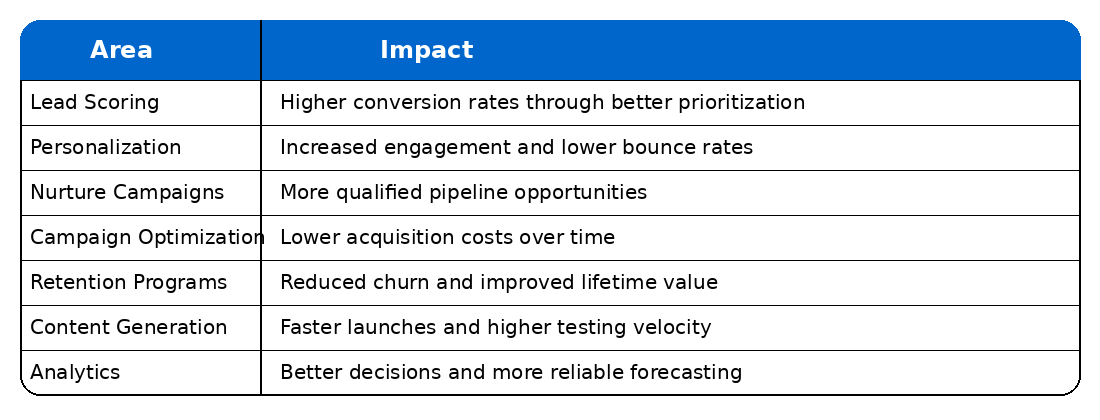
These enhancements compound. Better scoring way: sales focus on where it subjects. Better personalization keeps opportunities engaged through longer cycles. Better retention reduces the purchase volume needed to sustain growth.
AI Marketing Automation 2026 Trends
- Agentic AI structures that plan campaigns, execute movements, analyze effects, and adjust approaches autonomously represent the following significant evolution. Unlike traditional automation that follows rules, agentic AI responds to conditions. Major vendors are making a heavy investment right here.
- Hyper-personalization at scale: The use of loads of behavioral alerts is now realistic. Businesses that have no longer revisited their personalization strategy lately are probably underutilizing what is already available to them.
- AI-generated content material has moved from experimental to conventional exercise, shifting the manufacturing workflow management from creation to refinement.
- Predictive customer intelligence forecasting churn, purchase probability, and upsell potential before they turn out to be obvious is where an awful lot of the real ROI lives for mature implementations.
Risks Worth Naming
- Over-automation creates impersonal experiences customers can feel. Human oversight of customer-facing workflows remains essential.
- Data quality is a hard prerequisite. AI systems are only as good as the data they learn from. Poor data hygiene translates directly into poor AI outputs.
- Compliance and privacy obligations under GDPR, CCPA, and emerging AI governance frameworks require active management platform vendors do not automatically solve these.
Choosing by Growth Stage
- Under $2M revenue Mailchimp or Brevo. Build the fundamentals first.
- E-commerce brands Klaviyo. Purpose-built for the revenue workflows that matter.
- B2B SaaS and services ($5M–$30M) HubSpot or ActiveCampaign. Best balance of capability and usability.
- Enterprise organizations Marketo Engage or Salesforce Marketing Cloud.
Implementation Roadmap
Phase 1: Foundation Centralize client statistics, join the CRM, release fundamental workflows. Clean data is a prerequisite for the whole lot that follows.
Phase 2: Intelligence Deploy predictive lead scoring, AI segmentation, and automatic reporting. The platform starts off evolving, informing choices in preference to just executing tasks.
Phase 3: Personalization Expand omnichannel campaigns and follow predictive customer insights to retention and upsell applications.
Phase 4: Agentic AI automates marketing campaign control, optimizes budgets mechanically, and deploys AI sellers for ongoing execution. This calls for the previous three phases running properly first.
Conclusion
The question is not whether to adopt AI marketing automation. That has been answered by what customers now expect and what competitors are already doing. The question is how quickly and how well a business can implement it. Organizations that get this right gain compounding advantages in customer acquisition, engagement, and operational efficiency. The most successful ones will not have the largest marketing teams they will have teams that combine human creativity and judgment with AI-driven execution most effectively. AI marketing automation is the operational foundation of effective marketing today. Not a future consideration. Not an optional upgrade. A working requirement for any business that expects to grow.
FAQ's
AI marketing automation uses artificial intelligence to automate, personalize, and optimize marketing campaigns with minimal manual effort.
It helps businesses improve customer engagement, increase conversions, and save time by automating repetitive marketing tasks.
AI analyzes customer data to optimize targeting, content, timing, and campaign performance in real time.
Startups, e-commerce brands, B2B companies, and enterprises can all benefit from AI-driven marketing automation solutions.
Choose a platform with strong AI features, CRM integration, multi-channel support, and pricing that scales with your business.
The corporate world is changing, and AI data management software is leading the way. For decades, traditional document Forecasting systems have been s [...]
David N. Wilks
Sales teams across the US are under more pressure than ever, and the tools most of them rely on were simply not designed for what the market demands t [...]
David N. Wilks
Step onto almost any busy workplace floor today, and you may spot the precise identical operational bottleneck. Highly skilled groups drain their day- [...]