
What we'll cover
Share with your community!


Get Free Consultation
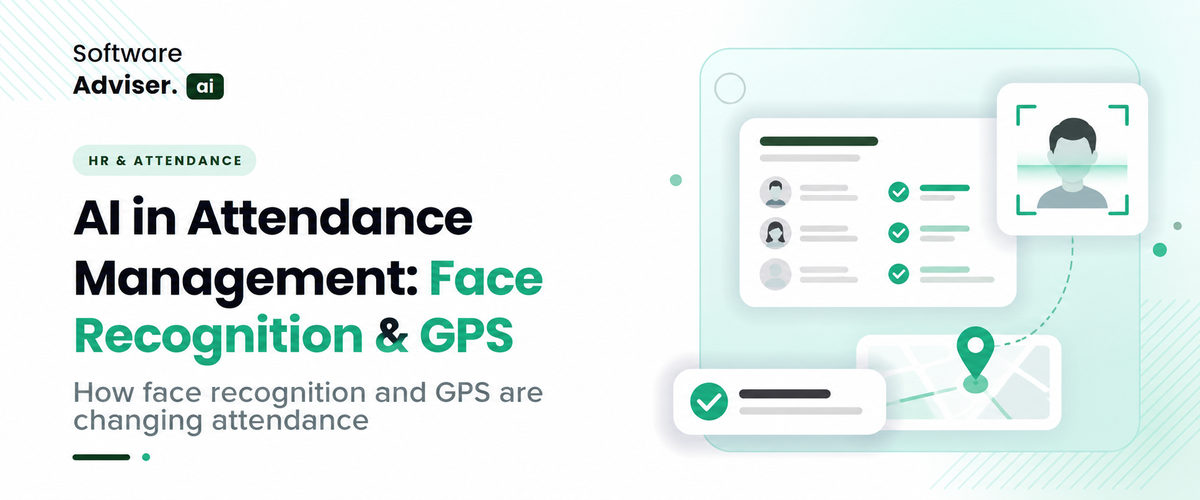
AI in Attendance Management: How Face Recognition & GPS Are Changing the Game
 Dokas mile
The process of recording work hours on a mobile device appears simple - but a supervisor sometimes notices identical arrival times from three employees who worked in different locations. In other cases, the payroll department uses two work days to correct time records for teams across five construction areas.
 Looking for AI Attendance Management Software? Check out Softwareadviser’s List of the Best AI Attendance Management Software in USA for Your Business.
Face recognition & GPS tracking are marketed as a complete solution for these issues. They improve accuracy in specific areas but introduce concerns regarding the privacy of employees and the trust of the workforce. The software identifies those discrepancies, although the marketing materials of manufacturers often describe capabilities that exceed the current performance of the technology.
What is AI in Attendance Management?
If you want to define this technology, it is software that employs machine learning to verify the identity of a worker and their location. It then marks records that contain errors. The action of pressing a button is not the intelligent component. The intelligence is located in the verification of identity, the verification of location, and the analysis of data trends.
Many current software systems incorporate three specific components: there is a face recognition step to identify the worker. There is a GPS rule to confirm the location. And there is an exception report that identifies irregular actions, like multiple entries at the same minute. Older biometric systems required permanent hardware like scanners mounted on walls.
The contemporary method operates on the mobile phones or tablets that employees already possess - this reduces the initial purchase price - but this shift transfers the potential for failure from physical hardware to the configuration of software and the policies of the organization.
The effectiveness of the AI used for attendance management software is influenced both by the configuration/set up of the AI (which needs to be correct) and your selection of the vendor. Two companies using the same attendance management software can find that they have completely different levels of accuracy, fairness, and employee satisfaction.
Do You Know?
Independent testing conducted by the US National Institute of Standards and Technology has revealed significant differences in face recognition algorithm accuracy, with some making more errors for certain demographic groups than others. The reason for seeking evidence from a vendor is one of them, not the headline accuracy figure.
Face Recognition: What It Fixes and What It Misses
Face recognition can help end these two buddy-punching methods: employees clocking in for each other. Password or card sharing occurs frequently. However, your face can't as easily be transferred to another person to have them clock in, especially if the facial recognition technology is capable of distinguishing between a living person and images.
To stop the transmission of delayed photos or replayed videos via video streaming, liveness detection inspects blinking, depth, and small movements to confirm whether the picture or video is authentic. When you are choosing a vendor, you should ask them about how exactly their liveness detection works, and if they’ve had their external tests done for liveness detection. Some systems don't undergo external testing but still produce very good output.
Sales pages very rarely inform people about the limitations that come with providing recognition. The number of false positives increases due to bad lighting, masks, protective eyewear, sudden new facial hair, and a poor-quality camera on the phone. An incorrect scan at 6 a.m. in the kitchen or on a construction site will cause significant annoyance among staff, which may lead them to no longer want to cooperate with the system.
For each deployment, there is a backup option available, which can be either obtaining supervisor permission, generating a PIN that will create misleading records, or using a tap on the technology.
Note: A lack of one can lead to honest workers being unpaid because of a technical malfunction, and the company ends up in ruins with an undeserved dispute.GPS Attendance: A Useful Boundary, Not a Perfect Witness
GPS attendance records, which capture a device's location when a user signs in. Geofencing turns these records into rules: if the device is not within a geographical perimeter defined by you (e.g., around a job location, store, or office), the punch made shall not be recorded in our system. This greatly reduces manual work for companies with teams that work at different places, and it works well as AI GPS tracking.
Even though GPS appears highly accurate, it is not. Signals are weakened by such factors as concrete construction and underground locations (basements, parking structures), and an employee working at their desk may very well appear to be outside of the perimeter fence. This makes the size of the fence a subjective decision. Too narrow a fence size could result in the refusal of legitimate punching in and out, and an overly wide fence size could permit an individual to clock in while they are parked across the street. Some applications can provide false locations; therefore, GPS alone is not an appropriate method to confirm the location of an employee and thus should be used with other types of identification such as face matching or device integrity.
Remote and hybrid employees are another story. A home address does not serve as a boundary for the workplace. If employers monitor employees’ location around their homes, they will have to answer questions they prefer not to be asked. For these kinds of employees, Task based/Output based tracking through AI time-tracking software & Apps or specifically designed AI Remote Work Tools are better suited for them.
A final distinction should be made. Location will be captured only at the time clock-in is done, so capturing someone's location all day is AI employee monitoring technology (which comes with a different price tag as it relates to legal as well as moral issues). Many employers don't know how to tell the difference between attendance and monitoring. When employers mistakenly do this, employees know that it is happening.
Where Face Recognition and GPS Together Make Sense
AI for attendance works well for some employers, while others may find little benefit in using this technology. The following are three areas where there is a clear benefit to using face recognition and GPS for attendance purposes.
|
Workplace situation |
Fit |
Reason |
|
Field crews across several sites (construction, cleaning, security) |
Strong |
Identity and location both matter, and supervisors cannot be at every site. |
|
Hourly retail or restaurant staff at fixed locations |
Often good |
Buddy punching is common, but GPS adds little inside one building. |
|
Office-based salaried staff |
Usually unnecessary |
Pay rarely depends on exact punch times, so privacy costs can outweigh the gain. |
|
Fully remote teams |
Weak |
There is no fixed boundary to enforce, so output-based tracking fits better. |
|
A small team where everyone knows each other |
Probably overkill |
A simple digital time clock handles the job. |
Let's take an example. Imagine there is a cleaning company that has 40 employees distributed among 5 locations. The supervisors visit each of the locations only once per day and are paid for the hours they work. Even minutes of lateness or leaving early could affect the amount the employees get paid. By using AI for attendance tracking, this company will be able to cut some of its operating expenses. The face recognition will determine if the employee has arrived or not. The geographic fences will assist in verifying if the employees have arrived at the correct client site. The reports will assist management in identifying which of the few records need to be addressed in person. In the event that the same company had only 10 employees located at one large centralized office, many of the same features would create more work and time spent setting them up than would be spent actually using them.
Here's the basic breakdown of how these types of programs can generate a return on investment (ROI): Their ROI is a function of the costs incurred by attendance that generate revenues via employee wages; costs incurred via employees working at multiple locations on a given day; and costs that result from insufficient supervision. For employers that are experiencing the challenge of correctly providing the number of employees at their workplaces for each shift, an AI employee scheduling system will likely provide more benefits than using only a facial recognition system will provide.
Lastly, since an accurate record of employee attendance is critical to the payment of employee wages, it is important to determine the integration of any prospective vendor's AI-based employee scheduling software with your current AI-based payroll or HRIS software before making a purchase.
The Legal and Trust Questions US Employers Should Settle First
The legal side of AI in attendance management is less settled than vendors imply. Face geometry counts as biometric data, and US law treats it differently from a swipe card. The Illinois Biometric Information Privacy Act is the best-known example. It requires written notice and consent before collection, and it has produced a steady stream of lawsuits against employers.
Both Texas and Washington include laws regarding biometric authentication, plus many other cities and areas that have passed or proposed comparable rules; thus, a set of regulations considered okay by one state's rules or constitution does not necessarily work everywhere else. The points below give some background context and should not act as official legal advice, so experts need to look at each project plan very closely.
The system operates with practical safeguards needing written consent and defined retention periods for files, alongside auto-deleting facial models upon employee departure and providing alternative identification methods for personnel wary of biometric tech. This policy resides inside Human Resources, similar to Information Technology, creating logic to align it with your wider AI HR software patterns.
Focus on trust demands equal attention from firms regarding their own compliance mandates. Staff members sensing observation often hide unhappiness by skipping open grievances. Instead, they find other paths, causing slow decay in information standards that first drove purchase decisions. Clarifying why data gets gathered and what access exists takes just a tiny part of overall costs.
Questions to Ask Before Choosing AI Attendance Management Software
Designing demos centers around building fluid visual interfaces. However, the demo phase often misses key details since one must query each AI attendance software provider with precise inquiries prior to finalizing a purchase decision.
- In what manner does the liveness check operate, and have independent tests confirmed its reliability? If a supplier fails to provide a clear response regarding these points, that serves as an indicator of potential concern.
- What happens when a scan fails? Look for a documented fallback that still produces an auditable record.
- Can the geofence size be defined per location, and does position recording happen solely upon clock-in? Non-stop monitoring represents another separate item.
- Where does biometric information reside, what duration applies to its retention, and is removal possible upon user demand? Inquire if the technology maintains a numeric profile or the source image itself.
- Can strikes be logged without internet and synchronized subsequently? Outdoor teams frequently operate where connection is weak.
- How cleanly does it export to payroll, and how are corrections approved? Weak correction workflows push the manual work back onto HR.

Pro-tip
The system needs to operate at a single location for thirty days during which all failed and disputed time punches must be documented. The actual number of genuine workers who face rejection from vendors provides better evidence than any vendor accuracy statement found on their website. Users need to first modify their geofence boundaries and adjust their lighting settings before they can evaluate the software performance.
Conclusion
Organizations that successfully deployed artificial intelligence for tracking presence treated the tool as an operational shift rather than merely installing new code. Leadership requires early orientation regarding the platform, whereas staff members must grasp exactly what information the application gathers and what specific metrics remain outside its scope. The first few weeks require managers to review all system exceptions with employees so they can modify the rules before employees start to experience negative consequences. You should switch to another solution if your attendance records determine employee pay and your workforce operates from different locations while buddy punching and incorrect timesheets generate actual financial losses.
FAQ's
Frequently so, yet specific state statutes regarding biometrics, like the Illinois BIPA, require obtaining written approval along with a legal examination as an initial phase.
Some attempt to use photo files or applications that fake location, making it essential to employ liveness verification alongside other checks.
It may log where a strike occurred, yet it contributes very little to those lacking a permanent job site.
It often yields results when personnel operate between locations or when wage rates hinge upon precise duration, but provides fewer benefits for small groups confined to one office space.
Biometric systems depend on fingerprint or facial recognition gear, whereas artificial intelligence tracking introduces code-driven ID verification, place constraints, and irregularity markers.
Small business growth across the United States has historically stalled against a single, predictable barrier: resource disparity. When an independent [...]

David N. Wilks
Putting an Artificial Intelligence AI Employee Assistance Program (EAP) into a workplace can, like, really modernize the way your organization support [...]
Dokas mile
Scale matters, but smart marketing teams refuse to sacrifice quality to get there. The old way, losing half your week to writer's block or babysitting [...]