
What we'll cover
Share with your community!


Get Free Consultation
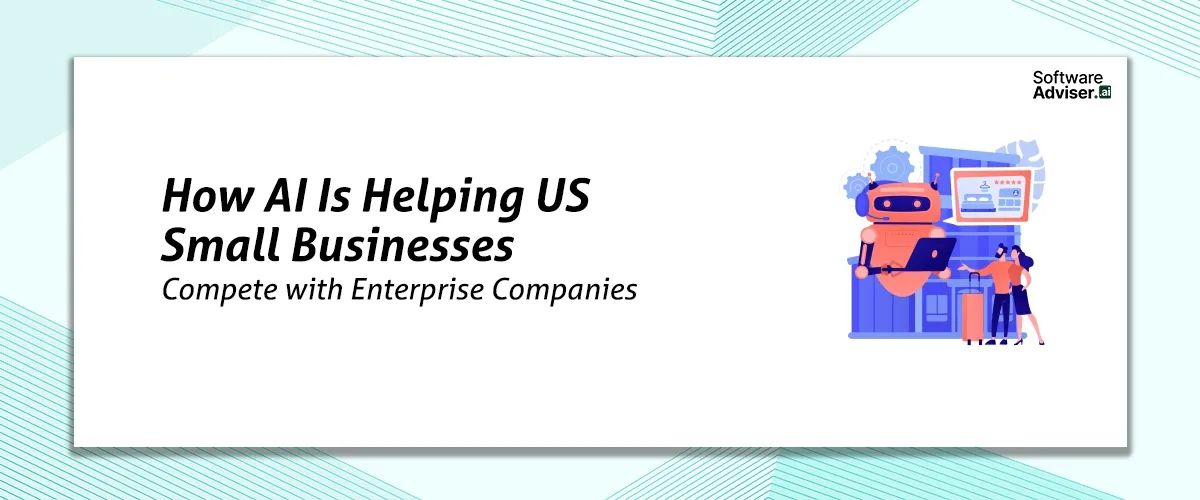
How AI Is Helping US Small Businesses Compete with Enterprise Companies
 David N. Wilks
Small business growth across the United States has historically stalled against a single, predictable barrier: resource disparity. When an independent retailer, a regional logistics provider, or a local service firm attempts to go up against a multi-billion-dollar corporation, the enterprise giant wins almost purely on financial scale. These market giants deploy massive operations teams, outspend competitors on specialized marketing analytics software, and build proprietary technology frameworks designed to streamline client acquisition.
Matching that pace with manual labor is a losing game. When small business owners spend their entire week buried in routine back-office data entry, troubleshooting supply chains over spreadsheets, or addressing customer inquiries one email at a time, strategic growth stops. The widespread availability of practical artificial intelligence has fundamentally broken this dynamic. Enterprise-grade execution is no longer locked behind million-dollar IT budgets.
The Democratization of AI for Business in 2026
The software procurement landscape has shifted completely away from expensive custom development toward flexible, plug-and-play digital platforms. Previously, deploying machine learning or predictive forecasting required dedicated data science divisions and massive corporate infrastructure. Today, a growing company can integrate advanced text processing, behavioral tracking, and financial modeling directly into its current tech stack with a basic software subscription.
This accessibility completely changes how smaller firms move within the market. While massive enterprise corporations are often weighed down by rigid legacy systems, multi-tiered approval processes, and complex corporate bureaucracy, independent businesses can deploy new software tools almost instantly.
By adding smart applications to their operations, small teams can handle workloads that previously required entire corporate departments. Whether it is calculating the most efficient delivery routes for a regional fleet or running multi-channel digital ad campaigns, modern AI business solutions turn lean teams into highly productive operational engines.
- Do You Know?
Cloud-based AI tools can help small businesses lower operational costs by up to 30% within the first year, and it does not require any headcount addition.
Strategic Functional Applications Driving Market Optimization
US small businesses are deploying machine learning across their core operations to remove manual friction points, maximize their margins, and dramatically boost output.
1. Customer Support and Continuous Availability
Enterprise firms spend heavily to keep AI customer support centers running around the clock. Small teams simply cannot afford to staff a midnight shift. By integrating conversational assistants into their web and mobile storefronts, independent brands can instantly handle routine tracking inquiries, process common return requests, and capture leads at any hour. This gives consumers the immediate response times they expect from a major brand, while ensuring internal staff can focus purely on high-value client accounts.
2. Marketing Strategy and Precision Ad Budgets
Corporate brands always make it rain with massive budgets on broad media campaigns and endless focus groups. For small firms, every dollar must count. Data analytics software automates the analysis of localized buying behavior and web traffic patterns for independent companies. With modern marketing platforms, omnichannel placements of digital ads are adapted, conversion-predicting copy variants identified, and bidding strategies updated in real-time. Now, this micro-targeting aligns your marketing message with the best-fit high-intent buyers, meaning no ads are wasted!
3. Supply Chain and Inventory Predictive Analytics
Those unsold units take up space in the backroom, hurting cash flow, while stockouts frustrate consumers, steering them toward the huge national chains. Predictive analytics software is now being used by small retailers to ensure that even their stock levels are synchronised with local demand. These algorithms meld historical sales data, regional weather trends, and local community event calendars to predict precisely when and what items should be reordered. This structure enables the small operations to sustain the agile, mass-throughput of a major corporate network.
4. Financial Forecasting and Business Intelligence
Most small business owners make financial decisions based on information that is already weeks old. Automated financial tracking platforms fix that by connecting directly to business accounts and flagging issues in real time, unexpected overhead spikes, approaching subscription renewals, and cash flow gaps on the horizon. Leadership stops guessing and starts making decisions based on what the numbers actually say, right now.
Structural Advantages of AI Adoption for Small Businesses
Moving away from manual administration toward automated software pipelines alters the baseline mechanics of a company's balance sheet:
|
Core Operational Area |
Traditional Manual Approach |
Modern AI-Driven Approach |
Strategic Value Captured |
|
Workflow Efficiency |
Staff spends hours sorting invoices, logging receipts, and filing data. |
Algorithms parse, organize, and upload financial records instantly. |
Human capital is redirected to client acquisition. |
|
Lead Management |
Incoming web inquiries sit in an inbox waiting for a manual review. |
Predictive tools score, filter, and route high-intent leads immediately. |
Faster response times and higher sales conversion. |
|
Trend Analysis |
Guessing purchasing shifts based on backward-looking data. |
Real-time predictive models highlight upcoming market changes. |
Proactive inventory adjustments safeguard capital. |
Overcoming Challenges in Technology Integration
At this point, the software itself is extremely accessible, but achieving a return on investment takes discipline and careful planning when it comes to execution. But it must be: smart and should also include procurement, good retention on the systems in the workflow.
One frequent misstep is rushing to adopt too many separate tools simultaneously. This creates application sprawl, where data becomes trapped in isolated silos. To prevent tracking errors, ensure every new platform links cleanly through standard integrations or central dashboard systems. This maintains your client call logs, supply chain statistics, and accounting documents completely aligned.
In addition, data protection must be an intrinsic part of the tech strategy for small businesses. Collaborating with software vendors, driving continuous compliance of the latest security frameworks, assures your organization processes sensitive customer data in a secure manner. Building this operational resilience helps insulate your brand from liability risks and builds long-term consumer trust.
Expanding Enterprise Capability: Scale Without Fixed Costs
The true power of modern software adoption lies in breaking the traditional link between revenue growth and overhead expenses. Historically, if a small business wanted to double its transaction volume, it had to double its headcount or lease a larger physical office. Machine learning breaks this linear relationship.
By running autonomous workflows, a lean team of five or ten people can comfortably manage operational scales that once required an entire corporate division. This capability stands out clearly in business operations and content management. This aligns your client communication logs, inventory metrics, and financial records. Moreover, data protection should become central to any small business tech strategy.
Your company can guarantee that proprietary customer data is being kept secure by partnering with software vendors who comply with the latest security frameworks. Armoured rather than shielded from potential liabilities, equipping your brand with operational resilience creates the foundation for future consumer trust.
The Long-Term Impact on Competitive Market Dynamics
The line between the local shop and the global conglomerate will completely disappear as software solutions designed for small businesses offer increasingly mature capabilities. Agility and genuine community interaction give independent businesses an inherent, deserved advantage over massive corporations. On the other side, enterprises are slow moving agents with several layers of internal approvals process and a legacy technology stack.
With the analytical strength of a cloud software and natural agility of a small business, it is an unbeatable competitor. Smaller teams can identify localized demand changes and roll out bespoke product options weeks before a major corporation makes it through the first level of the corporate committee review process. This trend is democratizing commerce in the United States, allowing independent entrepreneurs to retain local market share, the networks they need to survive and thrive, and provide experiences that appeal directly to their audiences in ways that larger corporations can rarely accomplish.
Conclusion
The growth strategy that used to be accessible only to companies with massive IT budgets is now adopting data-driven tools. It has become a practical necessity for small businesses to remain competitive and maintain margins in US market. The return on that investment depends on how deliberately it is implemented. Picking the right platforms matters. So does building a team culture that treats technology as a foundation for continuous improvement, not a one-time fix. Those two forces combine to make independent businesses much harder to compete with than their size might imply.
FAQ's
Mostly by removing the resource gap. Tasks that once needed entire departments, such as customer support, campaign management, and financial reporting, now run on affordable software. A team of five can cover ground that a corporate division used to own.
Begin with what hurts your business right now. The monthly fees for email automation, basic customer service tools, and analytics platforms are small – there is no large capital outlay or IT team required. Choose one, use it well, then improve.
Absolutely. Security and compliance features are baked into most cloud platforms today, you're not managing that yourself. Smaller teams can run trend analysis and inventory forecasting without touching anything that needs a dedicated security function.
Automation, unlike general campaigns based on speculation, follows people and what they really do on your site, then pulls the marketers that are poised to buy. Your budget is spent on people who are near a decision, not people who maybe.
Don't start with a shortlist of tools; start with your worst bottleneck. Slow response times? Unpredictable stock? Manual reports eating your week? Fix that one thing first with a single focused platform. Expanding too fast is where most businesses go wrong.
We are experiencing a significant change in how we manage our data. For example, it has been noted that by 2026, the amount of data companies have now [...]
David N. Wilks
The landscape of people management has shifted. If you’re running a startup or an SMB in 2026, you likely already know that the "human" in Human Res [...]
David N. Wilks
Evaluating and rewarding what your team brings to the table has officially outgrown those stale, once-a-year evaluations. Forward-thinking companies a [...]