
What we'll cover
Share with your community!


Get Free Consultation

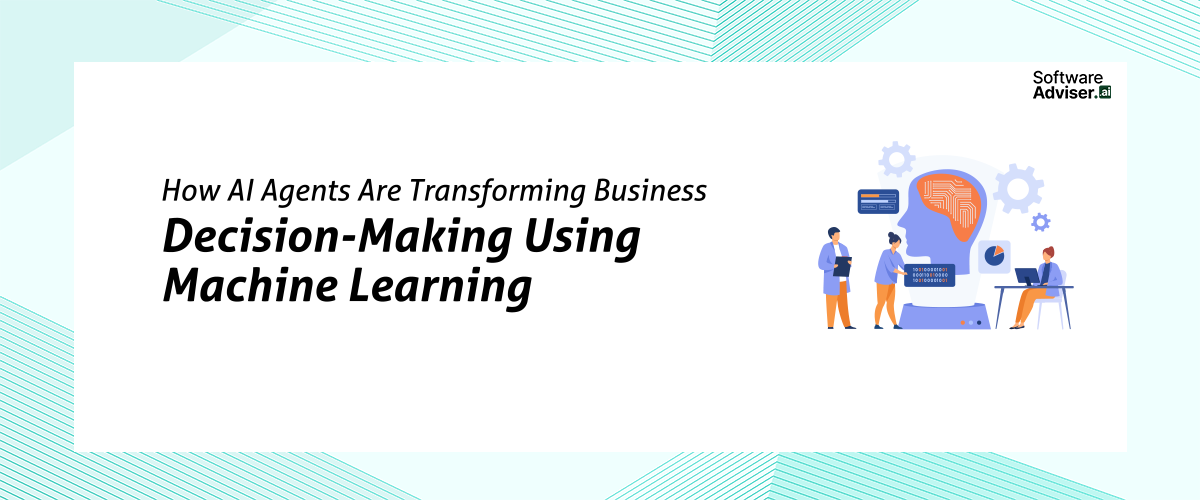
How AI Agents Are Transforming Business Decision-Making Using Machine Learning
 David N. Wilks
The process of decision-making has become increasingly challenging in the corporate environment owing to the rapid rate at which change occurs in the market as well as the increased generation of data within firms. Traditional techniques of decision-making, which include the use of spreadsheets and analysis of previous reports, have failed to cope with these challenges and do not provide relevant information. Hence, firms are now utilizing smarter techniques for decision-making.

Looking for AI Agent Platform? Check out SaaS Advisor’s List of the Best AI Agent Platform in USA for Your Business
The use of machine learning is playing a crucial role in the revolution by helping companies use their intricate data sets and find patterns and gain valuable insights. Machine learning helps companies make decisions when it comes to areas such as demand forecasting, customer behavior analysis, risk assessment, and operations management. This article highlights the role of machine learning in changing the nature of contemporary business decisions and their applications, benefits, as well as the challenges associated with its application.
What Does Business Decision-Making Mean Today?
Decision-making used to run on a clock. Pull a report Monday, argue about it Tuesday, sign off by Friday. Plenty of companies still run that loop, and for some of them it's fine. For a growing number, it's becoming the thing that loses them the deal.
What's replacing it looks less like a meeting and more like a constant low hum of adjustment. Prices shift by the hour based on live demand. Stock reorders itself before a warehouse manager has even clocked that shelves are thinning out. A fraud attempt gets shut down in under a second, long before any analyst would have opened a case file. The actual shape of the decision hasn't changed much. Who takes the first swing at it has.
1. Why Companies Need Faster and Smarter Decisions
Competitors move on Tuesday afternoon now, not next quarter. A company that finds out about a pricing change during Thursday's leadership meeting has already burned two days it can't get back. A few years ago that lag was survivable. In retail, logistics, and anywhere margins run thin, it increasingly isn't.
Then there's just sheer volume. No team of humans, however sharp, can manually sort through millions of transactions or sensor pings fast enough to catch the one that matters. Humans still win at judgment calls that need context, history, relationships the stuff data doesn't fully capture. But everything that happens before that judgment call gets made? Speed and pattern-spotting belong to machines now, and pretending otherwise mostly just slows a company down for no upside.
2. Role of AI Agents in Modern Decision Systems
This is where AI agents actually earn their keep. Forget the chatbot mental image. An AI agent watches a stream of data continuously, decides when something needs eyes on it, and either flags it for a human or increasingly handles it directly inside boundaries someone already approved.
Roughly 79% of enterprises already report some AI agent running in production somewhere. Far fewer have pushed past the pilot phase into something genuinely woven through daily operations. That gap is one of the more honest numbers floating around this whole topic, because it admits the obvious having agents isn't the same thing as having them actually move the needle yet. The companies pulling ahead are the ones treating agents as a decision layer, not a feature they bolted onto an existing dashboard so the board deck would look current.
What Are AI Agents in Simple Terms?
Cut the jargon, and an AI agent is software chasing a goal, not answering a single prompt and stopping. A chatbot replies once and waits. An agent watches, decides what's worth acting on, and takes the next step, sometimes without waiting for anyone to say go. It plans a little, and it pulls tools when it needs them. Some versions remember what happened last time and adjust accordingly.
Picture hiring someone whose entire job is staring at one process around the clock, catching trouble the second it shows up, fixing the small stuff without asking permission first. That's most of what a well-built AI agent does. Minus the coffee breaks, minus the Monday complaining.
How They Work in Business Environments
In the case of actual business processes, the agent gets connected to the system immediately and keeps running, independent of how often or infrequently some schedule was set up by anyone. A supply chain agent may be tracking shipment delays, weather disturbances, and supplier lead-time management all at the same time and silently rerouting the order without anyone noticing.
This is where the true difference lies from traditional rule-based automation. A basic rule says: if A happens, do B, forever, until someone manually rewrites it. An agent built on machine learning notices when the pattern around A has shifted and adjusts on its own. That one distinction explains most of why this category exploded over the past two years instead of staying a niche engineering experiment.
Role of Machine Learning in Decision-Making
This is the part that explains why any of the rest of this actually works, so it's worth sitting with for a minute.
1. Data Collection and Analysis
Every decision starts with data, and machine learning's first job is hoovering up more of it than a team of people could ever get through by hand. Sales numbers, customer service queries, browsing patterns, delays by suppliers, weather data impacting delivery times, even conversations happening online about the brand. All of this is drawn upon by the machine learning algorithm in a single process to find the signal in the noise.
A sharp analyst might check three or four sources before landing on an opinion. A model can cross-check dozens simultaneously, catching something like a spike in product returns lining up with one specific supplier's last shipment a connection nobody would have thought to draw by hand. That's not a marginal edge. It's the gap between catching a problem while it's still small and finding out about it after it's already cost money.
2. Pattern Recognition
This is where machine learning pulls ahead of manual analysis, and it isn't close. People are decent at spotting patterns they've already seen somewhere before. Machine learning spots patterns nobody's seen yet, because it isn't relying on memory or a hunch; it's running statistical comparisons across huge datasets in seconds flat.
Machine learning-based fraud detection in banks is not a simple process of comparing an ongoing transaction with a preset blacklist. Instead, machine learning teaches the system what constitutes normal for a single account, and any divergence is considered suspicious, no matter how subtle it may be. That's pattern recognition doing the heavy lifting long before a single human reviews a case file.
Some places this shows up day to day, no exaggeration needed:
- Retailers catching a shift in buying behavior weeks before it shows up clearly in a sales report.
- Manufacturers spotting early signs of equipment failure from sensor readings, well before a breakdown happens.
- Insurers flagging claim patterns that look like fraud, before an adjuster has even opened the file.
- Marketing teams noticing customers quietly drifting toward churn, months before anyone actually cancels.
 Pro Tip: Feeding messy, inconsistent historical data into a machine learning model and expecting clean pattern recognition out the other end is a losing bet every time. The model isn't the bottleneck. The data pipeline is fix first. |
3. Predictive Insights
Predictive analytics is what turns raw pattern detection into something a business can act on before the moment passes. There's no magic in it. It's statistics, built on what's already happened, projected forward to give a meaningfully better guess than waiting around for the thing to happen first.
A logistics company running predictive analytics doesn't just notice a shipment running late. It estimates how that delay ripples into every downstream order, which customers will feel it, and what the cheapest fix looks like, all before the delay has even finished playing out. That's the actual value here. Not certainty. A better-than-guessing estimate, applied early enough to still matter.
How Businesses Use AI Agents for Decisions
This is the part of the article that deserves the most room, because the use cases pull in genuinely different directions depending on the department.
1. Financial Forecasting
Finance teams have leaned on spreadsheet forecasting for decades, and it's always had the same crack running through it: the assumptions go stale the moment market conditions shift, and nobody updates the model until the next quarterly cycle rolls around.
A retail finance team forecasting holiday demand used to build one model back in October and just hope it held through December. Now an agent watching live sales velocity, weather forecasts affecting foot traffic, and competitor pricing can nudge that forecast weekly, sometimes daily, catching a deviation early enough to actually do something about it. Financial services has one of the highest agentic AI adoption rates of any sector, and it isn't a coincidence. Money moves fast. A forecast that's three weeks stale is basically decorative at that point.
2. Customer Behavior Analysis
Customer behavior used to get studied in hindsight, through a quarterly report built off last quarter's purchase history. Agents flip that timing around entirely. They're watching behavior as it happens browsing patterns, an abandoned cart, the tone of a support ticket, how long someone lingered on a pricing page before bouncing.
That matters because intent shows up in small signals long before it shows up in an actual transaction. Someone who stops opening marketing emails and starts spending less time browsing is showing churn signals weeks before they cancel anything. An agent trained on those patterns can trigger a retention offer at the exact moment it's likely to land, instead of after the customer's already checked out mentally. Retailers leaning on this kind of behavioral tracking report revenue lift tied directly to the personalization these systems make possible.
3. Risk Management
Risk used to get checked periodically, through scheduled audits that caught problems well after the damage was already done. Agents built for risk monitoring don't wait for a scheduled check. They run constantly, watching transactions and compliance signals in real time.
A bank using agents for fraud monitoring isn't running an overnight batch job anymore. It catches a suspicious pattern the second it drifts from someone's normal behavior, sometimes blocking the transaction before it even clears. Insurers run something similar to flag claims showing fraud-pattern traits before an adjuster opens the file. None of this is theoretical savings. Faster fraud detection means actual money that doesn't walk out the door.
Benefits of AI-Driven Decision Making
- Faster Decisions: Speed is the obvious one. Decisions that once required days’ worth of research now only require a few minutes due to the fact that the research and correlation of information was done before any decision-making. Once the task of gathering and correlating information is automated for the agent, the decision cycle gets compressed very easily.
- Reduced Human Error: People get tired. They get distracted. They carry bias they don't even notice in themselves. A sharp analyst on a Friday afternoon, four hours past lunch, misses things they wouldn't have missed Monday morning. Machine learning doesn't have an off day. It applies the same scrutiny to data point ten thousand as it did to data point one, which wipes out a whole category of mistake that's purely about being human and tired.
- Better Accuracy: Accuracy compounds in ways people underrate. A forecasting model that beats manual estimation by 15% doesn't just save money once. It saves money every single cycle it runs, quarter after quarter, and the gap usually widens as the model gets fed more data to learn from. Predictive analytics built on solid history consistently beats a gut-feel estimate once enough cycles have passed to actually prove it.
Challenges Companies Face
- Data Quality Issues: Nothing here works without clean data, and most companies don't realize how messy theirs actually is until they try feeding it into a model. Duplicate records. Inconsistent formatting. Fields nobody filled in. Customer info that's three address changes out of date. An agent built on bad data doesn't just give mediocre output. It gives confidently wrong output, which is arguably the worst outcome, because it looks trustworthy right up until the moment it costs someone money.
- Implementation Cost: Building and running AI agents isn't cheap, and the sticker price scares plenty of companies off before they've even tried a pilot. Data infrastructure, model training, integration, then the ongoing cost of actually watching these systems once they're live. It adds up fast. Smaller companies feel this hardest, since the same spend that's a rounding error for an enterprise is a budget fight for a fifty-person business.
- Skill Gaps: There's a genuine shortage of people who understand both the technical side of machine learning and the operational reality of how a specific business actually runs day to day. Hiring a data scientist is one problem. Finding someone who can take a model's output and turn it into an actual decision a warehouse manager or a finance lead will trust is a harder, different problem, nd it's a big reason agent projects stall right after the pilot instead of ever scaling up.
|
Pro Tip: Before pushing an AI agent project past the pilot stage, put one named person in charge of the outcome, not just the technology. Projects with a single accountable owner and a clear success number tend to succeed at noticeably higher rates than ones treated as a shared IT side project nobody specifically owns. |
Conclusion
None of this is subtle once it's pointed out, even if it doesn't feel dramatic from inside a normal workweek. Machine learning stopped being a back-office curiosity a while back, and AI agents are quickly becoming the layer deciding what actually reaches a human's attention versus what gets handled before anyone needs to look at it. That retail chain from the opening could have skipped its three-week inventory mess entirely with a system like this watching both regions at once.
FAQ's
Traditional automation runs on fixed rules someone has to manually update whenever conditions shift. Agents built on machine learning adjust their own behavior as patterns change, without anyone rewriting the underlying logic every time.
Small businesses can absolutely benefit, especially around customer behavior tracking and basic forecasting, though cost and data readiness tend to favor companies that already have some data infrastructure in place before starting.
It varies by use case and how clean the underlying data is, but a well-built predictive model consistently beats manual estimation once it's had enough history to learn from, and that edge tends to grow the longer it runs.
Unclear ownership, more often than not. Projects with one named owner, a defined success metric, and human checkpoints during the early rollout succeed far more often than projects nobody specifically owns.
To build a resilient and secure cloud setup, modern tech businesses need a smart approach to cloud architecture management. When running complex code [...]

Dokas mile
In 2026, relying purely on manual strategy and legacy workflows in digital marketing is no longer sustainable. The rapid rise of hyper-personalized au [...]
David N. Wilks
The landscape of American workforce management is shifting rapidly, and US-based companies are increasingly turning to AI HR chatbot software to stay [...]