
What we'll cover
Share with your community!


Get Free Consultation
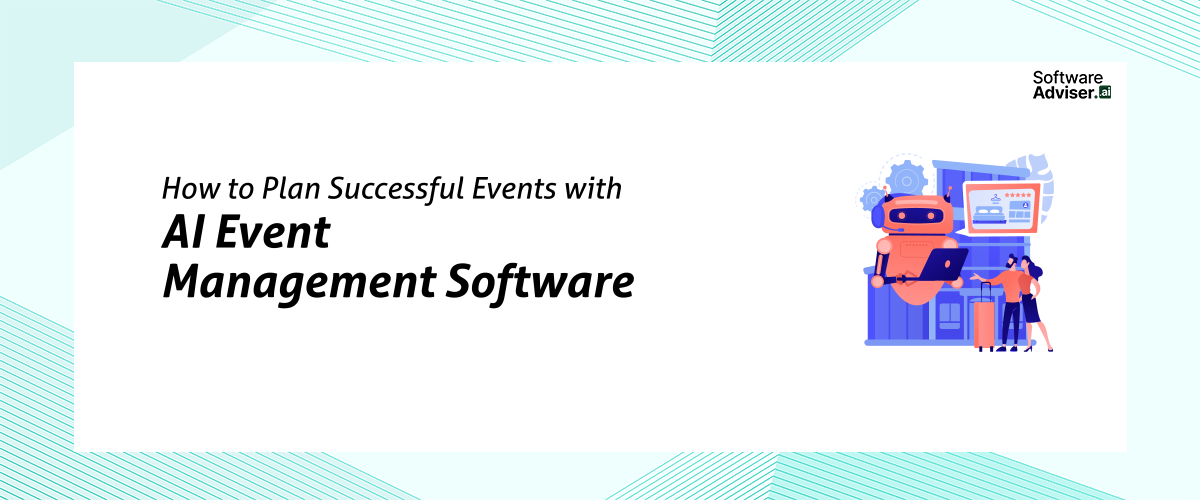
How to Plan Successful Events with AI Event Management Software
 David N. Wilks
The U.S. event management software business is undergoing a seismic upheaval, driven by a post-pandemic explosion in live events and a desire for operational efficiency. Today’s organisers are working with tighter budgets, shorter preparation cycles, and attendees with higher expectations. Artificial intelligence has shifted from being a future curiosity to being the practical backbone of business. AI-powered solutions are transforming the execution of corporate conferences, trade exhibitions, and municipal festivals, automating hectic registration operations, predicting guest engagement to help planners optimize their ROI while providing highly customized experiences.
What is AI Event Management Software?
AI event management software is a digital ecosystem that employs machine learning and automation for all stages of the planning lifecycle. To US organizers, who put on anything from tech meetings in Austin to giant trade exhibitions in Las Vegas, these platforms are an unseen, hyper-efficient co-planner. Instead of manually combing through spreadsheets, planners utilize AI to automate repetitive chores such as crafting marketing material, processing registrations, and generating complicated event plans. The software does a lot of the heavy lifting logistically, so lean teams can scale their operations and focus on the creative side of their events.
Where these systems really excel in the American market is in terms of data-driven personalization and real-time issue solutions. AI algorithms may assess attendee profiles on the fly and identify particular networking matches, appropriate breakout sessions, and even power chatbot assistants that answer guest questions 24/7. Behind the scenes, the platform records real audience movement and engagement indicators, giving organizers the predictive information they need to change room capacity, optimize vendor layouts, and provide actual return on investment (ROI) to sponsors and stakeholders.
How does AI Event Management Software help with event planning in the US?
In the fast-paced US hospitality and business industries, AI event management software may speed up the pre-planning and marketing process dramatically. Often, American planners are working with very tight timeframes for huge business conferences or multi-city roadshows. AI may simplify these chaotic beginning phases by automatically generating targeted email campaigns, providing bespoke marketing material for different social media outlets, and even anticipating ticket sales patterns based on previous market data. This program automates attendee registration and safe payments, immediately categorizes registrants by industry or interest, saving weeks of laborious data input, and enables lean planning teams to host events more quickly and attract the proper audience.
For the event itself, AI is a digital floor manager that maximizes the attendance experience and logistics in huge US venues. AI-powered face recognition and self-service kiosks accelerate the check-in procedure, instead of customers standing in lengthy queues. Inside, clever matching algorithms review participant LinkedIn data and registration profiles to recommend highly relevant networking contacts and breakout sessions, a big draw for high-stakes American business meetings. Meanwhile, AI-powered chatbots address thousands of simple participant requests like the schedule or Wi-Fi passwords, and real-time heat mapping monitors crowds so organizers can reposition personnel or vendors as necessary.
This is where the program shines in the post-event analysis, turning complicated event data into understandable numbers for US stakeholders and sponsors. In the past, determining the real return on investment (ROI) of a big trade show or seminar meant weeks of post-event questionnaires, with poor response rates. AI software alters this by combining session attendance, digital touchpoint engagements, and social media sentiment research into crisp, executive-ready reports, instantaneously. This allows American businesses to easily articulate sponsor ROI, know exactly which speakers or subjects resonated best, and leverage predictive information to plan a more successful strategy for their next event cycle.
What Features should you look for in AI Event Management Software?
1. Smart Matchmaking and Networking Algorithms: These evaluate participant profiles to suggest the best business contacts and breakout sessions.
2. Automated Content Generation: AI solutions for the automated generation of personalized AI event marketing, social media postings, and event descriptions.
3. Live Predictive Analytics: Live dashboards to track attendance, forecast ticket sales, and visualise crowd movement to optimise venue logistics.
4. AI-Powered Chatbots: 24/7 virtual assistants to quickly respond to FAQs from guests on schedules, Wi-Fi, and speaker updates.
5. Fast Registration & Check-In: Cut down waits at the venue with automated ticketing systems using face recognition or self-service kiosks.
6. Post Event ROI Reporting: Executive sponsor reports with real-time engagement stats and attendance sentiment analysis.
How can AI Event Management Software improve attendee experience?
1. Custom Agenda Builders: Creates a custom agenda of sessions and seminars for each registrant based on their industry, role, and interests provided at registration.
2. Immediate FAQ Help: AI chatbots (available 24/7) provide correct, immediate responses to visitors’ inquiries such as venue location, Wi-Fi password, schedule changes, etc.
3. Hyper-Targeted Networking: Uses an intelligent algorithm matching to link attendees with their most relevant peers, clients, or mentors in the room.
4. Real-time scheduling optimization: Real-time monitoring of capacity and value of events with quick warnings to participants, directing them to available high-value events.
5. Interactive Content Delivery: Keynotes are translated simultaneously and transcribed to speech-to-text to keep a large global audience engaged 24/7.
How Does AI Event Management Software Handle Event Budgeting?
AI event management software turns the laborious tracking of event budgets in spreadsheets into a predictive, automated AI financial CRM environment. The technology syncs straight to your accounting software and payment channels, automatically categorizing costs like venue hire, catering, and AV production, and monitoring ticket sales and sponsor income as it happens. Planners may establish tight expenditure limits for each category, and the program will constantly perform rolling projections identifying discrepancies or possible cost overruns proactively before they occur.
The platform also uses predictive analytics to help lower the financial risk for future meetings, as well as manage existing spending. The AI can analyze historical data from prior events such as past vendor bills, seasonal price shifts, and actual attendance numbers to properly anticipate the per-person cost on catering, determine best ticket pricing methods, and run various financial scenarios. This automation removes the uncertainty, cuts budget preparation time by up to fifty percent, and assures that organizers receive the most value for their dollar while eliminating wasteful, costly logistics.
How does AI Event Management Software streamline vendor and logistics management?
1. Automated Contract and RFP Analysis: AI techniques may be used to interpret incoming Requests for Proposals (RFPs) and contracts, rather than having to cross-reference the vendor bids manually. They quickly assemble crucial data points caterer delivery windows, AV power requirements, cancelation clauses, and fill up your master calendar with ease.
2. Smart Run-of-Show Sync: If a keynote speaker's flight is delayed or a session is pushed back by 30 minutes, the AI adjusts the master schedule. It automatically sends real-time communications to affected providers (e.g., warning the caterer to design components or the AV crew to change the stage layout), avoiding costly scheduling mistakes.
3. Predictive Resource Allocation: The program combines historical event data along with real-time registration patterns to predict asset demands. It tells you just how many security guards, buffet stations, or Wi-Fi routers you need for a certain room arrangement, so you avoid suppliers over-ordering.
4. Smart Floor Plan & Load-In Mapping: AI-based diagramming tools combine venue measurements with municipal safety requirements to produce to-scale floor designs. It can mimic vendor load-in schedules by giving specified dock times to freight and décor businesses to minimize traffic jams at the venue loading docks.
5. Automated task Cascades: When a milestone is crossed, the program updates the whole logistical chain. For example, if a stage design is authorized late, the AI immediately computes the compressed timetable, changes the dependencies, and pings the rental provider to confirm the accelerated shipment window.
Why should every US Event Planner use AI Event Management Software?
Speed to Market on Steroids: Create custom marketing material, social media campaigns, and email sequences in a flash, reducing weeks of pre-event preparation to days.
Significantly reduces manual labor. Automates repetitive, mundane processes like sorting registration data, processing invoices, and addressing basic guest queries, allowing small teams to expand quickly.
Perfect Real-Time Logistics: The master run-of-show is synced with all suppliers at once; if a session is moved, the AI promptly notifies caterers, AV crews, and personnel to reduce timing snafus.
Hyper-Personalized Attendee Journeys: Use clever algorithms to link participants with the proper business contacts and build bespoke agendas, significantly boosting event pleasure.
No more financial guessing. Use past vendor expenses, seasonal patterns, and ongoing ticket sales to estimate budget predictions and obtain early warnings about possible cost overruns.
Secured ROI for Sponsors: Delivers executive-ready reports that provide verifiable value to stakeholders by capturing live attendance of sessions, digital engagement touchpoints, and post-event sentiment research.
Conclusion
For U.S. organizers, using AI event management software is no longer a luxury but a competitive need to scale operations and maximize ROI. From automating chaotic logistical procedures to building profoundly individualized guest experiences, these intelligent solutions take the uncertainty out of preparation. As you think about integrating these technologies into your workflow, it’s important to find the proper match. Explore, analyze, and purchase best-in-class platform alternatives at softwareadviser.ai, the best SaaS marketplace to help organizations find, compare, and purchase the right software solutions to thrive.
FAQ's
Pricing varies widely based on features and event size. Smaller platforms like Eventbrite charge per ticket sold, while enterprise tools like Cvent use custom pricing. Many offer free trials, so you can test features before purchasing.
Most platforms are designed for ease of use, with intuitive dashboards and onboarding support. Tools like Whova and Eventbrite are especially beginner-friendly, while enterprise platforms may require more training.
Yes. Platforms like Hopin and Bizzabo specialize in virtual and hybrid events, offering features like live streaming, virtual networking, and interactive sessions.
Anyone planning events regularly—from corporate teams and conference organizers to wedding planners and nonprofits—can benefit. Choose a platform that matches your event type and scale.
No. The software handles repetitive tasks and data analysis, but human creativity, judgment, and relationship-building remain essential. AI is a tool that supports planners, not a replacement for them.
Operational efficiency relies heavily on selecting appropriate digital assets to support daily growth. Modern organizations regularly add multiple nic [...]

Dokas mile
Artificial intelligence is transforming Enterprise Resource Planning (ERP) systems from traditional record-keeping platforms into intelligent decision [...]
David N. Wilks
Insurance has in no way been an industry recognised for velocity. Forms, again-and-forth telephone calls, weeks of waiting on a claim choice- that was [...]