
Best Talent Management Software in
Are you looking for Talent Management Software for your Business in ? SaaS Adviser brings you the best Talent Management Software to ease your worries. In order to make your work smooth and swift, SaaS Adviser has compiled a list of the best software available. Compare the Best software features, pricing, free demo, and trial to select the best Talent Management Software for your organization.
 Researched and Written by Akash Patel
Top 3 Featured Softwares


List of Top Talent Management Software
Get Free Consultation

Workhuman Social Recognition

By Workhuman Social Recognition
What is Workhuman Social Recognition? Workhuman Social Recognition is a cloud-based platform designed to foster a culture of appreciation within organizations by enabling real...
View Profile
What is Culture Amp?Culture Amp is a leading employee experience platform designed to go beyond traditional HR tools by combining people analytics with behavioral science. Rath...
View Profile
Hootsuite Amplify
Boost reach and engagement on social media with the best employee advocacy platform
Hootsuite Amplify is an employee advocacy platform designed to empower organizations to extend their social media reach by enabling employees to share pre-approved, on-brand co...
View Profile

SeekOut
By SeekOut
What is SeekOut?SeekOut is an advanced AI-driven talent intelligence platform that helps organizations discover, connect with, and hire top-tier candidates across a wide range of i...
View Profile

What is Freshteam?Freshteam is a smart, all-in-one HR software designed primarily for growing businesses. It helps organizations manage their entire employee lifecycle, from at...
View Profile
Open HRMS
Open HRMS- to attain the growth that you sought
What is Open HRMS?Open HRMS is an open-source Human Resource Management Software designed to streamline HR processes across organizations. Powered by the Odoo platform, it prov...
View Profile

BreatheHR
The all-in-one HR solution loved by 16,000+ UK SMEs.
What is BreatheHR?BreatheHR is a cloud-based HR software tailored for small and medium-sized businesses (SMBs) to simplify and streamline people management. It provides a centr...
View Profile

Workday Student
By WorkdayCheck How Workday Student can help to automate Indian Business. SaaSAdviser provide their list of features, pricing, Free demo and Comparison with the best alternative
View Profile
Dayforce HCM
By CeridianDayforce HCM is an advanced human capital management software developed by Ceridian that centralizes HR, payroll, talent acquisition, benefits, and workforce management...
View Profile

Webcampus Tecnonexo
By AXG TecnonexoWhat is WebCampus TecnonexoWebCampus Tecnonexo is a comprehensive e-learning and training management platform designed to simplify digital education and corporate training. It enab...
View Profile
Feedz
You're in the right place. Feedz is TOTVS! Improve results with our performance management and engagement system.
Teamflect
Manage Performance Where Your Team Works: Microsoft Teams & Outlook
Teamflect is an easy-to-use feedback tool that helps you identify the potential for growth and bring out the best in your employees. With Teamflect, you can recognize employees for...
View Profile

Table of Content
What Is Talent Management Software and Why Is It a Must-Have?
Your people are your greatest asset in the present-day competitive business world. Talent management is the process of strategic attraction, development, motivation, and retention of high-performing employees. To implement this multifaceted, comprehensive strategy successfully, modern organizations depend on talent management software, which is a complex of integrated apps that are aimed at the automatization and optimizing the key HR processes throughout the employee lifecycle.
A strong talent management system will take your HR activities out of the fragmented spreadsheets and tools. It integrates all the important operations, including the first job application to the ultimate succession plan, on one platform. Such integration can be critical in terms of building a unified employee experience as well as empowering HR teams to become strategic business partners. An extensive HR and talent solution is no longer a luxury in the case of any business that is serious about growing, innovating, and ensuring a long-lasting, successful outcome.
1. How Can Talent Management Software Help Your Business Drive Growth and Innovation?
The correct talent management system software is not merely a way of putting HR paperwork online; it, in fact, alters the very way you look at and implement your workforce strategy.
-
Strategic Workforce Planning: With clear and data-driven information, this software assists you in predicting how your organization will require staffing and the most critical skills shortages, as well as developing a proactive plan to close these gaps before they have an effect on the everyday operation of your business.
-
Faster, Higher-Quality Hiring: Applicant Tracking System (ATS) tools in the software can reduce the time-to-hire by many folds and enhance the quality of the candidates. This is to make sure that the human capital you are importing is directly geared towards strategic business goals.
-
Cultivating Internal Talent: This is through integrated learning and performance modules, where employees will be in a continual development of skills required in future positions. This upskilling and career pathing is a source of internal innovation, which creates a future leader pipeline.
-
Agile Adaptation: You can easily change performance objectives and learning paths according to market changes by using the platform. This agility in organizations is a major source of competitive advantage and innovation in an era of high change in technology and economics.
2. Curious About the Features of Talent Management Software That Drive Success?
The best talent management platform will provide a suite of tools, developed in a modular manner, that will address five main areas of the employee lifecycle. These are the particular characteristics to consider when considering the systems that result in a unified end-to-end experience.
1. Talent Acquisition and Onboarding
This is the module that opens your door to attracting and integrating new workers.
-
Applicant Tracking System (ATS): A centralized service where job posts are managed, resume screening is done, and interviews are organized.
-
Recruitment Marketing Tools: Branded career page, social media posting management, and automated candidate communication to generate more applications to your employer brand.
-
Onboarding Workflows: Automated and customizable checklists and forms that verify compliance and provide a favorable and interactive welcome experience for all new employees.
2. Performance and Goal Management
It involves changing annual talent management system reviews to continuous performance enablement.
-
Continuous Feedback and Check-ins: The means of establishing short, non-heavy feedback between the manager and employees and ensuring that the performance discussion is a routine, non-punitive one.
-
Goal Tracking (OKRs): Capacity to plan and monitor and visualize at the departmental and business-wide strategic goals to individual goals (Objectives and Key Results).
-
Performance Reviews: Flexible design and processes of formal review cycles, including self-appraisal, manager review, and 360-degree feedback.
3. Learning and Development
Important in helping to bridge the skills gap and developing continuous growth.
-
Learning Management System (LMS): A platform of obligatory and optional training, courses, and educational material.
-
Personalized Learning Paths: AI-based recommendations proposing suitable courses and development activities, based on the existing job, performance statistics, and career pathing outcomes of an employee.
-
Skills Gap Analysis: A reporting feature that provides a comparison between the current skill set and the requirements of a current or desired role of an employee, marking skills gaps to be developed.
-
Career Pathing: Visual representations that enable the employee to look into the future and view how he/she could be given various jobs within the organization and what he/she needs to have (skills, training, experience) to get there.
4. Retention and Succession Planning
The strategic components that secure your organization's future.
-
Employee Engagement Tools: Pulse surveys, sentiment analysis, and recognition features that measure and boost morale, which will give you a real-time insight into the software experience of human resources talent management.
-
Succession Planning: These are used to identify and filter high-potential staff to fill vital positions, map out the availability of successors, and prepare successor strategies.
-
Compensation Management: Ensuring that the pay and bonuses, including the equity, are pegged on performance facts and market standards so as to be fair and competitive.
-
Internal Talent Marketplace: An internalization method where the company can gain access to internal talent, a method of internalizing talent, and an internal marketplace in which employees can get access to short-term projects, mentoring, and internal positions, resulting in internal mobility and retention.
5. Core Administrative and Reporting
The basis of the efficiency and strategic insights.
-
Integrated Platform: This is where all information of the employees is stored in one integrated database that eliminates silos of data and also ensures that all modules hold the correct data.
-
People Analytics and Reporting: Gain a complete picture of your workforce, having insights into turnover, hiring expenses, performance patterns, and compliance.
-
Employee Self-Service Portal: This is a characteristic that enables employees to update their personal details, look at their pay slips, request leave, and obtain benefits information, and really saves administrative clutter at HR.
-
Mobile Accessibility: Complete access through a mobile application, which is essential in sustaining a contemporary, distributed, and remote workforce.
3. Why Should Companies Care About the Benefits of Talent Management Software?
It is determined that the talent management solutions market size will increase at a compounded average rate of 12.64% in the forecast period of 2026-2032, with a projection of USD 12.77 billion in 2024 and USD 33.9 billion in 2032. Trying to find the answers to the problem of talent management, you are basically examining an investment whose payoffs extend much further than the HR department.
1. Reduced Costs
The automation of such functions as HR and payroll management software, time tracking, and onboarding reduces the administrative overhead and errors in entering data manually significantly. Moreover, intensive internal hiring minimizes the expensive nature of external recruitment.
2. Improved Efficiency
A talent management system based online standardizes HR operations, which are quicker and more precise. This enables the HR professionals to redirect their concentration from transactional activities to strategic initiatives.
3. Enhanced Employee Experience
One integrated and convenient platform demonstrates to the employees that they are paying attention to their growth and well-being. Such functions as employee self-service and personal learning make the experience modern, engaging, and professional, which is a retention factor.
4. Strategic Alignment
The software attributes each employee's individual objectives, performance reviews, and learning to business objectives in an overall way so that the work of each employee would have a positive contribution to the success of the company.
5. Data-Driven Insights
The unified platform enables the rich and real-time data to make an informed decision. You can stop guessing and start knowing with the help of metrics of turnover, performance distribution, and skills gaps to motivate the proactive change. This is a capability any contemporary HR can have.
4. Wondering What the Top 5 Talent Management Software Are Right Now?
The selection of the best top talent management software largely varies depending on your organization, based on the size, industry, and complexity of the organization. The following solutions for talent management are the market leaders that are strong in various domains of human capital management.
1. Workday
Workday is an integrated cloud platform that shares finance, human resources, and planning on a single platform. It is popular among large and global companies with complicated requirements.
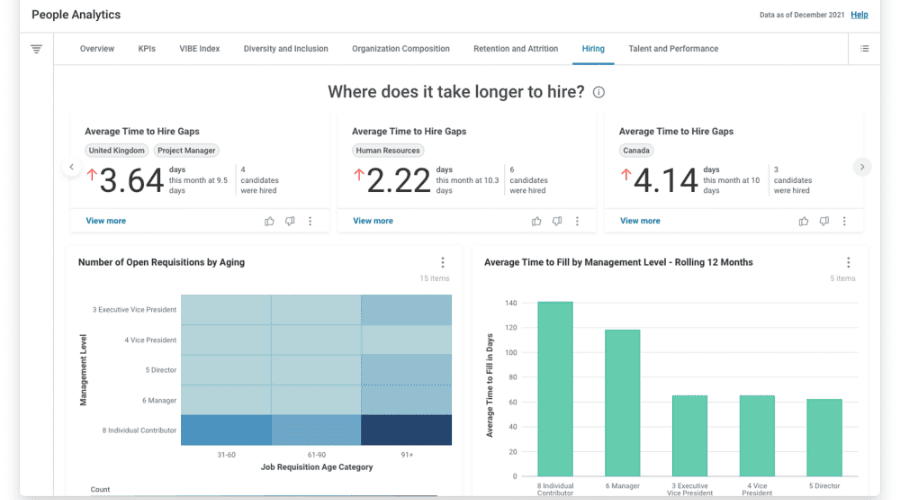
Features:
-
Onboarding through to career development in one platform.
-
AI-powered skills management, internal mobility, and talent visibility.
-
Performance enablement: goals, feedback, recognition.
-
Unified HR-and-finance platform (so talent sits with the broader HR stack).
-
Analytics and dashboards on workforce development.
Pros:
-
Very strong enterprise capabilities for large organizations.
-
Deep integration across the talent lifecycle.
-
Modern interface with AI features.
Cons:
-
Price is high and somewhat opaque (custom quotes).
-
Implementation can be complex and time-consuming.
-
It may be over budget for smaller organizations.
Pricing: Visit the website for detailed pricing.
2. SAP SuccessFactors
The other versatile talent management system is SAP SuccessFactors, which is preferred by multinationals and is approximated as a powerful and versatile system that is so interconnected with other SAP business applications.
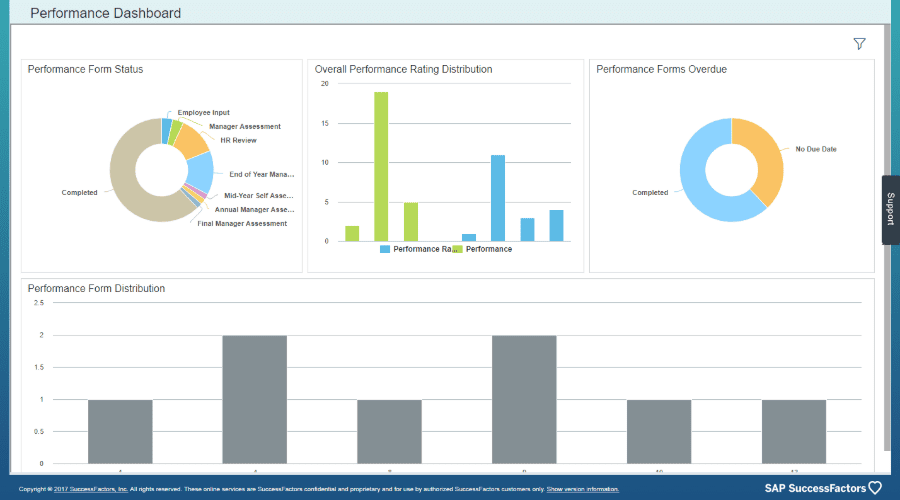
Features:
-
Cloud-based HCM suite covering recruiting, onboarding, learning, performance, and succession.
-
Employee Central Core HR plus talent-specific modules (performance & goals, learning, etc.).
-
Integration with broad HR systems and global deployment.
-
Analytics & reporting across talent management.
-
Modular architecture (you pick which modules you need).
Pros:
-
Highly scalable, good for global/multi-country organisations.
-
Broad talent-management functionality.
-
Strong reputation & many customers.
Cons:
-
It can be expensive, especially with many modules.
-
User interface and ease-of-use are sometimes criticized (learning curve).
-
Configuration/implementation can be complex.
Pricing: Visit the website for detailed pricing.
3. Rippling
Rippling is a full-service workforce platform with a well-known high level of automation and attention to the IT/HR/finance relationship. It is one of the leading competitors of modern, high-growth, and small-to-midsize talent management software companies.
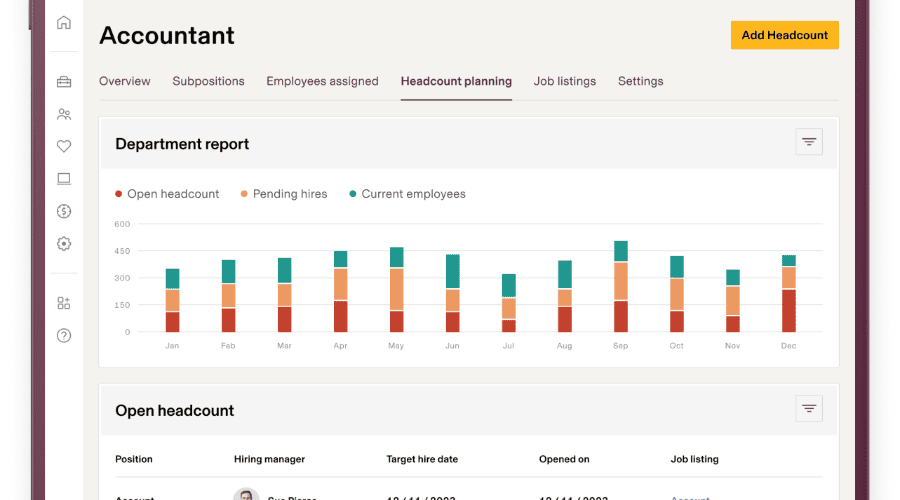
Features:
-
Unified platform covering HR, payroll, IT, benefits, talent, and workforce operations.
-
Onboarding/offboarding automation, unified directory, and workflow studio.
-
Performance management, applicant tracking, and talent lifecycle.
-
Integrations with many third-party apps and modular add-ons.
-
Multi-module pricing, so you pick HR + IT + payroll if needed.
Pros:
-
Very modern, intuitive interface; highly rated by users.
-
Excellent automation of many routine tasks (reducing manual work).
-
Good fit for companies that want to combine HR + I, T + operations in one system.
Cons:
-
Pricing can escalate with add-ons; modules add up.
-
Some users mention transparency of pricing and future cost increases as a concern.
-
It might be more than what a small company needs if only basic talent functionality is required.
Pricing: Visit the website for detailed pricing.
4. ADP Workforce Now
ADP Workforce Now is among the most established and most recognizable HR solutions, and this tightly integrated platform is particularly sound in payroll, benefits and core HR capability, which is the reason why it is a reliable benchmark in the software evaluation in talent management.
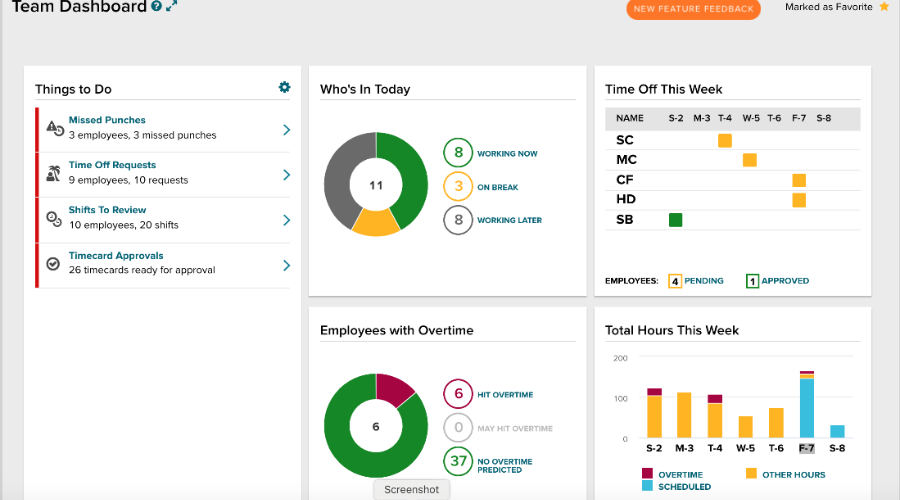
Features:
-
All-in-one HR platform: payroll, benefits, talent management, time & attendance.
-
Talent management portion: hiring, onboarding, performance, and learning.
-
Strong compliance, tax capabilities, and integrations.
-
Employee self-service portal for HR tasks.
-
Scalable for mid-sized to larger organizations.
Pros:
-
Very strong payroll + tax + compliance functions (good foundation).
-
Scalable to larger organizations; trusted brand.
-
Broad integrations and HR ecosystem.
Cons:
-
Talent management modules may require add-ons (increasing cost).
-
The interface or user experience may feel dated compared with new cloud-only players.
-
Costs for smaller businesses may be high; implementation & customization can be heavy.
Pricing: Visit the website for detailed pricing.
5. Paycor
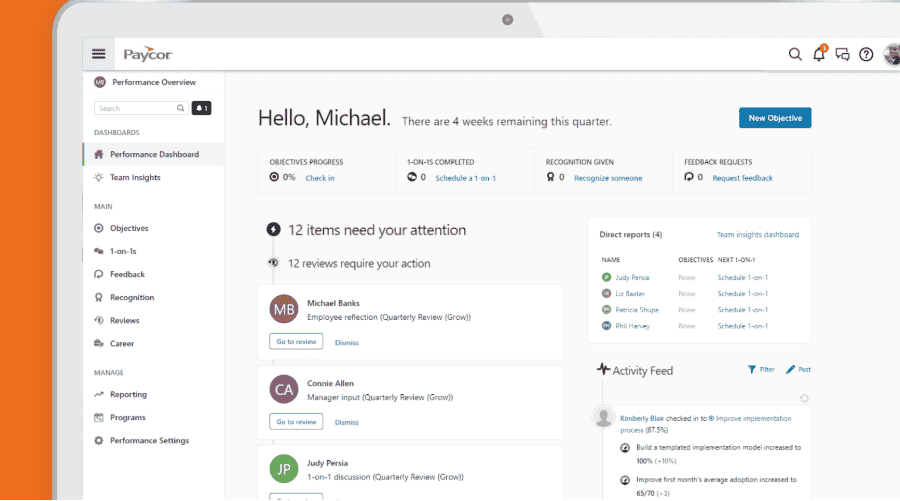
Paycor is a small- to mid-sized business human capital management (HCM) solution company, which uses predictive analytics and coaching technology to enable managers and leaders. It is an interesting talent management system within organizations that are oriented towards leadership development.
Features:
-
Talent development: goal-setting, 1:1s, peer feedback, and performance review.
-
Applicant Tracking System (ATS) with recruiting and onboarding functionality built in.
-
Analytics & reporting for workforce data, talent pipeline.
-
Integrated HR + payroll + benefits functions.
-
Developed for the mid-market; simpler deployment compared with enterprise-only systems.
Pros:
-
Strong talent management tools, especially for mid-sized companies.
-
Good balance of technology and service/support for HR operations.
-
A unified platform helps reduce administrative overhead.
Cons:
-
Global/multi-country capabilities may be limited compared to large enterprise tools.
-
Some users report multiple databases/data silos within the system, affecting real-time reporting.
-
Pricing and fee structure are not always transparent; they may require implementation fees.
Pricing: Visit the website for detailed pricing.
5. Why Do Organizations Face Challenges of Talent Management Software Today?
Though the advantages are quite evident, the introduction of talent management software is a major project that is associated with unique challenges. The knowledge of these challenges is the initial step of a successful deployment.
1. Implementation and Integration Challenges
All these barriers can be technical and financial in nature and have to be planned.
-
High Cost: It can be quite expensive to initially invest the thousands of dollars in the license and implementation, as well as training, particularly when it comes to enterprise-tier platforms. This usually entails having a powerful business case that will be used to justify the return on investment (ROI).
-
Integration with Existing Systems: The ultimate objective is to move to a unified system, but the integration of the new platform with the legacy systems, e.g., financial software, CRM, and the best applicant tracking software, may be very complex and difficult to implement.
-
Data Migration Issues: The old systems or spreadsheets to the new talent management tool should be accurately transferred with the historical information of the employees, their compensation, and performance reviews to prevent compliance errors and operational errors.
-
Security Risks: Storing all sensitive employee and corporate information in one repository poses an additional risk to the occurrence of a security risk in case the security measures of the platform are not well developed or the access controls of the internal system are poorly defined.
2. User Adoption and Operational Challenges
A system can only be as good as the number of people who utilize it well.
-
Resistance to Change: Employees and managers who have become used to old and manual processes may not be willing to change to a new system. This demands change management plans and a clear description of the why.
-
Steep Learning Curve: There are complex platforms, although powerful, which may be too complex or lack intuition, resulting in low adoption by the user and making it frustrating to use.
-
Reduced Human Interaction: As much as automation is essential to efficiency, excessive use of the system to obtain all feedback and developmental information may unwittingly diminish the presence of valuable, face-to-face, manager-employee interaction.
-
Data Overload and Poor Analytics: The system produces huge volumes of data. In the absence of appropriate training and proper reporting, HR departments may find it hard to transform such unprocessed data into strategic decision-making information.
3. Functional and Strategic Challenges
These concerns narrate the alignment of the technology to business needs.
-
Limited Customization: There are systems that are out-of-the-box simple but cannot be adjusted to specific organizational requirements, and this may be crucial to large or specialized companies.
-
Ineffective Use of AI: There are numerous systems that claim to have AI, yet the reference data is of poor quality, or the AI functionality is merely an add-on rather than a fundamental component of these systems; then the usefulness of such functions as personalized learning suggestions is reduced.
-
Inadequate Scalability: Selecting a talent management software that is currently suitable for your small business, yet will not be able to support the complexity of a workforce that will grow quickly, may result in a costly and disruptive migration process later. This is a pitfall that is usually faced by organizations that fail to see long-term growth.
-
Misalignment with Business Strategy: The final dilemma is that the new system deployed is not really aligned with the overall strategic objectives of the company, such as the decision to select a system characterized by heavy compliance when the key objective is the fast development of innovation and responsiveness.
6. Which Trends in Talent Management Software for 2025 Will Shape HR Strategies?
The talent management application landscape is in a steady state of development due to the blistering innovation in the technological world and the changing global workforce. The following are the crucial trends that should be considered when choosing cloud-based hr software in 2025:
1. Hyper-Personalization Generative AI.
AI is no longer just a simple automation. In 2025, anticipate GenAI to generate hyper-personalized experiences, e.g., writing personalized job descriptions, learning content, and even giving coaching recommendations to managers on the spot before important performance discussions.
2. The Emergence of Skills-Based Architectures.
Companies are turning their backs on more fixed job descriptions to a more flexible approach based on skills. The systems of talent management in 2025 will be based on the skills taxonomies, where AI will constantly inventory, evaluate, and align the skills of employees with internal opportunities, learning directions, and even projects in an internal talent marketplace.
3. Performance Enablement Rather Than Performance Management.
The emphasis will be squarely placed on the constant development and real-time assistance. The features promoted on platforms will be those that encourage frequent and futuristic check-ins with forward-looking functionality obtained through easy-to-use, leading employee performance software to ensure high engagement and velocity with SaaS businesses.
4. Profound People Analysis and Foretelling.
Such predictive services as the likelihood that high-potential employees will leave or that a skills bottleneck will occur within a team will become the norm. Workforce management system software vendors are the most strategic partners due to this trend because they provide deep and integrated analytics.
5. Experience-Centric Design
As the HR technology sector and the consumer-grade design converge, the talent acquisition software systems that thrive will be those with intuitive, mobile-first, and ssuper-engaginguser interfaces that stand at the same level of effortless experience as the well-known consumer applications. It focuses on the reduction of friction and enhancing employee well-being with tools designed directly within the workflow.
7. Conclusion
The decision to select the optimal talent management software solutions is a strategic decision with a high stake, which will touch all sides of your organization, from finance to the front-line productivity. It is about finding one unified platform that does not only process your administrative duties but is also used as the engine of your people strategy. Begin with what you are currently struggling with and what you want to achieve in the future as far as strategic talent is concerned.
