
Best Payment Management Software in
Are you looking for Payment Management Software for your Business in ? SaaS Adviser brings you the best Payment Management Software to ease your worries. In order to make your work smooth and swift, SaaS Adviser has compiled a list of the best software available. Compare the Best software features, pricing, free demo, and trial to select the best Payment Management Software for your organization.
 Researched and Written by Akash Patel
Top 3 Featured Softwares


List of Top Payment Management Software
Get Free Consultation


Easebuzz
Simple. Fast. Reliable. Payment solutions to power your businessEasebuzz, a software-enabled payments platform, is designed to help small businesses digitize their payments without worrying about business process issues. As they grow, companies...
View Profile

Online Paystub Generator

By Online Paystub Generator
The QuickPaystubs Online Paystub Generator is the simplest, most user-friendly tool on the market for creating accurate, professional pay stubs. You don't need any special knowle...
View Profile

SecurionPay is a cross-device payment platform that enables businesses to accept online payments in 160 currencies through the checkout translated into 23 languages. They have st...
View Profile

Easy Incentivizer
Commission Calculation Made EasyEasy Incentivizer allows you to automatically calculate the commissions of your sales agents/representatives for the opportunities that they close won. Manage their commissions and...
View Profile

Viewpost
By Viewpost
Viewpost is an electronic payment tool that allows businesses to eliminate the inefficiency and cost of sending paper checks. It is a simple, effective, and differentiated electr...
View Profile

Mollie is a digital payment solution that enables businesses of all sizes to implement an easy-to-use payment solution with intuitive features. This is a great tool for businesses ...
View Profile
.png "OnePay")
OnePay
OnePay: Simplifying All-in-One Payment Gateway SolutionsGet secure payment solutions with OnePay, an omnichannel payment gateway. Our payments enables merchant transactions and facilitates fast payments with unmatched security. We are p...
View Profile

FormPay By MakeWebBetter
HubSpot Payment Integration to Accept Payments with HubSpot FormsAccept payments or donations from multiple payment gateways within HubSpot. Try FormPay to create HubSpot payment forms and accept money through them, instantly, on your website.
View Profile

ITG Website Development
CMS Based Dynamic WebsiteIT Globalizer is a provider of web development services for the hospitality industry. Build customized software for your business. Enlist the services of IT Globalizer to design an...
View Profile

EduAx - Education ERP Software, can be defined as all-in-one School Management System Software in Salem, Tamilnadu, that is specifically designed and developed to simplif...
View Profile

DataPath Summit
COBRA and Billing
DataPath helps TPAs get where they want to grow by innovating business and technology solutions for consumer-directed healthcare accounts, COBRA, billing, and well-being benefits.
View Profile

Optimus Fintech
AI-Powered Financial OperationsOptimus Fintech is an advanced financial management platform designed to streamline payment reconciliation, analytics, and automation. Leveraging AI-powered tools, it enables busin...
View Profile

North One
Connect every part of your business to one bank account
North One transform the bank account from a basic utility to a financial platform that gives our customers a greater shot at success.
View Profile

Carepatron
By Carepatron
CarePatron software is a platform that automates workflows by managing client records and video calling. The software offers a Client Portal that allows doctors and patients to acc...
View Profile

Nuvopos
We make it easy for you
What is Nuvopos? Nuvopos is a modern Point of Sale (POS) software designed to help businesses streamline their sales, inventory, and customer management processes. It offers an in...
View Profile
TalentDesk.io
Conquer chaos with our Freelancer Management System
TalentDesk.Io is a cloud-based, totally freelancer and contractor control software designed to assist businesses in efficaciously manipulating their external workforce. It offers a...
View Profile

Lano
Building the future
of global payroll
Lano is more than just a global payroll and compliance platform. Our team is working tirelessly to transform global payroll and HR management to help businesses succeed. Lano's...
View Profile

Thera
Payroll, Treasury, and Payments for Global Teams
Thera is an integrated global payroll and financial operations platform designed to simplify workforce management for companies operating across international borders. Tai...
View Profile

DMS Trail
designed to simplify order processing, sales tracking, and inventory management for Fast-Moving Consumer Goods (FMCG) businesses
DMS Trail is the ultimate Distribution Management System designed for FMCG and manufacturing companies to streamline their distributor network, optimize inventory, and imp...
View Profile
.jpg "MX Merchant")
MX Merchant
Simplify Payments. Empower Business
What is MX Merchant? MX Merchant is a robust U.S.-based payment processing and business management platform tailored for American merchants. It helps streamline in-store, onli...
View Profile

Table of Content
For companies aiming to optimize financial interactions, minimize manual inaccuracies, and improve cash flow management, prompt payment processing is a key to success. Payment services automation software alters invoicing, payment reconciliation, and payment monitoring for effortless workflows. These systems are used by businesses in all sectors to manage various payment types such as credit cards, bank deposits, and e-wallets.
As the need for timely and reliable payment processing increasingly grows, payment management systems provide enhanced security, compliance to regulations, and payment processing visibility. Such platforms connect to accounting packages, e-Commerce platforms, and banks which allows organizations to experience holistic financial management. By automating payments being made, businesses lower operational expenses, increase financial precision, and boost customer experience.
Let's further discuss the operation of these systems, the elements and functions of systems, and the most suitable software selection for your company.
What is Payment Management Software?
Payment management software is defined as a particular means that assists companies in securely processing, managing, and tracking all monetary transactions. It enables the businesses to automate invoicing, use diverse payment methods, and adhere to business regulations. There is less operational redundancy because these management systems integrate with accounting, monitor transactions, lower manual errors, and provide real-time monitoring. Companies use these tools to enhance financial transparency, security, and cash flow efficiency.
1. Conclusion
If you choose the right payment management software for your business, it will handle multiple transactions daily. These tools will help you streamline payment processes and improve security. Also, you will love the handy financial reporting. There are amazing platforms like Xero and QuickBooks that offer unique features suited to different business needs.
As a business owner, you must prioritize automation and integration capabilities when you select a payment management solution. By implementing the right software, you can optimize cash flow and reduce operational costs. If you want more insights and expert recommendations on the best SaaS solutions, we recommend you visit SaaS Adviser.
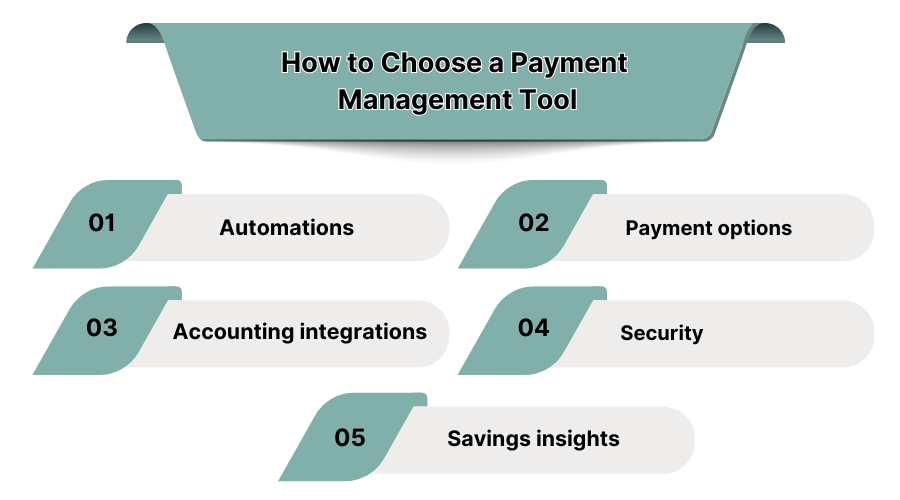
2. How to Choose a Payment Management Tool
-
Automations
Opt for tools that self-bill, self-issue invoices, and self-generate reconciliation to reduce manual workloads.
-
Payment Options
Check if the platform allows for payment by way of bank transfer, digital wallets, and credit card payment processing.
-
Accounting Integrations
Seek programs that incorporate QuickBooks, Xero, Sage, and other accounting packages without a hassle.
-
Security
Give preference to those tools that offer encryption, detection of fraud and other compliance security standards such as PCI DSS.
-
Savings Insights
Pick tools that provide analytical and financial information of cash flow and expenses for better management.
3. Five Best Payment Management Platform in USA
1. Xero
Xero is an online accounting software and payment processing platform created for small businesses. As a small company owner, you can benefit from automated tools for invoicing, billing, bank reconciliation, and much more which will simplify the financial operations of your business. Also, Xero's multi-currency feature will make it easier for you to operate internationally.
Pros:
-
Ideal for small businesses managing finances efficiently
-
Integrates seamlessly with major accounting and payroll tools
-
Real-time reporting and analytics for financial insights
-
Secure cloud-based access from multiple devices
-
Supports automatic payment reminders for overdue invoices
Cons:
-
Limited advanced payment processing options compared to full-scale platforms
-
Customer support can be slow during peak times
-
Some features require additional add-ons, by increasing costs
-
Transaction processing is not as robust as dedicated payment platforms
-
Free trial is limited for certain features
Pricing: Starts at $13/month
2. Chargebee
Chargebee is a top tier platform for billing subscriptions which is popular among SaaS businesses and companies which have recurring revenue models. Often, invoicing, revenue recognition, and dunning tasks that need to be performed in a timely fashion are automated to ensure payments are not missed.
Pros:
-
Best for SaaS businesses that require automated subscription billing
-
Supports multiple payment gateways for seamless transactions
-
Advanced reporting tools for revenue tracking and forecasting
-
Customizable checkout and pricing options
-
Helps businesses improve customer retention with smart features
Cons:
-
Complex setup for beginners unfamiliar with subscription management tools
-
Custom pricing makes cost estimation difficult for startups
-
Some advanced analytics features require higher-tier plans
-
Not ideal for businesses that primarily operate in one-time transactions
-
Customer support response times may vary
Pricing: Custom pricing based on usage
3. Sage 50
Sage 50 offers payment tracking and forecasting solutions. Also, there are compliance management tools in Sage 50, which makes it among the best financial management systems. This software is highly useful if your business requires in-depth financial information while also ensuring tax compliance.
Pros:
-
Comprehensive reporting features provide deep financial insights
-
Integrates well with major accounting and tax management systems
-
Suitable for medium-sized businesses needing compliance tracking
-
Automates recurring payments and vendor transactions
-
Offers industry-specific accounting solutions
Cons:
-
Not ideal for eCommerce businesses requiring online payment processing
-
Requires a learning curve for non-accounting professionals
-
Higher pricing compared to some cloud-based alternatives
-
Lacks flexibility for businesses with high transaction volumes
-
Some features are locked behind premium plans
Pricing: Starts at $44.97/month
4.QuickBooks
It is one of the leading software firms, as it has designed an accounting and payment management platform that takes care of invoicing, payment, and payroll management. Freelancers and small to medium sized enterprises often turn to this software for managing their finances.
Pros:
-
Suitable for freelancers and SMBs looking for an all-in-one solution
-
Easy-to-use interface with a minimal learning curve
-
Supports online payments and direct bank transfers
-
Secure cloud storage with automatic backups
-
Scalable pricing plans for different business sizes
Cons:
-
Transaction fees apply for credit card and ACH payments
-
Higher-tier plans are needed for advanced automation features
-
Customer support can be slow during high-demand periods
-
Limited multi-currency support compared to other platforms
-
Additional costs for payroll and tax compliance tools
Pricing: Starts at $30/month
5. Upflow
Upflow provides a reliable website for collecting payments while focusing on the automation of accounts receivable. It enables businesses to manage their invoices, reminders, and collections for better cash flow management.
Pros:
-
Best for businesses managing multiple invoices and accounts receivable
-
Helps optimize cash flow and improve on-time payments
-
Reduces manual workload by automating collections and reminders
-
User-friendly interface with easy-to-read dashboards
-
Supports multi-team collaboration for finance departments
Cons:
-
Limited payment processing features compared to full-service platforms
-
Custom pricing makes budgeting difficult for small businesses
-
Does not offer direct payroll or tax management tools
-
Integration options are limited compared to competitors
-
Requires additional setup for detailed analytics
4. Features and Benefits of Payment Management Software
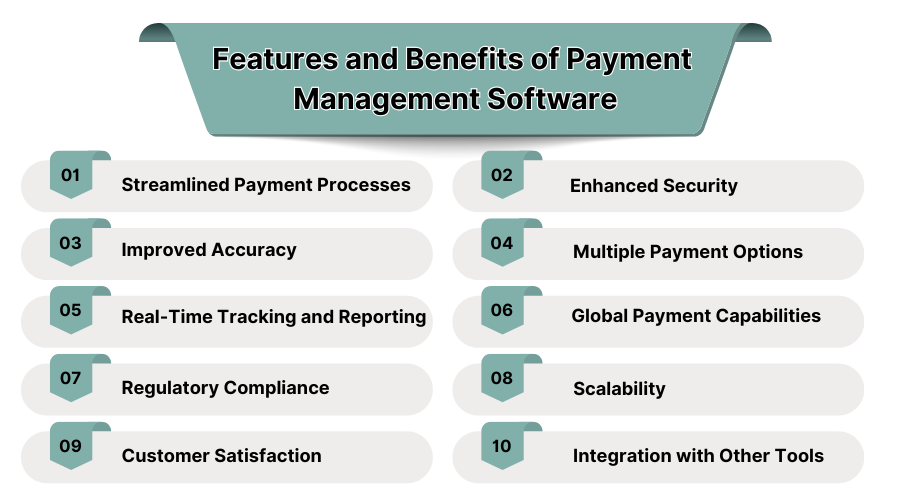
An effective payment management system allows the user to enjoy a list of features that will improve transactions, increase security, and make the entire payment system easier. Here are some of the features with their corresponding benefits:
-
Streamlined Payment Process
A shocking fact is that this domain market is expected to reach a worth of USD 148.50 billion by 2031. It shifts the responsibility of payment processing from the staff to the system. Payments can be smoothly made without any chances of humans making firsthand errors during the input of data into the system.
-
Enhanced Security
Employes features including but not limited to encryption, tokenization, and multi-factor authentication to protect critical payment data. Identification of dubious transactions is handled via fraud detection algorithms and other multi query systems, thus curtailing financial losses.
-
Improved Accuracy
Invoices, payment processing, and reconciliation are some of the areas that can have errors surgically cut down through automation. With accurate financial data, cash flow management becomes much smoother and record discrepancies are lowered.
-
Multiple Payment Options
Provides payment options such as credit/debit cards, bank transfers, as well as digital wallets. Increasing the means of payment by a number improves customer engagement and increases the likelihood of successful transactions.
-
Real-Time Tracking and Reporting
Instant updates on revenues gained from financial transactions allows a business to monitor revenue in real time, detect any inconsistencies, and utilize data for effective financial decision making. Reports can be altered to reveal patterns, customer payment trends, and volumes of transactions.
-
Global Payment Capabilities
Shopping becomes simpler with support of multi-currency and cross border payments. Businesses can now conveniently conduct international operations. Tools for conversion and calculations of exchange rates between currencies allow for hassle free global transactions.
-
Regulatory Compliance
Compliance with financial regulations like PCI DSS, GDPR, and error automated tax calculation can pose a challenge for many businesses. With France, on the other hand, these legal risks can easily be reduced while the hassle of administration increases.
-
Scalability
The handling of high volumes of transactions as business grows is properly handled. Software for payment management needs to be designed for executing thousands of transactions smoothly without losing efficiency.
-
Customer Satisfaction
Delivers an effortless final purchase step, minimizing payment obstacles and boosting the retention rate. User experience is enhanced by features such as one-click payment systems and recurring billing as well as instant confirmation of payment receipt. If you also use a business management software with it, your business will run smoothly as both business & payment will be streamlined.
-
Integration with Other Business Tools
Links with accounting applications (QuickBooks, Xero, Sage), ERP systems, and even with payroll services. This integration facilitates the free transfer of financial information within the company’s various departments, thus eliminating redundancy and increases productivity.
5. Exploring the Types of Payment Management Software Available in the Market
Payment processing software that can be divided based on the features that allow business to securely perform transactions. Payment Management Software is used at various levels of an organization. The systems developed for corporations and small businesses have differing features within them. Enhanced flexibility, automation, and security are at the forefront of transaction optimization for these systems.
1. Hosted Payment Gateway Systems
Payment is processed through gateways which use third party service providers, host payment systems. Customers are redirected to an external payment page where the service provider will manage the payment. Hosted payment gateways are mostly adopted by smaller, medium sized businesses that do not possess the resources for self-management of transaction security and compliance. A dedicated payment gateway software can also be a great choice to implement in your business as it allows various payment options.
Advantages:
-
No need to store payment data, reducing security risks.
-
Ensures compliance with industry standards like PCI DSS.
-
Quick and easy to implement with minimal technical setup.
Disadvantages:
-
Redirecting customers to external pages may reduce conversion rates.
-
Limited customization options for branding and user experience.
2. Self-Hosted Payment Gateway Software
Self-hosted payment gateways allow transaction processing to be conducted on the company's infrastructure. Payment information is gathered on the website of the company and then submitted to a payment processor for verification. With this method, the organization controls every detail of the payment process.
Advantages:
-
Allows businesses to customize the payment experience.
-
Provides greater control over data security and compliance.
-
Eliminates the need for third-party redirection, improving user experience.
Disadvantages:
-
Requires strict compliance with PCI DSS and other security regulations.
-
Demands technical expertise for integration and maintenance.
3. API Payment Gateways
An API payment gateway incorporates itself into the company’s website or app via an application programming interface. The interface facilitates transaction processing without taking users to a third-party payment page which is a seamless transaction process.
Advantages:
-
Provides a fully customizable payment experience.
-
Supports multiple payment methods, including credit cards and digital wallets.
-
Allows businesses to retain control over transaction data.
Disadvantages:
-
Requires in-house developers to integrate and maintain the API.
-
Security responsibilities fall in the business, increasing compliance requirements.
4. Local Bank Integration Platforms
Local bank integration platforms link a company directly to banks for transactions. This work eliminates the need for a third-party payment processor which lowers transaction cost and increases efficiency.
Advantages:
-
Faster transaction processing with lower fees.
-
Ensures direct compliance with local banking regulations.
-
Reduces dependency on external payment service providers.
Disadvantages:
-
Limited to specific geographical regions or banking networks.
-
May lack support for global transactions and multiple currencies.
6. What Are the Perks and Drawbacks of Using Payment Management Solutions?
Solutions for payment management are among the most important within any organization, and they facilitate the automation of business processes, securing financial information, and improving operational efficiency and management.
These systems have a myriad of advantages, but some drawbacks are evident. Knowing the advantages and disadvantages helps to pick the appropriate software for the firm’s needs.
-
Complete Flexibility in Payment Operations
Different methods of payments such as credit cards, direct bank payments, and wallets are supported through the payment management software. Such flexibility makes sure that business payment processing is smooth on all platforms so that the clients from different regions can be attended to.
-
Faster Transaction Processing
Automatic approval of payments eliminates the tedious manual work of processing transactions. This, in return, reduces expenditure in the time taken per transaction, enhances cash flow, and allows easier processing of a larger volume of payments which eliminates delays in issue and financial dealing with orders.
-
Better Security
Sophisticated payment management systems with fraud detection capabilities enable sensitive and critical financial information to be safe from unauthorized attacks preventing transactions that are not sanctioned. Sophisticated security enables acceptance and adherence to their financial laws and regulations by doing business with customers of high trustworthiness.
-
Lesser Operational Costs
Automating the payment process limits the requirement for manual entry and financial reconciliations which minimizes administrative costs. Companies save on costs by minimizing inaccuracies and reducing reliance on manual intensive payment tracking.
-
Save Time And Increase Efficiency
Automated payments also help in the simplification of other systems such as the generation of invoices, verification of transactions and reconciliation. This helps companies focus more on key areas that help to drive growth instead of repetitive administrative work. Also, you can opt for an absence management software if you want to keep a track of your employees’ timetable.
-
Improved Business Operations
Payment management solutions provide detailed reports about the operations of the company which aids in the revenue generation, cash flow management and overall financial performance assessment. This helps the company make sound allocation of expenditures and investments in the business.
-
Scalability for Growth
From small startups to large companies, payment management software fits the increasing volume of transactions while using the system. This type of software grows smoothly with the business and makes sure that companies do not experience any constraints with regards to payment processing as the business develops.
-
Dependence on Internet Infrastructure
Web-based payment managers require access to the internet to carry out essential functions. A business operating in regions that have connectivity issues will face challenges while trying to process payments as there will be delays and loss of revenue.
-
Technical Support Delays
Since payment processing software is dependent on outside vendors, there may be delays in the receipt of assistance. Customer services may be impacted negatively since troubleshooting is usually more tedious than it is straightforward.
-
Integration Challenges with Existing Systems
Certain clients might encounter problems concerning the integration of the payment processing software with the existing accounting, payroll, or even client management systems. There might be a need for further customization that adds a great deal of expense and time.
Regardless of these drawbacks, payments processing services offer value to businesses that want to optimize operations, strengthen security, and polish their financial powers.
7. How Does Payment Management Software Work?
Payment management software ensures unproblematic payment of finances by automating vital steps within the payment process. It establishes connections with the banking system, e-Commerce, and accounting system, which is something crucial for business transactions.
The software, in addition to validating payment of details, also processes payments in real-time while generating reports for the client. More sophisticated systems offer detection of fraudulent activities as an additional layer of protection. Businesses are able to optimize precision by integrating advanced systems with other payment methods. Credit cards, digital wallets, and bank transfers can now be received unmanned.
