
Best Headless CMS Software in
Are you looking for Headless CMS Software for your Business in ? SaaS Adviser brings you the best Headless CMS Software to ease your worries. In order to make your work smooth and swift, SaaS Adviser has compiled a list of the best software available. Compare the Best software features, pricing, free demo, and trial to select the best Headless CMS Software for your organization.
 Researched and Written by Akash Patel
Top 3 Featured Softwares


List of Top Headless CMS Software
Get Free Consultation


Lucidcms

By Lucidcms
Configure a free minimal headless CMS online in seconds to use up-to-date content in your project.
View Profile

Justfields
By Justfields
Justfields is a content management system (CMS) that provides companies with an easy and fast way to use up-to-date content in their projects. The CMS is specially designed to man...
View Profile

Easyweb Headless CMS
By Easyweb Headless CMS
Easyweb is an easy-to-use, minimalistic headless CMS that is ideal for crafting custom websites, shops, applications, and digital projects. As its name suggests, Easyweb comes wi...
View Profile

Headlesshost
By Headlesshost
Headlesshost provides a revolutionary way of making website updates and data entry easier than ever before. It drastically reduces complexity by creating an assumed structure, wh...
View Profile
This cloud-based visual headless CMS helps you create and launch websites faster. It's a serverless and highly secure headless CMS tool. It has a WYSIWYG editor that lets you vie...
View Profile

Sanity is a management system that helps you create and deliver high-quality content to digital devices and products. It provides solutions for things like landing page builder, ...
View Profile

Storyblok is an intelligent tool that helps businesses take care of their content in a systematic manner. The visual composer gives a preview of the changes users make to their w...
View Profile

Quintype is a digital publishing solution that offers users complete freedom to publish, distribute, and monetize content without facing any tech hiccups. The platform provides a...
View Profile

Prismic is a free, cloud-hosted and API-based headless CMS. It comes with a text editor, e-forms, customizable templates etc. You can conduct full-text search, document indexing an...
View Profile

Butter CMS is an easy to use marketing dashboard and fast content API for modern apps. It offers a Global content API, which integrates into any tech stack while saving time throug...
View Profile

It empowers the global and regional teams of businesses to manage their content in the way they want. Users can leverage the platform to streamline their global content, utilise d...
View Profile

This is a popular cloud-hosted headless CMS platform that is available in a free version as well. It supports full-text search, video content, text editor and helps in doing webs...
View Profile

GraphCMS is a headless CMS that offers a convenient way to manage content and build a GraphQL API infrastructure for digital products. It is fully API focused, allowing users to ...
View Profile
This headless CMS is a cloud-based software product by San Francisco-based Built.io. You can expand your traffic and be in control of your data without worrying about the infrastru...
View Profile
DotCMS is a tool that provides flexible API-first infrastructure that comes with NoCode, which lets users build, manage, and provide continuous, trusted, and connected customer exp...
View Profile

Strapi is an open-source headless CMS coded in JavaScript. Being open-source, it is a developer-focused software and completely customizable, which enables easy development of se...
View Profile
Magnolia
By Magnolia
Magnolia is a company that specializes in creating better customer experiences through digital means. We help brands stay ahead of their competition by offering faster DX projects ...
View Profile

Bold is an innovative content management system that is doubtlessly the best of the lot. It is a well-integrated, powerful solution for creating, curating and then eventually, di...
View Profile
DatoCMS is a website builder tool that enables users to manage content efficiently using its headless CMS protocol. With its GraphQL, users can feed content into their web portal...
View Profile

Payload CMS
By Payload CMS
PayloadCMS is a headless CMS (Content Management System) built with Node.js, designed for developers who want full control over their content architecture, APIs, and data mode...
View Profile

Table of Content
What is Headless CMS Software?
Headless CMS, or Content Management System, is a type of software that allows developers to manage and deliver content without being tied to a specific front-end delivery layer or system. This decoupled approach separates the content repository (the "back-end") from the presentation layer (the "front-end"), hence the term "headless". It offers more flexibility for content distribution, making it easier to deliver content across multiple platforms such as websites, mobile apps, IoT devices, and more. In essence, a headless CMS focuses purely on storing and delivering structured content, leaving the task of displaying that content to the application or platform accessing it. Headless CMS in US can be seen as the evolution of traditional CMS, which were often tied to a specific front-end and limited in their capabilities. With a headless CMS, developers have more freedom in how they choose to present their content and are not restricted by the limitations of a specific front-end system. This allows for more innovative and dynamic experiences for end-users.
1. How SaaS Adviser Headless CMS Software Solution Supports Your Business
SaaS Adviser, a software listing platform, has proven itself to be a reliable resource for evaluating and selecting headless CMS software. Its extensive listings, objective reviews, and user-friendly interface make it an invaluable tool for businesses looking to adopt the most fitting software solution for their needs. Through leveraging the potential of SaaS Adviser, companies can optimize their operations and drive their success to new heights. SaaS Adviser offers a wide range of features to assist businesses in their software selection journey. These include advanced filtering options, price comparison tools, and personalized recommendations based on specific business requirements. This ensures that companies are able to make informed decisions and choose the best headless CMS software for their unique needs.
2. How to Choose the Right Online Headless CMS Software?
Choosing the right online headless Content Management System (CMS) software requires careful consideration of several factors. Firstly, evaluate the software's API capabilities to ensure it can deliver content to any device or channel. Secondly, consider scalability. As your business grows, your CMS should be able to handle increased traffic and content without compromising performance. Thirdly, check the flexibility of the content modelling. A good CMS allows you to define and customize your content structure based on your specific needs. Lastly, consider the support and community surrounding the CMS. A strong and active community can be a valuable resource for troubleshooting and expert advice.
- Additional Factors to Consider
There are several more factors that you can take into consideration when choosing the right online headless CMS software. These include security, integrations, user-friendliness, and cost.
- Security
Security is a crucial aspect of any online platform, especially when it comes to managing content. Make sure to thoroughly research the security protocols implemented by the CMS software you are considering. Look for features such as encryption, user access controls, and regular security updates.
- Integrations
An online headless CMS should be able to easily integrate with other tools and platforms that your business uses. This could include e-commerce platforms, marketing automation systems, customer relationship management (CRM) software, and more. Check if the CMS has pre-built integrations or if it has open APIs that allow for easy integration.
- User-Friendliness
While functionality and features are essential, the ease of use of a CMS should not be overlooked. A user-friendly interface makes it easier for your team to create, manage, and publish content without any technical expertise. Consider doing a trial run or requesting a demo to see how user-friendly the CMS is.
- Cost
The cost of a CMS can vary greatly, depending on its features and capabilities. It's essential to determine your budget and find a CMS that fits within it. Keep in mind that the cheapest option may not always be the best choice, as it may lack critical features or have hidden costs. Consider the long-term return on investment when evaluating the cost of a CMS. Ultimately, choose a CMS that offers the best value for your budget and business needs.
By considering these additional factors, you can ensure that you choose the right online headless CMS software for your business. A thorough evaluation of all aspects will help you make an informed decision and find a reliable and efficient platform to manage your content seamlessly. Remember, a good CMS is not just about delivering content; it should also support your business goals and contribute to its growth. So take your time, do your research, and choose wisely.
3. The Challenges Of Headless CMS Software?
- While Headless CMS Software brings several advantages, like increased flexibility and improved content delivery, it also comes with its own set of challenges. One significant challenge is that they require a higher degree of technical skill to operate. Since they lack a front-end, developers have to build the presentation layer from scratch. This can involve complex coding and can be time-consuming. Furthermore, non-technical users, such as content creators or marketers, may find it difficult to preview and manage content without a user-friendly interface. Additionally, the absence of built-in templates can also pose a challenge as it requires additional effort to maintain consistency across different platforms.
- Another challenge that can arise with Headless CMS Software is the potential for security vulnerabilities. As the front-end presentation layer is not provided, it is the responsibility of developers to ensure that all code and integrations are secure. This includes regularly updating and patching any vulnerabilities that may arise. Headless CMS Software typically stores content in a centralized location, so there is a risk of a single point of failure. This means that if the central system goes down, all connected systems and platforms will also be affected. To mitigate this risk, it is essential for developers to have backup plans in place and regularly test the system's resilience.
- Another challenge with Headless CMS Software is the potential for compatibility issues with other systems or platforms. As each system may have its unique APIs and integrations, it can be challenging to seamlessly connect all the necessary components. This can result in technical difficulties and delays in content delivery another challenge with Headless CMS Software is the potential for high costs associated with development and maintenance. As these systems require a higher degree of technical skill, it can be costly to hire and retain skilled developers. Additionally, regular updates and maintenance for security purposes can also add to the overall cost.
4. Types of Headless CMS Software
There are several different types of Headless CMS software available in the market. Below are the main types:
- Traditional CMS: This is the most common type of CMS software. It includes both frontend and backend elements, which are intrinsically linked.
- Decoupled CMS: This type of CMS software separates the backend and front end, allowing developers to create the front end without relying on the CMS's built-in tools. Pure Headless CMS: This CMS doesn't come with a frontend layer, providing the maximum flexibility for developers to use any technology for the frontend.
- Git-Based CMS: This type allows for content editing and management directly within the codebase.
- API-first approach: This means that the CMS is built with an application programming interface (API) as the primary method for accessing content and data. This allows for easy integration with other systems and applications.
- Scalability: Headless CMS software should be able to handle large amounts of content and traffic effectively, especially if the organization expects growth in the future.
- Multichannel distribution: This feature allows for content to be distributed across various channels, such as websites, mobile apps, and social media platforms. This is especially important for organizations with a strong online presence.
5. How Headless CMS Software Can Help Your Business?
- Headless CMS software can be a game-changer for your business, offering a flexible, scalable and future-proof content management solution. Unlike traditional CMS, a headless CMS separates the content repository 'body' from the presentation layer 'head', allowing businesses to store their content in one place and publish it across any platform. This can greatly simplify content management, particularly for businesses targeting multiple channels, such as web, mobile, IoT devices, and more. Additionally, a headless CMS typically comes with API-based architecture, supporting a faster and more agile content delivery process. From a business perspective, this Transactional email software to quicker time-to-market, enhanced user experiences, and ultimately, a competitive edge in the digital marketplace.
- Headless CMS also allows for easier content updates and maintenance, as changes can be made in one place and automatically reflected across all platforms. This streamlines the content management process and reduces the risk of errors or inconsistencies. Furthermore, headless CMS offers a great level of flexibility for businesses to integrate with other systems and tools, such as analytics, eCommerce, and marketing automation software. This allows businesses to create a cohesive and streamlined digital ecosystem, where data can flow seamlessly between different systems and enable more personalized and targeted experiences for customers.
- Another benefit of headless CMS is its scalability, as it can handle large amounts of content without sacrificing performance. This is particularly important for growing businesses that need to constantly add and update content as their operations expand. In terms of future-proofing, a headless CMS allows businesses to adapt to new technologies and channels as they emerge, without having to completely overhaul their content management system. This eliminates the need for constant updates or migrations, saving time and resources in the long run.
6. Features Of Headless CMS Software
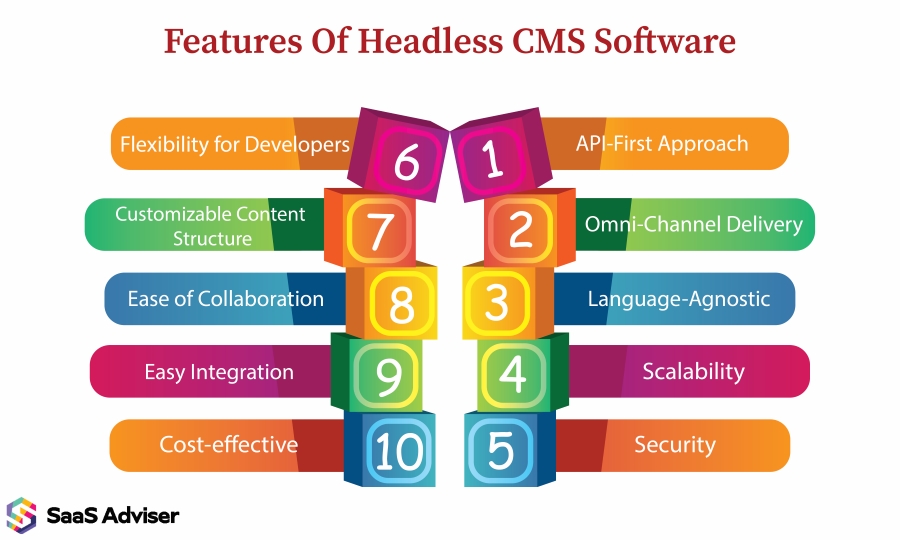
- API-First Approach: Headless CMS is designed with an API-first approach, making Content delivery network software seamless across any platform or device.
- Omni-Channel Delivery: It allows for distributing content across multiple channels, such as websites, mobile apps, IoT devices, and more.
- Language-Agnostic: As a headless CMS separates the content from the presentation, content can be passed to any front-end system, regardless of the programming language used.
- Scalability: Headless CMS is highly scalable due to its decoupled nature, able to handle high traffic loads and content volume.
- Security: In a headless CMS, the content management backend is separated from the front end, reducing security risks.
- Flexibility for Developers: Developers have the freedom to build the front end using any technology they prefer, without being tied to the constraints of traditional CMS platforms.
- Customizable Content Structure: A headless CMS allows for defining custom content types and structures, providing flexibility for different projects and use cases.
- Ease of Collaboration: With a headless CMS, teams can collaborate on content creation without the risk of AI writing assistant software and each other's work.
- Easy Integration: Headless CMS software easily integrates with third-party tools and services, providing a comprehensive solution for content management.
- Cost-effective: Headless CMS eliminates the need for separate hosting for each platform or device, reducing overall costs.
7. Benefits of Using Headless CMS Software
Headless Content Management System (CMS) software offers a range of advantages for businesses looking to create a flexible, scalable, and high-performing web presence:
- Decoupled Architecture: The separation of the backend and frontend allows developers to work on each component independently, improving workflow and efficiency.
- Omnichannel Readiness: Headless CMS enables content to be pushed across a variety of platforms and devices seamlessly, increasing reach and engagement.
- Greater Developer Freedom: By removing the constraints of frontend templates, developers are free to create custom user experiences using their preferred coding language.
- Improved Performance: With a focus on delivering content, rather than managing templates, headless CMS can often deliver faster load times, improving user experience and SEO rankings.
- Smoother Integrations: Headless CMS often supports better integration with other systems and tools, due to its API-driven nature. This allows for a more connected and streamlined Enterprise asset management software.
- Scalability: Headless CMS can easily handle large volumes of content and traffic, making it an ideal choice for businesses looking to grow and expand their online presence.
- Flexibility: With its decoupled architecture, headless CMS allows for quick changes and updates without affecting the overall functionality of the website, allowing for greater flexibility and agility in content management.
- Cost-Effective: By eliminating the need for managing frontend templates and hosting infrastructure, headless CMS can significantly reduce costs, making it a cost-effective solution for businesses of all sizes.
8. How Does Headless CMS Software Work?
- Headless Content Management System (CMS) software works differently from traditional CMS by separating the content creation from the content presentation. The 'head' refers to the front end, which is the presentation layer, and in a headless CMS, it is 'decapitated', meaning it doesn't exist. Instead, content is stored in the 'body' (the back-end) and is accessible through APIs. This allows developers to use any programming language to present the content, making it incredibly versatile for displaying on various platforms such as websites, apps, IoT devices, and more.
- A headless CMS is a powerful tool for content creators and developers alike. With its decoupled architecture, it offers flexibility and control over how content is displayed to end-users. This means that developers can build custom front-end experiences using their preferred languages and frameworks without any restrictions from the CMS itself. One of the major advantages of headless CMS software in the US is its ability to manage and distribute content to multiple channels simultaneously. This is made possible through APIs, which allow for seamless integration with third-party systems and devices.
- By utilizing a headless CMS, organizations can easily publish content to websites, Mobile analytics software, digital displays, and even emerging technologies like virtual reality and augmented reality. A headless CMS also offers better scalability compared to a traditional CMS. With a decoupled architecture, the content management system can handle high volumes of content and traffic without compromising performance. This is especially important for large organizations with multiple websites or applications that require frequent updates and changes to their content.
- Another key benefit of using a headless CMS is its flexibility in terms of design and presentation. Since content is separated from the front end, developers have the freedom to design and present content in any way they see fit. This allows for a more customized and seamless user experience, leading to increased engagement and conversions. Moreover, headless CMS also offers faster development time as developers can focus solely on creating front-end experiences without having to worry about the back-end infrastructure. This results in quicker deployment of new features and updates, giving organizations a competitive edge in the fast-paced digital landscape.
9. Why You Need Headless CMS Software?
- A Headless CMS Software is a game-changer for businesses aiming to deliver seamless digital experiences across multiple platforms. It separates the backend Content management software and Content Collaboration Software from the frontend presentation layer, thereby providing unparalleled flexibility to developers. They are no longer confined to pre-defined templates and can freely design unique user interfaces for each platform, be it a website, mobile app, or IoT device. Furthermore, with a headless CMS, content updates occur in real-time across all platforms, ensuring consistent and up-to-date information for the end-user.
- This technology aligns well with the rapid digital evolution, future-proofing your content strategy and optimizing your digital presence in the competitive market. In today's fast-paced digital landscape, businesses need to adapt quickly and efficiently to changing consumer behaviors and preferences. The rise of multiple channels and devices has made it essential for companies to have a unified content management system that can support their omnichannel strategy. This is where Headless CMS software comes into play.
- A Headless CMS decouples the backend content repository from the frontend presentation layer, allowing businesses to deliver content across various channels without any restrictions. This enables companies to create personalized and engaging experiences for their target audience on every platform they choose to engage with. Moreover, with a Headless CMS, developers have the freedom to use any programming language or framework of their choice. This means that businesses can easily integrate new technologies and adapt quickly to changing trends without any limitations. As a result, companies can keep up with the ever-evolving digital landscape and stay ahead of the competition.
10. Why Headless CMS Software It is Important?
- Headless CMS software in US is becoming increasingly pivotal in today's digital landscape. Unlike traditional CMS, which comes with a pre-defined front-end presentation layer, headless CMS is purely back-end, serving content through APIs for display on any platform. This allows developers the freedom to build a custom front-end that fits their needs. This flexibility is particularly beneficial in a world where Cloud content collaboration software to be displayed seamlessly across multiple channels, including websites, mobile apps, IoT devices, and more. It bolsters speed, performance, and scalability, making it a choice tool for businesses aiming to deliver superior user experiences and thrive in the competitive digital marketplace.
- Headless CMS software is also highly beneficial for content creators and marketers. With headless CMS, they can manage all their content in one central location, without having to worry about how it will be displayed on various platforms. This eliminates the need for duplicate content creation and ensures consistency across all channels. Moreover, headless CMS provides a streamlined workflow that allows teams to collaborate and make changes in real time, saving valuable time and resources.
- Furthermore, headless CMS offers advanced personalization capabilities. By leveraging customer data and behavior insights, businesses can tailor content for each user, improving engagement and conversions. This level of personalization has become a crucial factor in today's digital marketing strategies, as customers expect personalized experiences from brands. Another advantage of headless CMS is its ability to integrate with other systems and tools seamlessly. This eliminates the need for complex integrations, saving time and resources for businesses. It also allows for quick adoption of new technologies and channel expansions, ensuring that businesses stay ahead in the ever-evolving digital landscape.
