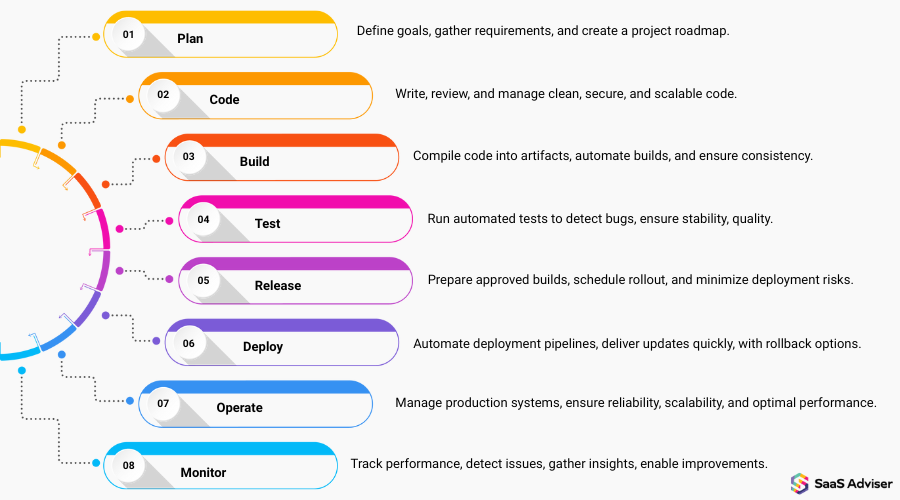
Best DevOps Software in
Are you looking for DevOps Software for your Business in ? SaaS Adviser brings you the best DevOps Software to ease your worries. In order to make your work smooth and swift, SaaS Adviser has compiled a list of the best software available. Compare the Best software features, pricing, free demo, and trial to select the best DevOps Software for your organization.
 Researched and Written by Akash Patel
Top 3 Featured Softwares


List of Top DevOps Software

Get Free Consultation

ManageEngine Site24x7 is a SaaS based, AI-powered observability platform for DevOps and IT operations. The cloud-based platform’s broad capabilities help predict, analyze, and tr...
View Profile

What is GitLab?GitLab is a complete AI-powered DevSecOps platform designed for software creation, allowing users to collaborate and develop software. It helps organizations boost d...
View Profile
Docker Hub

Docker for AI. Compose. Build. Deploy.
What is Docker Hub?Docker Hub serves as a repository and it's a cloud-based platform. Users upload their Docker container images there, and can also retrieve them from Docker Hub w...
View Profile

HashiCorp Terraform
By HashiCorp Terraform
HashiCorp Terraform is a cloud-based infrastructure automation platform that enables you to version, change, and provision resources in any environment. It helps enterprises accele...
View Profile

Buddy
By Buddy
Buddy is a software that enables people to rapidly make apps of any kind from scratch. It can handle complex CI/CD workflows in just a few minutes. On average, it takes the softwar...
View Profile

Circle CI is a VCS integration tool that helps automate testing processes. It is compatible with GitHub, BitBucket, and GitHub Enterprise. In the event that a test fails, Circle CI...
View Profile

AWS CloudFormation
By AWS CloudFormation
AWS CloudFormation is a software platform used to manage infrastructure as code for better workflows. The software offers templates to manage resources across multiple accounts and...
View Profile

Kubermatic Kubernetes Platform
By Kubermatic GmbHCheck How Kubermatic Kubernetes Platform can help to automate Indian Business. SaaSAdviser provide their list of features, pricing, Free demo and Comparison with the best alternati...
View Profile

Bamboo is a continuous integration tool that is suitable for people and developer teams who work with a wide range of programming languages such as PHP, Python, and Java. It is use...
View Profile

Azure IoT Hub
By Azure IoT Hub
Azure IoT Hub is a cloud-based solution that allows you to connect virtually any type of device. With per-device authentication, built-in device management, and scalable provisioni...
View Profile

This is a cloud-based application monitoring tool for infrastructure, event logs, and applications. It helps users search, collect and analyse traces across fully distributed platf...
View Profile

GitHub is a cloud-based platform that helps software program improvement, model management, and collaboration with the use of Git, an open-source model management system. It permit...
View Profile

Bitbucket
Code and CI/CD, powered by the Atlassian platform
What is Bitbucket? Bitbucket is a Git-based code hosting and collaboration platform designed for development teams that need secure repositories, version control, CI/CD automati...
View Profile

Open DevOps
By Atlassian
Check How Open DevOps can help to automate Indian Business. SaaSAdviser provide their list of features, pricing, Free demo and Comparison with the best alternative
View Profile
Rollbar is a code improvement platform that helps developers find and fix errors in their code in real-time, so they can deploy their applications with confidence. Rollbar's testin...
View Profile

KodeKloud
A HANDS-ON ONLINE TRAINING INSTITUTIONKodeKloud is a learning-by-doing platform that provides top-quality training in DevOps and Automation Technologies like Kubernetes, Docker, Ansible, OpenShift, Puppet, Chef, and a ...
View Profile

NGINX Plus
By NGINX Plus
NGINX Plus is a software package that offers a wide range of features that can help improve the speed, availability, and responsiveness of your applications. Some of the features i...
View Profile

Heroku
By HerokuCheck How Heroku can help to automate Indian Business. SaaSAdviser provide their list of features, pricing, Free demo and Comparison with the best alternative
View Profile

Monday.com Dev
Empower your R&D teams to build better products
Monday.com is a Devops tool your team would love to utilize. It is easy and simple for everybody to team up, concentrate on what's imperative, and accomplish more at work.
View Profile

onedev
DevOps Platform Powerful. Simple.
What is OneDev?OneDev is an open-source, self-hosted DevOps platform that mixes difficulty tracking, Git control, non-stop integration, and code evaluation in a unmarried, stre...
View Profile

Table of Content
In the competitive IT setting, business requires the top DevOps tools to provide secure, reliable, and swifter applications. These solutions manage workflows, increase collaboration, and provide scalability to organizations regardless of size. Since small companies start implementing DevOps services and large corporations launch sophisticated systems, the incorporation of the best DevOps tools is transforming the delivery of software in the USA. This guide explains why they are critical, how to make the most appropriate choice, and lists top platforms to empower your DevOps team.
1. Why Do Businesses Need DevOps Tools?
DevOps tools are being vigorously invested in by businesses operating in various industries since they have helped in bridging the gap between development and IT operations. The conventional models are expected to have siloed teams, which lead to delays and higher costs and even quality issues. The emergence of DevOps services makes companies streamline workflows, increase cooperation, and accelerate the provision of software. It is time to discuss the main reasons why organizations in the USA need powerful DevOps software.
1. Faster Delivery
Speed is the most short-term advantage of DevOps practices. Releases are more frequent with automation and CI/CD pipelines. Such agility enables the business to react swiftly to the market shifts, customer needs and insecurity. In either DevOps on AWS or on other cloud systems, teams are able to deploy changes in a few days instead of in a few weeks.
2. Improved Collaboration
DevOps tools eliminate the demarcations between development and operations. A DevOps team with centralized dashboards, chat integrations, and monitoring solutions operates more transparently. Such cooperation guarantees that all the people can see the processes, which will result in fewer misunderstandings and enhance the overall productivity.
3. Scalability
Scalability in modern systems has to be effective. Through the use of DevOps services and solutions, business organizations can gain the ability to provide automation of infrastructure provisioning using Infrastructure as Code (IaC) and the ability to integrate a hybrid or multi-cloud environment easily. This scalability is particularly essential to businesses that use cloud management software or other sophisticated log analytics tools to track performance.
4. Quality Assurance
Automation in a DevOps platform minimizes the threat of human error. Automated testing, Automated deployment, and monitoring give the same results, hence giving more reliable applications. Constant feedback loops also assist in the detection and correction of problems at the early stage of the lifecycle.
5. Cost Efficiency
Although there are initial expenses involved when investing in the DevOps software, the savings are huge in the long run. Repetitive tasks are automated, decreasing the amount of manual work; quicker deliveries decrease downtime, and the early identification of problems eliminates costly repairs. Finally, DevOps services allow companies to enjoy a better ROI through resource optimization.
2. Steps to Choose the Right DevOps Tools
The selection of the appropriate tools related to DevOps may be tedious in the presence of numerous tools available in the market. The point is not to take the most popular one but to choose one that suits your business objectives and technical context. The following is an organized model for analyzing DevOps software and making sure that your DevOps team is making the right choice.
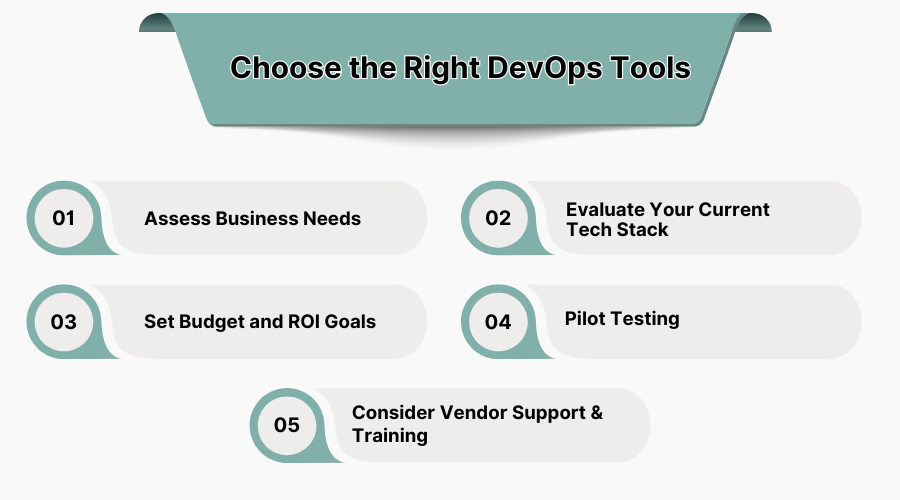
1. Assess Business Needs
Begin by determining the outcome that you want through a DevOps platform. Do you emphasize more rapid deployments, enhanced security, or more effective collaboration? Putting priorities straight will assist in the refinement of correct DevOps services and solutions. Startups and enterprises can focus on cost efficiency and scalability, and compliance, respectively.
2. Evaluate Your Current Tech Stack
Any additional DevOps tool must be effectively integrated with whatever systems you already have, e.g., application development platforms, continuous integration application tools, and application performance monitoring tools. Think of how it fits with your existing infrastructure, on-prem, hybrid, or DevOps hosted on AWS
3. Set Budget and ROI Goals
The companies providing different DevOps offer various pricing strategies (use-based, subscription-based, or enterprise licensing). Determine your budget at the very beginning and think about ROI in the long run. In other cases, the marginally more costly DevOps system will be compensated by less downtime, greater efficiency, and shortened time-to-market.
4. Pilot Testing
Conduct a pilot run of a small group before the full deployment of a DevOps service. This will assist in authenticating functionality, ease of use, and functionality without interruption of work processes. Pilot testing also reveals integration problems with other applications, such as log analytics software or cloud management applications.
5. Consider Vendor Support & Training
The success of your DevOps adoption may be determined by strong vendor support. Find providers of DevOps software with documentation, onboarding, training, and a good community. Access to ongoing training is a practice that would be adopted by growing teams to make sure that the discipline of DevOps is applied effectively.
3. Key Features to Look For in a DevOps Tools
When selecting the most appropriate DevOps tools, the business should prioritize the features that can effectively not only facilitate the workflow but also increase collaboration, scaling, and security. The powerful DevOps platform will guarantee the smooth integration with the available systems and the facilitation of the current DevOps activities. The following are the key characteristics that any organization must consider prior to investing in DevOps software.
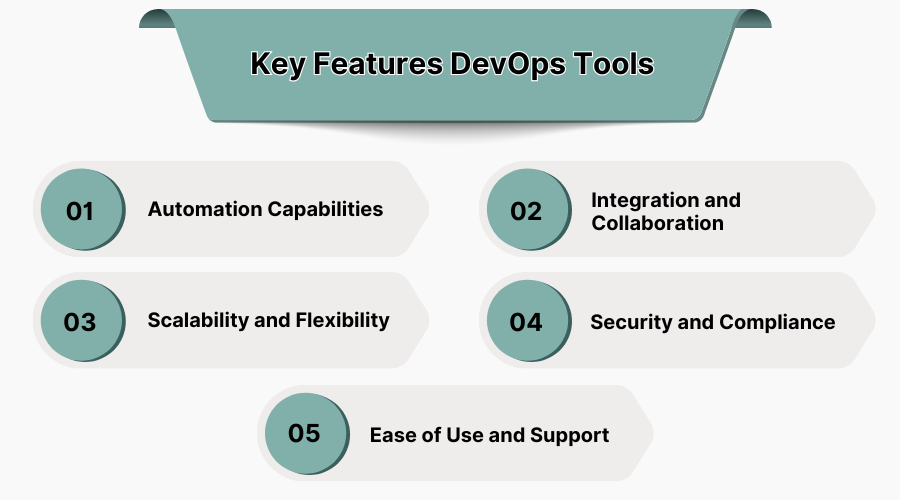
1. Automation Capabilities
Effective DevOps services revolve around automation. The appropriate tools minimize the amount of repetition and help your DevOps team to concentrate on innovation. Automation involves such functions as.
- Continuous Integration/Continuous Delivery (CI/CD): Code building, testing and deployment are automated.
- Infrastructure as Code (IaC): The infrastructure is driven by machine-readable configuration files.
- Configuration Management: Makes sure that systems are the same across environments.
- Event Processing and Logging: Automates monitoring and error reporting of the system.
2. Integration and Collaboration
A DevOps system is strong when it can be integrated well within the teams and tools. Look for.
- Seamless Integration: Compatible with application lifecycle management software comparison and other important systems.
- Centralized Dashboards: Provide real-time insight into the development, testing and deployment.
- Version Control Integration: Makes sure that there is a seamless interaction between developers and operation.
3. Scalability and Flexibility
DevOps services and solutions should scale out as the businesses expand. Important aspects include.
- Scalability: Membrane support growing workloads without interruption.
- Customization: Customize workflows to business requirements.
- Support for Multi-Cloud/Hybrid Environments: Essential to companies with DevOps on AWS, Azure, or Google Cloud.
4. Security and Compliance
The concept of security is not to be ignored in the current DevOps. Find the tools that combine DevSecOps functionality.
- Role-Based Access Control (RBAC): It assigns security user roles.
- Security Scanning: Remediated any code, dependency and infrastructure vulnerability.
- Compliance Adherence: Provides assurance of compliance with laws such as GDPR, HIPAA and PCI-DSS.
5. Ease of Use and Support
A highly developed DevOps tool needs to be user-friendly and easy to maintain even. Features to check.
- User-Friendliness: Navigating it is simple with a low learning curve.
- Documentation and Training: Definitive onboarding guides and tutorials.
- Community and Support: Help forums and expert support.
4. Key Benefits of DevOps Tools
Implementation of the correct DevOps tools will be quantifiable in gains throughout software development lifecycle. With accelerated launches, enhanced teamwork, and so on, these tools assist companies in integrating technology and strategy. The following are the most common benefits that organizations will experience upon adopting DevOps software and contemporary DevOps practices.
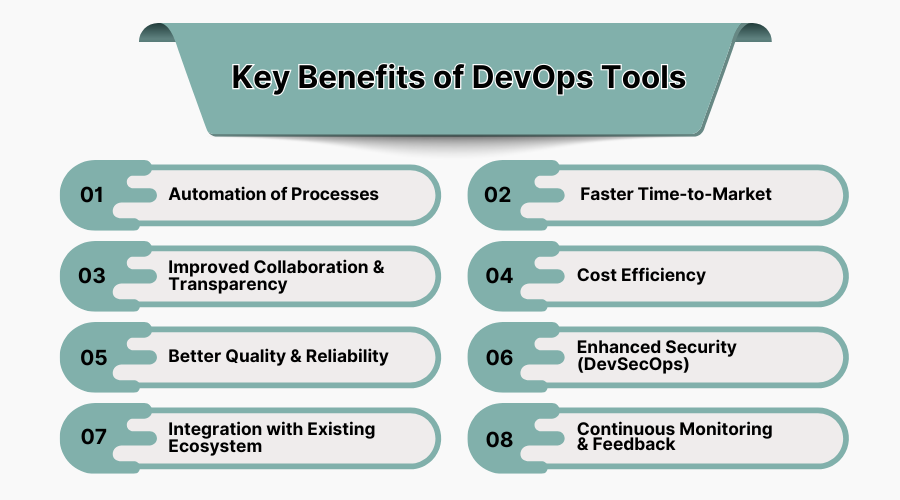
1. Automation of Processes
Automation of all DevOps platforms provides an opportunity to simplify routine activities like testing, configuration, and deployment. This will reduce the amount of errors that are caused by manual operation, and this will enable the DevOps team to focus on developing new solutions.
2. Faster Time-to-Market
The ubiquitous aspect of the application integration tools coupled with the CI/CD pipelines ensure that there is an accelerated development and deployment process. Companies can roll out features and updates quickly, and they are competitive in fast moving markets.
3. Improved Collaboration & Transparency
The culture of partnership is offered by DevOps services and solutions, which seal the gap between the operations and development. Such features as centralized dashboards and real-time reporting make the workflow of the teams visible and promote accountability and efficiency.
4. Cost Efficiency
Operational costs are lowered by automation of the processes and optimization of the resources. DevOps is an intelligent choice, as when implemented correctly, there is little downtime, better utilization of infrastructure, and increased ROI and is the reason as to why it applies in both small and large business.
5. Better Quality & Reliability
DevOps software improves the quality of a product with built-in testing and monitoring. Constant feedback mechanisms allow detection of problems in the early phases, which guarantee consistent and stable releases.
6. Enhanced Security (DevSecOps)
DevOps services incorporate security in all stages, and as a result, it serves to guarantee compliance and mitigate vulnerability. Instruments that have built-in scanning and RBAC are proactive and not reactive.
7. Integration with Existing Ecosystem
An efficient DevOps tool will be integrated with other enterprise solutions, including cloud management applications and monitoring and log analytics services. This forms an interdependent ecosystem in which all tools are collaborative.
8. Continuous Monitoring & Feedback
DevOps platforms that include monitoring tools allow real-time information on performance. Such insights enable businesses to identify the bottlenecks, streamline applications and keep on improving.
5. Top 5 DevOps Tools in the USA (2025)
DevOps tools are very varied in the US market, yet some of them are innovative, scalable, and serviceable. The following are five of the top DevOps software tools used by most enterprises, start-ups, and expanding teams.
1. GitLab
GitLab is an all-encompassing DevOps tool that supports the entire software development cycle, such as planning and source code management, CI/CD, and monitoring. It is particularly pleasant when it comes to teams that need transparency and automation.
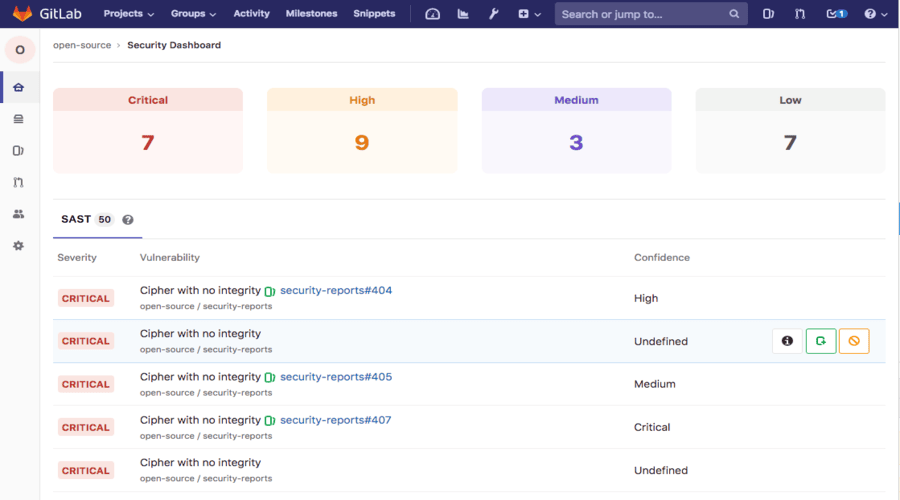
Feature:
-
Introduced in-built CI/CD pipelines to deliver faster.
-
Version control in source code.
-
Auto security scanning and testing.
-
Collaborative dashboards that are centralized.
-
Interoperability with several cloud services.
Pros:
-
End-to-end DevOps system.
-
Good community support and record keeping.
-
Enterprises can scale very easily.
Cons:
-
Complex functionalities can be very costly to learn.
-
The bigger the team is, the higher the cost.
-
The self-hosted version requires more maintenance.
Pricing: Visit the website for detailed pricing.
2. Docker
Docker changed the way in which applications are built and delivered by introducing containers. It allows developers and the DevOps team to develop it once and deploy it in many different places so that there is uniformity.
.jpg)
Feature:
- Light containerization technology.
- Impeccable coordination with CI/CD pipelines.
- Big database of ready-made images.
- Good level of container isolation.
- Easy to use with DevOps on AWS and other cloud providers.
Pros:
- Eases the process of deployment of applications.
- Lessens bugs in the environment.
- Portable and bendable.
Cons:
- Needs orchestration of containers on a large scale.
- Not portable to some environments.
- Configuration is an important part of security.
Pricing: Plans start at $11/user/month.
3. Terraform
Terraform, developed by HashiCorp, is a leading DevOps tool for Infrastructure as Code (IaC). It allows businesses to define and provision infrastructure using declarative configuration files, making it ideal for multi-cloud setups.
Feature:
- Automation of infrastructure with infrastructure as code.
- Covers a variety of cloud hosts (AWS, Azure, GCP).
- Infrastructure version control.
- Scalability by configuration modules.
- Good open-source community.
Pros:
- Supports repeatable deployments of infrastructure.
- Flexibility is supported by cloud-agnostic approach
- Large module ecosystem
Cons:
- Steeper learning curve for beginners.
- Debugging errors can be complex.
- Requires strong governance for large deployments.
Pricing: Visit the website for detailed pricing.
4. Kubermatic Kubernetes Platform (KKP)
Kubermatic is an enterprise level Kubernetes management that makes it easier to run containerized applications at scale by enterprises.It is created to suit companies that require a powerful DevOps infrastructure that is multi-cloud enabled.
.png)
Feature:
- Robotic K9s cluster control.
- Hybrid and multi-cloud support.
- Inbuilt logging and tracking.
- Role-based access control (RBAC).
- Ready to comply with enterprise-level security.
Pros:
- Makes Kubernetes easier to use.
- Powerful scalability for global businesses.
- Increased security and compliance.
Cons:
- Best applicable to larger organizations.
- Needs knowledge of Kubernetes to customize.
- Higher upfront investment
Pricing: Visit the website for detailed pricing.
5. CircleCI
CircleCI is a robust CI/CD-oriented DevOps service with a reputation for being fast, scalable, and user-friendly with developer-friendly workflows. It is easily compatible with GitHub, Bitbucket, and others.
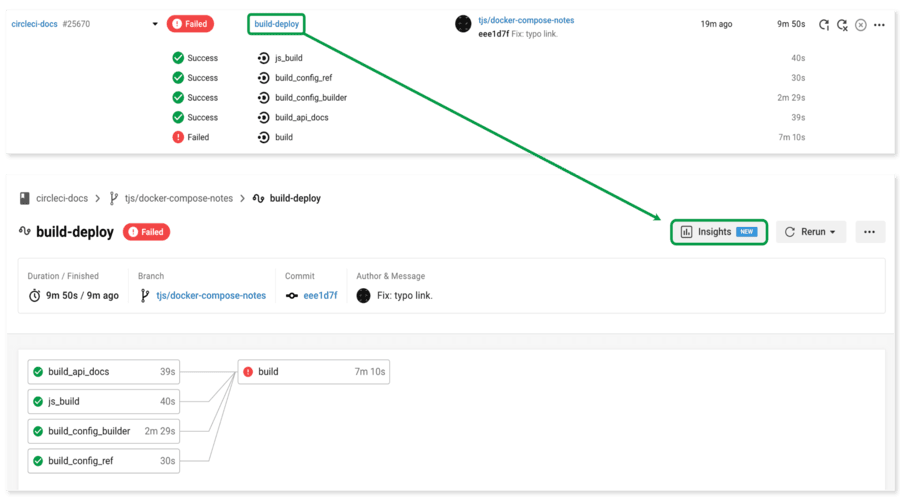
Feature:
- CI/CD pipelines of high performance.
- Cloud-hosted or self-hosted.
- Cache and parallelism to build quicker.
- Extensive reporting and analytics.
- Integration to the application development platform and monitoring tools.
Pros:
- Quick installation and well-documented.
- Scalable on-prem and cloud services.
- Powerful system of integrations.
Cons:
- High concurrency can be costly to price.
- Advanced pipeline setups learning curve.
- Features relative to complete DevOps platforms.
Pricing: Paid plans start at $15/user/month.
6. Related Reads
7. Conclusion
The fact that implementing the right DevOps tools is not some luxury anymore but an essential requirement that businesses wishing to remain competitive should adopt is expected to happen in 2025. DevOps software provides obvious value throughout the development lifecycle, whether it is better collaboration and automation or better security and scalability. With the industry being influenced by such trends as AI, DevSecOps, the adoption of multi-clouds, and so forth, having a reliable partner in the field of DevOps solutions could be a sure way of success in the long term. Through adopting the new standards of DevOps, the USA businesses are poised to innovate, scale, and deliver customer value more quickly than ever.
8. Latest Market Trends in DevOps Tools
The USA DevOps tools market is a fast-changing one and is being influenced by the technological breakthrough, rise in the use of clouds, and the necessity to become more automated. Based on projections, the DevOps market will grow from $10.4 billion in 2023 to $25.5 billion in 2028.
1. Rise of AI and Machine Learning in DevOps
DevOps services and solutions are being transformed through the introduction of predictive analytics and intelligent automation by AI into workflows. DevOps applications that are powered by AI can identify and help prevent anomalies, forecast failures, and propose optimization ideas, making them less susceptible to downtime and more efficient.
2. DevSecOps Becomes the Standard
Security is no longer considered as an afterthought. Security checks are now encompassed in CI/CD pipelines through modern DevOps and work to fulfill compliance and minimize risks. RBAC and vulnerability scanning have become core functionalities of any of the major DevOps systems.
3. Multi-Cloud and Hybrid Deployments
Firms are adopting the combination of DevOps on AWS, Azure, and Google Cloud. Multi-cloud strategy is flexible, cost-efficient, and risk-managed. Due to this, hybrid environments based on DevOps platforms are in demand.
4. Automation-First Mindset
Businesses are demanding end-to-end automation, starting with application performance monitoring tools and continuing to continuous application integration tools. This lessens man errors, accelerates delivery and sustains bigger and more complicated projects.
5. Shift Toward Observability and Monitoring
Simple surveillance is no longer satisfactory. To achieve a deep understanding of how systems perform, enterprises are moving towards the superior log analytics platform, search engine monitor software. Observability is a process whereby teams can identify problems ahead of time before they affect the customers.
6. Growth of DevOps Services Companies
A significant number of organizations have engaged a DevOps solutions company to work together in applying the best practices and training their staff, as well as handling complex systems. This tendency underlines the increasing need for the specialized DevOps services, not only software.
7. Low-Code and No-Code DevOps Tools
Businesses are implementing low-code/no-code DevOps platforms to empower non-technical stakeholders. These open automation and deployments do not require deep code knowledge, and more teams are made more aligned with DevOps culture.
9. What Are DevOps Tools?
DevOps tools are dedicated program codes and are used to facilitate the collaboration of the development and the IT operations teams, as well as automation of manual processes and enhancement of the entire software delivery lifecycle. These tools combine such functions as version control, continuous integration/continuous delivery (CI/CD), configuration management, and monitoring in one workflow.
As an example, a modern DevOps system can consist of such elements as build automation, release orchestration, and security scanning, all as a single platform of a DevOps system. The toolset can also be augmented by linking external solutions by businesses, like search engine monitoring software, application lifecycle management software comparison tools, and application performance monitoring tools.
Utilizing the appropriate DevOps software, organizations are able to minimize errors, achieve faster delivery, enhance collaboration, and increase the scalability of the infrastructure.