
Best Content Planning Tool in
Are you looking for Content Planning Tool for your Business in ? SaaS Adviser brings you the best Content Planning Tool to ease your worries. In order to make your work smooth and swift, SaaS Adviser has compiled a list of the best software available. Compare the Best software features, pricing, free demo, and trial to select the best Content Planning Tool for your organization.
 Researched and Written by Akash Patel
Top 3 Featured Softwares


List of Top Content Planning Tool

Get Free Consultation


StoryChief

By StoryChief NV
What is StoryChiefStoryChief is a content marketing platform designed to streamline the creation, collaboration, scheduling, and distribution of content across multiple channels. I...
View Profile

What is ClearscopeClearscope is an advanced content optimization platform designed to improve the quality, relevance, and SEO performance of written content. It uses AI to analyze ...
View Profile

What is BrandwatchBrandwatch is a digital consumer intelligence and social media monitoring platform that helps businesses understand online conversations and market trends. It ana...
View Profile

Pocket HRMS is a cloud-based software that greatly assists businesses with employee management policies and access to upgraded MIS reporting tools. The self-service portal of pocke...
View Profile

What is BasecampBasecamp is a popular project management and team collaboration tool designed for simplicity. It helps businesses organize tasks, communication, and files in on...
View Profile

Consolo
Provides fully customizable hospice management and billing tool for hospices
What is Consolo?Consolo is an advanced project management solution engineered to optimize workflows and drive team productivity. With features such as real-time collaboration, task...
View Profile

What is PlanablePlanable is a collaborative content planning and social media scheduling platform designed to streamline team workflows. It allows marketers to create, review, appr...
View Profile

AuthoredUp
The ultimate LinkedIn content creation & analytics tool
What is Authoredup?Authoredup is a powerful AI-driven writing assistant designed to help content creators, bloggers, marketers, and students generate, edit, and enhance written...
View Profile
Gripp Planning
Monitor capacity and billability Planning software
What is Gripp Planning?Gripp Planning is a cloud-based scheduling and task management software designed for service-based businesses and agencies. It helps teams manage capacit...
View Profile

OrgChart
The Org Chart You Need, Whenever You Need It
OrgChart is an advanced, cloud-based organizational charting and workforce planning software designed for HR teams, executives, and strategic planners. It automates the creatio...
View Profile

explaindio
The Easy To Use Drag-n-Drop Content Creator

Spiry.ai
Grow faster on LinkedinSpiry helps you grow your LinkedIn personal brand 10× faster on autopilot.
View Profile

Gumlet is a cloud-based image (and media) optimization and delivery platform. It is designed for websites and mobile apps that need to serve images efficiently, reducing load times...
View Profile

Catalister
Get Your First Sale 10x Faster
Catalister is a customer analytics and loyalty management platform designed to help businesses understand customer behavior and improve retention through targeted engagement. The s...
View Profile

Riverside
Create your best content yet.
Riverside is a cloud-based remote audio and video recording platform designed for creators, podcasters, broadcasters, and businesses who want professional-quality content without c...
View Profile

Table of Content
A lack of a structured content plan results in fragmentation, resource wastage, and missed opportunities. Businesses today need Planning Tools to create, manage, and optimize content with the prominence of digital marketing. These tools assist teams to streamline the content workflow, automate publishing, monitor engagement, and even improve SEO.
The global digital content creation market was valued at approximately $32.28 billion in 2024 and is projected to grow significantly. This research details the best Content Planning Tools in the market, their advantages, feature sets, challenges, pricing, and market gaps in order to help businesses select the most ideal Content Planning Tool for their specific needs.
1. Latest Market Trends in Content Planning Tools
The details below show the market trends that are defining the future of Content Planning tools.
1. Generative AI
Automated processes in content creation are significantly improving the business landscape. Marketing strategies and campaigns are now simplified through the help of AI tools like Jasper, ChatGPT, and Copy.ai, that provide ready-made structures for blogs, social media and even emails. With the help of machine learning, these systems examine content and suggest smarter ways to engage your audience more and improve your SEO ranking.
2. Agentic AI
Agentic AI means AI assistants that are used to automate many tasks increasing efficiency in scheduling as well as providing sophisticated content recommendations. Such assistants assist in the optimization of processes such as content approval, automatic social media posting, and even the best publishing time estimates for high audience engagement.
3. Platform Expansion
The reach of content marketing needs Content Planning tools to evolve from simple marketing software to sophisticated solutions capable of distributing content to multiple platforms. These tools now connect with:
-
Social media accounts such as Facebook, Instagram, LinkedIn, and Twitter;
-
Content Management Systems (CMS) like WordPress, Wix, and Hubspot;
-
Email marketing programs such as MailChimp, Active Campaign, and ConvertKit;
-
Project management packages such as Trello, Asana, and Monday.com;
-
SEO and analytical tools such as Google Analytics, SEMrush, and Ahrefs.
4. Line-of-Business Involvement
Content Planning Software’s user base always revolved around marketing departments, but businesses are increasingly using them in other departments such as:
-
Sales teams that assist clients in maximising their use of CRM tools.
-
HR staff who use content for advertising, training and routine administration.
-
Customer support staff who maintain knowledge bases, FAQs and help articles.
-
Executive and other senior level staff for corporate content and brand messaging.
5. Predictive Analytics
The use of artificial intelligence greatly enhances predictive analytics in terms of how an audience interacts with content. Content Planning software can now:
-
Offer insights to high-performing content topics based on trending searches.
-
Advise on ideal times to upload content for optimal viewing and audience engagement.
-
Supply content gap reports to show areas that are under developed in a particular strategy.
-
Modify and fine-tune content strategies in real time based on audience reactions.
2. 5 Best Content Planning tools in USA
1. Airtable
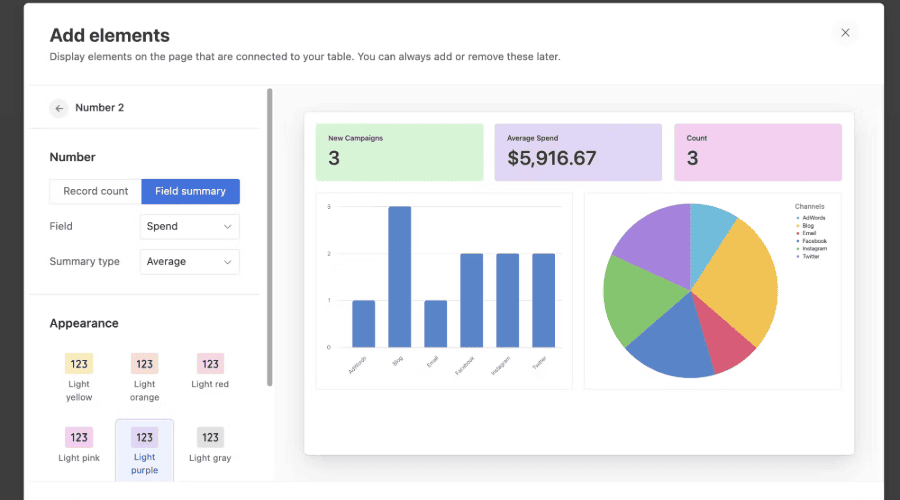
Airtable is a content planning and management platform for teams that supports automation and tracking of projects. It is tailored for content teams and other businesses that require the efficiency of a database and the ease of a spreadsheet. Workflow management is simple with Airtable because of the customizable templates and third party integrations that aid in the management of different data types.
Pros:
-
Strong database management allows easy tracking of content.
-
Supports automation to streamline workflows.
-
Customizable templates help organize content efficiently.
-
User-friendly interface makes it accessible for non-technical users.
-
Integrates with third-party apps like Slack, Google Drive, and Zapier.
Cons:
-
Limited built-in SEO features reduce optimization capabilities.
-
Lacks advanced reporting tools for content performance analysis.
-
Free plan has restrictions on automation and storage.
-
May require time to set up complex workflows.
-
Can be overwhelming for users unfamiliar with database-style tools.
Pricing: Starts at $10 per user/month
2. Basecamp
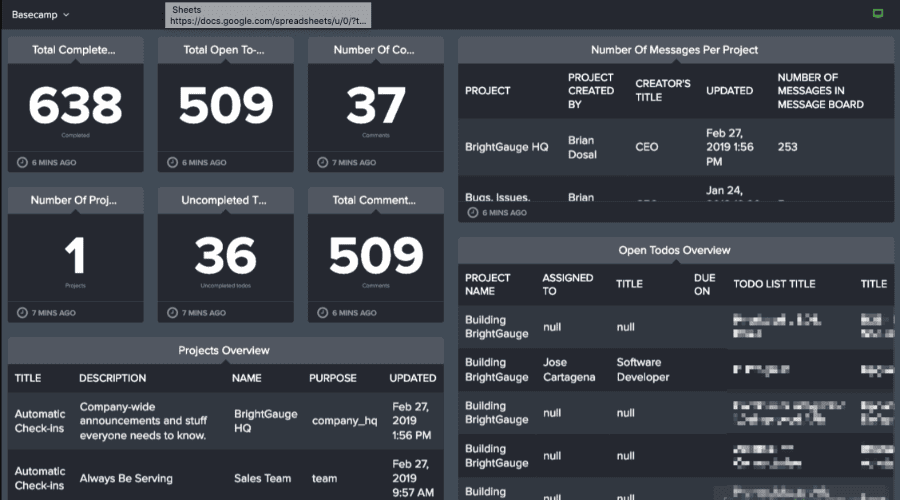
Basecamp is used by teams to plan and manage simple projects because they can store tasks and communications on a central web based platform. Important functionalities like task lists, file sharing, messaging, and team communication make collaboration easier and drive increased productivity. Additionally, pricing plans in Basecamp are not restrictive on the number of users. Therefore, it is more cost-effective for large teams looking to work together on content with ease.
Pros:
-
Easy-to-use interface allows for simplified coordination of content projects.
-
Unlimited users at a flat fee make it economically favorable.
-
Team chat and message boards improve collaboration significantly.
-
Content workflow organization is enhanced through task and to-do lists.
-
File sharing is easily accessible through Centralized file sharing system.
Cons:
-
No complex tools for optimization of content through SEO.
-
Advanced automation of repetitive tasks cannot be done.
-
Content tracking through monitoring of reports and analytics is restricted.
-
Not suitable for advanced workflows that need extensive customization.
-
Relative to competitors, there are no third-party integrations.
Pricing: Flat $99 per month for unlimited users
3. Asana
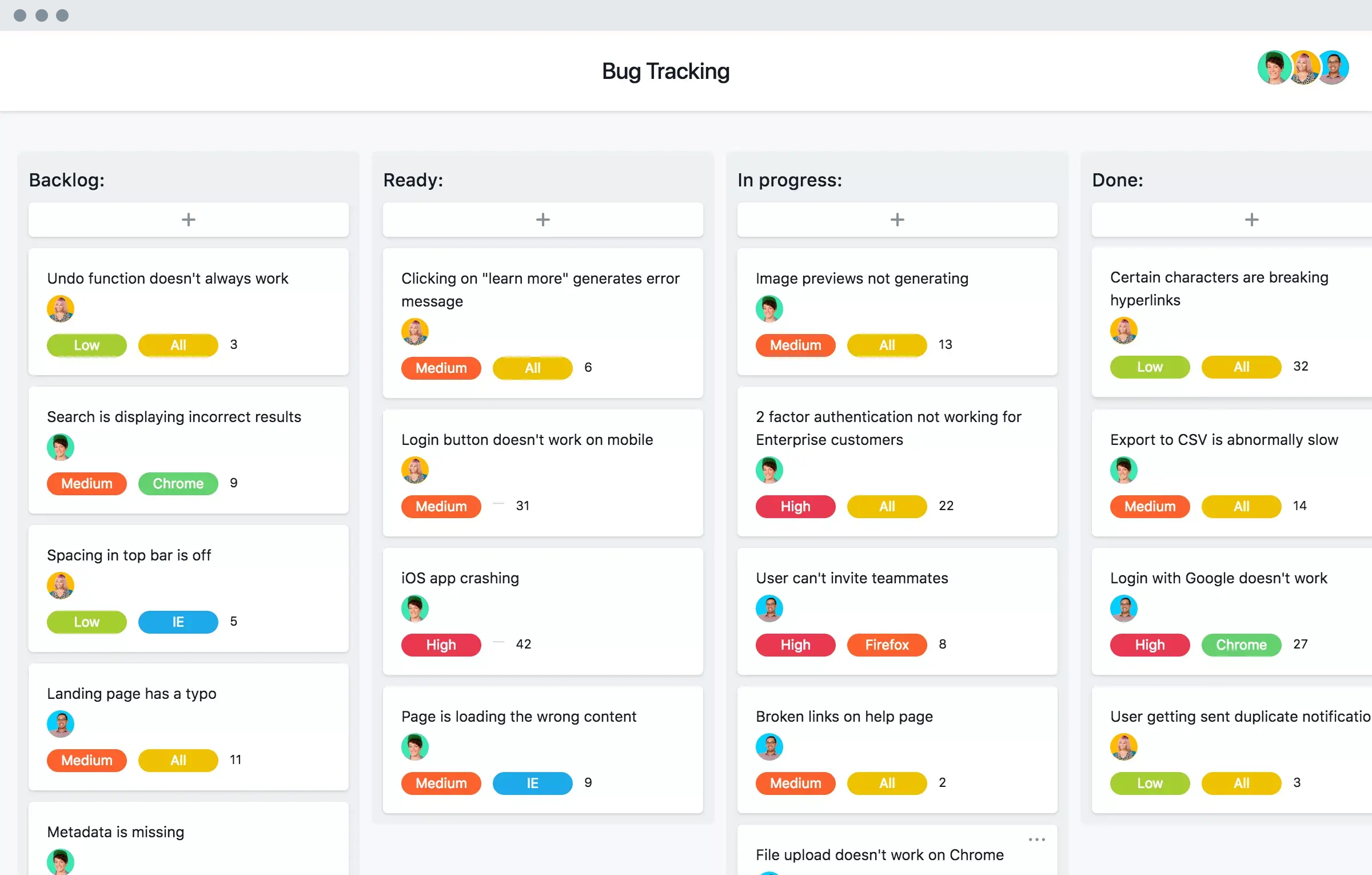
For content marketers and those that seek an advanced way of content organization, Asana serves as a perfect solution. Teams can develop projects and allocate timelines. Also, it can manage tasks that need to get done within a project. Thus, it streamlines workflows. Asana provides organizations with the ease of collaboration on content projects through their robust integrations and customizable workflows that help boost efficiency of project management and content planning.
Pros:
-
Third-party app integration improves workflow flexibility.
-
Customizable tracking of tasks boosts collaboration between teams.
-
Supports repetitive task automation.
-
Provides content calendars for easy scheduling and planning.
-
This tool is appropriate for any organization, no matter the size.
Cons:
-
Advanced features require some training for effective utilization.
-
Overwhelming for new users who have complex projects to manage.
-
Limitations for automation and reporting on the free plan.
-
Most advanced features can only be paid for optimal use.
-
Does not include built-in tools for content strategy SEO optimization.
-
Pricing: from $13.49 per user/person each month.
Pricing: Starts at $13.49 per user/month
4. Wrike
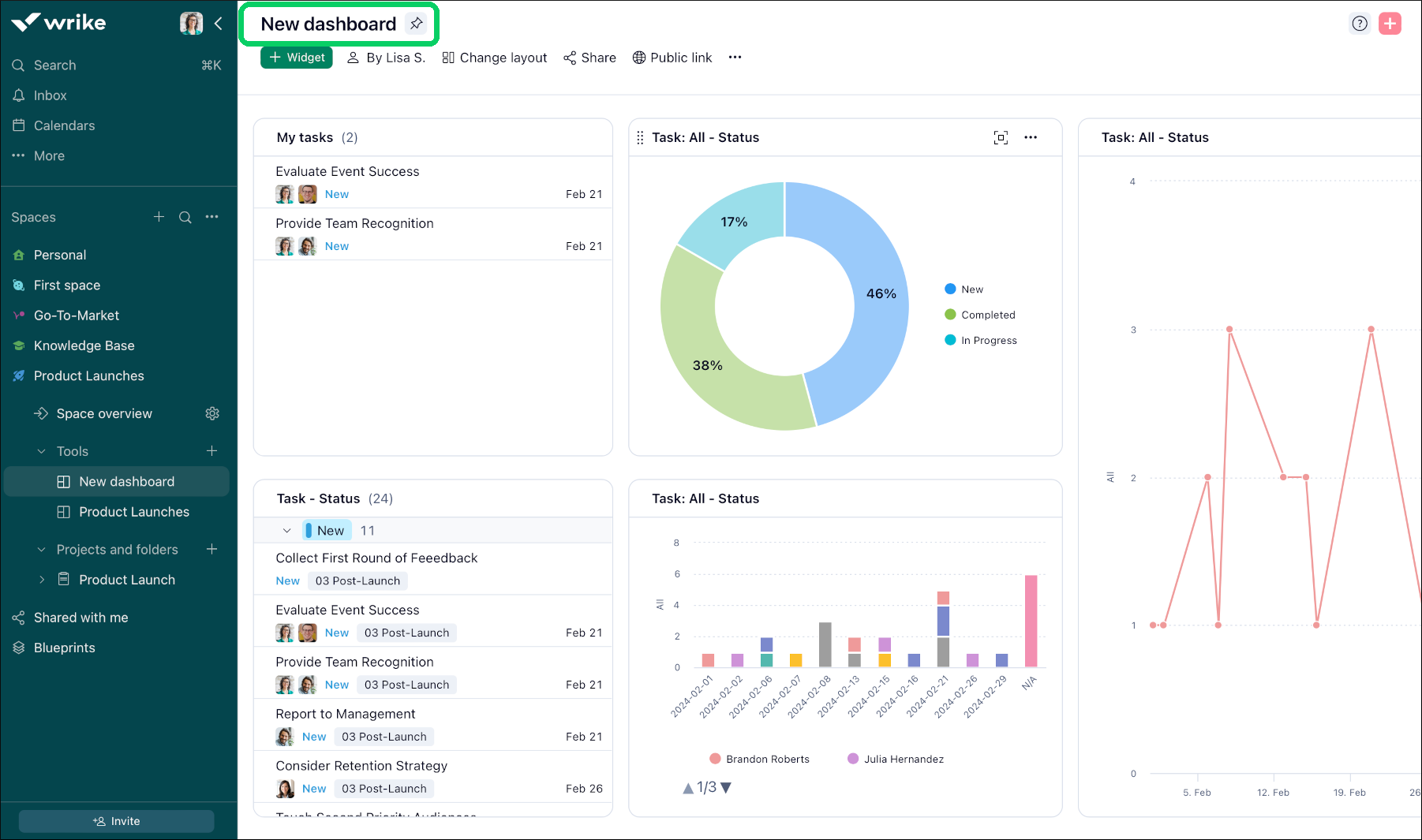
Wrike is a content creation and management solution that employs AI technology to aid in planning and work automation. Its strong analytics, project tracking, and AI recommendations makes it a perfect fit for teams who need detailed reports and performance tracking for their content. For such teams, the automation features of Wrike helps boost productivity and organization by streamlining the planning stages of content development.
Pros:
-
Content tracking and reporting is enhanced with strong analytics tools.
-
AI recommendations further enhance content strategies.
-
Dashboards can be customized to provide real-time progress tracking of content.
-
Multiple integrations with platforms such as Google Drive, Slack, and Microsoft Teams.
-
Task assignments can be automated to improve efficiency.
Cons:
-
May be too costly for small teams with budget constraints.
-
Advanced tier plans have restrictions on some options.
-
New users not accustomed to advanced analytics may take time to adapt.
-
Free plan offerers are very limited in features and user restrictions.
-
All training is required to use AI powered features optimally.
Pricing: Starts at $9.80 per user/month
5. Trello
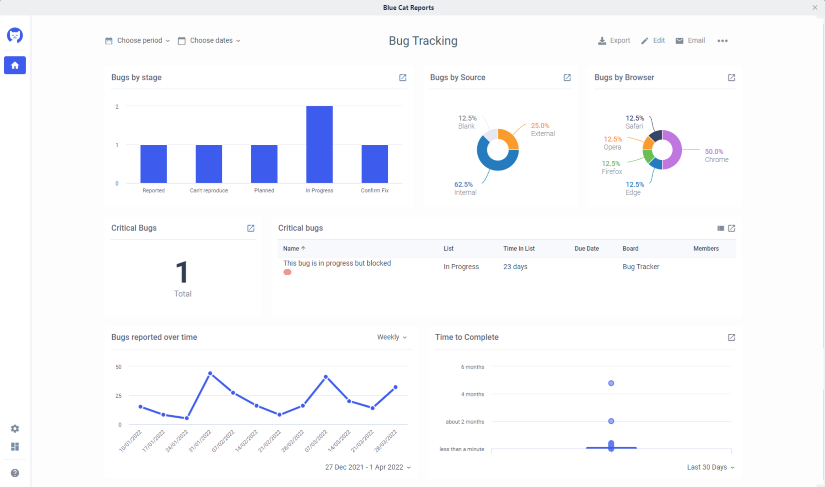
Trello is among the most simple to use content planning tools available, as it uses drag-and-drop functionality alongside a visual interface. This application is helpful for content teams since it is visually intuitive for managing content workflows. Trello lets the users collaborate and divide tasks by making boards and lists which organize workflow. In this way, members of the team can track progress and see the completion status of the tasks.
Pros:
-
User-friendly interface allows people to manage tasks with ease.
-
Assists in team collaboration by allowing diverse customizations on the board.
-
Content planning becomes painless with drag-and-drop features.
-
Allows integration with external services such as Google Drive, Slack and Dropbox.
Cons:
-
Does not offer built-in performance analytics for content management.
-
Automation is poor in comparison to other project management applications.
-
Free plan comes with limited integrations and automations.
-
Difficult to manage complex content planning that requires deeply nested workflows.
Pricing: Free basic plan; paid plans start at $5 per user/month
3. Features of Content Planning Tools
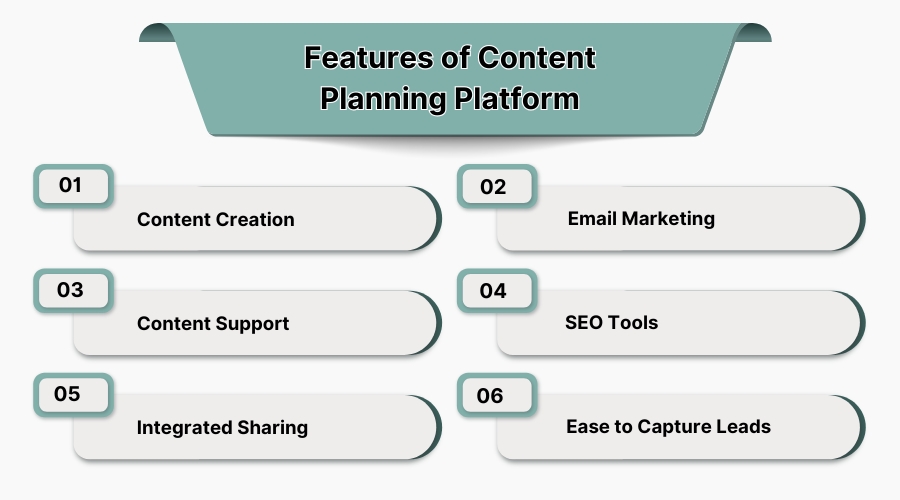
Improved content marketing efficiency, automation, and success require a powerful Content Planning system with all the essential features.
1. Content Creation
Proficient Content Planning platforms should feature an AI writing assistant, an editorial calendar, a topic research tool, and content approval workflows. Also, you can use a dedicated content creation software if you want to focus on the content part more.
2. Email Marketing
To automate content distribution, businesses can connect effective email marketing platforms like Mailchimp, HubSpot, and ActiveCampaign to analyze campaign effectiveness automatically.
3. Content Support
AI-driven content creativity enhancement and topic recommendations combined with trend analysis should offer ample support in content planning software.
4. SEO tools
Search visibility and ranking performance can be improved with the help of real-time SEO optimization tools, keyword analysis, metadata crafting, and backlink monitoring software.
5. Integrated Sharing
A content planning system must ensure cross-platform content distribution to social media, blogs, video sites, and newsletters for maximum reach.
6. Ease to capture Leads
To properly generate and track business leads, a powerful Content Planning platform features a CRM system, landing page and audience segmentation integrations.
4. Cost of Content Planning Tools
Content Planning platforms vary in pricing depending on various factors. Depending on their budget plans and other marketing tactics, businesses can select the most suitable content planning option.
1. Basic Plans ($5 - $15 per user/month)
-
Freelancers, solo entrepreneurs, and small teams will find this most helpful.
-
Offers moderate content scheduling, task sharing and collaboration features.
2. Mid-Tier Plans ($20 - $50 per user/month)
-
Emphasis is placed on mid level marketing business growth, agencies, and mid level marketing departments.
-
Moderate level of AI based content suggestions and performance tracking tools are provided alongside premium automation features.
3. Enterprise Plans ($100+ per user/month)
-
Fulfills the needs of large businesses, content agencies, and media publishers.
-
Provides custom integrations, AI insights, predictive analytics, and multi-platform publishing.
5. Conclusion
The proper Content Planning system allows for better organization of content workflows, automation on how–when–where content is scheduled, an improvement on SEO ranking, and engagement boost. Modern Content Planning tools are much better than previous with the integration of AI, predictive analytics, and multi-platform support. Also, you can use cloud collaboration software to efficiently collaborate with your team while planning content.
6. Benefits of Content Planning Tools
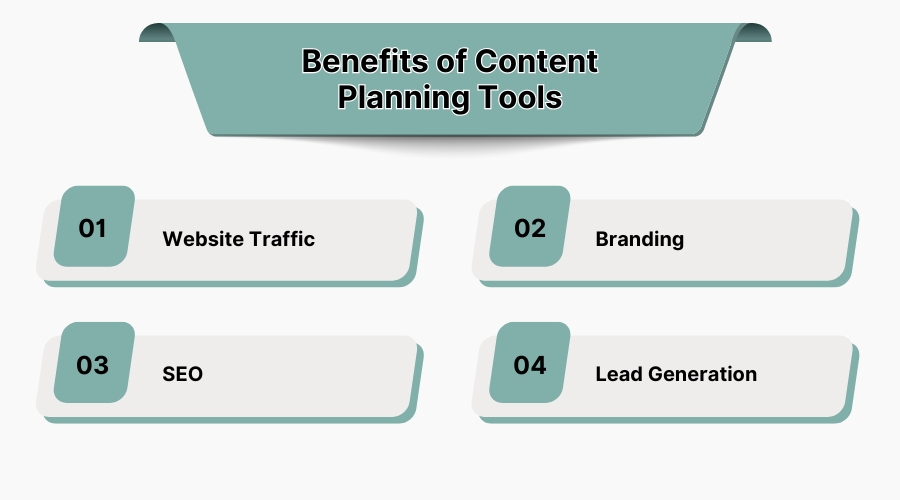
Content Planning tools are helpful for any business that wants to improve brand visibility and engagement along with marketing strategy. Here are the primary advantages these tools offer:
1. Website Traffic
A properly set search engine optimization under a brand strategy increases social engagement and referral traffic. Content Planning tools assist marketers in optimizing keywords and tagging, garnishing higher qualified leads.
2. Branding
Publishing consistent content helps build authority, credibility, and trust. A Content Planning tool helps businesses ensure compliance with the brand messages, values, opportunities and preferences, before publishing, thus strengthening their position in the marketplace
3. SEO
Content Planning Systems offer AI-powered keyword recommendations, backlink monitoring, and performance analytics to facilitate the best exposure on the marketing network. Companies may use these to perform competitor analysis and adjust their SEO strategy.
4. Lead Generation
Adjusted content in terms of target audiences assists in capturing leads. A Content Planning tool works with landing pages, lead capturing forms and marketing automation interfaces to elevate the conversion ratio and, accordingly, ROI.
7. Challenges in Content Planning Tools
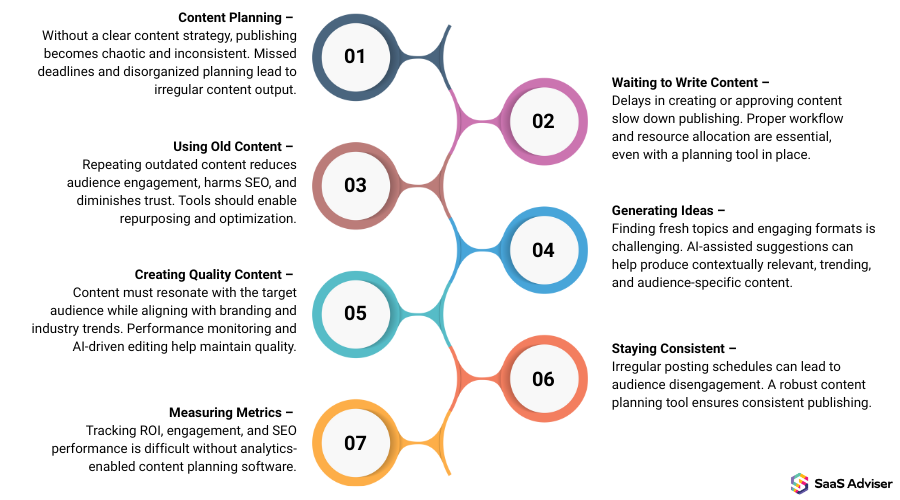
Although Content Planning systems smooth some workflows, execution, consistency, and ideation remains a challenge. Below are some common issues:
1. Content Planning
In the absence of a defined Content Strategy, publishing is likely to become chaotic, unorderly, and unmanageable. In turn, planning does not happen, which means deadlines are missed, and content gets published inconsistently.
2. Waiting to Write Content
Anything involving work as well as obtaining approvals cause publishing delays. Even with a Content Planning system in place, appropriate resource allocation and workflow structure is essential.
3. Using old Content
Engagement diminishes considerably when outdated content is used over and over again. It negatively impacts SEO and audience trust. A planning tool should provide for repurposing and optimization of content.
4. Generating Ideas
New topics and engaging formats are a challenge. Businesses ought to try contextually relevant, trending, and audience specific AI-assisted suggestions that can help them create content.
5. Creating Quality Content
Whatever the content is, it should appeal to the target audience alongside branding and current trends relevant to the industry. Content Planning needs performance monitoring and optimization by AI driven editing tools.
6. Staying Consistent
Without a rigid tool for content planning, businesses struggle with sticking to regular content schedules, eventually losing audiences and forcing them to disengage.
7. Measuring Metrics
It can be tough to monitor ROI, levels of engagement, and rank for SEO without a content planning software with good analytics and reporting features.
8. Why Do You Need Content Planning Tools?
To enhance the efficiency and quality of work and ensure that the business is publishing consistently, a Content Planning system is needed. These are some of the main reasons why brands should have a Content Planning platform:
-
Better Organization: Computers are designed to help businesses streamline the scheduling, brainstorming, and distribution of content which greatly helps in ensuring proper execution of the content plan.
-
Improved SEO Performance: Planning content has the benefit of advising effective SEO strategies, providing relevant metadata, as well as suggesting keywords to rank along with optimized content.
-
Consistent Publishing: Audiences can now remain engaged with automated scheduling, which streams regularly scheduled postings across many platforms.
-
Saves Time: Team members can now focus more on creating the content instead of worrying about organization, approval processes, and publishing efforts which saves time on manual work.
-
Performance Insights: Engagement rates, traffic, conversions, and behavioral analytics can be tracked which provide valuable information on how to optimize their content.
-
Better Content Collaboration: Cloud based tools allow for teams to collaborate much more easily. This facilitates faster approvals and increases access to shared material.
-
Cross-Platform Distribution: The software allows for easy sharing of the businesses websites, blogs, social media, and even integrated email marketing campaigns.
Such platforms enable brands to streamline the most complicated content workflows, improve engagement, and help achieve certain marketing goals within a short span of time.
9. Criteria for Selecting the Right Content Planning Tools
Finding the optimal Content Planning tools relies on various elements within content workflow, automation, analytics, and integrations. Businesses must assess effectiveness with respect to efficiency, collaboration, and visibility management. Here are the considerations as you choose a Content Planning platform:
1. Usability and Interface
To organize and categorize content planning, a platform should feature a clean dashboard with content categories as well as a drag-and-drop scheduling feature. The user-friendly interface must support easy navigation, ensuring that tasks such as content search and categorization can be created seamlessly.
2. Automation and Scheduling
With the best Content Planning software, automated publishing, post reminders, and workflow approval become effortless on top of AI-generated scheduling recommendations. By automating content workflows, email reminders, and sharing onto several platforms, teams can save time, reduce manual effort, and improve content consistency.
3. Integration Capabilities
For stronger systems of Content Planning, integration with Google docs, WordPress, Trello, Asana, HubSpot, Hootsuite, and Buffer should enable better collaboration and content sharing. Furthermore, API integration with social media and various analytics tools ensures that proper data driven decisions can be made.
4. SEO and Performance Analytics
Effective tools should feature real-time SEO optimization, engagement tracking, content heatmaps, backlink monitoring, and keyword ranking analysis. Ideas such as organic reach, audience retention, and social engagement can better help businesses refine their content strategies.
5. Collaboration and Task Distribution
Effective Content Planning tools should have features that allow teams to work together on content calendars, editing, tracking feedback, and managing deadlines. Even assignments and automation make it easier for the team to cooperate and stay organized.
10. Related Reads:
11. What is Content Planning Tools?
A marketing content planning software is an application that allows marketers, content producers, and other companies who are planning to implement their content marketing strategies to develop, manage, and execute their plans in an efficient manner. It consists of features for scheduling, idea development, collaboration, performance metrics, and audience interaction.
Companies employ content planning systems to:
-
Arrange content production processes.
-
Organize blog and social media posts, as well as emails.
-
Measure audience engagement and improve SEO indicators.
-
Work with team members and simplify approval processes.
A company’s selected Content marketing tool will be the determining factor for business continuity and reliability in terms of content.
