
Best Cloud Management Platform in
Are you looking for Cloud Management Platform for your Business in ? SaaS Adviser brings you the best Cloud Management Platform to ease your worries. In order to make your work smooth and swift, SaaS Adviser has compiled a list of the best software available. Compare the Best software features, pricing, free demo, and trial to select the best Cloud Management Platform for your organization.
 Researched and Written by Nikita Rao
Top 3 Featured Softwares


List of Top Cloud Management Platform
Get Free Consultation


Google Workspace

The better way to work
Google Workspace is an intuitive platform that helps teams of all sizes to connect and collaborate with each other and improve their efficiency levels in real-time. It provides an ...
View Profile
Cloudways is a managed cloud hosting platform designed to streamline and optimize the deployment, management, and scaling of web applications. Unlike traditional cloud hosting,...
View Profile

name.com
Nail your name. Build your business.
Name.com is an ICANN-accredited domain name registrar and web hosting company based in Denver, Colorado. Founded in 2003, it has grown to become a leading domain registr...
View Profile
Flexera SaaS Manager
By Flexera SaaS Manager
Flexera SaaS Manager enables you to easily integrate with your systems, increasing visibility to what lives in your SaaS environment. With proactively generated, easy-to-read repor...
View Profile
CloudHealth Secure State
VMware Tanzu CloudHealth
VMware is a main issuer of multi-cloud offerings for all apps, permitting virtual innovation with company control. At the coronary heart of the whole lot we do lies the duty an...
View Profile

Morpheus Data is a cloud management platform that helps manage hybrid clouds and modernize apps. It provides DevOps teams with self-serve provisioning of bare metal, VM, and cont...
View Profile
CloudBolt is a hybrid cloud management platform designed for enterprises. It helps users to unify orchestration and accelerate hybrid cloud strategies quickly, securely and in the ...
View Profile

Nutanix Beam is a multi-cloud management platform that helps companies to optimise their resource allocation process and reduce cloud costs. The platform provides unified visibilit...
View Profile
Azure Arc
By Azure Arc
Azure Arc is a hybrid and multi-cloud management service that brings Azure security and cloud-native facilities to different environments, enabling users to govern and secure app...
View Profile
AWS Cloud Map
By Amazon Web Services
Check How AWS Cloud Map can help to automate Indian Business. SaaSAdviser provide their list of features, pricing, Free demo and Comparison with the best alternative
View Profile
OpenStack
By OpenStack
OpenStack is a set of software components that helps businesses and organisations by providing common services for cloud infrastructure. The software controls large pools for com...
View Profile
HashiCorp Terraform
By HashiCorp Terraform
HashiCorp Terraform is a cloud-based infrastructure automation platform that enables you to version, change, and provision resources in any environment. It helps enterprises accele...
View Profile
CloudCheckr CMx
By CloudCheckr CMx
CloudCheckr CMx is a cloud management software that helps in the end-to-end management of the cloud by eliminating budget overruns. This feature further decreases the management ...
View Profile

CloudZero is a tool that allows teams to uncover cost issues and obtain insights into data. Machine learning is used by the program to identify abnormalities and fix problems. You ...
View Profile
CoreStack
By CoreStack
CoreStack is an AI-powered multi-cloud governance solution that helps companies to achieve autonomous and continuous cloud governance at scale. The solution enables users to asse...
View Profile

Droplets are Linux-based virtual machines (VMs) that run on virtualized hardware in DigitalOcean. Each Droplet you create is a separate server that you can use on its own or as par...
View Profile
Scalr
By Scalr
Scalr is a cloud management software that helps IT operation and development teams to maintain compliance with company best practices and policies. It uses hybrid cloud managemen...
View Profile

TotalCloud
By TotalCloud
TotalCloud software is a platform that helps you create, deploy, and execute workflows. The software provides tools that give you visibility into every account, with triggers, filt...
View Profile
BMC Cloud Lifecycle Management
By BMC Cloud Lifecycle Management
BMC Cloud Lifecycle Management is a software that helps with the management of multiple clouds and can streamline service delivery to meet user demands. Some of the features the ...
View Profile
OpenShift
By Red HatCheck How OpenShift can help to automate Indian Business. SaaSAdviser provide their list of features, pricing, Free demo and Comparison with the best alternative
View Profile

Table of Content
The Infrastructure Cloud Market Cap in the United States is estimated to exceed USD 60 billion by the year 2025 due to the increasing reliance on Cloud storage services by US businesses. Organizations are moving towards Cloud-based infrastructures. As a result, having a Cloud management platform is a requirement for automating processes, enhancing security, and reducing the cost associated with the Cloud.
When the number of Cloud Management Platforms increases, organizations need the right solutions to govern Multi Cloud environments and efficiently manage security and resource utilization. This report sheds light on the most effective Cloud management platforms in the United States, their characteristics, abilities, and factors which are currently influencing the marketplace.
1. What are the Trends in Cloud Management Platform?
With the development of cloud management platforms, businesses now utilize automation, AI technologies, multi-cloud approaches, and reinforced security measures to make their operations more effective and scalable. Here are trends that will affect cloud management solutions in the coming years.
1. Automation and AI Integration
Cloud management is being transformed with the use of Artificial Intelligence technologies which helps in automating workload allocation, security checks, and even incident management. Machine learning allows for predicting performance problems, automating cloud provisioning, and minimizing human involvement to guarantee the most effortless cloud management possible.
2. Expansion of Multi-Cloud and Hybrid Cloud Strategies
There is a growing trend in organizations adopting multi-cloud and hybrid cloud frameworks to increase resiliency, flexibility, and manage expenses all at the same time. A multi-cloud management platform helps businesses combine a wide assortment of cloud suppliers. This enables companies to avoid being restricted to a single vendor while still acquiring the best possible service.
3. Increased Focus on Security
Increased security threats have caused a surge in the utilization of cloud computing tools which now integrate zero trust designs, AI backed anomaly detection, and automated risk assessment. Modern cloud management software allows businesses to control the degree of security exposure, supervision of compliance policy, and protection of cloud networks against data leakage.
Businesses that incorporate AI automation, reinforce security measures and multi-cloud embracing will be able to work more efficiently. They save on costs, secure data better, and this way, Multi-cloud management platforms will ensure success within the changing cloud environment for the long term.
2. Conclusion
Evaluating management systems in the USA and choosing the best one is a matter of assessing scalability, security, automation, and cost management effectiveness. Multi-cloud businesses have to figure out and evaluate their multi-cloud needs, compliance checks, or even AI-driven automation to optimize security, efficiency, and cost management to choose the right cloud management system.
The identification of requirements for an optimized cloud performance and security opens the door to the right management platform tools. If you are looking for the best solution tailored to your business profile, you can visit the SaaS Adviser page and request a demo to try the free version of the software!
3. What to Look for When Choosing the Best Cloud Management Platform?
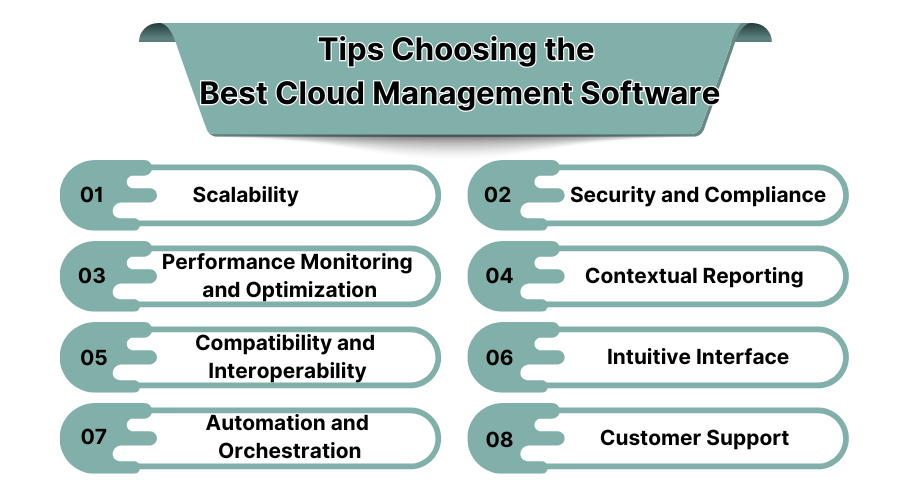
For companies that want to improve scalability, security, performance, and cost efficiency, it is essential to choose the right cloud management platform tools. Now note the most important aspects that you must think of in order to get the ideal cloud management software for your institution:
1. Scalability
Whatever tool you select should accommodate increasing workloads, and hybrid and multi-cloud strategies. The tool needs to allow for operational flexibility so that a business can increase its cloud resources with the least amount of disruption.
2. Security and Compliance
Cloud infrastructure is better protected with strong security and compliance. Features such as Role Based Access Control (RBAC), encryption, security monitoring, and compliance reporting adequate for GDPR, HIPAA, and SOC 2 should be on your checklist.
3. Performance Monitoring and Optimization
Tracking cloud performance in real time will ensure that services are available, workloads are executed efficiently and resources are utilized optimally. Resolving issues proactively will enhance reliability of the system.
4. Contextual Reporting
Organizations can monitor resource consumption, allocate costs, and analyze trends with the aid of more sophisticated data analytics and visualization tools facilitating intelligent decision-making.
5. Compatibility and Interoperability
Effective cloud management requires seamless integration with the existing IT infrastructure, cloud services, third party applications, and automation tools.
6. Intuitive Interface
The cloud management software’s dashboard should be intuitive to enable effortless handling of workloads, security policies, and cost controls from IT’s perspective to eliminate the need for any technical intricacies.
7. Automation and Orchestration
The distribution of work, responding to issues, and enforcing different policies get manual assistance for cloud management done efficiently. This will boost overall effectiveness with the use of AI automated orchestration and automation solutions.
8. Customer Support
To provide timely resolutions during cloud-related issues and to keep the cloud environment running smoothly, round-the-clock customer support along with dedicated account managers and on-demand training sessions is a requisite.
4. Who Uses Cloud Management Platform?
To enhance the security and cost associated with cloud services, there has been widespread adoption of Cloud Management Platforms (CMPs) across industries. Organizations use these platforms to improve the quality of automated cloud processes and simplify IT systems.
1. IT Industry
CMPs are of utmost importance to IT personnel tasked with overseeing multi-cloud sites. These systems allow for the automation of processes, the real-time monitoring of security, and the optimization of resources. This ensures that the cloud functions seamlessly without requiring human supervision.
2. Finance Industry
Financial institutions, banks, and securities firms use Multi-cloud management platforms to monitor cloud expenditures, guarantee compliance, and improve security. While enabling the optimization of monetary exchanges in different cloud locations, CMPs also provide guarantees for compliance.
3. E-commerce Industry
E-businesses utilize CMPs to scale cloud infrastructure, manage virtual stocks and guarantee speedy response time of websites. Business operations alongside clouds with rich responses help in coping with overwhelming high numbers of visits and automating business operations.
4. Automotive Industry
The automotive firms want to harness cloud management services for their sophisticated uses like connected cars, advanced cloud analytics, and cloud R&D. CMPs allow manufacturers to increase the effectiveness of their clouds and their innovation potential.
5. Healthcare Industry
CMPs have become vital for the secure storage of patient healthcare information, complying with the law, and managing healthcare cloud applications. Medical colleges and institutions are readily adopting cloud technology as it provides security, improves cloud service, and as well meets HIPAA and GDPR compliance.
5. Top Best Cloud Management Platform in USA
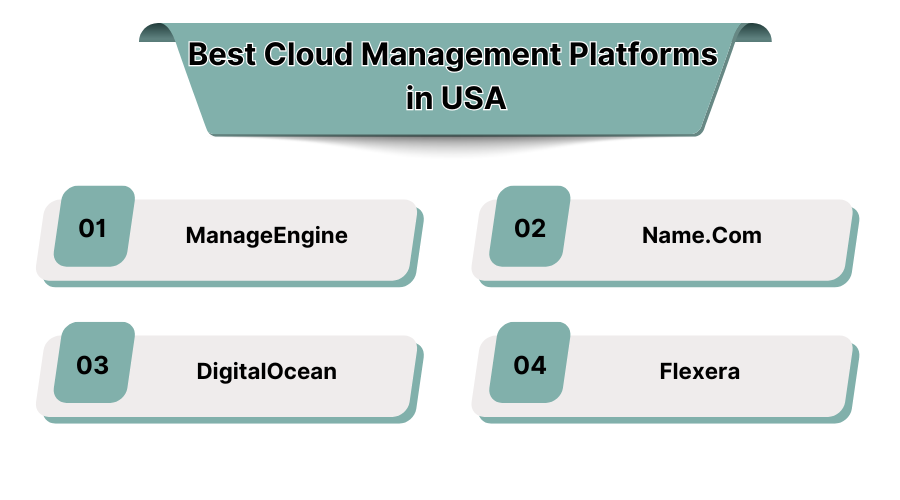
1. ManageEngine
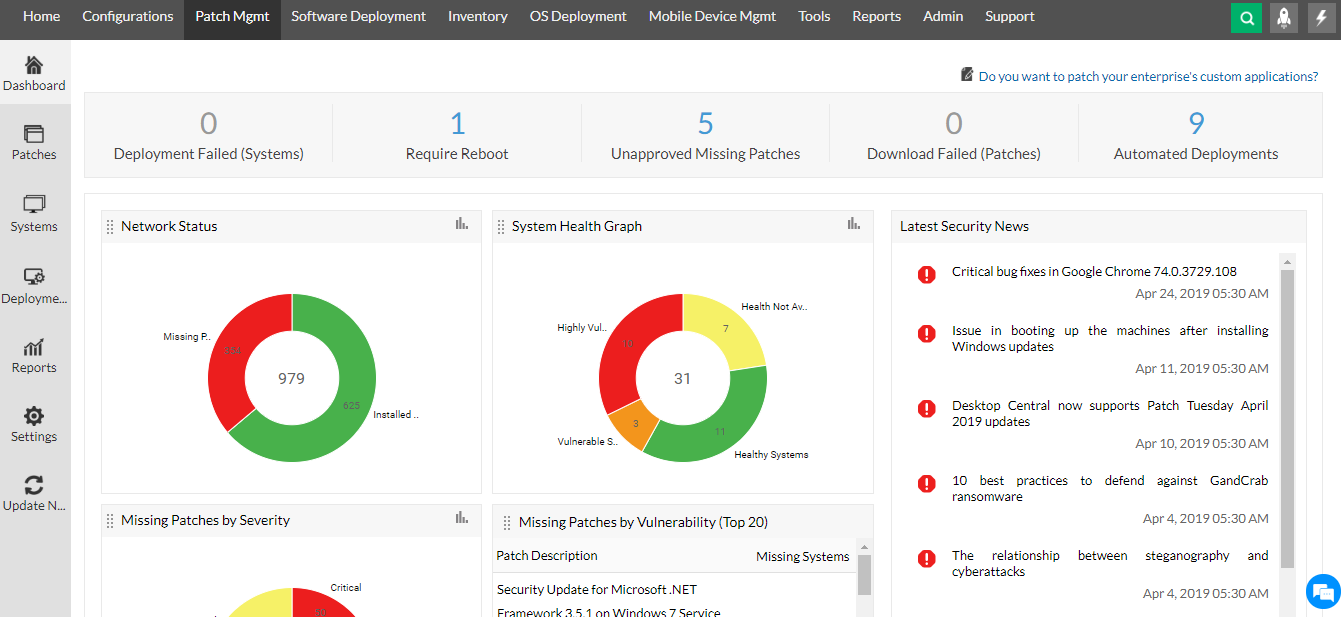
ManageEngine is a cloud management and IT automation tool. It helps businesses in managing security compliance and monitoring cloud performance. It additionally improves the efficiency of cloud-based workflows. Due to the low costs associated with this tool, it is widely adopted by small and mid-sized companies. However, its lack of profound integration with third-party cloud vendors makes it inefficient for multi-cloud infrastructures.
 Pros:
Pros:
- User-friendly interface with minimal learning curve.
- Cost-effective solution suitable for small firms.
- Strong security compliance features for cloud operations.
- Offers automation tools to streamline cloud management.
- Provides monitoring insights to detect potential threats.
Cons:
- Limited support for third-party cloud providers.
- Not ideal for large-scale multi-cloud deployments.
- Customization options can be limited.
- Lacks advanced predictive analytics.
- Customer support can vary based on pricing tier.
Pricing: Custom pricing available.
2. Name.com
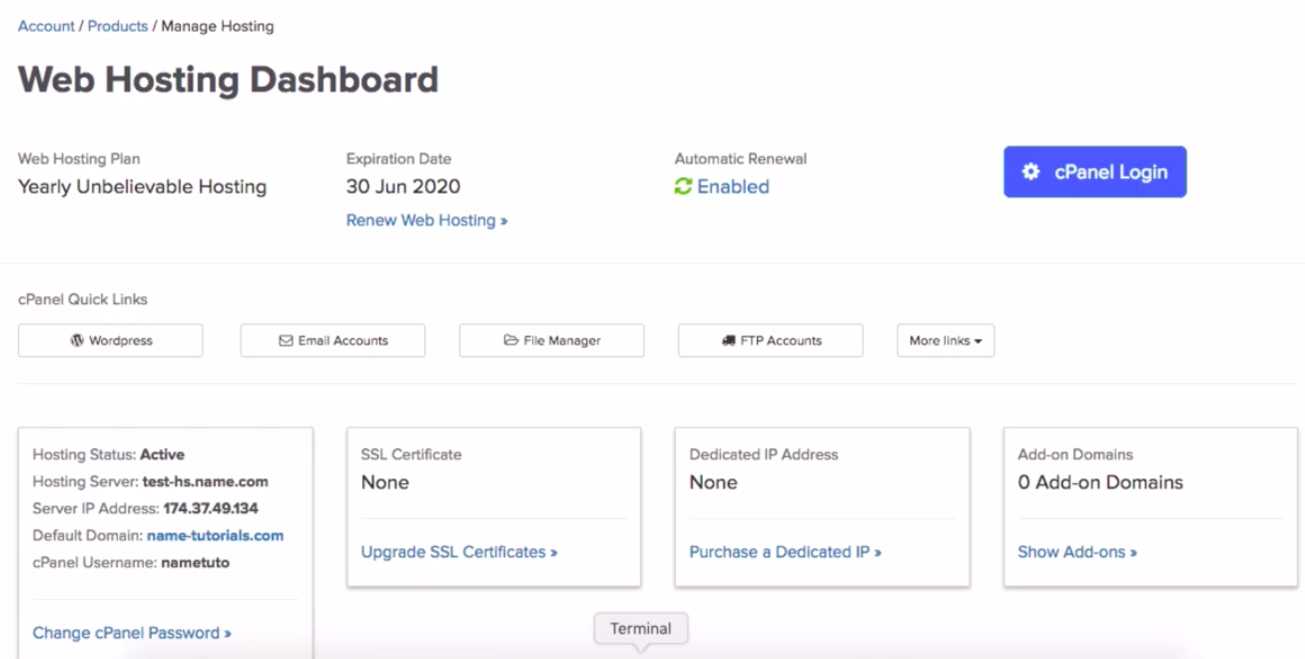
Name.com offers an affordable cloud infrastructure platform combined with domain management and security tools. It is primarily used by small businesses that require reliable cloud services with excellent customer support. While it is a budget-friendly solution, its ability to handle enterprise-level workloads is limited, making it less ideal for large-scale operations.
 Pros:
Pros:
- Affordable cloud services ideal for startups and small businesses.
- Excellent customer support for quick issue resolution.
- Includes domain management tools for added convenience.
- Simple setup process with minimal technical expertise required.
- Secure cloud storage options for small-scale applications.
Cons:
- Does not scale well for larger business workloads.
- Limited advanced cloud computing capabilities.
- Lacks comprehensive enterprise security compliance.
- Not suited for businesses requiring high-performance computing.
- Fewer integrations with major third-party cloud services.
Pricing: Starts at $10/month.
3. DigitalOcean
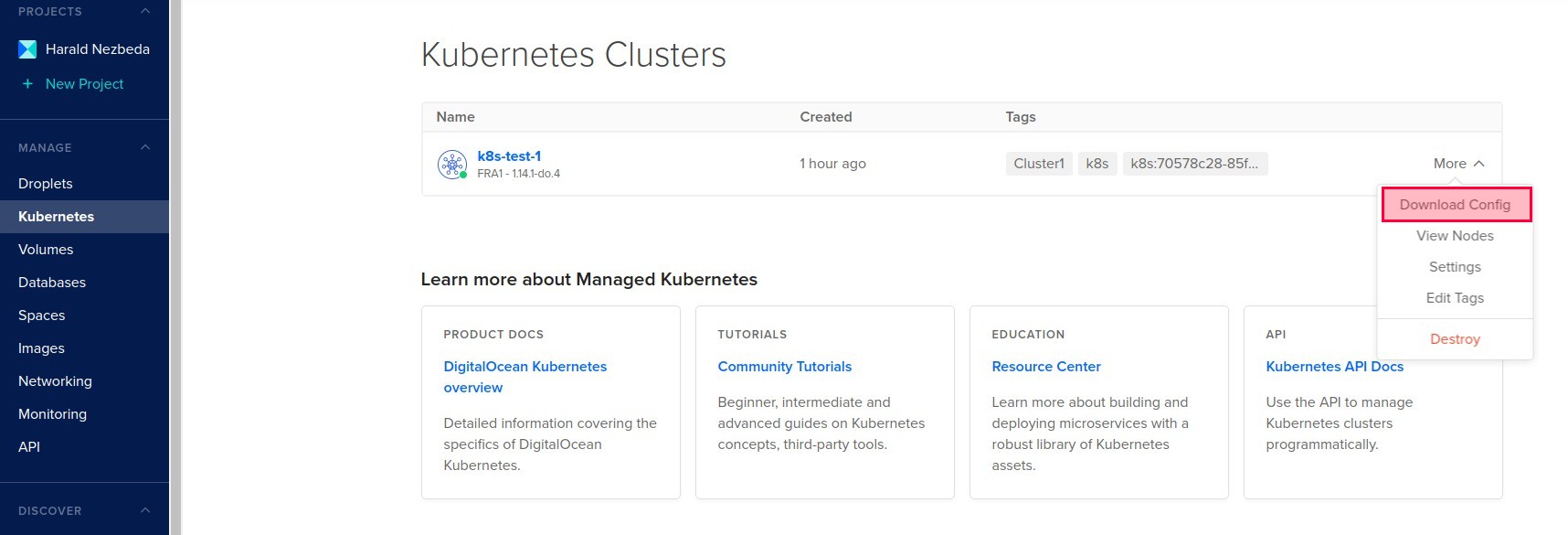
Small businesses and independent developers looking for a user-friendly infrastructure solution turn to DigitalOcean. This cloud service provider offers digital solutions at economical rates. Its superb cost efficiency and ease of use are unmatched. DigitalOcean lacks some advanced security and compliance capabilities needed by large corporations.
 Pros:
Pros:
- Cost-effective solution with flexible pricing.
- Great for developers and startups needing scalable resources.
- Simple and intuitive control panel for cloud management.
- Provides Kubernetes and container services for app development.
- Global data centers ensure better performance across regions.
Cons:
- Lacks enterprise-level security and compliance certifications.
- Limited automation features compared to premium cloud providers.
- No built-in hybrid or multi-cloud support.
- Not ideal for large-scale enterprise applications.
- Customer support response times can be slow on lower plans.
Pricing: Starts at $5/month.
4. Flexera
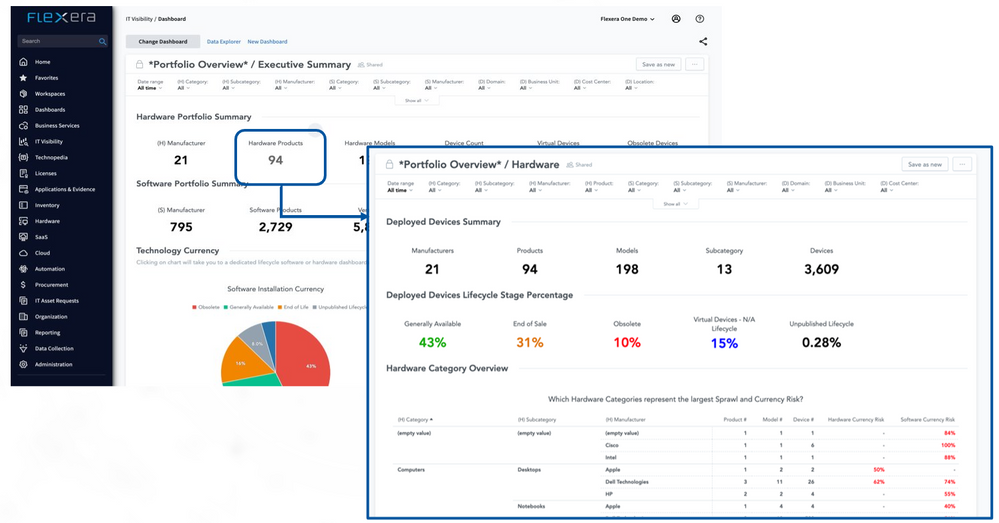
With a focus on IT professionals managing hybrid multi-cloud environments, Flexera offers heavy-duty resources to large organizations for optimizing budgets and ensuring security. It also automates cloud governance and improves security compliance via cloud spend tracking. However, the cost factor might limit small and mid businesses from adapting to this innovative solution.
Pros:
- Best for large enterprises requiring cloud compliance and automation.
- Supports hybrid cloud environments for maximum flexibility.
- Advanced security management tools for compliance-heavy industries.
- Helps businesses reduce unnecessary cloud costs.
- Provides detailed analytics for cloud usage insights.
Cons:
- Can be extremely costly for small businesses with limited cloud budgets.
- Requires technical expertise to set up and optimize.
- Pricing is based on usage, which can fluctuate significantly.
- Lacks an easy-to-use interface for non-technical users.
- Advanced automation features may require additional customization.
Pricing: Custom pricing based on usage.
6. Capabilities of Cloud Management Platform
With the help of Cloud Management Platforms (CMP’s), organizations can enhance performance and reduce operational expenditure. These capabilities enable organizations to manage their cloud infrastructure in a compliant manner while being cost effective.
1. Service Management
CMPs equipped with self-service portals enable organizations to provision, monitor, and manage cloud resources. CMPs provide workloads and storage deployment automation tools along with network configuration tools. This enablesIT staff to manage cloud operations automatically and autonomously.
2. Resource Management
Effective cloud resource management ensures the cloud storage, computing power, and networking services used by the business is utilized efficiently. CMP’s monitor resource consumption, highlight underutilized resources, and redistribute workloads, in order to improve operational performance and reduce expenditure.
3. FinOps Management
Cloud Financial Operations (FinOps) monitoring and analyzing tools are integrated into CMP’s with the objective of helping businesses control cloud spending. Automated cost allocation and budget tracking, along with predictive cost analytics, help organizations enhance cloud expenditure as well as strengthen financial efficiency. If managing funds has become a tough job for you, we suggest you cherish the cloud cost management software.
4. Governance and Security
Security remains the most critical component of cloud management. CMPs offer robust security frameworks that automatically identify risks, engage compliance policies, and control access to sensitive data. Real time threat detection and data encryption protects the cloud infrastructure while ensuring adherence to regulations.
7. How to Choosing the Right Cloud Management Platform
Cloud management platform selection must incorporate the overarching operational goals, budgetary constraints, and scalability parameters of an individual organization.
- For those businesses that utilize a single cloud provider, focused cloud platforms are the optimal choice.
- Multi-cloud platforms provide the greatest versatility for organizations that require the use of multiple cloud systems.
- Industries that necessitate an effective means of cloud management that is secure, scalable, and cost-efficient are best suited for hybrid cloud solutions.
8. What are the Types of Cloud Management Platform Are Available?
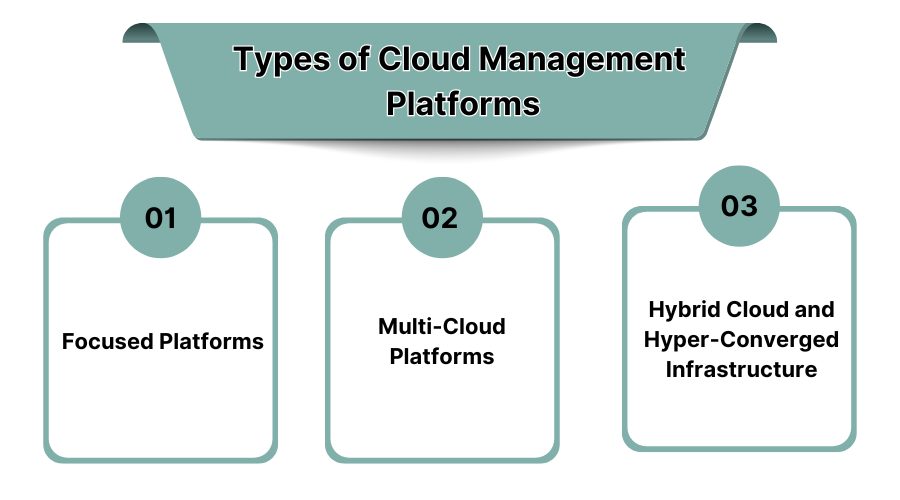
Cloud management platforms (CMPs) vary in types which cater to different business requirements. These platforms allow an enterprise to improve the administration of cloud operations, facilitate security, and manage resource usage in the most efficient manner. Here are the most common cloud management solutions that organizations use today.
1. Focused Platforms
Focused cloud management platforms operate solely on a single chosen cloud such as AWS, Google Cloud, or Microsoft Azure. These platforms ensure that businesses get the utmost benefits from their cloud environment by providing deep integration and advanced security along with optimization tools within the cloud. These platforms do not support multi-cloud functionality which makes it difficult for organizations to expand past a single provider.
Key Benefits:
- Optimized Performance: Tailored to enhance the efficiency and speed of a specific cloud provider.
- Enhanced Security: Adheres to required security compliance and best practices from the respective cloud provider.
- Cost Efficacy: Streamlines cloud management for businesses operating with single cloud-focus.
Limitations:
- Inflexibility in Multi-Cloud Implementation: Businesses are not able to easily incorporate multiple cloud providers.
- Vendor Lock-in: Moving past one provider involves complicated migration options beyond simple restrictions.
2. Multi-Cloud Platforms
Businesses can control AWS, Microsoft Azure, Google Cloud, and IBM Clouds using a single interface due to multi-cloud management platforms. Organizations can utilize the strongest features from various cloud service providers while making sure that cost optimization and security is taken care of by these platforms.
Key Benefits:
- Avoid Vendor Lock-in: Provides businesses with the ease to choose and switch cloud providers giving greater flexibility.
- Improved Cost Control: The monitoring and analytics in real time reduces expenses by resource usage optimization.
- Attention Standardization: Ensures that all the clouds have a unified security policy in place.
Limitations:
- Complex Implementation: Proper definition and approach towards strategy along with systematic know-how is a necessity to manage the numerous cloud services.
- Higher Costs: The combination of multi-cloud infrastructure can lead to increased operational expenditure for an organization.
3. Hybrid Cloud and Hyper-Converged Infrastructure
A hybrid cloud management platform merges private and public cloud infrastructures, which enables businesses to manage workloads with ease. It enhances flexibility while sustaining security and compliance of data.
Hyper-converged infrastructure (HCI) integrated computing and networking are available in a single platform. It will simplify complexity and enhance scalability. This solution is extensively adopted by organizations that need secure and flexible cloud services.
Key Benefits:
- Flexible Workload Distribution: Efficient movement of workloads between cloud and on-premise facilities.
- Improved Security and Compliance: Guarantees data protection in strict-regulated industries.
- Cost Efficiency: Economical in utilizing on-premise and cloud resources.
Limitations:
- Maintenance Requirements: Continuous monitoring and management of hybrid cloud solutions.
- Latency Issues: Performance reductions can happen due to data transfer between cloud and on-premise facilities.
9. What is a Cloud Management Platform?
A cloud management platform (CMP) is software that lets organizations monitor, manage, and optimize their cloud infrastructure using a single interface. CMPs assist IT teams in the management of computing resources inclusive of private cloud and hybrid cloud. It will guarantee automation and security.
Some of the services offered by these platforms include:
- Preventative measures against spending through proper budgeting.
- Monitoring the cloud environment for potential security threats.
- Provisioning of resources for sufficient workload distribution.
- Automation and orchestration of sequential processes for the enhancement of cloud operations.
