
What we'll cover
Share with your community!


Get Free Consultation


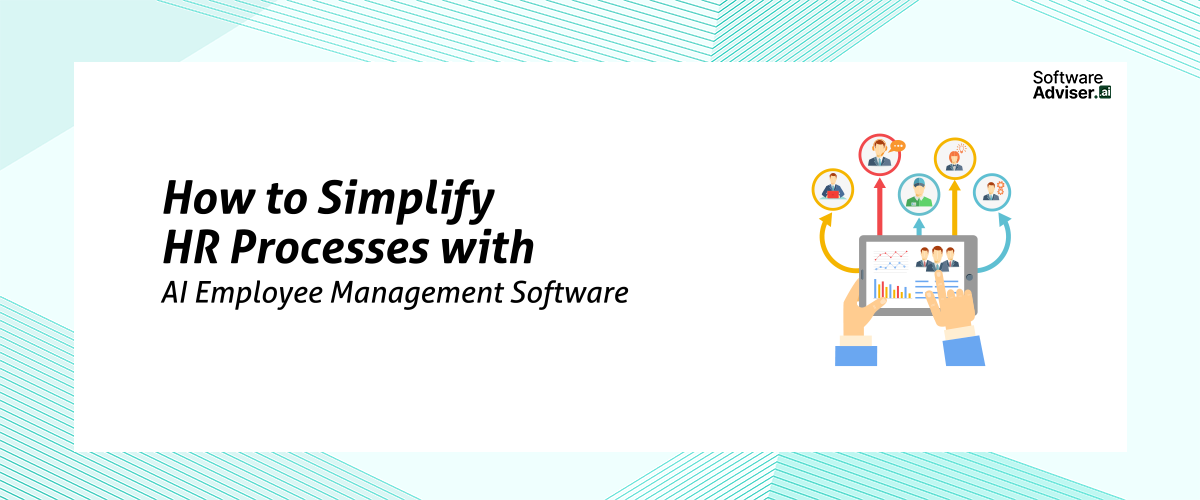
How to Simplify HR Processes with AI Employee Management Software
 David N. Wilks
AI personnel management software is developing at a meteoric rate, changing the way that modern enterprises deal with workforce logistics. These smart systems automate and streamline routine administrative operations, including attendance, payroll, and shift scheduling, eliminating human mistakes and drastically reducing administrative hours. HR is no longer mired in repetitive data input. Using real-time information allows for the creation of an optimal staffing strategy, accurate predictions of employee attrition, and faster employee integration. Using artificial intelligence (AI) in your HR ecosystem helps you shift to a more strategic development approach vs. manual methods, allowing you to better leverage productivity levels from your employees.
What is AI Employee Management Software?
AI personnel management software is a digital platform powered by machine learning and automation that streamlines the daily operations of a staff. These solutions do the hard lifting, freeing up AI HR professionals from hours-long tasks of manually recording clock-ins, preparing weekly shift schedules, or going through reams of onboarding documentation. The software integrates with a company’s internal systems to alleviate the drudgery of data input and reduce the human mistakes that might lead to payroll anomalies or compliance difficulties.
What makes these intelligent systems unique is not the collection of static data but the delivery of actionable insights. The program monitors workforce trends in real time, allowing managers to estimate when staffing will be at its highest, discover early symptoms of employee fatigue, and identify high-turnover concerns before they happen. It successfully transforms HR from a reactive, administrative role into a proactive, data-driven partner focused on employee engagement and strategic growth for businesses across the U.S. that want to scale.
How does AI Employee Management Software Save Time for HR Teams?
AI employee management technologies claw back hours for HR professionals primarily by fully automating basic administrative duties. Smart algorithms, working quietly in the background, take care of the drudgery of recording daily attendance, granting time-off requests, and processing payments. Instead of the HR manager spending half their week manually cross-referencing timesheets, hunting for signatures, or developing elaborate shift schedules on an Excel sheet, the program accomplishes it in seconds. This dramatic decrease in boring data input immediately frees up precious time and allows small HR teams to operate with the efficiency of a bigger department.
These tools not only manage the everyday paperwork, but they also speed up the entire recruiting and onboarding process significantly. Screening applicants, organizing interviews, and sending out initial offer letters can take weeks when done manually. AI systems can scan hundreds of applications in seconds to identify top talent, provide automated follow-ups to prospects, and assist recruits through their day-one compliance training without ongoing HR monitoring. This automated method makes the onboarding of new workers a smooth experience, and saves HR staff from the repetitious back and forth communication that sometimes slows down the hiring process.
Finally, the program is time-saving, serving as a proactive helper that mops up operational errors before they turn into time-consuming disasters. Instead of HR experts manually examining data to find out why turnover is high or where scheduling issues are happening, the AI looks at workforce trends in real time. It may quickly identify any labor law infractions, warn managers to employees nearing overtime restrictions, and even detect early signs of exhaustion. By moving HR from a reactive state of continual firefighting to a proactive state of strategic planning, organizations can keep their operations operating smoothly without wasting days to compliance audits and dispute resolution.
Can AI Employee Management Software reduce hiring mistakes in the US?
Yes, AI personnel management software may help minimize recruiting blunders dramatically by removing unconscious bias and gut-feeling judgments from the first vetting phase. Recruiters in the U.S. may get hundreds of applications for a single vacancy, leading to resume fatigue, where outstanding applicants are easily ignored or the wrong profiles are advanced. AI systems compare resumes to precise skill sets, qualifications, and experience criteria stated for the post using objective data matching. The program scores all applicants against the same performance-based criteria, creating a fair and uniform screening process that progresses candidates based on their merits, not a recruiter's subjective initial impression.
These smart solutions also increase hiring accuracy by deploying predictive analytics to analyze a candidate’s long-term cultural and operational fit. New AI techniques may evaluate historical workforce data within a business to uncover the exact qualities, backgrounds and behavioral patterns of its best-performing, longest-retaining personnel. During the hiring phase, the program may evaluate candidates using specific behavioral and situational judgment tests, comparing their profiles against these internal success parameters. This way, US companies avoid the costly error of recruiting people who appear great on paper but don’t have the particular working style needed to succeed in the company’s specific setting.
AI software can automate and standardise compliance checks and interview questions, thereby significantly reducing the risk of hiring mistakes for companies. Through the use of AI-assisted scheduling and structured interview kits, candidates receive identical compliance, role-specific questions, and avoid questions that may expose the company to legal liability or are unnecessary. These systems automate the process of verifying candidates' credentials, reference checks, and career histories, allowing the company to detect issues or inconsistencies prior to offering a candidate a formal employment contract. By implementing rigid, pre-defined guidelines in the process of hiring, American businesses can protect themselves from the impact of incompetent hiring decisions and invest in talent that will ultimately benefit their workforce.
How does AI Employee Management Software handle employee onboarding?
AI-powered Talent Management Software allows for an orderly and guided experience for new employees, transforming the chaos of the paper-based onboarding process into a digital experience. Upon acceptance of an offer letter from a candidate, a customized onboarding site is created immediately for the new employee using this technology. This eliminates a lot of the busy work that H.R. has to go through trying to keep track of multiple email chains with new employees throughout the entire process. Secure electronic signatures allow the employee to upload identification, complete tax withholding forms (such as the W-4), sign direct deposit authorizations, and access business handbooks from their own device.
The platform centralizes all paperwork and guarantees that all federal, state, and company-specific compliance obligations are fulfilled from day one, thereby liberating HR professionals from tiresome administrative data input. And as the software gathers papers, it also manages the operational and social side of integration to provide for a smooth first week. The AI auto-schedules all necessary compliance training, assigns localized orientation pathways, and syncs milestone check-ins straight to the employee’s calendar. At the same time, it automatically notifies internal departments, contacting IT to supply hardware and software access, and notifying the direct manager to assign a workplace buddy or plan a team welcome. The platform takes care of these dependencies behind the scenes to ensure no step is skipped, reducing early-stage turnover by giving the recruit a very planned, professional, and pleasant introduction to the organization.
What Compliance Benefits does AI Employee Management Software offer US businesses?
AI staff management software helps U.S. companies stay compliant with regulations in an automated way, which reduces their legal risk. Here are six of the biggest compliance benefits these systems offer:
-
Real-Time Employment Law Tracking: The software constantly analyzes evolving federal, state, and local labor laws, including abrupt changes to minimum wage, paid leave, and safety standards, to automatically adjust firm workflows and employee handbooks for continued compliance.
-
Automated Tax Registration - Multi-State: The platform will handle the registration of your business with individual state agencies. It will also calculate payroll withholdings, using local jurisdictional tax rates, for employees who work remotely in different states. Finally, the platform will file quarterly payroll returns on your behalf in all fifty states.
-
Predictive Time and FLSA Reporting: Through the use of real-time time tracking, the technology allows you to predict when employees are close to violating the Fair Labor Standards Act (FLSA). Then, the system will automatically notify your management of the potential violation before the employee exceeds their established work schedule or exceeds the maximum number of overtime hours.
-
Objective, Audit-Ready Documentation: All administrative actions take place via an electronic time stamp and are securely stored, producing a permanent and centrally located audit trail to be used for regulatory audits. Examples of actions that will produce an audit-ready documentation record include timecard approvals, onboarding documentation, and completion of required compliance training.
-
Non-Biased Standardized Hiring Practices: The platform eliminates the subjective components of the hiring process, which reduces your company's equal dignity Opportunity Commission (EEOC) risks. All applicants will be evaluated based solely on performance-driven criteria and pre-defined skill benchmarks.
Benefits Automated Eligibility and ACA Reporting: The software will allow you to compare your employees' hours with the Affordable Care Act (ACA) eligibility requirements, thus identifying full-time employees and automating the enrollment period, while also generating the necessary IRS forms. As a result, manual processes will be removed from your employee eligibility and ACA reporting.
How does AI Employee Management Software improve Employee Performance Tracking?
AI personnel management software is transforming how firms measure performance, shifting from subjective, once-a-year appraisals to continuous, data-driven insights. These platforms give a far clearer and fairer view of how productive the staff is by looking at the day-to-day process.
Here’s how AI fundamentally improves employee performance tracking:
-
Constant, Real-Time Monitoring: Instead of waiting for quarterly or annual cycles, AI monitors progress against Key Performance Indicators (KPIs) and Objectives and Key Results (OKRs) in real time. Managers get real-time visibility into project milestones to make course changes on the fly instead of late shocks.
-
Elimination of Managerial Bias: Human assessments are sometimes subject to recency bias (recall of only the recent few weeks) or personal favoritism. AI analyzes performance with standardized, objective data points accumulated over months, offering fair, transparent, and completely merit-based judgments.
-
Granular Productivity Analytics: Conventional technologies measure just generic indicators such as total active hours or screen time. AI systems take this a step further, differentiating between really deep work and valuable job advancement vs scattered, non-productive app usage or basic administrative burden.
-
Early signs of Employee: Dissatisfaction or fatigue may be detected using machine learning models that track changes in communication volume, methods of interaction, and system behavior over time. This enables HR to be proactive and step in before a performance decline results in churn.
-
Automated 360-Degree input Summaries: Gathering input from peers, subordinates, and managers might take weeks of laborious compilation. Generative AI combines and synthesizes these text-based assessments from numerous business platforms to provide comprehensive, constructive performance summaries in seconds.
-
Hyper-Personalized Growth Paths: When the system discovers a skill gap or performance barrier for the person, it doesn’t just report it. The program may automatically propose targeted micro-learning courses and specific coaching plans that are designed to assist the individual employee to win.
Is AI Employee Management Software affordable for small US businesses?
AI staff management software is shockingly inexpensive for small organizations in the U.S., mostly due to the trend toward tiered, software-as-a-service (SaaS) pricing structures. Modern providers usually offer a predictable per employee, per month rate, frequently in the neighborhood of $3 to $12 per user, instead of driving small firms into huge, enterprise-level contracts. Because it’s adaptable, a small retail company or a growing 15-person marketing agency only pays for exactly what they need. Many entry-level tiers include solid core features such as automatic scheduling and basic time tracking—for free or at a very low flat charge, making it easier for cash-strapped owners to use the technology without a huge financial strain.
When considering the real cost, small companies must go beyond the monthly membership price and evaluate the instant return on investment (ROI). By automating tedious tasks like payroll administration, changing schedules, and onboarding paperwork, an owner or office manager easily saves five to 10 hours a week. In a market where the cost of administrative overhead and human compliance failures may break a tight budget, the software pays for itself. These smart technologies are a very cost-effective multiplier to small business growth by decreasing costly payroll disparities, preventing unlawful overtime before it happens, and removing the need to engage a full-time, dedicated HR administrator.
Why should US companies switch to AI Employee Management Software?
Many companies in the USA must adopt AI Employee Management Software to continue being viable, especially in tight labour markets. One of the main reasons is to eliminate operational friction (where a significant amount of time is lost because of manual HR functions such as timecards, payroll, etc). By automating these types of processes with AI-powered platforms, many companies have reclaimed hundreds of hours that were once wasted to reallocate those hours to more collaborative and strategy-focused work.
In addition, these companies will be able to protect themselves from tracklessForms on the data security/legal side as these tools can provide organisations with unprecedented levels of real-time, secure, and compliant data (particularly in relation to the myriad of changing FLSA regulations among states and the general complicated nature of doing business across the country). Compliance violations can now be reduced by governments being less likely to issue large financial fines as a result of all the technological barriers being put in place before they occur.
Conclusion
The move toward AI-powered employee management platforms is no longer a futuristic vision but should be viewed as an absolute requirement for all U.S.-based organisations that want to become more productive and compliant with regulations related to their workforce. The tools will be used to provide information about workers and their performance while eliminating administrative duties associated with managing workers.
FAQ's
It automates HR tasks like recruiting, onboarding, performance tracking, and compliance using artificial intelligence. The software learns from your data to flag risks, suggest actions, and handle repetitive work, freeing your HR team to focus on people.
HR teams that automate administrative tasks save over seven hours per week, according to a Workato survey cited by SHRM. Onboarding alone can be cut by about 53%.
Yes, but you must use it responsibly. The EEOC monitors AI for discrimination, so employers should audit their software for bias regularly and keep a human involved in final hiring decisions.
Costs depend on your team size, chosen features, and number of users. Many providers offer tiered or free plans, and cloud-based delivery has made these tools increasingly affordable for small businesses.
Absolutely. Small teams often gain the most, since they have fewer staff to handle HR tasks. The time savings and reduced hiring risk usually pay for the software within months.
No. The DOL emphasizes keeping the "human" in human resources. These tools handle repetitive work and surface insights, but final decisions should stay with people.
Building a modern email marketing strategy by manually segmenting lists, guessing send times, and writing individual copy variants is a losing battle. [...]
David N. Wilks
Managing a website is currently much more than just uploading simple text files onto a server. Enterprises often have issues keeping up with making da [...]

Dokas mile
For small businesses that want to grow, managing cloud infrastructure can feel like that nonstop juggling thing between costs that creep up and techni [...]