
What we'll cover
Share with your community!


Get Free Consultation
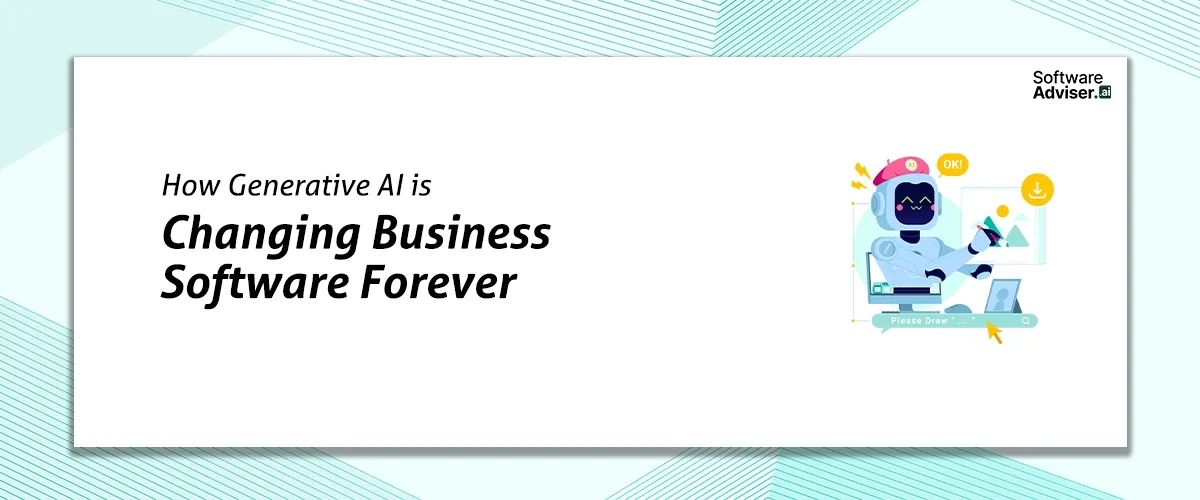
How Generative AI is Changing Business Software Forever
 David N. Wilks
Generative AI has rapidly transformed enterprise software, moving from a competitive feature to a core business capability. Organizations are increasingly adopting AI to automate workflows, improve decision-making, accelerate software development, and enhance employee productivity. As AI becomes a standard part of modern business operations, companies are shifting their focus from experimentation to long-term implementation.
This rapid adoption is backed by strong industry data, with businesses investing heavily in AI-driven solutions across multiple functions. Rather than changing software in a single way, generative AI is reshaping how applications are built, used, and delivered. This article explores the five major ways generative AI is transforming enterprise software and what these changes mean for businesses planning their AI strategy.
How Business Software Worked Before AI
To understand what changed, start with what business management software used to be. Behind every screen of the enterprise software your company bought in 2018 sat thousands of hand-written rules. Invoice over $10,000? Route to a manager. Does the email contain the word "refund"? Open ticket type B. The system knew nothing. It followed instructions, forever, exactly as written.
Why Traditional Software Couldn't Keep Up
That architecture worked when information arrived in tidy, structured fields. It collapsed against reality, where the important material lives in rambling emails, scanned contracts, call transcripts, and PDFs photographed at an angle. Traditional software simply couldn't read any of it. So humans did, one document at a time, and companies staffed entire departments around that limitation without ever naming it as one.
What Changed with Generative AI?
Generative AI removed the limitation, and it did so almost casually. Systems built on large language models read messy, unstructured, real-world input and act on it without a developer scripting every variation. Everything else generative AI has done to this industry follows from that single unlock.
1. You Can Simply Talk to Software
The most visible change is the interface itself. Dropdown menus, filter panels, and configuration forms are steadily giving way to a text box where you describe what you want in natural language.
Examples of AI in Everyday Business Software
We see it in tools we test every week. Image generative fill replaced a dozen sliders with a sentence. Shopify's Sidekick builds a discount code because a merchant asked for one in words. Excel now accepts "show me which region underperformed last quarter" and answers with a chart. The pattern repeats in every category we cover, and it quietly changes who gets to be a power user. The employee who memorized the menus loses their moat. The employee who can describe a problem clearly gains one.
How AI Reduces Training Costs
There's a financial consequence hiding in this shift too. When natural language becomes the interface, training costs collapse. New hires stop learning software and simply start using it, which removes one of the largest hidden expenses in enterprise software adoption. In our conversations with operations leaders, several now list "no training required" among their top three purchasing criteria, a phrase that would have sounded absurd in 2020.
2. AI Is Now Available to Every Business
Before large language models, adding intelligence to a product was brutally expensive. A company wanting real machine learning capability needed its own data scientists, its own labeled datasets, its own custom models, and a year of patience. Only giants could afford the entry fee.
Businesses Can Add AI Without Building It
Any development group can now lease global-magnificence intelligence via an API for pennies in step with request, ground it in employer statistics using retrieval strategies, and ship an AI characteristic in a sprint instead of an economic 12 months. The proof is anywhere in our assessment queue: the regular CRM software that all of a sudden summarizes calls, the accounting tool that reads receipts, and the HR platform that drafts job descriptions overnight.
Why "AI-Powered" Is No Longer a Selling Point
This commoditization explains why "AI-powered" stopped being a differentiator around 2025. When each supplier can buy the identical underlying intelligence, the aggressive moat moves somewhere else, to proprietary statistics, to workflow depth, to accept as true. Our advice to buyers has adjusted accordingly. The AI badge on the box means almost nothing. What the AI actually completes inside your workflows means everything, and that distinction should anchor every evaluation you run this year.
3. AI Can Complete Tasks Instead of Just Answering Questions
The first generative AI wave produced assistants, and honestly, we underrated how quickly the second wave would follow. Ask a question, receive an answer, then go do the work yourself. Useful, but the human remained the engine.
What Are AI Agents?
The current wave produced AI agents, and the difference is the whole story of 2026. An agent perceives context, makes decisions, and executes multi-step tasks with limited supervision. In customer support, that looks like Intercom's Fin reading a ticket, checking the order history, issuing the refund, and closing the conversation with no human involved, at resolution rates its customers routinely report above 50%. In payments, Mastercard's fraud models scan billions of transactions in real time and have doubled the detection rate of compromised cards. McKinsey's latest survey found 23% of large organizations already scaling agentic systems across multiple functions, with another 39% actively experimenting.
How AI Agents Are Changing Business Software
We'd flag this as the shift that changes what business software fundamentally is. For four decades, software organized work for humans to do. Agents do the work. Categories built entirely around organizing human labor, ticketing queues, data entry screens, and manual report builders are starting to look like scaffolding for a workforce that's shrinking away from those tasks. Not every category, and not overnight. But the direction is no longer in question.
4. AI Makes Software Development Faster
Generative AI didn't just change what software does. It changed how software gets made, and the software development world felt the generative AI effect before anyone else did.
How AI Helps Developers Write Code Faster
Coding assistants like GitHub Copilot propose complete capabilities, provide an explanation for legacy code whose authors left the employer a decade ago, and in agent mode take a written difficulty and return a working pull request. Controlled studies have proven builders complete tasks dramatically faster with those tools, and in our own experience the productiveness advantage compounds maximally in the unglamorous places: test generation, documentation, and the refactoring work every team postpones for years.
Why This Matters for Businesses That Don't Build Software
Two downstream consequences matter for businesses that never write a line of code. First, custom internal tools that were never worth building suddenly are, because a team of six now ships what previously needed fifteen. Second, legacy modernization, the project every enterprise dreads and defers, finally has a practical path, since machine learning systems can read and translate the old code nobody fully understands anymore. The software development bottleneck that constrained a generation of digital ambition is loosening, and mid-sized companies are the surprise beneficiaries of that change.
5. Software Pricing Is Starting to Change
Here's the shift nobody puts on a keynote slide. Business software has been priced per seat since the beginning: the more employees using the tool, the more licenses sold. But what happens to per-seat economics when AI agents perform work that used to require seats?
Companies Are Paying for Results, Not Users
The market is already answering. Intercom charges roughly $0.99 per resolution rather than per support agent. Automation platforms price per operation executed. Outcome-based pricing, a consulting fantasy for twenty years, is appearing in real contracts, because paying for resolved tickets or processed invoices maps to value in a way seat counts never did.
What Buyers Should Expect in Software Contracts
Expect turbulence here for several years. Vendors whose revenue models depend on seat expansion will resist the transition, buyers will push for it, and in our estimation the companies that solve fair pricing for machine labor will define the economics of enterprise software for the next decade. If you're negotiating a multi-year contract in 2026, this tension belongs in the conversation.
Common Challenges of Using Generative AI
Enthusiasm without honesty is how bad purchases happen, so here are three warnings from the failure cases we've documented.
Hallucination has not been solved. Generative AI produces confident, fluent, and every now and then incorrect output, and any enterprise procedure that skips human assessment will subsequently put up a costly blunder somewhere. Courts have already sanctioned experts for precisely this. The dependable restore is workflow design as opposed to wishful questioning: AI drafts, and people approve, especially anywhere cash, customers, or compliance is worried about.
Change management fails more often than the technology does. BCG's research on successful adoption puts the formula at 10% algorithms, 20% technology, and 70% people and process. The deployments we've watched collapse were almost never technical failures. They were teams who felt replaced rather than helped, quietly starving the system of good inputs until the pilot died without ever appearing in a status report.
And measurement gets skipped with remarkable consistency. Productivity gains that are real but diffuse do not survive budget season. The organizations getting funded for year two defined their metric before deployment, baselined the hours a process consumed, and returned with a number finance could not argue with.
How to Choose AI Business Software in 2026
Pull the 5 shifts collectively, and a sensible playbook emerges for absolutely everyone retaining software finances in 2026.
Evaluate generative AI features via what they hold, no longer what they generate. A device that drafts an email saves minutes; a tool that resolves the price tag saves a role's well worth of hours, and the space between those claims is wherein most dealer exaggeration lives. Ask each seller where your facts go and whether they train their models, because the answers vary wildly, and the awful ones fall on the second-worst viable option. Favor automation embedded in workflows you already run over standalone equipment that uploads every other silo to control. And take a hard look at contracts built purely on seats, because your seat count and your workload are about to diverge, possibly sharply.
Above all, resist the urge to transform everything at once. The pattern behind every success story we've covered is almost embarrassingly simple: one workflow, one tool, one measured result, then the next.
Conclusion
Every few decades something changes what software is. The spreadsheet did it. The browser did it. Generative AI is doing it now, faster than either predecessor, and the evidence is already sitting inside your company's stack: the CRM that fills itself in and the support queue that shrinks the natural language box appearing where configuration forms used to be. The companies handling this transition well share one habit we keep noticing. They ignore the hype cycle entirely and ask a boring question about every workflow they run: could intelligence remove this work? Asked honestly and answered one workflow at a time, that question turns the transformation everyone else is still theorizing about into something your business quietly finished first.
FAQ's
Generative AI enables business software to understand natural language, automate tasks, and generate useful content or actions.
It reduces manual work by automating workflows, speeding up decision-making, and assisting employees with everyday tasks.
AI agents can complete multi-step tasks with minimal human input by making decisions and executing workflows automatically.
Large language models allow software to understand, analyze, and respond to natural language instead of relying on fixed rules.
Businesses should prioritize AI tools that solve real workflow problems, integrate with existing systems, and deliver measurable results.
In the highly competitive 2026 US job market, organizations are shifting away from fragmented legacy checklists toward cohesive, hyper-personalized di [...]
David N. Wilks
E-commerce brands face a relentless challenge: executing hyper-personalized communication at scale without draining human resources. Manually drafting [...]
David N. Wilks
The e-commerce landscape in 2026 is hyper-competitive. With online sales projected to surpass $8 trillion globally, running generic email blasts is a [...]