
What we'll cover
Share with your community!


Get Free Consultation
How to Choose the Right AI MR Reporting Software
 David N. Wilks
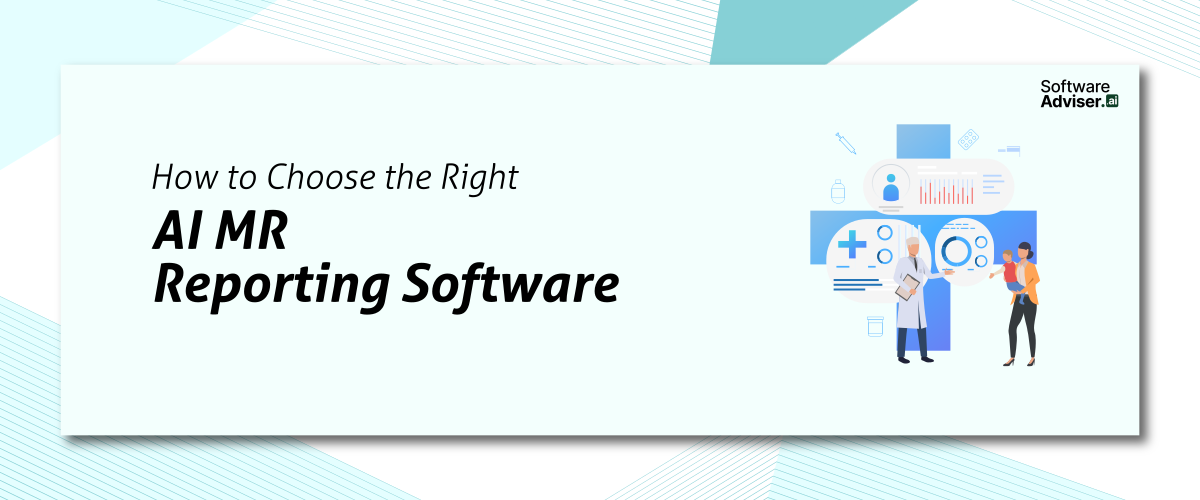
A major priority in modern healthcare practices and hospital systems is finding the right AI-powered Medical Record (MR) Reporting Software solution(s). With provider burnout at an all-time high, the right software must do more than just offer speech-to-text dictation capabilities; it will need to integrate with current EHR systems seamlessly, automate cumbersome clinical paperwork, and be HIPAA compliant. When selecting a vendor for US-based practices, there is also a choice between clinical accuracy vs. workflow efficiency and strong data protection vs. feasibility (cost). By emphasizing interoperability, accuracy of charts, and vendor reliability, healthcare leaders can break free from their administrative rut so they can provide high-quality patient-centered care smoothly and efficiently.
What Is AI MR Reporting Software?
Medical Record (MR) data entry software from AI streamlines and automates the process of creating MR documentation for physicians in the U.S., making it easier to create an MR. The software is powered by AI and ML, utilizing ambient AI and NLP that listens to/for physician dictation audio to instantly create accurate MR reports based on those dictations in a variety of formats, like SOAP notes and discharge summaries. The AI scribe can document patient histories and physician assessments while using highly specialized medical terminology and other complex data as they convert the data produced from the audio (and/or other raw/structured) into a usable/documented MR.
AI MR reporting software Technology is creating a wave in the U.S. healthcare system because it assists with reducing physician burnout and administrative fatigue due to the overwhelming amount of time they spend typing (not direct patient care related) outside of their patient care hours. American physicians use AI MR reporting technology to produce accurate documents to maintain compliance with the Health Insurance Portability and Accountability Act (HIPAA) when documenting in their Electronic Health Record (EHR) systems. In addition, AI MR reporting technology represents a bridge between complex insurance billing regulations and the delivery of patient-centered care provided by physicians and other clinicians.
Why Does AI MR Reporting Software Matter in the US Market?
The significance of AI MR reporting software in the US market cannot be overemphasized, as healthcare institutions in America are experiencing an unparalleled operational crisis. Due to complex insurance reimbursement schemes, tight regulatory tracking, and extensive charting requirements, healthcare providers spend too much time on data input. One of the best remedies for physician burnout available today is this software that is powered by an AI medical scribe, which is driven by powerful medical language processing. By moving the administrative load from human hands to intelligent technologies, medical practices throughout the country may substantially cut the hours physicians spend typing notes after their shifts conclude.
And we’re seeing that shift happen with the advent of ambient clinical intelligence, where the software can listen safely to a normal dialog between a doctor and a patient without dictation being so strict. The device leverages high-accuracy medical speech-to-text to record the chat and instantaneously turns it into organized clinical data. Instead of creating a random wall of text, the program functions as an automatic SOAP note generator, quickly formatting the information into the standardized Subjective, Objective, Assessment, and Plan template needed by US hospitals and insurance carriers. This clinical documentation automation helps to finish the record faster with improved clinical accuracy and fewer coding mistakes.
Also, the technological design of these platforms is a make-or-break aspect for healthcare managers in the stringent regulatory environment of the United States. Hospitals must only use HIPAA-compliant AI software with end-to-end AI database management encryption to safeguard patient privacy and avoid devastating financial penalties. More importantly, the long-term success of this technology is highly dependent upon integration of EHR with the leading American registries. When AI software can fill these medical records immediately, without the need to copy and paste manually, it bridges the gap between cutting-edge artificial intelligence and everyday clinical operations, ultimately allowing US doctors to return to focusing fully on patient care.
What Features Should You Look for in AI MR Reporting Software?
When assessing AI MR reporting software for the US market, focusing on certain characteristics can help guarantee the platform fulfills both clinical and operational demands. Look for these six key features:
- Ambient Listening & Live Transcription: The program should include ambient clinical intelligence that, in the background, detects normal patient contacts and transcribes talks into correct notes using medical speech-to-text technology without relying on strict, human dictation.
- Deep EHR Integration: Choose a solution that integrates easily with major US systems, syncing structured clinical data straight into patient charts, eliminating the need for repetitive copying.
- Automated Clinical Structuring: The platform should serve as an intelligent SOAP note generator, capable of converting unstructured audio into standardized, compliant forms (Subjective, Objective, Assessment, and Plan) using specialized medical language processing.
- HIPAA Compliant & Enterprise Grade Security: The platform should be a complete HIPAA-compliant AI software solution, with end-to-end encryption for all data, and execute Business Associate Agreement (BAA) contracts. The platform should not keep the original audio at all.
- Multi-Specialty and Customizable Template: The software must AI employee recognition unique, complex medical terms from a variety of specialties (ie, cardiology, orthopedics, etc.) and allow a practice to create templates that match their current clinical practice and procedures.
- Mobile Friendly Flexibility: A quality AI medical scribe will also have a fully functional mobile app for downloading audio or quickly dictating data on an iPhone/iPad while moving from patient to patient.
How Does AI MR Reporting Software Improve Accuracy?
AI MR Reporting Software enhances accuracy with auto data gathering and gap flagging. AI MR reporting software enhances clinical AI document management by replacing fallible, memory-based manual charting with accurate data recording. In the standard US healthcare process, a tired doctor could be typing up a patient’s file hours after the actual interaction, relying on a shorthand scrawl and mental recollection that is inherently prone to human error, mistakes, and unintended omissions.
The risk is removed by Ambient AI solutions that record the full provider-patient dialog in real-time. The program uses a large collection of medical dictionaries and the most powerful clinical NLP to accurately capture very complicated, multi-syllabic medication names, doses, and diagnostic phrases. This thorough, point-of-care capture greatly reduces documentation deficiency rates and ensures that the final medical record contains a complete and highly credible description of the patient's visit.
The system also improves accuracy by producing organized clinical data that meets the exacting criteria of US regulation and insurance. Rather than the copy-paste habit that spreads historic medical mistakes throughout the Electronic Health Records (EHR), the AI intelligently examines the context of the discussion. It differentiates between a symptom the patient now has and a condition they are discussing, and automatically organizes these insights into a very exact SOAP format.
The program maps the clinical narratives directly to the standardized terminology necessary for billing and coding, reducing the potential for clinical misunderstanding. Ultimately, American physicians still have the final responsibility for reviewing and approving each note, but starting with an AI-generated, well-structured draft goes a long way in reducing systematic data entry mistakes and keeping the downstream patient safety integrity intact.
Is AI MR Reporting Software Compatible With US Compliance Standards?
1. Pillars of Core Compliance
-
Signed Business Associate Agreements (BAA): Any AI vendor that processes patient data is legally classed as a Business Associate under HIPAA. All legitimate software providers must sign a BAA with the healthcare provider, legally committing the vendor to federal data privacy rules and creating a legal obligation for data protection.
-
Zero-Retention & Data Masking Data Flows: More sophisticated platforms use a zero-retention design to meet the privacy requirements. This implies that the raw audio recordings of patient-doctor exchanges are processed in real time to create text, then promptly erased. Additionally, advanced systems automatically redact or tokenize Personally Identifiable Information (PII) before the data is evaluated by backend language models.
-
End-to-End Encryption & Access Controls: The HIPAA Security Rule requires data to be encrypted in transit and at rest using enterprise-grade standards (such as AES-256 and FIPS-compliant protocols). Compliant software also enforces tight Role-Based Access Control (RBAC), meaning an AI tool accesses just the minimum necessary patient data fields necessary to create a given record.
-
Independent Security Certifications: Most large US healthcare organizations need their AI providers to prove their security promises through rigorous independent third-party audits such as SOC 2 Type II and HITRUST communications certifications.
2. Federal Governance and Algorithmic Transparency
-
The regulatory environment is really hard on the algorithms themselves: Federal laws overseen by the Office of the National Coordinator for Health Information Technology (ONC), including baseline requirements such as USCDI Version 3, stress algorithm openness, and prohibiting information blockage. Certified health IT with embedded AI capabilities must give clear traceability to demonstrate how data is processed.
-
The Golden Rule of Compliance: In the end, the program is an aid. Under US law, the licensed healthcare professional is legally accountable for the end product. When a physician electronically signs an AI-generated chart, that indicates they have reviewed its correctness, and the ultimate medico-legal responsibility is with the provider. The AI is to be used just as an administrative assistance (with the human physician as the last arbiter to evaluate, revise, and approve the content); it is subject to FDA guidance as clinical documentation software, not a medical device regulated by the agency.
How Do You Choose AI MR Reporting Software Successfully?
The use of AI Medical Record (MR) reporting software is more than just a basic software download method. It’s a high-stakes clinical setting; the success of the deployment is very much about workflow integration, user adoption, and technological sync.
Having a systematic framework will allow for a smooth, productive rollout throughout a medical practice or healthcare system:
1. Define Operational Goals and KPIs Baselines: Phase 1: Pre-Work
Before rolling the program out to the clinic, form an implementation team that includes IT workers, a compliance officer, and a clinical leader. Set explicit and quantifiable Key Performance Indicators (KPIs) such as average charting time per interaction, time to close charts after clinic hours, and overall note correctness.
2. Map Workflow Patterns and Integrate the EHR Phase 2: Technical Mapping
Understand how the AI will integrate with your existing Electronic Health Record (EHR). Obtain deep, bi-directional integration such that produced content flows effortlessly into distinct data fields (e.g., History of Present Illness, Plan), as opposed to forcing physicians to copy and paste material manually. Select your clinician-AI cooperation pattern, such as an AI-first approach in which the tool instantly generates the note for the doctor to examine.
3. Create a Focused Pilot Program: Phase 3: The winning phase.
Don't roll the program out to the whole organization at one time. Identify a small number of clinical champions, tech-savvy providers who are excited to try the technology. The pilot program allows you to work out technological friction spots, adjust bespoke templates for certain medical specializations, and collect internal user testimonials that help create trust for the larger rollout.
Conclusion
The key to choosing the proper AI MR reporting software is simply to locate an application that strikes a balance between deep clinical accuracy and seamless workflow integration. US healthcare practices have been struggling with significant provider burnout and regulatory tracking. The ideal solution should be a smooth bridge between ambient documentation and compliance data input. Choosing the right solution for your individual medical specialty and EHR configuration will revolutionize your everyday operations, giving clinicians back hours of administrative paperwork and freeing them up to focus on direct patient care. When you’re ready to analyze and choose the best platform for your practice, you can quickly explore specialized choices at softwareadviser.ai.
FAQ's
AI MR Reporting Software is used to automate field reporting for pharmaceutical medical representatives. It captures visit data, tracks activity, and delivers real-time analytics to managers.
Pharmaceutical and healthcare companies with field sales teams benefit most. It's ideal for managers who need accurate reporting and reps who want less admin work.
Yes. Many providers offer scalable plans, so small pharma teams can choose affordable options and upgrade as they grow.
Timelines vary by provider and team size. A focused pilot with one team can speed up adoption and help you work out any issues before a wider rollout.
The integration of artificial intelligence across US factory floors is no longer a futuristic concept it is a baseline requirement for operational eff [...]
David N. Wilks
Online shopping used to be like going around a certain huge department store, like a really enormous supermarket. It was difficult to distinguish one [...]

Dokas mile

There’s a major change happening in the US payroll situation. Traditional methods are not sufficient as firms cope with complicated compliance stand [...]