
What we'll cover
Share with your community!


Get Free Consultation
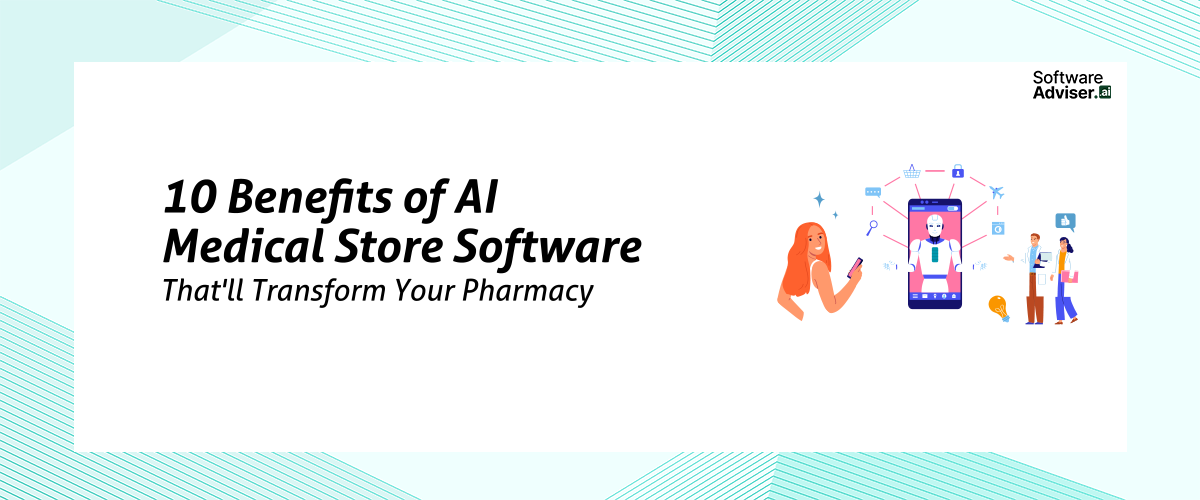
10 Benefits of AI Medical Store Software That'll Transform Your Pharmacy
 David N. Wilks
By 2026, Artificial Intelligence will have changed medical store software from simple point-of-sale systems to proactive operational hubs. Modern platforms such as Innovaccer GravityRx, CoverMyMeds, and Marg ERP use machine learning and optical character recognition (OCR) to automate difficult operations, which reduces manual invoice data entry by up to 85%. Some benefits that can be realized include accurate real-time prediction of needs for inventory (avoiding expensive losses due to drug expiration), speedy parsing of digital prescriptions, automated prior authorizations, and drug interaction alarms, which serve to actively protect patient safety. These advanced AI ecosystems streamline supply chain operations, reduce administrative burden, and provide seamless regulatory compliance to both independent pharmacies and large integrated healthcare systems.
What is AI Medical Store Software, and why does your pharmacy need it in 2026?
AI Medical Store Software has transformed from a luxury to an absolute need for modern pharmacies in 2026. This technology combines artificial intelligence, machine learning, and computer vision to automate the complicated life cycle of pharmacy activities in their entirety. Instead of manually entering data and ordering reactively, the software actively parses digital prescriptions, instantaneously cross-referencing patient records for dangerous drug interactions, and automates the cumbersome prior-authorization process with US insurance providers. It is a digital health hub that joins front-end sales directly with back-end clinical data, revolutionizing the pharmacy from a typical dispenser to a highly efficient one.
For US pharmacies competing in today’s hyper-competitive healthcare market, the use of this software is a matter of financial survival. Today, pharmacies are under unprecedented pressure from low reimbursement margins and acute labor shortages, as well as compliance with stringent regulations. AI software directly solves these pain areas by deploying predictive inventory models that reduce overstock and drug expiration waste by up to 30%. Additionally, with up to 85% automation of administrative chores such as invoice processing and billing, the program takes back-office paperwork off the table, freeing pharmacists to focus on high-margin clinical services and patient care that accelerate business growth in the modern world.
Which Features & Benefits should you prioritize when evaluating AI Medical Store Software for your US-based store?
When selecting AI pharmacy management software, the focus should be on removing your personnel from manual administrative responsibilities and moving them toward secure, automated operations. The appropriate platform must be a seamless bridge between complex US insurance networks and daily clinical operations.
1. Automating Smart Prior Authorizations Reduces Administrative Delays: Look for a platform that can automatically fill out, submit, and track real-time insurance approvals.
2. Using Predictive Inventory and Expiration Forecasting: Use machine learning algorithms that analyze historical local prescription usage trends to help determine if you are overstocking an item, and help to minimize the amount of time drugs will be wasted due to expiration.
3. Automating Optical Character Recognition of Digital Prescriptions: Ensure the program has high-accuracy OCR for immediate digitization of handwritten or electronic prescriptions, resulting in fewer errors due to manual entries.
4. Real-time Drug Interaction Alerts: The AI must be able to cross-reference the patient's full medical history with every database globally and notify if there is a contraindication before dispensing.
5. Automating US Insurance Billing/Audit Compliance: Look for software that checks Medicare/Medicaid eligibility within a short time frame, identifies potential billing problems, and creates a tight HIPAA-compliant audit trail.
6. Ensuring Omnichannel Patient Engagement through Automation: Patients should receive automated AI text messages and email messages for prescription refills, pickup reminders, and medication adherence checks.
7. Clinical Oversight and Human-in-the-loop (HITL) Validation: Although automation network address time-consuming repetitive tasks performed manually, this software's internal processes will have to enforce patient safety and legal requirements using robust HITL frameworks.
8. DSCSA Compliance for Tracking and Tracing: According to the Drug Supply Chain Security Act (DSCSA), pharmacies need to track every prescription drug down to the package level. Give higher priority to pharmacy automation software that automatically scans/reads/serializes/logs EPCIS data directly from manufacturers and wholesalers.
9. Intelligent Clinical Trial Matching & Coordination Using Specialty Drugs: Today's pharmacy revenue is built on the delivery of clinical services/ specialty drugs; pharmacies should look to invest in systems that use natural language processing (NLP) technology to search their customer database securely for potential candidates for local clinical trials and/or other specialty disease management initiatives.
10. Importance of Predictive Analytics for Non-Adherence: Rather than sending out generic text message reminders after a patient’s refill date (telling them they missed their refill), utilize an AI platform that employs predictive analytics to identify your patients before they become non-adherent.
How does AI Medical Store Software help you Stay HIPAA-compliant and meet US Regulations?
1. Enhanced Access Controls and Data Encryption (HIPAA)
The platform uses advanced AI-powered identity verification and role-based access controls to meet rigorous HIPAA Security Rules. Real-time user behavior tracking allows the system to ensure that access to Protected Health Information (PHI) is limited to authorized individuals.
The moment a person accesses or exports more than an unexpected volume of patient data, the system's AI detects this anomaly and locks down that user's AI accounting in order to prevent a breach of data. There is a digital trail associated with every action, which is permanent and audit-ready.
2. Secure Electronic Prescribing and Parsing of Digital Prescriptions
Manual processing of faxed or written prescriptions brings compliance risks that are serious, from misinterpretation to lost documents. The software securely ingests e-prescriptions straight from clinics using a digital prescription parsing tool.
The AI Advantage: The AI automatically analyzes the prescriber’s DEA and NPI numbers against national databases before the automated prescription dispensing software even prepares the drug, assuring full DEA compliance for prohibited substances.
3. Automated Fraud, Waste, and Abuse (FWA) Detection
US pharmacies are under close inspection from Medicare, Medicaid, and commercial PBM (Pharmacy Benefit Manager) audits. The integration of healthcare compliance and pharmacy analytics enables software to internally evaluate billing procedures before the submission of claims.
Smart pharmaceutical billing and insurance automation uses AI to scan claims for upcoding, duplicate billing, or inaccurate quantities. This early detection helps avoid federal FWA infractions and hefty audit clawbacks.
4. Reducing Malpractice Through Smart Clinical Alerts
The FDA and state pharmacy boards impose a strong duty of care with respect to patient safety. A smart alert system for drug interactions uses machine learning to review a patient’s full electronic health record (EHR), not simply simple drug-to-drug checks.
AI suppresses small alerts to avoid alert fatigue, but it will firmly interrupt the workflow if it detects a severe contraindication, allergy, or dose error, safeguarding the pharmacy legally from malpractice lawsuits.
What Integrations Should your AI Medical Store Software Support to fit your Existing Systems?
1. Electronic Health Records (EHR) and e-Prescribing Networks
Your product has to interface directly with large US healthcare networks like Surescripts and popular EHR systems (like Epic, Cerner, or Athenahealth).
This allows your digital prescription parsing tool to immediately take in incoming e-scripts, validate provider credentials, and update patient medical records in real time without manual faxing or data entry.
2. Pharmacy Benefit Managers (PBMs) & Insurance Clearinghouses
Your pharmacy billing & insurance automation needs seamless connection with major PBMs (CVS Caremark, Express Scripts, OptumRx, etc.) and clearinghouses.
It permits the quick, real-time adjudication of claims at the point of sale. The e-prescribing and prior authorization AI can instantly detect coverage gaps, compute precise patient copays, and automatically submit authorization requests so your staff doesn’t have to make phone calls.
3. Automated Dispensing and Robotic Systems
If your store is implementing physical automation, the software has to interact with the manufacturers of pharmacy robots.
The AI is the brain, sending verified orders directly to the automated prescription dispensing software or robotic pill counters, greatly speeding up fulfillment and eliminating human counting errors.
4. Supply Chain Portals and Wholesale Drug Distributors
Your software has to connect straight to the major US wholesalers (McKesson, Cardinal Health, and AmerisourceBergen).
This delivers real-time data into your predictive pharmacy inventory control. If the AI expects a rise in demand for a certain prescription or notices a low stock level, it can automatically develop and send purchase orders directly to your distributor’s site.
How do Pricing Models for AI Medical Store Software Compare Across Top Vendors?
Investments require knowing the complete cost of ownership for an AI-powered pharmacy management system. Vendors have mostly moved away from pricey, one-time legacy software licenses to scalable, cloud-based pricing structures in 2026. Pricing structures might vary quite a bit based on whether you operate a single independent pharmacy or a multi-location chain. Here’s a side-by-side of the top vendor pricing models:
1. SaaS Tiered Subscription Model (Most Popular): Vendors such as Liberty Software and PioneerRx charge a monthly or annual membership fee based on your pharmacy's volume. Basic packages include fundamental independent pharmacy POS software 2026 features, while advanced predictive inventory control for pharmacies and AI analytics are available in premium tiers.
2. Per-Transaction or Claim-Based Pricing: Some platforms base their pricing on the amount of business. You pay a lower base monthly price, but a tiny fee is charged per e-prescription, automated audit, or claim processed by your pharmacy billing and insurance automation engine.
3. Modular Add-On Pricing: Vendors such as Marg AI ERP and Micro Merchant Systems (PrimeRx) provide a cafeteria-style model. You pay a base price for standard dispensing instruments, then pay different monthly fees to add modules like e-prescribing and prior authorization AI, or a smart medication interaction alarm system.
4. License Per User or Per Terminal: Traditional approaches employed by certain vendors still charge by the number of concurrent staff logins or physical workstations executing the software. While predictable, this technique might be pricey if you have several checkout lanes or drive-thru windows.
5. Enterprise/Custom Tier Pricing: For major hospital systems or regional drugstore chains, vendors will design unique contracts. These are features such as limitless licensing, dedicated cloud servers, deep EHR integrations, specialized healthcare compliance, and pharmaceutical analytics dashboards, usually supported by a multi-year service level agreement (SLA).
How do you make the Final Call on which AI Medical Store Software is Right for your Store?
Choosing the right AI-powered system for your pharmacy is more than just being marketed; it should help you alleviate the challenges your pharmacy faces as a whole. Moving to another system will disrupt your daily processes, so your final selection must provide a significant and immediate operational present benefit, as well as an acceptable or measurable ROI.
To assess the final candidates systematically, you can use the following methods for selecting the best system:
1. Calculate the Real Total Cost of Ownership (TCO)
But be careful. Don’t only look at the monthly subscription charge; also include any initial data conversion costs, hardware upgrades (i.e., the need for new touchscreen computers, bar code scanners, etc.), training, and costs related to optional add-on modules. Compare the total cost of ownership for your different suppliers based on your volume of business. For example, flat-rate SaaS pricing tiers are typically preferred for high-volume retailers; however, modular pricing can typically provide less expense for independent specialty pharmacies.
2. Stress-Test the Staff Workflow & UI
An AI system that requires fifteen clicks to clear a basic alarm may slow down your team and produce "alert fatigue." Ask for a live sandbox demo and get your lead pharmacist and front-end clerks to truly test the interface. The independent pharmacy POS software 2026 part should be intuitive, and the smart medication interaction alert system should be able to distinguish between a major medical concern and an ignorable small warning.
3. Audit Compliance and Financial Protections
Your software must actively defend your bottom line and your pharmacy license. Pick the vendor who offers the most robust automated guardrails for US requirements. Make sure that their pharmacy billing and insurance automation engine has proactive pre-edit audits to prevent PBM clawbacks, and check that their e-prescribing and prior authorization AI automatically handles state-mandated PDMP reporting.
Conclusion
Selecting the best AI medical store software in 2026 boils down to striking a balance between strong automation and smooth system integration to safeguard your pharmacy's bottom line. The proper platform removes administrative noise and streamlines US regulatory compliance so your personnel can pivot back to high-margin clinical patient care. When it comes to weighing your options, specialized B2B procurement platforms such as SoftwareAdviser.ai offer an extensive Saas marketplace that assists you in easily finding, comparing side-by-side, and securely purchasing the perfect business software customized to match the operational size of your pharmacy.
FAQ's
It automates up to 85% of tedious administrative tasks, allowing your pharmacy staff to focus on high-margin patient clinical services.
Yes, its predictive inventory control models analyze local prescription trends to minimize overstocking and reduce drug expiration waste by up to 30%.
It uses highly accurate optical character recognition (OCR) to instantly digitize prescriptions, eliminating human manual entry errors and misinterpretations.
Yes, the e-prescribing and prior authorization AI automatically compiles required clinical data and submits approvals to insurance clearinghouses in real time.
Yes, built-in pharmacy billing and insurance automation audits claims for compliance errors before submission to protect your revenue from insurance penalties.
Blink in 2025 and you missed a launch, a pricing shake-up, or a whole new category of tool. The pace has not eased off since. And for US business lead [...]
David N. Wilks
To build a strong corporate reputation in 2026, companies need to implement tools to drive successful recruitment marketing efforts. AI-enabled employ [...]
David N. Wilks
Running a gym or health studio inside the United States comes with a protracted list of daily obligations, from dealing with memberships to keeping cu [...]